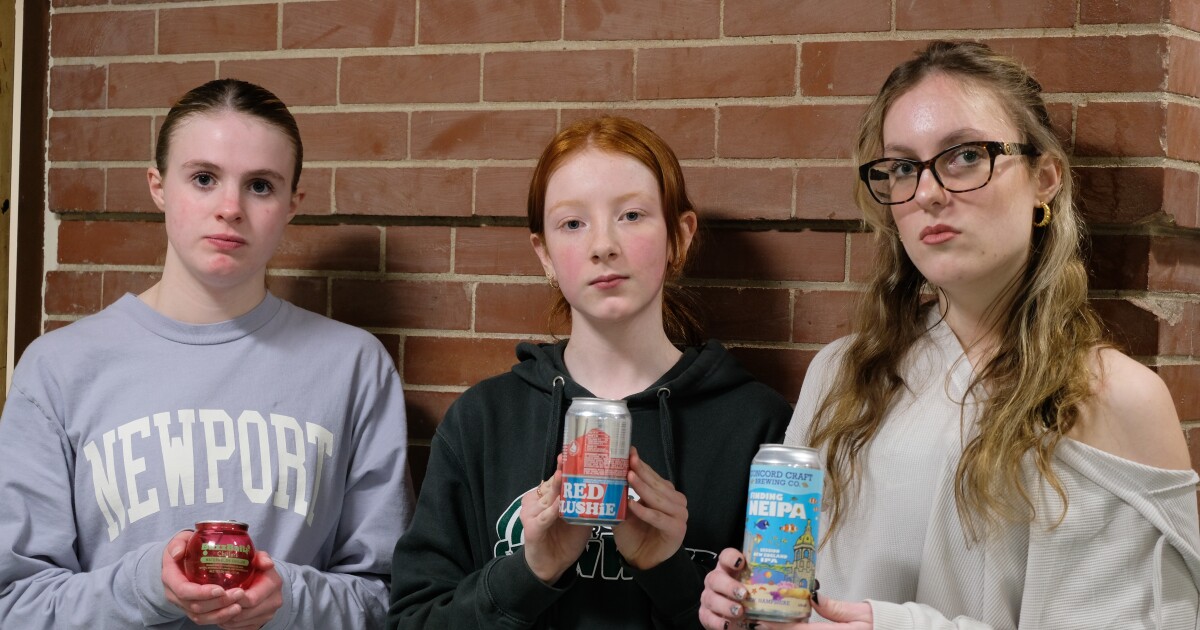
Last month, the members of an after-school club called Dover Youth 2 Youth took a field trip to the State House in Concord. They arrived armed with empty beer cans, part of their planned testimony before lawmakers.
“For example, we have this brand of beer from Concord Brewing Company that has cans designed like the kids animated movie we’ve all seen: ‘Finding Nemo,’ ” explained Megan Merrigan, 12, during public testimony on the bill.
State senators were handed a can with an illustration of a brightly colored fish resembling a character in the Disney movie.
Merrigan, along with her teenage peers, contend that alcohol-makers are using imagery on their labels–whether intentional or not–that appeals to minors. They offered this as Exhibit A for why the laws needed to change.
Advertisement
Concord Craft Brewing Company’s Finding NEIPA beer label, which the state liquor agency said it mistakenly approved despite its potential for inducing minors to drink.
“They’re most likely not going to pick something that’s like a big, boring bottle of beer,” said Dani Lynn Somer, 14, another member of the Dover after-school program. “Kids go for something that’s more enticing to the eye.”
The legislation these students are backing seeks to provide more clarity to both the alcohol industry and state regulators about what’s acceptable on a label of beer, wine or spirits. Cartoons, toys and other fictional characters that a kid may associate with would be prohibited.
But local craft brewers contend their labels, which are often designed by local artists and rooted in the individual culture of the business, are at risk of getting caught up in any enhanced regulations. These beers are being brewed for adults, they contend, and only available for purchase by people 21 and up.
Real dog, illustrated dog
Under current New Hampshire law, the state Liquor Commission has the power to block any alcohol label that regulators believe is designed to induce minors to drink. Alcoholic products that also falsely imply through labeling that they improve athletic performance are also prohibited.
Advertisement
In total, the agency reviews 5,400 labels annually — every bottle of wine, can of beer, or spirit sold in the state — approving 96% of them.
Senate Bill 335 would add clarifying language to the statute, spelling out that cartoons, toys, robots, fictional animals and creatures that are consistent with other products marketed at minors are a no-go. It would also create a new board to handle appeals from rejected applicants.
Aaron Share, co-owner of To Share Brewing Company in Manchester, opposes a plan to explicitly prohibit certain images on alcohol labels.
(The Liquor Commission said, in a statement to NHPR, its approval of the “Finding NEIPA,” Nemo-themed label was done in error, and that after a “constructive conversation with the brewer, Concord Craft agreed to change the imagery, according to a spokesperson.)
Last November, To Share Brewing based in Manchester submitted four labels that were initially rejected by the Liquor Commission. Two of those labels included illustrations by a local artist of the co-owner’s pet.
Advertisement
“It’s the face of my dog with her tongue sticking out,” said Aaron Share, holding up a can inside of his brewery on a recent morning. He said he has submitted more than 80 labels since founding the brewery, and that these were the first to be rejected.
“I don’t see anything on this label that would be considered a cartoon, or that would induce a minor to drink,” he said.
Share said the Liquor Commission later notified him, without explanation, that it had reversed course and approved the labels.
He fears that under the proposed legislation, regulators would have to make subjective calls about products, and may lack the qualifications to do so.
“Do they have a background in art? You know, are they a child psychologist?” he said.
Advertisement
As well known as Mickey Mouse
The debate now going on in the New Hampshire State House is in some ways a throwback to the 1990s, when it was tobacco, and not alcohol, coming under scrutiny. Federal regulators determined that much cigarette advertising — including Camel’s cartoon spokesperson, Joe Camel — was designed to appeal to children.
Dr. James Seargent, a behavioral epidemiologist at Dartmouth’s Geisel School of Medicine, was a young researcher at Joe Camel’s peak, and said the ads were so ubiquitous and seductive that a study found the camel was “recognized as commonly as Mickey Mouse” amongst children.
1 of 4 — 5 Year IPA.jpeg
Labels submitted by To Share Brewing Company that were initially rejected, but later approved by the New Hampshire Liquor Commission.
Courtesy of To Share Brewing Company
Advertisement
2 of 4 — Balloon Music.jpg
3 of 4 — H&BR_OatmealStout.jpg
Labels submitted by To Share Brewing Company that were initially rejected, but later approved by the New Hampshire Liquor Commission.
Advertisement
Courtesy of To Share Brewing Company
4 of 4 — Barrel Aged Hugs.jpg
Labels submitted by To Share Brewing Company that were initially rejected, but later approved by the New Hampshire Liquor Commission.
Courtesy of To Share Brewing Company
Advertisement
There were eventually stricter labeling and marketing rules applied to cigarettes in the United States, and some parts of Europe have gone farther with tobacco packaging restrictions.
“I don’t think we’re ready to do that for beer,” Sergeant said, “but I certainly think the New Hampshire law to do away with cartoon-like characters is not unreasonable.”
But during the legislative hearing last month, some lawmakers, including Republican state Sen. Dan Innis, seemed skeptical that any new guidance or regulation could be done in a way that’s consistent.
Advertisement
“The hard part for me is how are these decisions going to be made,” he said. “And that’s where it just gets messy.”
Take for example other boozy offerings now available on store shelves: alcoholic Monster energy drinks, spiked Sunny D, and Eggo Waffles branded liquors. What do you do with those products? Are they aimed at kids? Nostalgic adults?
Mia Mozzoni, 18, from the Dover Youth 2 Youth group, said she doesn’t appreciate how the broader industry views people her age and wants to see adults take steps to protect her and other young people.
“I don’t like being targeted by the industry. I don’t like seeing my peers ruin their brains and their livers at like 14 and 15 because they’re binge drinking,” she said, adding, “It’s just a problem.”
Two people are facing charges after they allegedly broke into a New Hampshire home on Tuesday wearing black masks and armed with baseball bats, all while a 12-year-old was inside.
Danville police said they received a call around 9 p.m. Tuesday for a report of a home invasion on Beatrice Street. A 12-year-old was home alone on a video chat with his friend when three people wearing black masks and armed with baseball bats broke through his front door. The 12-year-old’s friend quickly called 911.
According to police, the three people were attempting to locate the child’s father and threatened the father with serious bodily injury.
An officer soon arrived at the scene, set a perimeter, and called in two K9 units.
Advertisement
A search of the area didn’t initially turn up anything, but a K9 track led officers to another nearby home. Police interviewed the resident of the mobile home, identified as Nathan Wilder, who denied any involvement in the home invasion.
As the investigation continued, police learned that the original caller had heard from some other friends that one of the suspects in the home invasion had bragged about being involved. They determined that Nathan Wilder, John Wilder and a juvenile were the three people who had broken into the home.
John Wilder admitted to police that he had broken into the home on Beatrice Street and said that Nathan Wilder and a juvenile had assisted him.
Police were able to locate and seized three baseball bats, two ski masks and a few articles of clothing used in the crime.
John and Nathan Wilder were arrested and the juvenile who was involved was released to a parent.
Advertisement
John Wilder is charged with burglary with a weapon, criminal threat with a deadly weapon and criminal mischief. Nathan Wilder is charged with with burglary with a weapon and criminal threat with a deadly weapon. Both men are currently being held at the Rockingham County Jail awaiting arraignment.
A former New Hampshire state representative was sentenced to more than 33 years in prison for involvement in a child exploitation case — almost double the mandatory minimum.
Stacie Marie Laughton, 42, pleaded guilty to three counts of sexual exploitation of children after soliciting and receiving nude photos of three toddlers from an ex-girlfriend who worked at a daycare.
Lindsay Groves, 41, of Hudson, N.H., was sentenced to almost 22 years in prison earlier this month after pleading guilty to the same charges as well as an additional count of distribution of child pornography.
According to court documents, Groves took the photos of the victims in 2023 at Creative Minds daycare in Tyngsboro, where she was a teacher, during designated bathroom breaks and nap times.
Advertisement
She then sent the photos to Laughton, who requested the images and asked that Grove touch one of the minor’s genitals. In the conversation included in the records, the pair sexualizes the victims.
“Did the girl give you an issue,” Laughton texted after receiving the photos.
“No… the boy didn’t either,” Groves texted back.
In a sentencing memorandum, Laughton’s counsel had argued that she should receive a shorter sentence than Groves and asked for the minimum mandatory sentence, which would have 15 years for each count to be served concurrently.
“Stacie Laughton is a complex 42-year-old woman,” the memo said, noting that she was the first openly transgender woman to be elected to the New Hampshire legislature.
Advertisement
The filing described Laughton’s history of mental health, substance abuse, sexual abuse, and trauma as mitigating factors the judge should consider.
“One of the few consistencies in Ms. Laughton’s life is her challenges with mental health illnesses,” the memo said. “She began receiving mental health treatment at the age of four and has been in and out of extensive treatment programs ever since.”
The death of Laughton’s wife in 2020 and a tumultuous relationship with Groves also added to her mental health struggles, the memo said, stating that the defendant drank every day and had tried heroin for the first time leading up to her arrest.
A doctor quoted in the filing said that Laughton likely had a low IQ, tied in part to her premature birth, as well as “normal sexual interests.”
“This finding shows both how caught up Ms. Laughton was in her relationship with Groves that she participated in activity counter to this and is … an important factor in considering whether Ms. Laughton would be a future threat upon release,” the memo said.
Advertisement
The filing described Laughton’s actions as “horrendous, reprehensible, and shocking,” but said that even though the crimes were “utterly inexcusable,” she should still receive a shorter sentence than her codefendant out of a sense of justice.
However, in their own sentencing memo, federal prosecutors requested Laughton receive 40 years in prison.
“These crimes only came to light when Laughton reported them in an apparent attempt to punish Groves for ending their relationship,” prosecutors wrote. “The defendant, of course, did not disclose her own role in the creation of the imagery.”
“She ultimately admitted that she told Groves to touch one child’s penis, and claimed that she was feeding Groves’s attraction to children,” their memo said.
The prosecutors said that Laughton’s voice was the “more prominent one” in the conversation about exploiting children.
Advertisement
In addition to her prison sentence, Laughton will also serve five years of supervised release.
Massachusetts U.S. Attorney Leah Foley said in a statement that she felt the sentence fit the crime.
“The victims in this case were toddlers – children who were not yet old enough to care for themselves and, in some cases, not even fully verbal. Everyone who learns about the conduct in this case should be outraged,” United States Attorney Leah Foley said in a statement. “The sentences imposed reflect the depravity of the conduct and the seriousness of the crimes. My office will seek the most serious charges and the stiffest sentences for anyone who preys on children.”
Three people suffered injuries in a two-vehicle collision early Tuesday morning in Hooksett, New Hampshire.Courtesy of New Hampshore State
Three people suffered serious injuries Tuesday in a two-vehicle crash in Hooksett, N.H., police said.
The head-on collision happened around 5:40 a.m. on Interstate 293 northbound, State Police said.
Police said that Timothy Hubbard, 43, of Rome, Maine, was traveling south when he lost control of his car and crossed the median into oncoming traffic, police said.
Hubbard, his passenger, and the other driver were taken to hospitals to be treated for serious injuries, police said. The injures were not believed to be life-threatening.
Advertisement
Police said speed was believed to be a factor in the crash, which is under investigation.
Hannah Goeke can be reached at hannah.goeke@globe.com.