Politics
Column: Will 'double haters' determine the outcome of the 2024 presidential election?

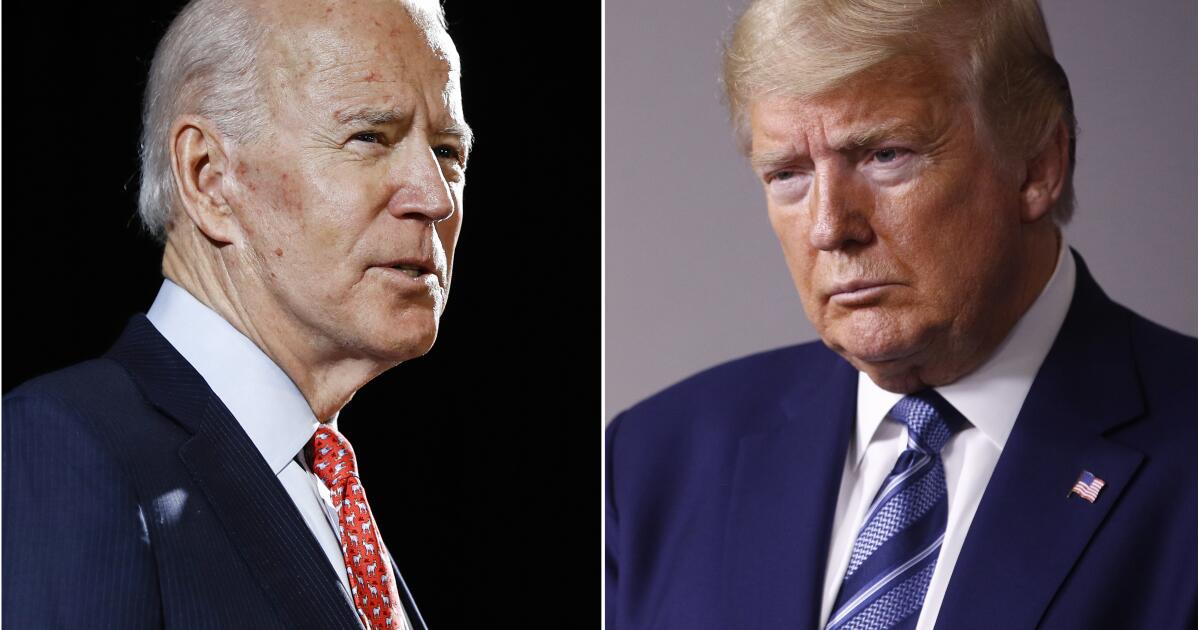
The general election campaign between President Biden and former President Trump, the rematch almost nobody wanted, began ahead of schedule last week.
Former South Carolina Gov. Nikki Haley is still contesting the Republican nomination, but she will need a miracle — actually, more than one miracle — to dethrone Trump.
The chairwoman of the Republican National Committee, Ronna McDaniel, declared the former president to be her party’s presumptive nominee even though only two states have actually voted in caucuses or primaries.
In practice, Biden and Trump are campaigning against each other as if Haley were already gone.
This indecently early start isn’t the only factor that makes this election unusual:
It has been 112 years since an incumbent president and a former president collided in a rematch. Never in modern history have two candidates so unpopular gone up against each other (although the 2016 contest between Trump and Democrat Hillary Clinton came close). And never before have the presumptive nominees been so old; Biden is 81, Trump will turn 78 in June.
“The fact that you have two [candidates who’ve been president], neither of whom is well-liked, makes it a unique situation,” Democratic pollster and strategist Mark Mellman said.
When an incumbent president runs for a second term, the election is normally a referendum on his record.
But this will be a “dual referendum,” because both candidates have recent records to defend.
Biden is viewed unfavorably by 58% of Americans and Trump by 57%, according to a recent Gallup Poll.
Many voters will choose by deciding which unappetizing candidate to vote against, not which champion to vote for.
That’s especially true for one key subset: the roughly 15% of Americans who dislike both candidates, often called “double haters.”
The double haters helped determine the outcome in both 2016, when most of them chose Trump over Clinton, and 2020, when most deserted Trump for Biden.
The combination of a dual referendum and dual unpopularity guarantees that this will be one of the most negative campaigns in memory.
“Both sides want to make the election a referendum on the other candidate. That will push the campaign to be negative,” Mellman noted.
It’s already started.
Trump’s message has focused on the damage he claims Biden has inflicted on the country: high inflation, surges in undocumented immigration, rising crime. (Inflation is easing, the economy is growing, and the FBI’s statistics show crime dropping, but that won’t stop the former president from repeating his claims.)
Biden’s message has focused on the damage he says a second Trump presidency would do: the erosion of democracy, tougher restrictions on abortion, deeper economic inequality.
Neither has presented much in the way of a positive vision. Both campaigns are focused on fear, not hope.
“This could be the most depressing nine months ever in terms of public discourse,” Republican pollster David Winston predicted.
Here’s what the two candidates need to do to win, according to strategists from both parties:
“Trump’s team needs to keep the focus and the pressure on Biden, to make the election a referendum on his record,” Mellman said. “They also need to reassure people about Trump’s faults and foibles — which is hard to do, because Trump constantly reminds people of his faults.”
Republican strategists say Trump needs to spend less time complaining about the 2020 election, which he wrongly claims was stolen. Those grievances mobilize Trump’s already-loyal supporters, but they alienate the moderate voters and “double haters” who will decide the election.
Biden, meanwhile, “has to do two big things,” Mellman said. “One is to communicate more effectively what he has accomplished,” because “people are largely unaware” of what he’s done.
“Second, he has to make clear the downsides of choosing Trump. Yes, it’s about democracy, but it’s about much more than that.”
Biden started in on that priority last week when he spoke at an abortion rights rally in Virginia.
Aides say the president also intends to lay out a positive agenda for a second term in his State of the Union address on March 7.
“Question No. 1 is: How is someone who dislikes both candidates going to choose?” Winston said. “They want to hear candidates discuss solutions to problems. They don’t want to hear a battle of grievances.”
Head-to-head polls suggest that if the election were held tomorrow, Trump would win a narrow popular-vote victory.
But nine months before election day, those polls are not reliable predictions. Much can change between now and November.
If the economy continues to improve, that should help Biden. If Trump is convicted in one of the criminal trials he faces, that might help Biden too. International crises could cut either way.
Third-party candidates — including Robert F, Kennedy Jr., Green Party candidate Jill Stein, and the wild-card organization No Labels — could draw votes from both candidates.
One more wild card: the elderly candidates’ health. A major medical event on either side could tip the election.
However uninspiring the campaign may be, the stakes remain enormous.
Biden and Trump offer starkly contrasting futures: an old-school Democrat who has moved gradually toward the left, and an autocratic Republican populist who says he will use the presidency to prosecute his opponents.
And the outcome remains unpredictable. This month’s polls can’t forecast how voters will feel in November.
So don’t believe anyone who claims to know how it will come out. They don’t.

Politics
Spencer Pratt surges to runoff in LA mayor’s race after angry voters send message to Karen Bass

NEWYou can now listen to Fox News articles!
Reality television personality Spencer Pratt appears on track to clear a key hurdle in Los Angeles’ mayoral race as he seeks to unseat incumbent Mayor Karen Bass in November.
Bass, who has led the city since 2022 amid a turbulent stretch rocked by her response to wildfires, advanced to a runoff after failing to secure a majority of the vote in Tuesday’s primary election. With no candidate surpassing the 50% threshold, the top two finishers will face off in a November runoff.
The anticipated runoff is a symbolic blow to Bass, who was endorsed by Gov. Gavin Newsom, D-Calif., and former Vice President Kamala Harris and has spent decades serving California in a series of elected Democratic offices.
Pratt, a first-time candidate known for the MTV reality show “The Hills,” was running in second place as of Wednesday morning.
Los Angeles Mayor Karen Bass attends the Women for Bass Phone bank event in the Baldwin Hills area of Los Angeles on June 1, 2026. (Louise Barnsley/Splash for Fox News Digital)
REALITY TV STAR SPENCER PRATT TESTS LA VOTERS’ APPETITE FOR POLITICAL OUTSIDER
“Obviously, God wanted five more months of me exposing the failures of our mayor,” Pratt gloated to reporters as the returns came in Tuesday evening.
Pratt has relentlessly hammered Bass on issues that have long plagued the city, including fire recovery, street homelessness and crime. The insurgent candidate holds Bass personally responsible for devastating wildfires that destroyed more than 18,000 structures in the city, including his Pacific Palisades home.
Pratt’s surge appears to have shut out Los Angeles City Council member Nithya Raman, a former ally of Bass who challenged the incumbent from the left and was once viewed as a threat to her bid for a second term. Raman is a member of the Democratic Socialists of America and has argued for steering the city in a more progressive direction.
Raman has not yet conceded despite running well behind Bass and Pratt as of Wednesday morning.
Pratt, a registered Republican, faces an uphill battle to defeat Bass in November if he advances to the runoff election.
Less than 20% of voters in the heavily Democratic city identify with the GOP, though Los Angeles’ mayoral contest is officially nonpartisan.
Media personality and independent candidate Spencer Pratt, left, pictured alongside LA mayor Karen Bass, right. (Robert Gauthier/Los Angeles Times via Getty Images; Justin Sullivan/Getty Images)
KAREN BASS GRILLED OVER BROKEN HOMELESSNESS PROMISE, BLAMES BUREAUCRACY FOR SLOWED PROGRESS
Rep. Darrell Issa, R-Calif., who represents a San Diego-anchored seat, told Fox News Digital that Pratt has won a following in the mayoral contest due to widespread voter discontent with Bass’ leadership.
“He’s catching fire among ardent historic Democrat voters because Karen Bass has been so ineffective,” Issa said in an interview. “And every time she opens her mouth, she’s talking about more of the same to people who have seen their streets, both crime-ridden and in fact … ineffectively managed.”
Bass, conversely, argues that her leadership is leading Los Angeles in the right direction.
“Los Angeles is at a turning point. After decades of rising homelessness, under-built housing and a shrinking police force, it’s Mayor Karen Bass who finally stepped up to change how City Hall works,” Bass’s website reads.
Los Angeles City Councilmember Nithya Raman appears likely to finish in third place, keeping her out of the November runoff. (Eric Thayer/Getty Images)
CLICK HERE TO DOWNLOAD THE FOX NEWS APP
“Homelessness is down, more housing is being built, and the LAPD is hiring new officers,” it also claims.
Fox News Digital’s Leo Briceno contributed reporting.
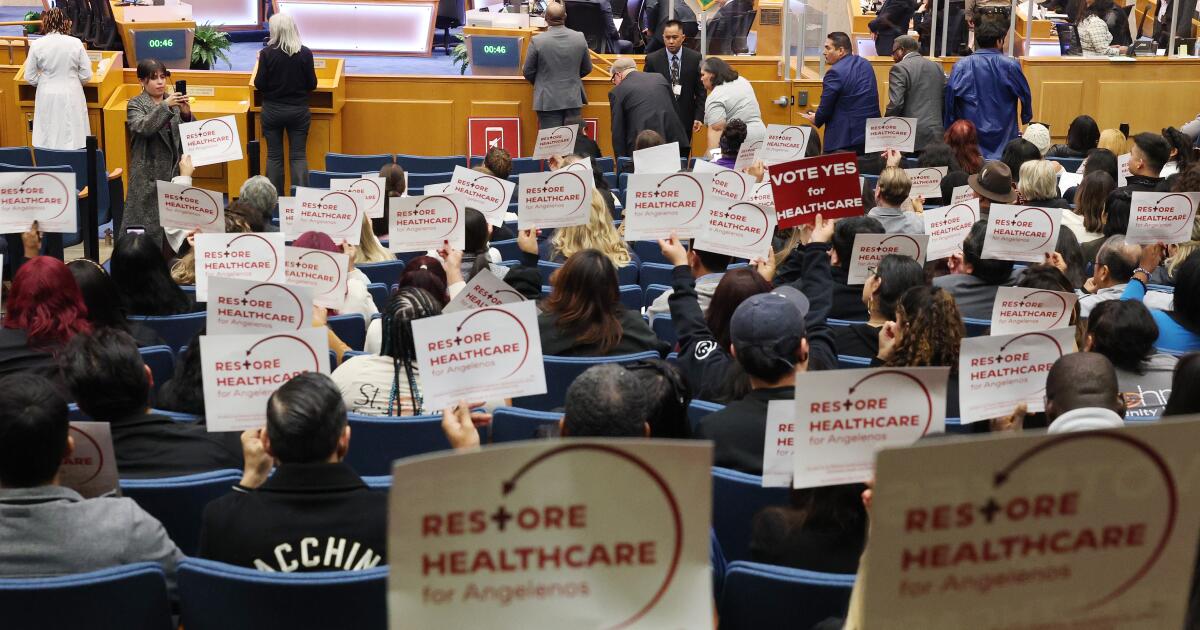
Los Angeles County’s half-cent sales tax to fund healthcare services was trailing Tuesday, with early returns showing a majority of voters rejecting the measure.
The tax — a half-penny of every dollar spent in the county — is meant to prop up local hospitals and clinics that are hemorrhaging funding after recent federal cuts.
The sales tax, which needs a simple majority to pass, would take effect Oct. 1 and last five years. Officials say it would pull in $1 billion annually to help plug the budget holes hitting local hospitals and clinics.
L.A. County health officials anticipate the One Big Beautiful Bill Act, signed into law by President Trump last summer, will slash more than $2 billion from the county’s health services budget within the next three years. Due to eligibility changes, the county will no longer be able to get reimbursements for many Californians who have lost Medi-Cal.
The measure was championed by a coalition of healthcare advocates called Restore Healthcare for Angelenos who warned that mass layoffs and emergency room closures could be imminent if new funding didn’t come fast. The Department of Public Health recently closed seven clinics — a grim sign, supporters said, of service cuts to come.
Voters haven’t rejected a sales tax hike since 2012, when a transportation measure fell just short with 66.1% support. It needed 66.7% to pass.
A majority of county supervisors had supported the new tax proposal, voting 4 to 1 this February to put it on the ballot. But the measure faced significant opposition from local cities, with opponents arguing the sales tax hike would unfairly burden the poorest county residents and encourage people to spend their dollars across the county line.
Supervisor Kathryn Barger, the board’s lone opponent of the tax, said she was concerned it was a “general” tax, meaning the money wouldn’t be earmarked for healthcare costs. Instead, she argued, politicians would have final say over how the money gets spent.
The supervisors have created a plan for spending the tax money, with the largest chunk of the money meant to cover the costs for patients without insurance. The measure also asked voters to sign off on a nine-member oversight committee.
The county currently has a base sales tax rate of 9.75%, and cities impose local taxes on top of that.
Politics
DOJ expands indictment against SPLC, alleging $4M secretly funneled to KKK and extremist groups

NEWYou can now listen to Fox News articles!
The Department of Justice last month announced an indictment against the Southern Poverty Law Center (SPLC), alleging that the civil rights nonprofit defrauded donors by secretly paying informants associated with extremist organizations, including the Ku Klux Klan.
A federal grand jury in the Middle District of Alabama returned an 11-count indictment in April charging the SPLC with six counts of wire fraud, four counts of making false statements to a federally insured bank and one count of conspiracy to commit concealment money laundering, according to the Justice Department.
The superseding indictment retains those charges while expanding on the alleged misconduct.
According to the DOJ, the SPLC “secretly funneled” more than $3 million in donor funds between 2014 and 2023 to numerous individuals associated with extremist organizations, including the Ku Klux Klan, United Klans of America, the National Socialist Movement, participants in the Unite the Right rally and the Aryan Nations-affiliated Sadistic Souls Motorcycle Club.
NEO-NAZIS, ‘SADISTIC’ BIKERS AND CHARLOTTESVILLE ORGANIZER: 5 OF THE MOST SHOCKING SPLC INFORMANTS
The Southern Poverty Law Center has widespread influence in education. FILE: Acting Attorney General Todd Blanche, left, and SPLC interim President and CEO Bryan Fair are shown in a split image as the Justice Department pursues charges against the Southern Poverty Law Center. (Nathan Posner/Anadolu via Getty Images; USA TODAY Network via Imagn Images)
The original indictment alleged approximately $3 million in payments between 2014 and 2023.
“The SPLC’s paid informants (‘field sources’) engaged in the active promotion of racist groups at the same time that the SPLC was denouncing the same groups on its website,” the indictment states.
Prosecutors further allege the SPLC opened bank accounts tied to fictitious entities in order to conceal donor funds that were allegedly routed to confidential sources.
MIKE DAVIS: SOUTHERN POVERTY LAW CENTER: A TALE OF A RACISM SCAM
The Southern Poverty Law Center (SPLC) building seen in March 2020 in Montgomery, Alabama. (Barry Lewis/InPictures via Getty Images)
According to the indictment, the SPLC began operating a covert informant network in the 1980s, and between 2014 and 2023 allegedly paid those sources in a clandestine manner.
The DOJ alleges an SPLC employee instead encouraged the pair to remain involved and offered them a monthly salary of $1,200.
The two subsequently agreed to remain in the organization, according to the indictment.
DR. BEN CARSON: I KNOW HOW BAD THE SPLC WAS, IT CAME AFTER ME AND PUT ME AT RISK
Acting Attorney General Todd Blanche spoke during a press conference alongside FBI Director Kash Patel at the Department of Justice on April 21, 2026, in Washington, D.C., following the indictment of the Southern Poverty Law Center. (Nathan Posner/Anadolu via Getty Images)
Prosecutors allege an SPLC employee instructed the individuals to claim they worked for a company called Rare Books and helped college students with research and writing assignments if anyone questioned the source of their income.
The indictment alleges donor funds were used to pay both individuals through SPLC accounts.
According to prosecutors, the pair were also reimbursed for expenses related to Ku Klux Klan activities, including cross-burning events and associated costs such as wood and fuel.
One of the individuals is also accused of recruiting new members using donor-funded payments. The indictment further alleges the SPLC knew donor funds were used to purchase materials for Ku Klux Klan garments.
In a statement to Fox News Digital, attorney Abbe Lowell, who represents the SPLC, denied the allegations.
A composite image shows Acting Attorney General Todd Blanche overlaid on photographs of the Department of Justice and FBI headquarters in Washington, D.C. (Valerie Plesch/Bloomberg via Getty Images; Graeme Sloan/Bloomberg via Getty Images)
“This apparent superseding indictment attempts to shore up the flaws in the initial charges, but it changes nothing,” Lowell said.
“The SPLC did not lie to its donors, it did not mislead banks it did business with, and its informant program prevented violence and saved lives,” he continued.
“It appears the Justice Department shared the indictment with media before it was unsealed by the court – another example of the government’s troubling handling of this case.”
“We will be addressing these irregularities with the court and look forward to presenting the truth at trial,” he added.
NONPROFIT REVENUE TOTALS SURGE AMID GROWING SCRUTINY AFTER MAJOR FRAUD CASES
SPLC interim President and CEO Bryan Fair speaks during a wreath-laying ceremony at the Southern Poverty Law Center Civil Rights Memorial in Montgomery, Ala., on March 5, 2026. (Jake Crandall/Advertiser / USA TODAY NETWORK via Imagn Images)
The superseding indictment also notes that the SPLC’s reported revenue increased from roughly $38.7 million in 2010 to more than $129 million in 2023, an increase of approximately 233%.
According to the filing, the organization’s net assets grew from approximately $238 million to nearly $787 million during the same period.
The SPLC is a longtime nonprofit organization that says it combats white supremacy and extremism through research, reporting and monitoring efforts intended to assist law enforcement and the public.
During a news conference announcing the original indictment, Acting Attorney General Todd Blanche alleged the SPLC paid members of extremist groups so it could generate “work product” documenting their activities.
CLICK HERE TO DOWNLOAD THE FOX NEWS APP
“To that end, [SPLC] was doing the exact opposite of what it told its donors it was doing – not dismantling extremism but funding it,” Blanche said.
Fox News Digital’s Alexandra Koch, David Spunt, Jake Gibson and Alec Schemmel contributed to this report.
-
 Lifestyle5 minutes ago
We’re having a main character summer. Are you? : It’s Been a Minute
-

 Technology13 minutes ago
Microsoft AI chief Mustafa Suleyman says there are three labs that matter — and he wants Microsoft to be the fourth.
-

 World20 minutes ago
US ally Kuwait condemns ‘brutal and ongoing Iranian attacks’ after airport was hit
-

 Politics23 minutes ago
Spencer Pratt surges to runoff in LA mayor’s race after angry voters send message to Karen Bass
-

 Health28 minutes ago
One extra serving of processed meat a day linked to higher cancer risk
-

 Sports35 minutes ago
AJ Brown trade outcome: Dianna Russini paid a heavy price while Mike Vrabel emerged unscathed
-

 Technology38 minutes ago
Could your Samsung phone replace your passport?
-
 Business43 minutes ago
Rent-hike ban to protect fire victims ends despite gouging concerns

