Politics
Oprah's 'spiritual guru,' a longtime Californian, tests whether new age can win votes in New Hampshire

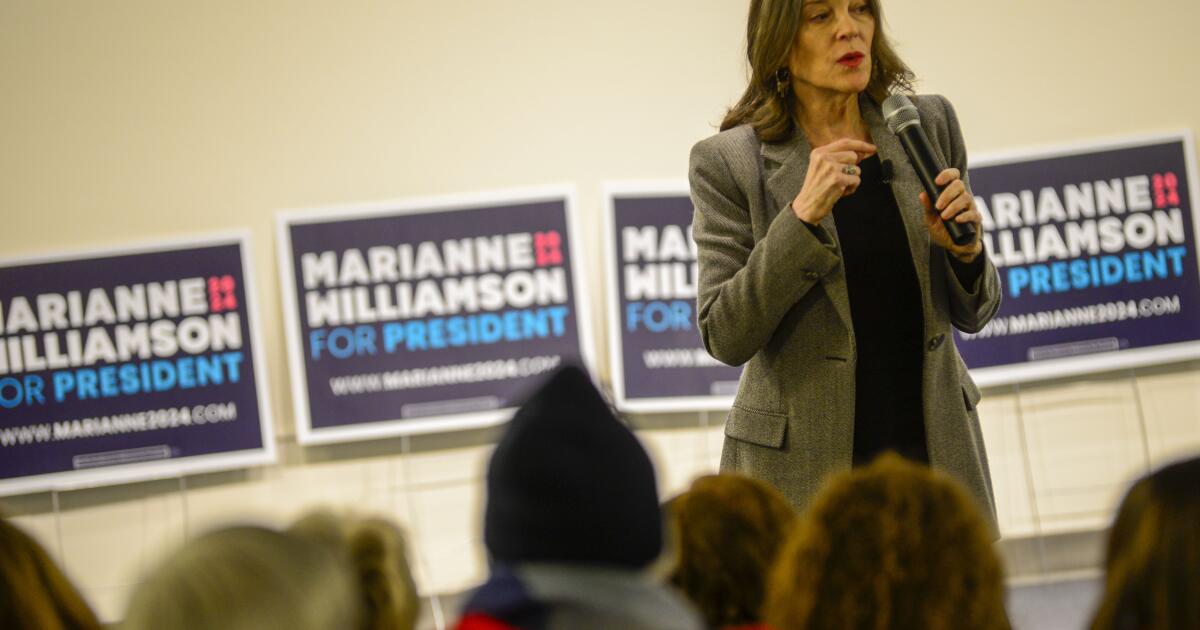
Presidential long shot Marianne Williamson flitted down the aisle of a two-century-old granite church, pausing to gracefully bow to dozens of supporters as they chanted her name.
The author, the most well-known Democrat who will appear on the ballot Tuesday, when New Hampshire holds the nation’s first presidential primary, spent much of her adult life in Los Angeles before moving east in 2018.
Williamson, who has never held elected office but was once dubbed Oprah Winfrey’s spiritual guru, has next to zero chance of denying President Biden his renomination. Polls suggest that many New Hampshire voters may write in Biden, who will not appear on the ballot after the Democratic Party chose to revoke the state’s first-in-the-nation status and make South Carolina the first official primary.
Gatherers for presidential candidate Marianne Williamson gathered at a Unitarian church in Portsmouth, New Hampshire Saturday. The long shot candidate has almost no chance of winning the state’s vote, but she may be the best-known candidate on the Democratic ballot, since President Biden won’t be on it. Asked what she planned to do after Tuesday’s primary, Marianne Williamson said she would follow her heart.
(Faith Pinho / Los Angeles Times)
But Williamson’s quixotic second bid for the White House (she also ran in 2020) is a test of a different question: Exactly how many of these supposedly flinty New Hampshirites will vote for a woman who has been stereotyped as a “woo woo” Californian?
The Texas native’s ties to California date back decades. In 1970, she moved to California to attend Pomona College, where she studied theater and philosophy and protested the Vietnam War before dropping out a couple of years later. After bouncing around the nation and being sidetracked by what Entertainment Weekly called “bad boys and good dope,” she moved to L.A. in 1983 and shared an apartment with actress Laura Dern.
Williamson, 71, became a spiritual leader and wrote more than a dozen books, one of which Winfrey promoted by saying, “I have never been more moved by a book than I am by this one.” Millions have bought her books, and she was adored by celebrities, officiating the 1991 wedding of Elizabeth Taylor and Larry Fortensky at Michael Jackson’s Neverland Ranch.
Williamson was also actively engaged in charities that helped those with HIV or living in poverty.
She came to believe that the two-party system disenfranchises the average voter by prioritizing the interests of wealthy elites.
Democratic presidential candidate Marianne Williamson, center, is cheered by the crowd after finishing her talk at The Interfaith Center for Spiritual Growth, Sunday, Sept. 10, 2023, in Ann Arbor, Mich. “The most important things you do in life, not because there’s guaranteed success on some external level, but because you feel in your heart it’s the right thing to do,” Williamson, 71, said during an interview in New York City.
(Jose Juarez / Associated Press)
“The majority of Americans are demonstrably a little bit left of center,” Williamson told The Times in an interview last year. “The problem is that we have a political system which is more beholden to the short-term profits of their corporate donors than to the will of their own constituents. Their idea of an acceptable candidate is someone who will perpetuate the system as it is. What we need in a president is someone who will disrupt that system.”
Williamson’s message resonates with a diverse group, but especially with people who believe that changing the system starts with changing oneself. Her followers include fans of her books, disillusioned Democrats and some former Bernie Sanders supporters.
But not many are New Hampshire voters.
When she arrived this weekend at South Church Unitarian Universalist in Portsmouth, the pews were filled with nearly as many volunteers as voters.
Orson Maazel drove from rural Virginia to volunteer for the campaign. Wearing a “Disrupt the corrupt” sweatshirt, he said he was drawn to Williamson because she’s an outsider who doesn’t take money from corporations.
“I agree with her that we don’t just need people who got us into the climate mess we’re in and economic mess we’re in to get us out of the system,” Maazel, 35, said. “We need somebody outside who’s not bought by anybody and who has a really good character.”
Williamson brought tears to the eyes of Nicole Dillon, 47, who lives in Massachusetts. Dillon, who hadn’t known much of Williamson before the event, said she loved the candidate’s message about advocating for women and children, ending the war on drugs and combating climate change.
Dillon watched closely when, about 20 minutes into Williamson’s stump speech, a man approached the stage and took the candidate’s hand, quietly thanking her. The 50 or so people seated in the pews watched in uneasy silence until a couple of security guards approached the man to usher him off the stage.
“Can you just sit down for me now?” Williamson said softly to the man.
He turned around, noticed the crowd in the pews and, with a look of surprise, allowed security to usher him up the aisle, apologizing for the disruption.
“Just tripping on his birthday,” a guard said, shrugging and laughing, after leading the man out. “She draws all kinds!”
“He was drawn to her truth and her light,” Dillon said. “She was so gentle with him and like a mother. She’s very motherly; she’s gonna gather us all in her basket and take care of us.”
Democratic presidential candidate Marianne Williamson, second from right, answers a question from University of Michigan senior Mahi Vyas, 20, at The Interfaith Center for Spiritual Growth, Sunday, Sept. 10, 2023, in Ann Arbor, Mich. (AP Photo/Jose Juarez)
(Jose Juarez / Associated Press)
But neither Dillon nor Maazel can vote in New Hampshire’s primary.
Only 2% of New Hampshire’s registered Democratic voters said they planned to vote for Williamson, compared with 64% who planned to write in Biden’s name, according to a recent Suffolk University poll.
“She has a perspective that actually reaches a certain percentage of the population. The issue is, was that ever going to be enough to catch on nationally?” said Ray Buckley, chairman of the New Hampshire Democratic Party. “I don’t know anyone that doesn’t think she’s a good person. She’s in it for the right reasons. She just doesn’t seem to be connecting with enough voters to be able to be successful.”
Perhaps the inability to connect with voters comes in part from her unusual political presence. Williamson peppered her speech with $20 words, book titles and quotes. Her answers to voters’ questions frequently invoked references to books she had read, and sometimes an esoteric history lesson.
She repeatedly voiced frustration with the Democratic National Committee’s dismissal of her campaign. In several states — including North Carolina, Florida and Tennessee — Biden will be the only Democratic candidate on the ballot.
Should something happen to the president to prevent him from running for a second term, “I suppose their idea would be to put [California Gov.] Gavin Newsom …” she said, before catching herself. “I don’t know. I don’t know any more than the next person does.”
Tables at the entrance laden with “Marianne Williamson for president” signs, buttons and stickers were still full at the end of the night.


new video loaded: Steve Hilton Holds Slim Early Lead in California Governor’s Race
transcript
transcript
Steve Hilton Holds Slim Early Lead in California Governor’s Race
Steve Hilton, a Republican and former Fox News host, held a narrow lead in early votes over two Democratic opponents in California’s nonpartisan primary for governor. The top two candidates will advance to the general election in November.
-
“Change is coming to California, and it’s long overdue. I want to just say something from my heart to every single person who’s voted for me. We’re not — We’re not there yet, but it’s looking good.” [cheers] “Tonight, the people of the great state of California, in the greatest nation on earth, have spoken. [cheers] Loudly and proudly. [cheers] And while I take nothing for granted, there are lots of ballots left to be counted, it appears that we are on track to advance to November.” [cheers] “It might take some time to figure out where this is going. We’re going to wait until every ballot is counted. We’re going to give democracy a time to work, and we know we finished really strong.” [cheers]
By Axel Boada
June 3, 2026
Politics
Spencer Pratt surges to runoff in LA mayor’s race after angry voters send message to Karen Bass

NEWYou can now listen to Fox News articles!
Reality television personality Spencer Pratt appears on track to clear a key hurdle in Los Angeles’ mayoral race as he seeks to unseat incumbent Mayor Karen Bass in November.
Bass, who has led the city since 2022 amid a turbulent stretch rocked by her response to wildfires, advanced to a runoff after failing to secure a majority of the vote in Tuesday’s primary election. With no candidate surpassing the 50% threshold, the top two finishers will face off in a November runoff.
The anticipated runoff is a symbolic blow to Bass, who was endorsed by Gov. Gavin Newsom, D-Calif., and former Vice President Kamala Harris and has spent decades serving California in a series of elected Democratic offices.
Pratt, a first-time candidate known for the MTV reality show “The Hills,” was running in second place as of Wednesday morning.
Los Angeles Mayor Karen Bass attends the Women for Bass Phone bank event in the Baldwin Hills area of Los Angeles on June 1, 2026. (Louise Barnsley/Splash for Fox News Digital)
REALITY TV STAR SPENCER PRATT TESTS LA VOTERS’ APPETITE FOR POLITICAL OUTSIDER
“Obviously, God wanted five more months of me exposing the failures of our mayor,” Pratt gloated to reporters as the returns came in Tuesday evening.
Pratt has relentlessly hammered Bass on issues that have long plagued the city, including fire recovery, street homelessness and crime. The insurgent candidate holds Bass personally responsible for devastating wildfires that destroyed more than 18,000 structures in the city, including his Pacific Palisades home.
Pratt’s surge appears to have shut out Los Angeles City Council member Nithya Raman, a former ally of Bass who challenged the incumbent from the left and was once viewed as a threat to her bid for a second term. Raman is a member of the Democratic Socialists of America and has argued for steering the city in a more progressive direction.
Raman has not yet conceded despite running well behind Bass and Pratt as of Wednesday morning.
Pratt, a registered Republican, faces an uphill battle to defeat Bass in November if he advances to the runoff election.
Less than 20% of voters in the heavily Democratic city identify with the GOP, though Los Angeles’ mayoral contest is officially nonpartisan.
Media personality and independent candidate Spencer Pratt, left, pictured alongside LA mayor Karen Bass, right. (Robert Gauthier/Los Angeles Times via Getty Images; Justin Sullivan/Getty Images)
KAREN BASS GRILLED OVER BROKEN HOMELESSNESS PROMISE, BLAMES BUREAUCRACY FOR SLOWED PROGRESS
Rep. Darrell Issa, R-Calif., who represents a San Diego-anchored seat, told Fox News Digital that Pratt has won a following in the mayoral contest due to widespread voter discontent with Bass’ leadership.
“He’s catching fire among ardent historic Democrat voters because Karen Bass has been so ineffective,” Issa said in an interview. “And every time she opens her mouth, she’s talking about more of the same to people who have seen their streets, both crime-ridden and in fact … ineffectively managed.”
Bass, conversely, argues that her leadership is leading Los Angeles in the right direction.
“Los Angeles is at a turning point. After decades of rising homelessness, under-built housing and a shrinking police force, it’s Mayor Karen Bass who finally stepped up to change how City Hall works,” Bass’s website reads.
Los Angeles City Councilmember Nithya Raman appears likely to finish in third place, keeping her out of the November runoff. (Eric Thayer/Getty Images)
CLICK HERE TO DOWNLOAD THE FOX NEWS APP
“Homelessness is down, more housing is being built, and the LAPD is hiring new officers,” it also claims.
Fox News Digital’s Leo Briceno contributed reporting.
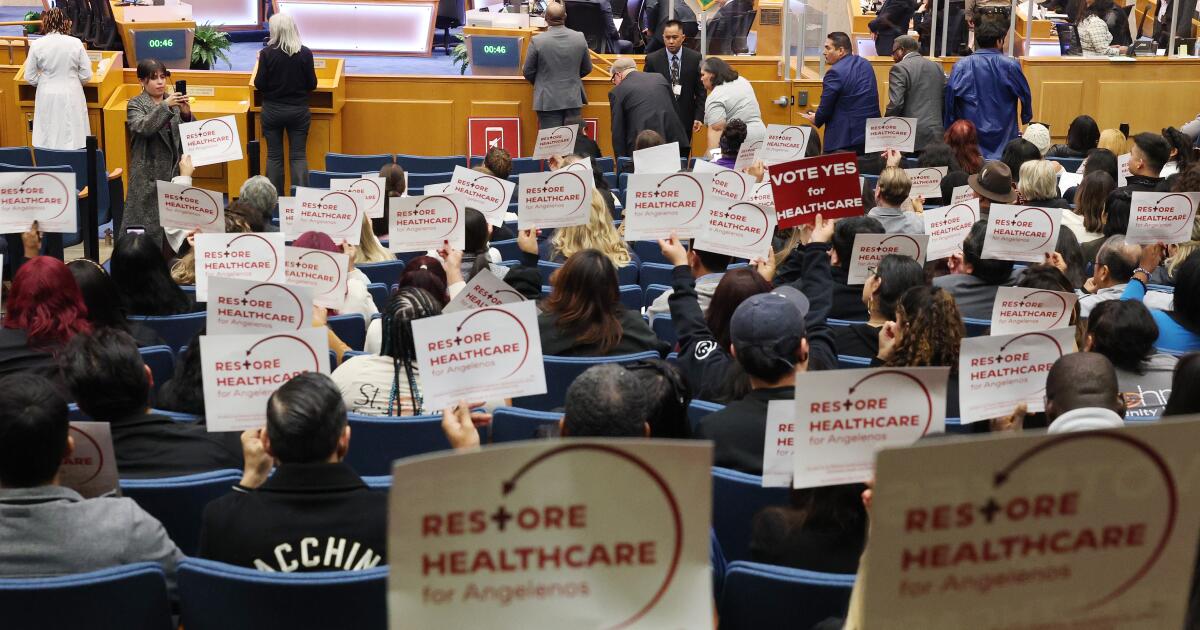
Los Angeles County’s half-cent sales tax to fund healthcare services was trailing Tuesday, with early returns showing a majority of voters rejecting the measure.
The tax — a half-penny of every dollar spent in the county — is meant to prop up local hospitals and clinics that are hemorrhaging funding after recent federal cuts.
The sales tax, which needs a simple majority to pass, would take effect Oct. 1 and last five years. Officials say it would pull in $1 billion annually to help plug the budget holes hitting local hospitals and clinics.
L.A. County health officials anticipate the One Big Beautiful Bill Act, signed into law by President Trump last summer, will slash more than $2 billion from the county’s health services budget within the next three years. Due to eligibility changes, the county will no longer be able to get reimbursements for many Californians who have lost Medi-Cal.
The measure was championed by a coalition of healthcare advocates called Restore Healthcare for Angelenos who warned that mass layoffs and emergency room closures could be imminent if new funding didn’t come fast. The Department of Public Health recently closed seven clinics — a grim sign, supporters said, of service cuts to come.
Voters haven’t rejected a sales tax hike since 2012, when a transportation measure fell just short with 66.1% support. It needed 66.7% to pass.
A majority of county supervisors had supported the new tax proposal, voting 4 to 1 this February to put it on the ballot. But the measure faced significant opposition from local cities, with opponents arguing the sales tax hike would unfairly burden the poorest county residents and encourage people to spend their dollars across the county line.
Supervisor Kathryn Barger, the board’s lone opponent of the tax, said she was concerned it was a “general” tax, meaning the money wouldn’t be earmarked for healthcare costs. Instead, she argued, politicians would have final say over how the money gets spent.
The supervisors have created a plan for spending the tax money, with the largest chunk of the money meant to cover the costs for patients without insurance. The measure also asked voters to sign off on a nine-member oversight committee.
The county currently has a base sales tax rate of 9.75%, and cities impose local taxes on top of that.
-

 Fitness7 minutes ago
Fitness coach debunks 8 ‘crazy’ exercise myths women still believe: From periods and workouts to weightlifting
-

 Movie Reviews15 minutes ago
Movie Review: ‘Sacred Heart: His Reign Has No End’ – Catholic Review
-

 World25 minutes ago
Video: A Death at the Epicenter of Ebola
-

 News30 minutes ago
Map: 5.1-Magnitude Earthquake Strikes off the Coast of California
-

 Politics37 minutes ago
Video: Steve Hilton Holds Slim Early Lead in California Governor’s Race
-
 Lifestyle1 hour ago
We’re having a main character summer. Are you? : It’s Been a Minute
-

 Technology1 hour ago
Microsoft AI chief Mustafa Suleyman says there are three labs that matter — and he wants Microsoft to be the fourth.
-

 World1 hour ago
US ally Kuwait condemns ‘brutal and ongoing Iranian attacks’ after airport was hit

