Northeast
CRISIS IN NEW YORK: 39-year NYPD vet says ‘palpable fear’ still plagues city as crime remains high
This article is part three of Crisis in New York, a series examining the effects public policies have on the city’s already strained housing, law enforcement and drug services. Read parts one and two.
NEW YORK CITY — A 39-year police veteran said New Yorkers live in fear, scared that brazen criminals will attack them on the subways or streets, even as city leaders boast decreases in crime.
“There’s a sense of disorder, a sense of decay, and what I like to call palpable fear,” retired NYPD Sgt. Pete Panuccio told Fox News. “Those are things you can’t quantify, but people are scared again.”
WATCH MORE FOX NEWS DIGITAL ORIGINALS HERE
New York City leaders have touted crime reductions since the historically bloody 2020, which saw the most murders since 2011 among other violent crimes, according to New York City Police Department data. But Panuccio said a culture of lawlessness, which he blamed on permissive, progressive policies, exploded during the COVID-19 pandemic and has persisted ever since, leaving residents on edge as crime remains high.
“People are scared to go out on the street late at night,” Panuccio said.
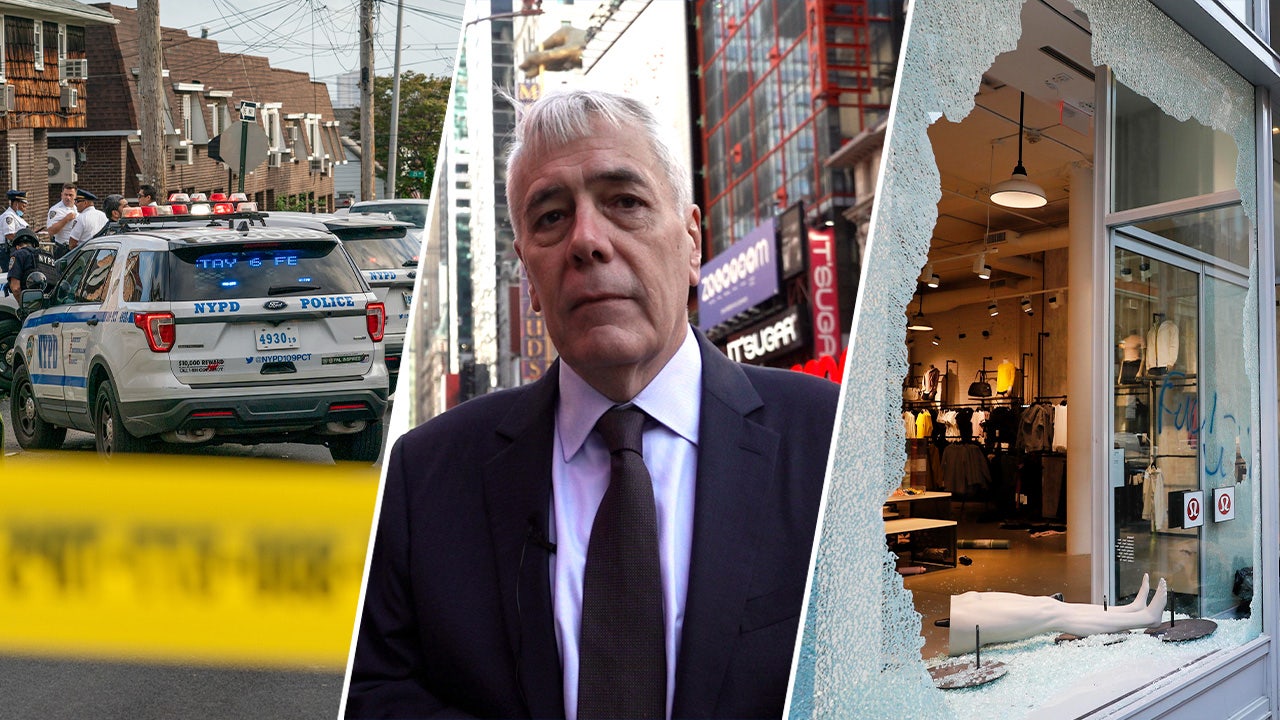
A 39-year New York City cop says city officials tout recent crime drops but ignore the major spike still lingering since the pandemic. The “palpable fear” New Yorkers feel can’t be quantified, he adds. (Fox News/Teny Sahakian/Megan Myers)
Mayor Eric Adams touted crime reductions during a Jan. 3 public safety address, including a 12% drop in homicides and a 25% decrease in shootings between 2022 and 2023. He added that “New Yorkers are breathing easier” because of his administration’s efforts to reduce crime.
But Panuccio said those figures hide the real story and pointed to pre-pandemic crime levels.
“You can play numbers games all day long, which city hall is very fond of,” Panuccio said. “If you compare it to 2019, the crime jump is staggering.”
“There’s a sense of disorder, a sense of decay, and what I like to call palpable fear. Those are things you can’t quantify.”
While crime has trended downward since the pandemic, some offenses are still much higher, including homicides, which were up 21% at the end of last year compared to 2019, according to NYPD data. Robberies and felony assaults have risen 26% and 35%, respectively, and motor vehicle thefts nearly tripled.
CRISIS IN NEW YORK: 94-YEAR-OLD VET STRUGGLES TO MOVE ON AFTER NURSING HOME EVICTS HIM, REPLACED BY MIGRANTS
More than two-thirds of New Yorkers said crime was a serious issue in their community and that they were concerned they would be the next victim of a crime, according to a Siena College Research Institute poll published in July. More than 40% felt threatened by a stranger’s behavior in public.
Crime has been on a downward trend since 2020, but many offenses remain high compared to pre-pandemic levels. (AP Photo/Frank Franklin II)
CRISIS IN NEW YORK: MOTHER RECOILS AT SAFE INJECTION SITE SET ACROSS FROM SCHOOL: ‘OUR BABIES ARE THERE’
The city’s crime “numbers are garbage,” Panuccio said. “People are scared. You can’t attach a number to that.”
Panuccio joined NYPD in 1981, spending 25 years working in the detective bureau, plus a few in narcotics. But he became frustrated with New York’s progressive policies and retired July 30, 2020, after seeing social justice protests in the city devolve into riots with mass destruction and looting.
The long-time cop told Fox News the current culture of fear gripping the Big Apple reminds him of the 1980s, when crime was running rampant across the city at historic highs.
“We clean the city up. We have a 20-year run,” Panuccio said. “Now we’re back to this sense that people feel like the streets are out of control again. People felt safe, but now people have fear again.”
Hundreds of looters burglarized and vandalized stores throughout New York City following the murder of George Floyd. A former NYPD cop says the culture of lawlessness borne from liberal policies allowed the violence and vandalism to continue at the largest scale he’s ever seen. (Associated Press)
One woman, Paula Gavioli, told the New York Post in July she was fleeing the Big Apple for New Jersey to escape the crime. She said she no longer felt safe without her pepper spray, which she keeps in her handbag at all times.
“Everything emanates from public safety in New York City. If we don’t have public safety, we don’t have a city.”
Another New York woman, Marjorie Mann, said she felt more uneasy about going on the subway or walking the streets alone.
“Being in public places feels more unsafe than ever before,” Mann told the NYP. “People seem like they’re looking for fights a little bit more than they used to. People seem angry and like they’re looking for an excuse to get it out.”
Panuccio said he saw that same sense of terror in the crime-ridden ‘80s, but watched it subside over the course of the following decade when city officials got tough on crime during Republican Mayor Rudy Guiliani’s administration.
Panuccio, a 39-year NYPD veteran, says New Yorkers’ fear will only continue if Democrats remain in power, allowing a culture of lawlessness to persist. (Fox News/Megan Myers/Teny Sahakian)
“The number one issue, and what saved New York City in the ’90s, was public safety,” he said. “Everything emanates from public safety in New York City. If we don’t have public safety, we don’t have a city.”
Panuccio accused progressive politicians of pushing soft-on-crime policies that have enabled criminals, fostered a culture of lawlessness and created the fear New Yorkers feel. He said real change won’t come until Democrats are out of power.
“New York City’s a captive city, captured by the progressives,” Panuccio said. “A lot of people gave their lives to make this city a safer place. It’s all been washed away.”
Adams’ office, in response to Fox News’ request for comment, noted that crime has decreased under his administration. Neither NYPD nor the New York City Council’s Progressive Caucus responded to requests for comment.
Read the full article from Here
Boston, MA
Andris Nelsons out as music director of Boston Symphony at end of 2026-27 season
Entertainment
Boston will have the third vacancy among major U.S. orchestras.
Andris Nelsons is being forced out as music director of the Boston Symphony Orchestra in the summer of 2027 after 13 seasons.
The orchestra made an unusually blunt announcement Friday.
“The decision to not renew his contract was made by the BSO’s board of trustees because, beyond our shared desire to ensure our orchestra continues to perform at the highest levels, the BSO and Andris Nelsons were not aligned on future vision,” the BSO said in a statement from its trustees and CEO Chad Smith.
A five-time Grammy award winner, the 47-year-old Nelsons is currently leading the Vienna Philharmonic on a U.S. tour and was to conduct the orchestra in Naples, Florida, on Friday night.
“While this is not the decision I anticipated or wanted, I am unwaveringly committed to you and to our work together,” Nelson wrote in a letter to BSO musicians and staff that was released by his management agency. “I understand the decision was not related to artistic standards, performances, or achievements during my tenure, and, therefore, my focus is straightforward: to protect the music, support the orchestra’s stability, and continue to perform with the musicians of the BSO at the highest artistic level.”
Nelsons made his BSO debut in March 2011 at New York’s Carnegie Hall as a replacement for James Levine, who announced 10 days earlier he was stepping down as BSO music director at the end of the 2010-11 season because of poor health.
Nelson was announced as music director in May 2013 and given a five-year contract starting with the 2014-15 season. The orchestra announced contract extensions in 2015 and 2020, then in January 2024 said he was given an evergreen rolling contract. He was bestowed an added title of head of conducting at Tanglewood, the music and educational center that is the orchestra’s summer home.
The last extension was announced a few months after Smith, who had been with the Los Angeles Philharmonic, started as the BSO’s chief executive.
Nelsons was music director of the City of Birmingham Symphony Orchestra in Britain from 2008-09 and has been chief conductor of Leipzig Gewandhaus Orchestra in Germany since the 2017-18 season. He married soprano Kristine Opolais in 2011, and in 2018 they announced their divorce.
Boston will have the third vacancy among major U.S. orchestras. Gustavo Dudamel is leaving the Los Angeles Philharmonic this summer after 17 seasons to become music director of the New York Philharmonic and Franz Welser-Möst will depart the Cleveland Orchestra at the end of 2026-27 after 25 seasons.
In addition, Klaus Mäkelä takes over the Chicago Symphony Orchestra in 2027-28, when he also starts as chief conductor the Royal Concertgebouw Orchestra in the Netherlands.
Pittsburg, PA
Video shows Amazon driver illegally passing school bus in Pittsburgh area
A West Deer Township woman captured video of an Amazon driver illegally passing a school bus on Saxonburg Boulevard, saying it’s not the first time it has happened.
“They act like it’s a racetrack,” Carley Gavulich said of Tuesday’s incident. “What if there was multiple children? What if you were to hit my child, anyone’s child?”
It felt too close to home for Gavulich. She was waiting for her son to come off the bus from Curtisville Primary Center when it happened on Tuesday.
“He actually was getting his new dirt bike delivered, so that’s why we were even recording,” she said.
She wanted to get his reaction to the dirt bike. Instead, the bus driver pulled up, and the Amazon Prime truck blew past the stop-arm.
“The Deer Lakes School District’s top priority is always the safety, security, and wellbeing of its students,” a spokesperson for the district said on Friday. “The District is aware of the situation and is taking all steps to address any concerns.”
A spokesperson for Amazon told KDKA it is looking into the incident and will take appropriate actions after a review.
“Amazon should hold him 100% accountable,” Gavulich said.
But whoever was driving is not the only person Gavulich believes needs a bus safety refresher. She said her husband has witnessed vehicles blowing by the stop-arm at least seven times.
Both are grateful that the bus driver saw the delivery truck coming and stopped her son from getting off.
“She is amazing, 100 percent props to her. If she would have let him off that bus, we would be having a different conversation,” Gavulich said.
The chief of the West Deer Police Department told KDKA that someone in the community had notified him about this. He added that all the district’s buses have cameras and that an officer will review the video and approve the violation.
That video from the bus has not come in yet, though, the chief said on Friday, adding that it can take a few days.
Connecticut
Connecticut is Poised to Lose More Residents If It Fails to Fix Affordability
Connecticut may become a ghost town if lawmakers fail to address affordability concerns — and the warning signs are becoming harder to ignore.
A new AARP survey of residents aged 45 and older shows deep concern about rising living costs. Respondents cited housing, utilities, and medical care as major financial pressures, fueling broader worries about long-term financial security and the ability to afford retirement in Connecticut.
The numbers are sobering: 72% of respondents say they are concerned about the cost-of-living, up from 66% in 2023; more than half worry about being able to retire in Connecticut; and 33% report difficulty affording healthcare.
Those anxieties are translating into real financial strain. Nearly half say they have tapped into savings to cover rising costs. Forty-two percent have stopped saving for retirement altogether. Thirty-six percent struggle with monthly bills. Thirty percent have difficulty affording food. Thirteen percent report skipping medications due to cost.
These are not marginal concerns. They represent warning signals from a key demographic in one of the nation’s oldest states. Connecticut’s median age is 41.2, the seventh highest in the country. Meanwhile, the 35-to-49 age group declined by 13.1 percent between 2010 and 2022 — more than any other age group.
Older residents are increasingly relocating to states such as North Carolina, South Carolina, Florida, and Texas. The reasons are familiar: lower taxes, lower housing costs, and lower energy bills.
Despite a relatively high average annual income, Connecticut residents face some of the highest property taxes, income taxes, and corporate taxes in the country. At the same time, the state struggles with elevated housing costs and some of the highest utility rates nationwide. For retirees, the financial math often simply doesn’t work.
In the AARP survey, 92% of respondents agreed that the state government should prioritize utility rate and regulatory changes. That is telling.
Energy policy illustrates the broader challenge. Over the past several decades, Connecticut has adopted increasingly ambitious renewable energy mandates, including Renewable Portfolio Standards (RPS). This measure severely restricts utilities’ ability to find the cleanest and most efficient means of providing electricity. While environmental goals are important, restricting utilities’ energy sourcing options has contributed to higher costs.
The Public Benefits Charge, a state-imposed fee on electric bills that funds various renewable energy programs, has become another driver of high rates. When policy costs are layered onto utility bills, households feel it immediately.
Connecticut’s long-term emissions goals are ambitious. But energy policy must balance environmental objectives with cost and reliability. In Alternatives to New England’s Affordability Crisis, a coalition study of New England’s energy market found that a more diversified portfolio, including nuclear and natural gas, could significantly lower costs while maintaining reliability and reducing emissions.
The General Assembly is currently considering a bill to establish a workforce that would advance nuclear energy technologies. That is a conversation worth having. Energy decisions that improve affordability and reliability would directly address the concerns raised in the AARP survey.
Affordability, however, extends beyond energy. Government spending and taxation play a central role in everyday costs. When taxes and regulatory burdens increase, those costs ripple outward — affecting housing prices, transportation costs, and grocery bills.
Even proposals framed as targeting large corporations can affect consumers. For example, H.B. 5156, would impose retroactive costs on fossil-fuel producers. Industry groups estimate it could raise gasoline prices by nearly 33 cents per gallon. For families already struggling with food and medical bills, even incremental increases matter.
Gov. Ned Lamont has spoken about the need for growth and reform to strengthen Connecticut’s future. Growth, however, requires a competitive cost structure.
If lawmakers truly believe affordability is the top issue this session, structural reform, not temporary rebates, is required. That means reassessing the tax and regulatory environment that drives costs higher.
Connecticut’s affordability challenge is not inevitable. It is the cumulative result of policy choices. If those choices are not revisited, the state will continue to lose residents, particularly those in their prime earning years and those approaching retirement, to more affordable alternatives.
The survey results are not just statistics. They are signals. Lawmakers would be wise to take them seriously.
-
World1 week agoExclusive: DeepSeek withholds latest AI model from US chipmakers including Nvidia, sources say
-
Wisconsin5 days agoSetting sail on iceboats across a frozen lake in Wisconsin
-
Massachusetts4 days agoMassachusetts man awaits word from family in Iran after attacks
-
Massachusetts1 week agoMother and daughter injured in Taunton house explosion
-
Maryland6 days agoAM showers Sunday in Maryland
-
Florida6 days agoFlorida man rescued after being stuck in shoulder-deep mud for days
-
Denver, CO1 week ago10 acres charred, 5 injured in Thornton grass fire, evacuation orders lifted
-
Oregon1 week ago2026 OSAA Oregon Wrestling State Championship Results And Brackets – FloWrestling