Politics
Independence-leaning party's nominee wins Taiwan election, auguring more tension with China

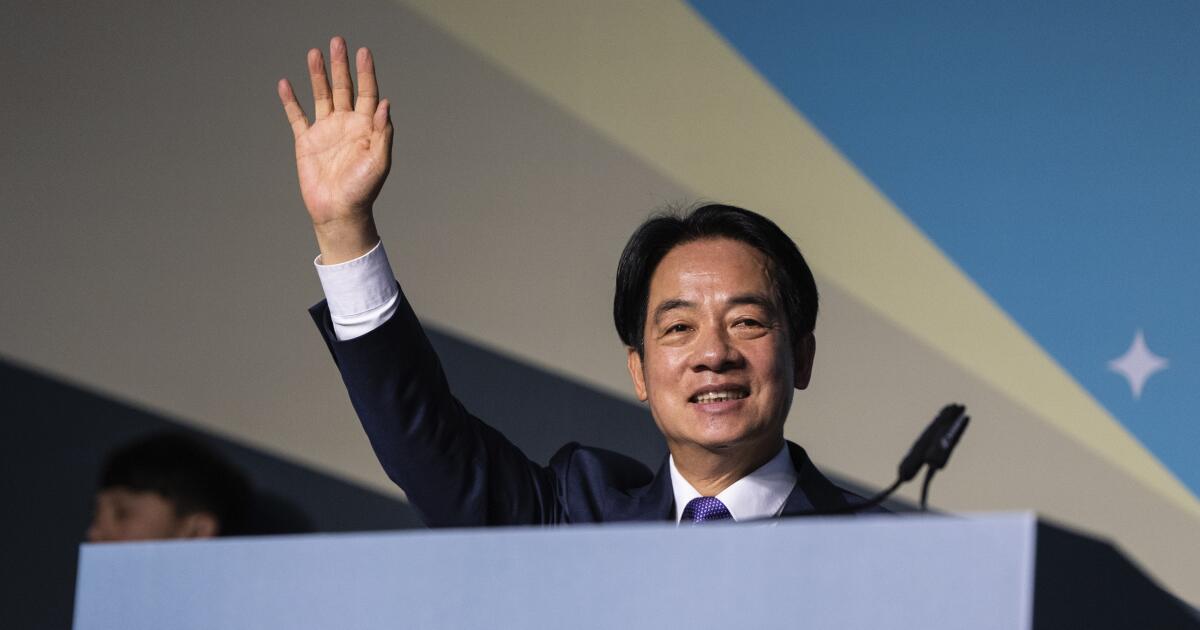
Taiwan’s ruling party clinched a third presidential term in Saturday’s election, in a historic win that portends the continuation of a tense cross-strait standoff between Beijing and the self-governed island.
With 40.1% of the vote, current Vice President Lai Ching-te of the Democratic Progressive Party defeated two candidates who favored closer ties with Beijing, indicating that for the majority of voters, antipathy toward China outweighed growing discontent over the economy and other domestic issues.
“They have just proven that its possible to break the eight-year curse,” Wen-ti Sung, a political scientist with Australia National University’s Taiwan Studies Program, said of the DPP’s win. “They can signal to Beijing that they have staying power.”
But despite the unprecedented third-term victory, analysts said the Democratic Progressive Party failed to gain ground with voters outside of its traditional support base. The opposition parties together accounted for 59.8% of the vote, and growing fatigue with the ruling party could pose additional challenges for Lai, who must prove his ability to navigate international and domestic grievances. The new president also likely will experience headwinds from a divided legislative yuan, the 113-seat parliament, making it more difficult to advance his agenda.
Supporters of Taiwan’s Democratic Progressive Party, which won a third presidential term Saturday, cheer at a rally in New Taipei City.
(Louise Delmotte / Associated Press)
“This is Lai’s victory, but it’s also a failure of the opposition,” said Lev Nachman, professor of political science at National Chengchi University in Taipei. “This is going to be a really tough administration. Now they have to deal with a very divided society and a very divided legislative yuan.”
In his victory speech, Lai acknowledged that the Democratic Progressive Party had lost its majority in the legislature, and said he would study the policies of his opponents and potentially incorporate them into his own.
“The elections have told us that the people expect an effective government as well as strong checks and balances. We fully understand and respect these opinions from the public,” he said.
Lai also reiterated his intention to maintain the status quo with China and preserve peace in Taiwan.
“We will use exchanges to replace obstructions, dialogue to replace confrontation and confidently pursue exchanges and cooperation with China,” he said.
Lai will take office at a highly fraught juncture for the U.S., China and Taiwan. The self-ruled island’s sovereignty has become a flashpoint in the deteriorating relationship between the two superpowers, igniting concerns of a potential military conflict that could quickly expand to the broader Asia-Pacific. That’s made maintaining peace in the Taiwan Strait, already a delicate balancing act, a harder task for the next administration in Taipei.
China considers Taiwan a part of its territory that must eventually be unified with the mainland, by force if necessary. Cross-strait relations have grown strained during the eight years under outgoing Taiwanese President Tsai Ing-wen, who has adopted a more confrontational stance toward Beijing while strengthening ties with other democracies, especially the U.S.
Hou Yu-ih, the presidential nominee of the opposition Kuomintang, greets party supporters in New Taipei City, Taiwan.
(Ng Han Guan / Associated Press)
For its part, the U.S. has long adhered to a policy known as “strategic ambiguity.” It acknowledges that China lays claim to the island democracy of 23 million, but does not endorse it. Nor does it recognize Taiwan as a country, but Washington maintains governmental communications with and sells defensive arms to Taipei. U.S. officials decline to explicitly state whether they would offer military assistance in the event of conflict, both to deter China from launching an attack and Taiwan from formally declaring independence.
But in recent years, Beijing has accused the U.S. of shifting away from the policy and quietly emboldening Taiwan to pursue independence. When then-House Speaker Nancy Pelosi (D-San Francisco) visited Taipei in August 2022, Chinese officials responded by launching military drills unprecedented in scale around Taiwan and suspending imports of some fruits and fish. That military and economic pressure has continued with more naval and air patrols and halts of preferential tariffs on Taiwan trade last month.
Analysts said they expect Beijing to express its displeasure with Lai’s election through more displays of military and economic power, adding to the risk of an inadvertent clash that could spiral out of control.
“It sees these pressure tactics, especially the military provocations, as deterrence, showing them [that] if you make the wrong move, we will fight,” said Michael Cunningham, a research fellow at the Heritage Foundation’s Asian Studies Center. “Beijing knows it’s not normal for the incumbent party to hold onto power for this long. It’s going to try to make sure Lai has only one four-year term.”
Though Lai was the longtime front-runner, his lead in the polls narrowed considerably in the weeks before the election. The Democratic Progressive Party candidate campaigned on the assurance that he would continue Tsai’s trajectory of bolstering Taiwan’s international ties and defense capabilities while maintaining the status quo.
Yet Chinese officials have criticized the 64-year-old former doctor as a dangerous choice for president who could lead the island into war. Lai’s choice of words to describe himself— as a “pragmatic worker for Taiwanese independence”— in 2017 has helped fuel that characterization, giving ammunition to Beijing and the opposition parties to label him as a separatist who would provoke China’s military ire.
The Chinese Nationalist Party, better known as the Kuomintang or KMT, also framed the election as a choice between war and peace. Its candidate, Hou Yu-ih, a 66-year-old former police chief and current mayor of New Taipei City, stressed his dedication to “law and order” and said he would seek to improve relations with Beijing but does not support unification.
The KMT, which fled mainland China after losing the Chinese civil war in 1949, has largely fallen out of favor with the younger generations, the majority of whom now consider themselves more Taiwanese than Chinese. The island’s oldest political party has struggled to attract young voters and shake its image as the pro-China choice.
But there have been signs that voters are also unhappy with the ruling DPP and eager to express their discontent, especially over stagnating economic growth.
In 2022, the KMT won a broad swath of victories in Taiwan’s local elections, prompting Tsai to step down as chairperson of the DPP. A November poll by the Taiwan Public Opinion Foundation showed 57.4% of respondents were dissatisfied with the DPP’s governance, including both its approach to cross-strait relations and the economy.
That frustration fueled an early wave of unexpected support for Ko Wen-je as a third-party alternative, particularly among Taiwanese people disenchanted with the two main political parties. The 64-year-old former trauma surgeon served as Taipei mayor for two terms before running for president this year with the Taiwan People’s Party, which he founded. He attacked the DPP for being too adversarial toward Beijing and the KMT for being too acquiescent. However, his momentum dwindled after a failed attempt to form a joint ticket with Hou against the DPP.
Beijing’s response to another DPP president will set the tone for its shaky relationship with the U.S., which has seen a slight thaw since President Biden and Chinese leader Xi Jinping convened in November for their first meeting in a year. The two agreed to resume military dialogues that were halted after Pelosi’s trip to Taiwan. Biden reiterated that U.S. policy on the island had not changed, while Xi reportedly reassured Biden that he did not imminently plan to exercise military force.
“The momentum behind an improvement in U.S.-China relations is ongoing,” said Amanda Hsiao, senior China analyst at International Crisis Group. “That will incentivize China to adopt slightly more discreet or ambiguous forms of pressure. But pressure will definitely be there.”

Politics
DOJ expands indictment against SPLC, alleging $4M secretly funneled to KKK and extremist groups

NEWYou can now listen to Fox News articles!
The Department of Justice last month announced an indictment against the Southern Poverty Law Center (SPLC), alleging that the civil rights nonprofit defrauded donors by secretly paying informants associated with extremist organizations, including the Ku Klux Klan.
A federal grand jury in the Middle District of Alabama returned an 11-count indictment in April charging the SPLC with six counts of wire fraud, four counts of making false statements to a federally insured bank and one count of conspiracy to commit concealment money laundering, according to the Justice Department.
The superseding indictment retains those charges while expanding on the alleged misconduct.
According to the DOJ, the SPLC “secretly funneled” more than $3 million in donor funds between 2014 and 2023 to numerous individuals associated with extremist organizations, including the Ku Klux Klan, United Klans of America, the National Socialist Movement, participants in the Unite the Right rally and the Aryan Nations-affiliated Sadistic Souls Motorcycle Club.
NEO-NAZIS, ‘SADISTIC’ BIKERS AND CHARLOTTESVILLE ORGANIZER: 5 OF THE MOST SHOCKING SPLC INFORMANTS
The Southern Poverty Law Center has widespread influence in education. FILE: Acting Attorney General Todd Blanche, left, and SPLC interim President and CEO Bryan Fair are shown in a split image as the Justice Department pursues charges against the Southern Poverty Law Center. (Nathan Posner/Anadolu via Getty Images; USA TODAY Network via Imagn Images)
The original indictment alleged approximately $3 million in payments between 2014 and 2023.
“The SPLC’s paid informants (‘field sources’) engaged in the active promotion of racist groups at the same time that the SPLC was denouncing the same groups on its website,” the indictment states.
Prosecutors further allege the SPLC opened bank accounts tied to fictitious entities in order to conceal donor funds that were allegedly routed to confidential sources.
MIKE DAVIS: SOUTHERN POVERTY LAW CENTER: A TALE OF A RACISM SCAM
The Southern Poverty Law Center (SPLC) building seen in March 2020 in Montgomery, Alabama. (Barry Lewis/InPictures via Getty Images)
According to the indictment, the SPLC began operating a covert informant network in the 1980s, and between 2014 and 2023 allegedly paid those sources in a clandestine manner.
The DOJ alleges an SPLC employee instead encouraged the pair to remain involved and offered them a monthly salary of $1,200.
The two subsequently agreed to remain in the organization, according to the indictment.
DR. BEN CARSON: I KNOW HOW BAD THE SPLC WAS, IT CAME AFTER ME AND PUT ME AT RISK
Acting Attorney General Todd Blanche spoke during a press conference alongside FBI Director Kash Patel at the Department of Justice on April 21, 2026, in Washington, D.C., following the indictment of the Southern Poverty Law Center. (Nathan Posner/Anadolu via Getty Images)
Prosecutors allege an SPLC employee instructed the individuals to claim they worked for a company called Rare Books and helped college students with research and writing assignments if anyone questioned the source of their income.
The indictment alleges donor funds were used to pay both individuals through SPLC accounts.
According to prosecutors, the pair were also reimbursed for expenses related to Ku Klux Klan activities, including cross-burning events and associated costs such as wood and fuel.
One of the individuals is also accused of recruiting new members using donor-funded payments. The indictment further alleges the SPLC knew donor funds were used to purchase materials for Ku Klux Klan garments.
In a statement to Fox News Digital, attorney Abbe Lowell, who represents the SPLC, denied the allegations.
A composite image shows Acting Attorney General Todd Blanche overlaid on photographs of the Department of Justice and FBI headquarters in Washington, D.C. (Valerie Plesch/Bloomberg via Getty Images; Graeme Sloan/Bloomberg via Getty Images)
“This apparent superseding indictment attempts to shore up the flaws in the initial charges, but it changes nothing,” Lowell said.
“The SPLC did not lie to its donors, it did not mislead banks it did business with, and its informant program prevented violence and saved lives,” he continued.
“It appears the Justice Department shared the indictment with media before it was unsealed by the court – another example of the government’s troubling handling of this case.”
“We will be addressing these irregularities with the court and look forward to presenting the truth at trial,” he added.
NONPROFIT REVENUE TOTALS SURGE AMID GROWING SCRUTINY AFTER MAJOR FRAUD CASES
SPLC interim President and CEO Bryan Fair speaks during a wreath-laying ceremony at the Southern Poverty Law Center Civil Rights Memorial in Montgomery, Ala., on March 5, 2026. (Jake Crandall/Advertiser / USA TODAY NETWORK via Imagn Images)
The superseding indictment also notes that the SPLC’s reported revenue increased from roughly $38.7 million in 2010 to more than $129 million in 2023, an increase of approximately 233%.
According to the filing, the organization’s net assets grew from approximately $238 million to nearly $787 million during the same period.
The SPLC is a longtime nonprofit organization that says it combats white supremacy and extremism through research, reporting and monitoring efforts intended to assist law enforcement and the public.
During a news conference announcing the original indictment, Acting Attorney General Todd Blanche alleged the SPLC paid members of extremist groups so it could generate “work product” documenting their activities.
CLICK HERE TO DOWNLOAD THE FOX NEWS APP
“To that end, [SPLC] was doing the exact opposite of what it told its donors it was doing – not dismantling extremism but funding it,” Blanche said.
Fox News Digital’s Alexandra Koch, David Spunt, Jake Gibson and Alec Schemmel contributed to this report.
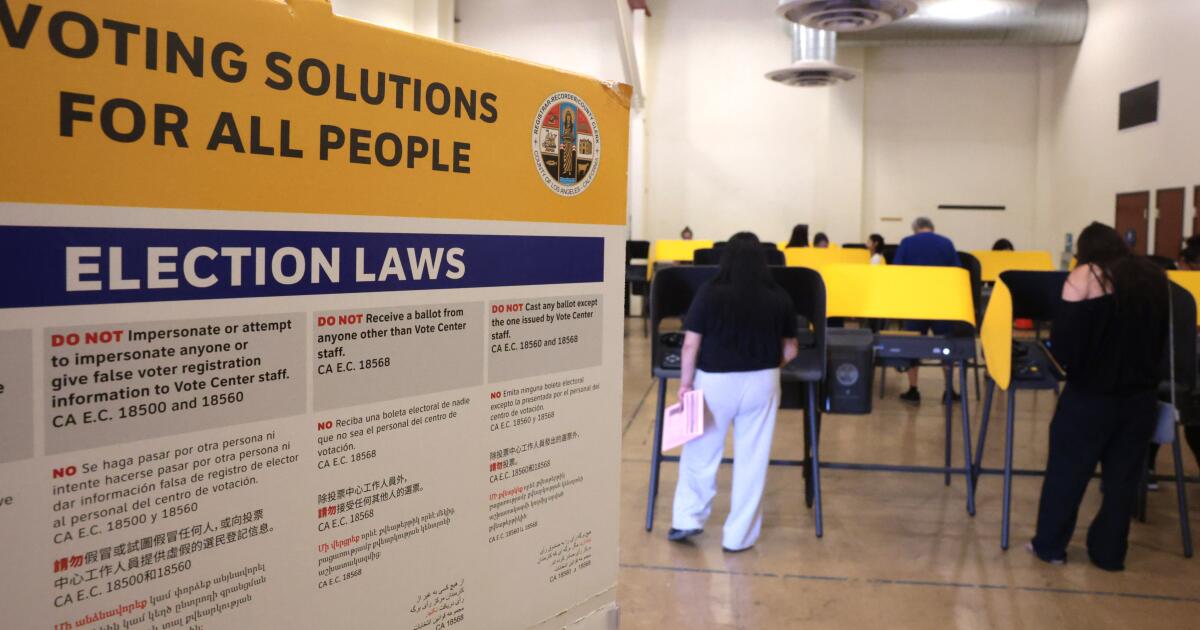
Buoyed by a new Congressional map favoring their party, California Democrats were eyeing Tuesday’s primary elections as a critical first step toward flipping a handful of House seats and taking back power in Washington.
Results from California’s massive and slow-moving election process were not immediately clear late Tuesday, as polls closed and mail ballots continued to be processed and counted. Still, Democrats were bullish about their chances of advancing candidates to November’s general election in all five districts that were redrawn in their favor as a result of last year’s Proposition 50 ballot measure.
“The path to winning back the House starts with voting in the June 2nd primary,” the California Democratic Party posted online Monday.
Meanwhile, California Republican Party Chairwoman Corrin Rankin urged Republican voters to make their own voices heard too.
“Like President Trump said, we need to make it too big to rig,” Rankin said on “The Benny Show.” “We need to swamp the vote.”
One of the most closely watched races was in the redrawn 22nd Congressional District in the Central Valley, where incumbent Rep. David Valadao (R-Hanford) is facing challenges from moderate Assemblymember Jasmeet Kaur Bains (D-Delano) and progressive college professor Randy Villegas.
Another closely watched race was in the redrawn 48th Congressional District in San Diego and Riverside counties, where Rep. Darrell Issa (R-Bonsall) decided to retire rather than run for reelection, and where Republican San Diego County Supervisor Jim Desmond — who is endorsed by Trump — is running against a pack of Democrats.
Prop. 50 — which Californians passed with nearly 65% of the vote a year ago — was California Democrats’ response to Texas Republicans redrawing their state’s Congressional maps in the GOP’s favor, at President Trump’s behest. It was also the only major Democratic counterpunch in the wider mid-decade redistricting brawl that has spread across the country in the last year.
Experts expect the redistricting battle to deliver a net gain of a handful or more House seats to Republicans. But Democrats could gain even more ground given Trump’s lousy approval ratings and the long history of midterm election losses for the president’s party.
Combined, those factors make the battle for control of the House incredibly close, which in turn makes the five seats up for grabs in California pivotal — and potentially decisive.
Tuesday’s primaries won’t determine if any of those five seats will indeed flip parties in November. However, the primaries will define those head-to-head races to come and better inform the odds of Democrats toppling Republican incumbents, experts said.
In addition to flipping the seats currently held by Valadao and Issa, Democrats are hoping to pick up three additional seats.
In the 1st Congressional District — which after Prop. 50 lost rural reaches of northeast California and picked up liberal North Bay communities — various candidates were vying for the seat long held by the late Rep. Doug LaMalfa (R-Richvale), who died in January. They include Democratic state Sen. Mike McGuire and Republican Assemblymember James Gallagher, who is endorsed by Trump.
Voters from the existing district are also voting in a special election Tuesday to fill the remainder of LaMalfa’s term.
In the 3rd Congressional District, which lost an eastern rural stretch along Nevada and now holds more tightly to the Sacramento suburbs, Rep. Ami Bera (D-Elk Grove) — who currently represents a different district — is running to remain in Congress in a new seat.
Meanwhile, the 3rd Congressional District’s incumbent, Rep. Kevin Kiley (I-Rocklin), is seeking to do the opposite. He quit the Republican Party, became an independent and is now running for Bera’s current seat in Congressional District 6, which includes the city of Sacramento and Placer County suburbs.
In the 41st Congressional District, which became more liberal after Prop. 50 by losing voters in Riverside County and gaining them in Los Angeles County, a slate of candidates — including Rep. Linda Sánchez (D-Whittier), who currently represents a different district — are running to replace Rep. Ken Calvert (R-Corona). Calvert, a 17-term incumbent, decided to run in the neighboring 40th Congressional District instead.
In the 40th Congressional District, which covers a swath of inland Orange County and portions of San Bernardino and Riverside counties, incumbent Rep. Young Kim (R-Anaheim Hills) is now going head-to-head with Calvert, while also facing several Democratic challengers.
Other districts that were not part of the Prop. 50 shuffle are also attracting attention.
In the 11th Congressional District in San Francisco, several Democratic candidates are vying to replace Rep. Nancy Pelosi (D-San Francisco), the retiring former House Speaker, including state Sen. Scott Wiener; tech millionaire and Democratic political operative Saikat Chakrabarti; and Connie Chan, a member of the San Francisco board of supervisors who Pelosi endorsed.
Democrats are also closely watching several races where younger Democrats and progressives are challenging older incumbent Democrats, and where newer Democratic incumbents are seeking to hold onto their seats in relatively competitive districts.

NEWYou can now listen to Fox News articles!
LOS ANGELES — Outside a Bristol Farms market in LA’s Westchester neighborhood, residents who spoke to Fox News Digital all agreed that homelessness is a top problem facing the city, but disagreed on which mayoral candidate is the right choice to clean it up.
“Love him,” Shelley Zuckerman said about reality television star and independent candidate Spencer Pratt, adding that homelessness is a main motivator of her support for the reality TV star’s mayoral run.
“The fact that he’s not a politician, so he may or may not be a liar, we don’t know that yet, and I know that he wants to do something for LA that the politicians have been saying they’re going to do and then don’t,” Zuckerman added. “And I know politics works, that once you get in there you can’t always do what you want to do, but at least he’s got the passion.”
SPENCER PRATT SAYS HIS POLICY WILL FORCE HOMELESS OUT OF LA AND INTO CITIES LIKE SEATTLE
Los Angeles residents say homelessness is the top problem facing the city as they head to the polls for the mayoral primary. (Fox News Digital)
When asked if crime was a motivating factor to vote for Pratt, Zuckerman’s husband Saul responded, “Of course.”
The couple says they are supporting Republican Steve Hilton for governor.
Patrick Reynolds, who lives in the neighborhood, said he is “not happy with any of the candidates” and called Pratt a “clown” before saying he voted for incumbent Mayor Karen Bass “a little reluctantly.”
Homelessness has been a top-of-mind concern for voters in Los Angeles, and despite Bass being mayor for the last four years, Reynolds said he believes she’s the best choice on that front.
Reynolds, who said he is supporting billionaire Democrat Tom Steyer for governor, spoke at length about the problems with homelessness, including a local park he said has become “too dangerous” to visit in recent years.
KAREN BASS GRILLED OVER BROKEN HOMELESSNESS PROMISE, BLAMES BUREAUCRACY FOR SLOWED PROGRESS
Mayoral candidate Spencer Pratt hosts a campaign block party on 10th Avenue in Los Angeles on May 20, 2026. (Robert Gauthier/Los Angeles Times)
“Homelessness for sure,” a woman named Diane, who said she voted for Bass, told Fox News Digital, “That’s number one on my list, and I think she’s tried very hard to fix that problem. It’s a big problem, I know. And I just think she is down to earth. She’s not some rich billionaire, which I appreciate.”
Diane said she is supporting former Department of Health and Human Services Secretary Xavier Becerra, a Democrat who served in the Biden administration, for governor because he is a “good guy.”
“I like that he is an immigrant and that he has worked his way up in this world,” Diane said. “I think he has a good sensibility. I like also that he isn’t a billionaire. I can relate to him.”
Dan Madden, a resident of nearby Manhattan Beach, told Fox News Digital that if he could vote in LA proper, he’d go with Pratt.
WHO IS TOM STEYER? ANTI-ICE BILLIONAIRE IN CA GOVERNOR’S RACE FACES SCRUTINY OVER DETENTION INVESTMENTS
A Los Angeles city councilwoman and progressive candidate for mayor Nithya Raman, left, pictured alongside incumbent mayor Karen Bass, right. (Ronaldo Bolaños/Los Angeles Times via Getty Images; Justin Sullivan/Getty Images)
“That’d be my man,” said Madden, who added that he is voting for Hilton for governor. “The last 20 years in Los Angeles has been screwed.”
“It’s getting worse,” Madden said about the homeless situation in the Los Angeles area. “They cleaned up here and there. Spots, especially along the beach, coastline, you see it cleaned up. Two months later, everybody’s back.”
CLICK HERE TO DOWNLOAD THE FOX NEWS APP
Pratt, a registered Republican running as an independent, faces off in a nonpartisan mayoral primary against incumbent Mayor Karen Bass, a Democrat, and City Councilmember Nithya Raman, a socialist.
Tuesday’s election will determine which two candidates advance to the November general election. If a candidate receives more than 50% of the vote, they will automatically be named the next mayor.
-

 Massachusetts3 minutes ago
Massachusetts high school under investigation after teachers diagnosed with breast cancer
-

 Minnesota10 minutes ago
Medical services in limbo for thousands of providers amid Minnesota fraud crisis
-

 Mississippi13 minutes ago
Mississippi Lottery Mississippi Match 5, Cash 3 results for June 2, 2026
-
Missouri18 minutes ago
Missouri Lottery Mega Millions, Pick 3 winning numbers for June 2, 2026
-

 Montana25 minutes ago
In eastern Montana, Brian Miller wins Democratic primary for U.S. House • Daily Montanan
-

 Nebraska27 minutes ago
Free summer meals available for Nebraska children
-

 Nevada33 minutes ago
Primary election June 2026 – Nevada County results
-
 New Hampshire40 minutes ago
The Dip | River House Restaurant Concert Series

