Connect with us

West

Suspect in plot to kill famous rapper leaves jail

Published

on

Suspect in plot to kill famous rapper leaves jail
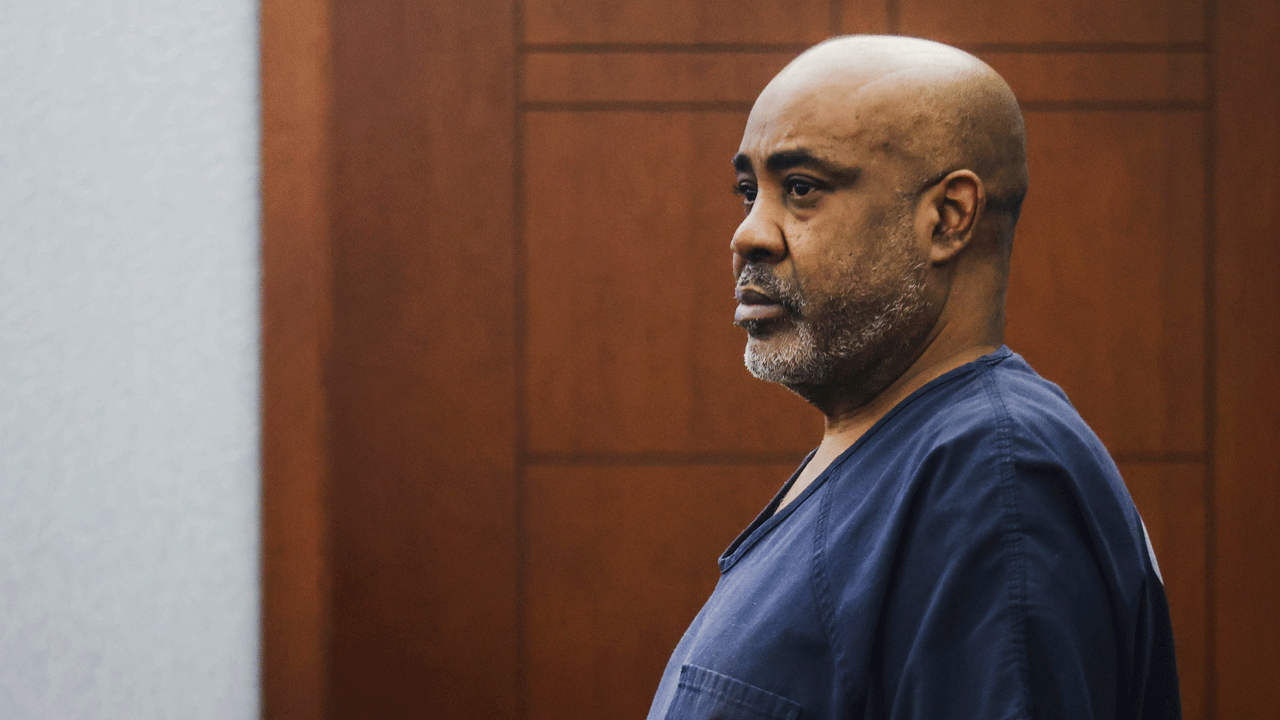
LAS VEGAS (AP) — A Nevada judge set bail Tuesday at $750,000 for a former Los Angeles-area gang leader charged with orchestrating the killing of hip-hop legend Tupac Shakur in 1996, saying he can serve house arrest with electronic monitoring ahead of trial on a murder charge.

Court-appointed attorneys for Duane “Keffe D” Davis told The Associated Press after the judge’s decision that they believe Davis can post that amount. They had asked for bail of not more than $100,000 and noted for the judge that the demands of preparing a defense based on two decades of evidence may require a postponement of the current June trial date.

MAN INDICTED IN TUPAC SHAKUR’S 1996 MURDER

Clark County District Attorney Steve Wolfson told reporters that he expects Clark County District Judge Carli Kierny will hold a “source hearing” to determine whether money posted for bail is legally obtained. The judge did not set a new trial date but called for a status check Feb. 20.

Prosecutors Binu Palal and Marc DiGiacomo argued Tuesday that Davis has never left gang life, that his 15 years of admissions about his role in Shakur’s killing show he is guilty of murder, and that a jailhouse phone call in October suggested he poses a threat to witnesses.

Advertisement

“There is one constant,” Palal told the judge. “Mr. Davis has consistently admitted to being architect of the murder.”

DiGiacomo called Davis “a very, very high danger to the community.”

The judge, in her ruling, acknowledged that Davis “made a living talking about his past life as a leader of the South Side Crips,” a street gang in his hometown of Compton, California, “and also the killing of Mr. Shakur in graphic detail.”

Arroyo and co-counsel Charles Cano argued that police and prosecutors could have arrested Davis 15 years ago but didn’t, and that the prosecutors were wrong with their interpretation of the jail telephone call and a list of names provided to Davis’ family. The defense lawyers said it is Davis and his family who are at risk.

Arroyo and Cano said their 60-year-old client is in poor health after battling cancer, which is in remission, and said he would not flee to avoid trial.

Advertisement

They also downplayed evidence against Davis as the product of tales told by witnesses with gang backgrounds that make them not credible, and noted the prosecution lacks evidence, including the gun and the car involved in the September 1996 drive-by shooting that killed Shakur.

Arroyo focused Tuesday on what he called “the obvious question” dating to 2008 and 2009 — when Davis talked with police in Los Angeles and Las Vegas. He went on to write a 2019 tell-all memoir and began giving interviews on social media in which he described his role as gang leader and “shot-caller” in Shakur’s death.

“If his guilt is so overwhelming, what’s been happening for 15 years?” Arroyo asked in court Tuesday. “Why did we wait 15 years to make the arrest?”

Davis was arrested Sept. 29 outside his home in suburban Henderson, which Las Vegas police had searched in mid-July. He pleaded not guilty in November to first-degree murder and has been jailed without bail at the Clark County Detention Center in Las Vegas, where detainees’ phone calls are routinely recorded. If convicted at trial, he could spend the rest of his life in prison.

Arroyo argued Tuesday that his client’s accounts in “the YouTube world” accentuated violence to attract viewers and make money.

Advertisement

“Conflict sells,” Arroyo said. “They get on these interviews, they puff out their chest. They’re trying to get clicks.”

Prosecutors say Davis’ own words are strong evidence that he is responsible for the crime, even if he didn’t pull the trigger. DiGiacomo said other people who have described Davis’ role in other media interviews, and to police, corroborate his accounts.

Davis is the only person still alive who was in the car from which shots were fired, mortally wounding Shakur and wounding rap mogul Marion “Suge” Knight. Knight is serving 28 years in a California prison for an unrelated fatal shooting in the Los Angeles area in 2015.

Davis’ attorneys noted that Knight is an eyewitness to the Shakur shooting but did not testify before the grand jury that indicted their client.

Davis maintains he was given immunity from prosecution in 2008 by an FBI and Los Angeles police task force investigating the killings of Shakur in Las Vegas and rival rapper Christopher Wallace, known as The Notorious B.I.G. or Biggie Smalls, six months later in Los Angeles.

Advertisement

DiGiacomo and Palal say any immunity agreement was limited. Last week, they submitted to the court an audio recording of a December 2008 task force interview during which they said Davis was told that what he said in the room would not be used against him, but that if he talked to other people he could be in legal jeopardy.

Davis’ attorneys responded with a reference to the publication 12 years ago of a book written by former Los Angeles police Detective Greg Kading, who attended those interviews.

“Duane is not worried,” the attorneys said, “because his alleged involvement in the death of Shakur has been out in the public since … 2011.”

Read the full article from Here

Advertisement
Continue Reading
Click to comment

Leave a Reply

Your email address will not be published. Required fields are marked *

This site uses Akismet to reduce spam. Learn how your comment data is processed.

Colorado

Colorado River states have just weeks to strike a deal. Here’s why it’s so hard for them to agree.

Published

on

Colorado River states have just weeks to strike a deal. Here’s why it’s so hard for them to agree.


Each negotiator drew a card from the deck.

John Entsminger, from Nevada, picked the highest card: the ace. Gene Shawcroft, from Utah drew the lowest: an eight.

“My luck in Las Vegas isn’t very good,” Shawcroft said, holding up his card to show an audience of 1,700 people. They chuckled under the ornate chandeliers of a Caesars Palace ballroom.

Shawcroft, Entsminger and the five other negotiators from the states in the Colorado River Basin were picking cards to determine the speaking order for the final panel of the Colorado River Water Users Association conference in Las Vegas in mid-December.

Advertisement

While the stakes for that card draw were quite low, the stakes of what the seven states are negotiating couldn’t be much higher.

(Brooke Larsen | The Salt Lake Tribune) Gene Shawcroft, Utah’s Colorado River commissioner, speaks on a panel of state negotiators at the Colorado River Water Users conference in Las Vegas on Thursday, Dec. 18, 2025. Negotiators picked from a deck of cards to determine the speaking order. Shawcroft chose the lowest card, so he went first.

The Colorado River is the lifeblood of the American Southwest and northern Mexico. Cities, tribes, farms, fish and various industries rely on it for drinking water, irrigation, habitat, power and more.

But it has been overtapped. And as the region gets hotter and drier and populations continue to boom, there is less and less water to go around.

The states have struggled to agree on how to share the river. Politics, different experiences of the river, complicated regulations and dwindling water supplies make negotiations difficult.

Advertisement

On the last day of the conference, state negotiators tried to appear cordial and close to consensus, even making light of the tension.

“It’s an honor and pleasure to be here today alongside my Colorado River family,” Becky Mitchell, Colorado’s negotiator, said. “As you all know, sometimes you can’t pick your family, but you get through it anyways.” The audience roared in laughter.

Differences quickly surfaced, though, and states didn’t appear close to reaching a deal.

The clock is ticking: The seven basin states only have until February 14 to come up with a plan for how to manage the river in dry times. The current guidelines expire at the end of the year. If they test their luck and fail to reach an agreement, they risk the Interior Department making a plan for them or years of litigation.

The seven state negotiators are meeting for four days in Salt Lake City this week as they work to hash out a deal before that deadline, according to Becki Bryant, public affairs officer with the Bureau of Reclamation.

Advertisement

The bureau released a draft environmental impact statement on Friday that lays out a series of pathways to manage the river system and its major reservoirs. If the states reach a deal, the bureau says it will insert that plan as the preferred way forward, Scott Cameron, acting commissioner for the bureau, told The Tribune at the conference. If states can’t agree, the federal government will choose an alternative itself, he added.

(Brooke Larsen | The Salt Lake Tribune) Scott Cameron, acting commissioner of the Bureau of Reclamation, addresses a large audience at the Colorado River Water Users Association conference in Las Vegas on Wednesday, Dec. 17, 2025. He emphasized the urgent need for states to reach a deal on the future management of the river.

In this game of water diplomacy, there will likely be no clear winners. “No one is too big to fail,” said Becky Mitchell, Colorado’s negotiator.

Federal officials say sacrifices must be made going forward.

“That means being willing to make and adhere to uncomfortable compromises,” Cameron said.

Advertisement

Whether states are willing to give enough to seal a deal is yet to be seen.

Is hydrology the problem?

Throughout the conference, anxiety about drought and the abnormally warm start to winter hung over panel discussions and side conversations in hallways lined with velvet curtains colored terracotta, like the Colorado River after a big storm.

October brought heavy rains, but November and December were abnormally warm and dry. Snowpack in the Upper Colorado River Basin is at its lowest level in a quarter century, according to the Colorado Basin River Forecast Center.

Lake Powell is only 28% full and could drop below 3,490 feet next year, according to forecasts from the Bureau of Reclamation. At that level, water would be unable to pass through Glen Canyon Dam’s electricity-generating turbines.

(Christopher Cherrington | The Salt Lake Tribune)

Advertisement

The drought has been blamed for the stagnation in the negotiations. “We need to remember that hydrology is the problem,” Brandon Gebhart, Wyoming’s negotiator, said. “It’s not political positions. It’s not legal interpretations. It’s not one state.”

Low reservoirs mean less water storage to prop up the river system when flows are low.

“Without that resiliency, people are very risk averse, very concerned about every acre-foot, so the give and take becomes very difficult,” Chuck Cullom, director of the Upper Colorado River Commission and former Colorado River programs manager in Arizona, told The Tribune.

When the seven states established guidelines for how to manage the river during dry years in 2007, drought had begun to plague the basin. But there was a much greater storage buffer then.

“The 2007 guidelines started with Lake Powell and Lake Mead, the two largest reservoirs in the United States, at about 90% capacity,” Cullom said. Today, the combined contents of Powell and Mead is closer to 30% full, he added.

Advertisement

Even with additional deals in 2019 and 2023 that led to sharp reductions in water use in the Lower Basin, the water crisis has continued to worsen, and climate scientists have said that trend will continue.

“We haven’t really got much of a break hydrologically, but this is something that has been foreseeable for a very long time,” Sarah Porter, director of the Kyl Center for Water Policy at Arizona State University, told The Tribune in November.

(Bethany Baker | The Salt Lake Tribune) The bathtub ring is visible at Lake Powell near Ticaboo, Utah on Tuesday, Oct. 17, 2023.

Some at the conference argued leaders need to stop blaming the stalemate on the river’s flow.

“Water is life, and like all of nature, the river is inherently chaotic,” Kirin Vicenti, water commissioner for the Jicarilla Apache Nation, said. “Despite those that think hydrology is the problem, it’s not, and it can’t always be the scapegoat. Our planning and policies must allow for flexibility and innovative and dynamic solutions.”

Advertisement

A ‘very technical’ disagreement

The basin states are working to come to terms that will provide more flexibility in river management during dry years.

The Upper Basin states — Utah, Colorado, New Mexico and Wyoming — have been at odds with the Lower Basin — Arizona, California and Nevada — over how to divvy up and enforce water cuts, though.

That’s in part due to different interpretations of the Upper Basin states’ obligation to the Lower Basin under the Colorado River Compact established over a century ago.

“This is a very technical, nerdy, hydrological disagreement,” Porter told The Tribune after the conference.

If a rolling average of 7.5 million acre-feet of water doesn’t make it past Lee’s Ferry, just below Glen Canyon Dam, over a ten year period, Lower Basin states may sue the Upper Basin.

Advertisement

(Trent Nelson | The Salt Lake Tribune) Glen Canyon Dam in Page, Ariz., on Monday, May 19, 2025.

State negotiators want to avoid litigation and may include protections against that in their deal. But so far, states have not found enough common ground.

Tom Buschatzke, Arizona’s negotiator said he needs the Upper Basin to make conservation commitments that are “verifiable and mandatory.” To sign on to a deal, Buschatzke has to get a deal approved by his state legislature, an “additional burden” unique to Arizona, Porter said.

The Upper Basin negotiators said demands for mandatory cuts from their water users ignores the realities of how water is managed and flows through their states.

‘Different experience of the river’

Across much of Utah, Colorado River water is often known by a different name locally: Ashley Creek, Price River, Escalante River, Rock Creek. Dozens of smaller waterways flow through the mountains and canyons of Utah to major tributaries like the Green and San Juan Rivers, before dumping into the Colorado in the southeast corner of the state.

Advertisement

The flow in those lesser creeks and rivers fluctuate day to day, year to year, based on snowpack, creating a variable water supply across Utah and other Upper Basin states.

Some reservoirs, such as Strawberry and Scofield, exist along the journey to store water for drinking water and irrigation. But those human-made lakes pale in comparison to the nation’s largest reservoir, Lake Mead, that the Lower Basin relies on for water delivery.

“That very different experience of the river and water supply makes it hard for people to find common ground because there’s not a lot of common experience,” Cullom said.

(Rick Egan | The Salt Lake Tribune) The San Juan River, a tributary of the Colorado River, near Mexican Hat, on Friday, May 27, 2022.

Beyond just differences in storage and water availability, the Secretary of the Interior has much greater powers in the Lower Basin thanks to a 1964 Supreme Court ruling that deemed the secretary the “water master” of the river below Lake Mead.

Advertisement

“The secretary could go to water users in the Lower Basin and say, ‘There’s an existential crisis. I’m going to cut you off.’ The secretary does not have that authority in the Upper Basin,” Cullom said.

‘We’re all on the same rowboat’

Entsminger, the Nevada negotiator, spoke last on the final panel at the Colorado River Water Users Association conference — a reward for drawing the ace.

He kept it short and pointed at his fellow negotiators.

“If you distill down what my six partners just said, I believe there’s three common things: Here’s all the great things my state has done. Here’s how hard, slash impossible, it is to do any more. And here are all the reasons why other people should have to do more,” he said. “As long as we keep polishing those arguments and repeating them to each other, we are going nowhere.”

Entsminger closed his speech, and the largest Colorado River conference of the year, with a metaphorical warning for any negotiator that holds a hard line.

Advertisement

“We’re all on the same rowboat,” he said. “The first one to fire a shot puts a hole in the boat and sinks it.”

(Trent Nelson | The Salt Lake Tribune) A raft on the Colorado River as seen from Navajo Bridge in Ariz. on Tuesday, May 20, 2025.

This article is published through the Colorado River Collaborative, a solutions journalism initiative supported by the Janet Quinney Lawson Institute for Land, Water, and Air at Utah State University. See all of our stories about how Utahns are impacted by the Colorado River at greatsaltlakenews.org/coloradoriver.


Source link

Advertisement
Continue Reading

Hawaii

Virus to fight coconut rhinoceros beetle shows promising results – West Hawaii Today

Published

on

Virus to fight coconut rhinoceros beetle shows promising results – West Hawaii Today


Every other day inside a lab on the third floor of the St. John Plant Science Laboratory building on the University of Hawaii at Manoa campus, doctoral student Kristen Gaines opens up a refrigerator full of beetle larvae, hoping to find them dead.

“When I see a dead one, it’s still pretty gratifying,” she said.

Gaines is a research assistant investigating a virus to kill the coconut rhinoceros beetle, also referred to as CRB, which is decimating Oahu’s coconut and palm trees. After years of trying to eradicate the beetle, the problem has grown to a full infestation, with thousands of trees dead because of the pest.

The virus Gaines is testing is a variant of the oryctes rhinoceros nudivirus, referred to as OrNV, which was discovered in the 1960s by German scientist Dr. Alois Huger, according to a 2022 report by researchers from New Zealand and Samoa. The virus, which Huger isolated after he killed healthy beetles by feeding them ones that had died of the virus, was the first time Samoa was able to successfully manage the pest after its introduction in 1910 from a Sri Lanka cargo vessel.

Advertisement

Preliminary results from her testing are promising, Gaines said. She’s observed larvae die after contracting the virus both by injection and naturally from deceased larvae. Most recently, she said, three out of four larvae died after she placed them inside a bin with a dead infected specimen.

Lack of testing facilities

Several East Asian and Pacific island nations have used the virus or variations of it to manage CRB for decades. While there is plenty of research that confirms the virus’ efficacy against the pest, there has been little research on how the virus may affect native beetles, such as the Kauai stag beetle, according to UH principal researcher Michael Melzer.

Other island chains that used the virus against CRB had economies more dependent on palm oil where the potential benefits of releasing the virus outweigh the risks or did not have native insects to worry about, Melzer said. The virus is host-specific, meaning it doesn’t mutate to infect other types of creatures, so the main concern is its effect on native beetles and similar insects.

Despite the beetle arriving in Hawaii in 2013, the state did not receive a permit to test the virus until April due to the lack of facilities where the tests could be safely administered and contained, said Jonathan Ho, plant quarantine branch manager for the state Department of Agriculture and Biosecurity.

Advertisement

He said the CRB invasion on Oahu reached the point where it was “all over the place,” and it wasn’t feasible to spray or inject every coconut tree on the island and properly dispose of all the green waste.

“At that point, at the landscape level, biocontrol was the only real realistic solution to mitigate the threat of CRB,” Ho said. “We weren’t going to spray or treat our way out of it.”

He added that despite its efficacy elsewhere in the Pacific, adequate testing is crucial to protect Hawaii’s environment and ensure the right virus strain is being utilized.

Melzer said federal funding the state received to respond to the CRB threat changed from an eradication focus to containment around 2020, ultimately leading to the development of the containment lab and procedures in order to score a federal permit to import the virus and begin testing on larvae.

A near ‘eureka’ moment

Advertisement

The entry to the colony lab, where Tomie Vowell, a member of the research support team, rears beetles for experiments on request, is a secure, pitch-black room that serves as a bridge between the lab and the hallway.

If a beetle were to escape — one never has, according to Melzer — it would get confused in the darkness. A single light in the corner would be turned on to attract the beetle so it could be recaptured.

“We basically just don’t want that virus leaving the lab, because we don’t know what impact it might have on both native or beneficial insects in Hawaii,” Melzer said.

From the dark room is a door that leads to the lab, where there are four locked refrigerators with beetles at different life stages in various labeled containers.

CRB eggs resemble small white balls. Once hatched, the tiny, pale grubs grow up to 2-1/2-inches long with a strong, black exoskeleton adorned with a rhinoceros-­like horn and fuzzy underbelly. Their natural life cycle from grub to adult is typically a year, Vowell said.

Advertisement

Melzer traveled to Palau to get the virus strain the island nation had used successfully to combat the beetle, and brought it back to Hawaii.

In a separate lab, Gaines dresses in full protective gear before injecting the virus into CRB larvae. The infected larvae become lethargic as their gut becomes inflamed.

Gaines said the first time she suspected a larva exhibiting symptoms had died of the virus, it was “not quite a eureka moment, but close to it.”

It can take two to four weeks for larvae to succumb to the virus, Melzer said, while infected adults live longer but ultimately become too lethargic to eat and starve to death.

He said the virus is effective because the beetles live long enough to spread the infection to others but in the end die themselves within weeks.

Advertisement

‘It’s already too late’

If everything goes to plan, Melzer estimates the virus could possibly be released into the wild within two years. Ho said the timeline is dependent on state and federal regulatory processes.

For some landscapers, the window for effective CRB containment has long closed.

“It just sucks because there’s a lot that could be done,” said Brent White, owner of Lush Palm Landscapes. “Maybe you should just let that thing (the virus) go out now and kill the beetles. It’s already too late. The North Shore is already gone. All the trees on the North Shore are going to be cut down pretty soon, they’re all going to be gone. There’s no saving it now — sorry, too late — which is really sad.”

White said he’s turned to treating his palm trees nightly with essential oils, which has helped keep his trees alive, but takes a lot of labor.

Advertisement

“It’s still so hard,” he said. “The minute you stop treating, the beetles come back and attack the tree. It’s just really sad that it’s growing out of control and there wasn’t proper mitigation methods in the beginning to stop it from happening.”

Chance Correa, owner of Malama Aina Landscape and Masonry Design, and Daniel Anthony, founder of nonprofits Hui Aloha ‘Aina Momona and Aloha Organic, agree.

The two employ Korean organic farming techniques to combat the beetle.

“In two to four years, we could lose every coconut tree,” Correa said. “There might not be coconuts to farm. It’s that bad.”

Aloha Organic uses a sulfur mixture to deter the beetle, Anthony said, along with nutrients to feed the trees.

Advertisement

“We noticed that the healthier your tree was, the more resilient it was to the beetle,” he said.

Anecdotally, Anthony’s methods have worked. During a visit Thursday, the residential property he’s been treating monthly in Kaaawa had plenty of coconuts in its trees, while a next-door neighbor’s trees showed evidence of beetle damage.

For both Correa and Anthony, coconuts are part of their culture that helped their ancestors survive for centuries.

“It’s life or death for us, for our culture, for our community,” Anthony said.

The two also share concerns about the long-term effects of chemical use on the trees and the fruit they produce.

Advertisement

More testing planned

Existing recommendations from the Department of Agriculture and Biosecurity to combat CRB include chemicals, organic options such as fungi and physical barriers such as netting. Ho said that while he has not heard of sulfur successfully deterring the beetle and it hasn’t been formally studied, any organic option that can be replicated would be welcome.

Basal oil is another organic option to repel beetles, according to the agency’s website.

Ho said the process for a pesticide to get approval for use against CRB does not necessarily require the same type of rigorous testing on its effects on native species that a bio-agent such as the virus does. But, he explained, both the U.S. Environmental Protection Agency and the state have labeling processes for use as a pesticide.

He added that the chemicals listed on the agriculture department’s website are labeled as being usable and then tested by either UH or a survey response to test efficacy.

Advertisement

Other than treating palm trees, Ho said the best way to manage CRB until a successful bio-agent is approved is to manage green waste and prevent breeding.

In the meantime, Melzer and Gaines plan to begin testing the virus against native species and potentially bring in a different strain from another affected area to build a virus “library.”

Melzer said he also hopes to get a permit to test on adult beetles, which so far has not been approved due to the risk of the winged insects escaping by flight.

“We rear CRB for research purposes and we’ve never lost an adult out of there,” he said. “We’re hoping to convince them that we’re never going to lose an adult over here.”

If a permit is not obtained, Melzer said, UH will have to look at better bio-containment facilities so it can finish the testing process.

Advertisement

“Everyone recognizes how important it is that we have these facilities, not even just for CRB, but for other things in the future,” he said. “CRB will not be the last impactful invasive species in Hawaii.”


Source link

Continue Reading

Idaho

The man who tricked government officials into making Idaho Falls the home of what is now INL – East Idaho News

Published

on

The man who tricked government officials into making Idaho Falls the home of what is now INL – East Idaho News


Editor’s note: This episode was originally published on Oct. 19, 2025.

Thomas Sutton’s main goal weeks into his inauguration as the mayor of Idaho Falls was to ensure Idaho Falls became the headquarters for the Atomic Energy Commission, the agency that managed the predecessor to Idaho National Laboratory.

A great deal of schmoozing and lobbying by Sutton and others paved the way for the city’s future growth and the INL campus becoming the largest employer in the region.

RELATED | How former mayor helped Idaho Falls become home to nation’s leading nuclear energy research facility

Advertisement

RELATED | How a naval proving ground became a national lab that’s ‘changing the world’s energy future’

This week on “It’s Worth Mentioning,” Rett Nelson speaks with Sutton’s great-granddaughter about his golden moment in history and the unique connections she’s discovered about her deceased relative.

Previous episodes are available in the audio player below. Watch previous episodes here.

Season two is currently in production. If you have a topic or guest idea for an upcoming episode, email rett@eastidahonews.com.

Advertisement

=htmlentities(get_the_title())?>%0D%0A%0D%0A=get_permalink()?>%0D%0A%0D%0A=htmlentities(‘For more stories like this one, be sure to visit https://www.eastidahonews.com/ for all of the latest news, community events and more.’)?>&subject=Check%20out%20this%20story%20from%20EastIdahoNews” class=”fa-stack jDialog”>


Source link

Continue Reading

Trending