Connect with us

Entertainment

David Soul, one half of TV's 'Starsky & Hutch,' dies at 80

Published

on

David Soul, one half of TV's 'Starsky & Hutch,' dies at 80

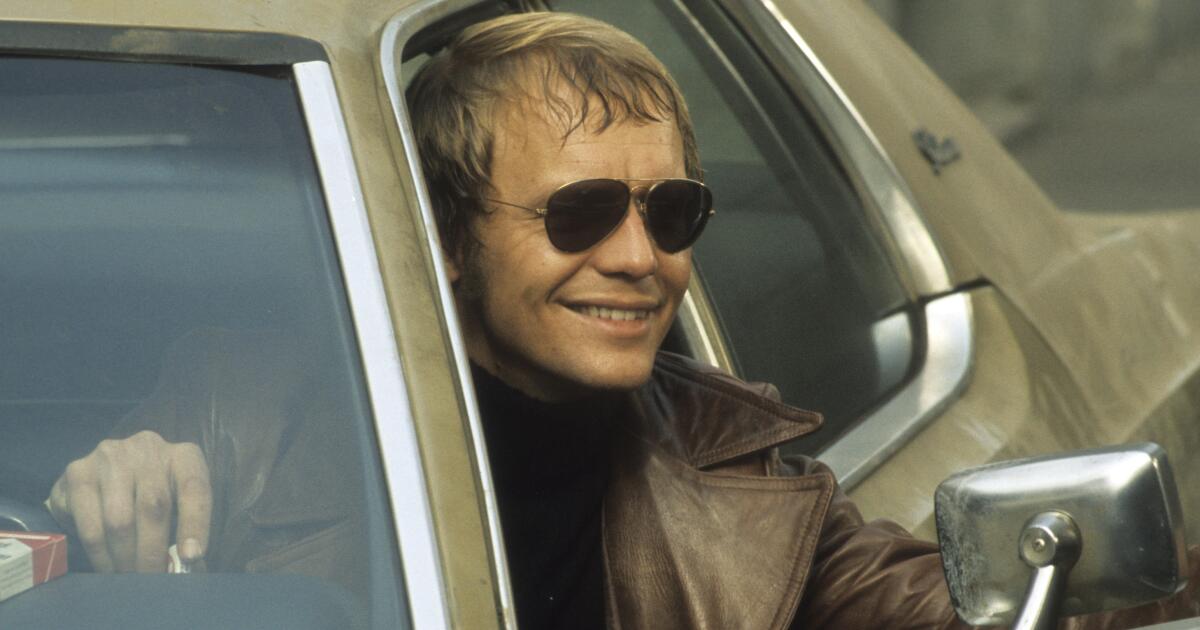
David Soul, the actor who brought the cool detective Ken Hutchinson to life in the popular 1970s TV series “Starsky & Hutch,” has died. He was 80.

In a Friday statement to The Times, the actor and director’s family confirmed that Soul died Thursday “after a valiant battle for life in the loving company of family.”

Additional details about Soul’s death, including a cause of death, were not immediately available.

“He shared many extraordinary gifts in the world as actor, singer, storyteller, creative artist and dear friend,” the statement said. “His smile, laughter and passion for life will be remembered by the many whose lives he has touched.”

David Soul, left, portrayed Ken Hutchinson and Paul Michael Glaser was David Starsky in the ABC crime drama “Starsky & Hutch.”

Advertisement

(ABC Photo Archives/Disney General Entertainment Con)

In addition to ABC’s “Starsky & Hutch,” in which Soul starred with Paul Michael Glaser, Soul was known for the television series “Here Come the Brides” and “The Yellow Rose.” He also starred in the films “Johnny Got His Gun,” “Magnum Force” and “Appointment With Death.”

This story is developing.

Advertisement

Entertainment

Argentine club queen Six Sex wants you to get free

Published

on

Argentine club queen Six Sex wants you to get free

In an era hallmarked by what experts call a “sex recession,” Six Sex is a symbol of liberation.

The Argentine baddie fashions herself as a baby-voiced, bikini-clad fembot, beamed in from the clubs of Buenos Aires — and has become known for cheeky, instructive celebrations of desire. Her songs are designed to galvanize like-minded club rats into Dionysian revelry, or, in the case of the song “How to Make Your Ass Bigger,” squats.

To a certain subset of the Latine underground, she represents a pure-hearted hypersexuality. Yet, for the artist behind the persona, Francisca Agustina Cuello, this wasn’t always the intention.

“I don’t know if it was because I still had to keep my innocence or what, but I didn’t envision the project that way,” she said, calling from a hotel room in Barcelona. “That response sort of came about from the people, towards me. So, I said OK, I’m making it my own.”

In doing so, Cuello has churned out six thumping EPs as Six Sex, a campy character that she describes as a “fable” — a mix of “fantasía y hedonismo.”

Advertisement

That dynamic is taken to extremes on her debut album, “Ultra”, released June 6. It’s a dark and propulsive journey through decades of electronic dance music, best described by its own opening words portending “ultra terrorific fantasy.” (The phrase conjures up images of grandeur, but really, it evokes that “Blades of Glory” quote: “no one knows what it means, but it’s provocative.”)

“I feel like nothing I say is all that serious,” she said about her lyrics. “It’s a thing about my personality to be silly and goof around.”

“Ultra” centers Cuello’s winking, suggestive sense of humor. “Not Your Mom” features a conversation with a garbled, omnipotent voice akin to the parents in Charlie Brown; “FUchi!” features schoolyard taunts about “low dickie energy;” the album ends with “No More Porn,” a playful yet powerful subversion of sexual expectations.

Advertisement

“At the same time, for me, that acts as a filter,” she added with a laugh. “Weeding out the people who get scandalized by it, and identifying the people who get it and say: ‘Yas, yo también quiero tener cuatro novios.’”

Earlier this year, Cuello took the stage at Don Quixote, performing in front of a sold-out crowd for her Los Angeles debut. The smell of sweat permeated the air as she ripped through several of her hits — including collaborations with Reysha Rami and German producer MCR-T. Every single one of her signature ponytail flips sent the room into hysterics. The audience screamed every word at the top of their lungs; it was the loudest, most raucous show I’d been to in years.

Cuello took a breather in the middle of her world tour to chat with De Los over Zoom about all things Six Sex: her new record, her writing style and how it feels to connect with fans spun into febrile intensity.

This interview has been condensed for clarity and was translated from Spanish to English.

Argentine artist Six Sex poses in the cover of her album 'Ultra.'

“[I’m] weeding out the people who get scandalized,” says Six Sex of her provocative music.

(Catalina Jacobo)

Advertisement

I was really taken by the “Ultra” album cover. You’re wearing a white bikini and in this “come to Jesus” pose. What was the goal?
[laughs] It was hard, because I wanted the cover to represent what the entire journey of the album meant to me. I was looking for something strong and heavy in visual terms, because with “Ultra”, this is the first time I’ve finished a long, heavy project and I see the start of something. It’s like something new was unlocked. I found a new way to convey feelings, and a new way to create as well. It’s not like I just finished, and it is what it is. Rather, it is the beginning of something bigger.

Is there an element of separation at all between the artistry and you as a person?
I think they’re pretty close. It’s as if Six Sex was sort of a fable, or like a hentai or comic [version of] my life. It’s also happened that things I wrote as a joke later became reality. But generally, I draw inspiration from things that actually happened to me.

Is it weird to put those intimate experiences on an album?
No, not for me. Because I’m not speaking so seriously, I don’t feel exposed. Even though my persona and my character are very close to one another, I don’t have to prove anything to anyone. I’m not trying to make you believe in something. The songs stop being about me as soon as someone else listens to them. There are certain things we can all see ourselves represented in, and I think my music aims for that, too.

I want to ask about your performance style. I saw you live in Los Angeles and was really taken by the energy exchange between yourself and the crowd. How do you approach live performance?
Nowadays, I’m in a balance between performance and being a human being that connects with people and can pause to look in the eyes of the audience to register how they feel. I like being in a showgirl role, and at the same time, knowing when to step out of it.

Advertisement

Sometimes I go up there after having a crappy day, thinking that I’m gonna screw it up. And when I get up there and connect with the people, everything flows in a perfect way.

Does the music transform when it’s performed live, versus on a record? A lot of your music seems designed to be played in the club.
I think it’s very personal. For me, I’m a bit autistic; sometimes when I’m at a show, I get different sensations. It really depends on the person. I like seeing people’s reactions live when I start playing these songs for the first time. People were super hyped. They were enjoying them and jumping around a lot. It feels really fresh.

You reference ‘90s club classics all over “Ultra,” including by U.K. band the Prodigy on “Bitch Up.” How did these sounds come into your life?
These sounds evoke a special kind of nostalgia for me. Even though I hadn’t been listening to them lately, they sounded like something I wanted to bring back to the table — songs my uncle used to listen to when I was really young. Like a CD [of] pirated songs that somehow ended up at my house, and at the time I was like, “Wow, what is this music?”

There’s an element of Six Sex that gives “fembot,” like a female, sexy robot. I’m curious if you feel that playing out in your work.
[laughs] I didn’t know about the fembot thing. I don’t use Twitter. I [keep] a bubble… against some things that I don’t know. But I’ve always liked the idea that people have that perception of me, to some extent.

Advertisement

How do you feel about the rise of AI as a musician, especially considering your persona adopts that perception?
I mean… I don’t have a formed opinion on the matter. I do think that, I don’t know, it’s all very relative. For one thing, I obviously feel like it strips away the human value, but at the same time, it’s also a tool for humans. So it’s kind of contradictory. I feel weird about it…. I don’t know.

Zooming out, I’ve noticed Argentina has been having a musical moment over the last few years between yourself, Ca7riel y Paco Amoroso, Juana Rozas… How do you feel Argentina being represented or even challenged in your music?
I feel that culturally, Argentina is a very rich country. However, I do feel like, over generations, a paradigm was broken, and new sounds have been created that don’t necessarily abandon the roots of our music, but were created out of counterculture.

That same kind of counterculture is what makes Argentina be in such turmoil. It’s also the context of our country. Economic, political, social. The key Argentinian figures we refer to nowadays are constantly changing. And that allows you to listen to a variety of genres from Argentina, from people doing different things, and at the same time raising the flag and saying: “Yo soy argentino.” And we love that.

Advertisement
Continue Reading

Movie Reviews

Millie Bobby Brown leads frothy sleuthing caper

Published

on

Millie Bobby Brown leads frothy sleuthing caper

A still from ‘Enola Holmes 3’
| Photo Credit: Netflix

Enola Holmes 3sees Philip Barantini (Adolescence) take over direction from Fleabag’s Harry Bradbeer while Jack Thorne (another Adolescence alum) continues as writer from the first two films. The supposed darker take is not very apparent in this tale featuring the consultant detective’s sister.

Based on Nancy Springer’s charming The Enola Holmes Mysteries, Enola Holmes 3 opens with a wedding in Malta. Enola (Millie Bobby Brown), the younger sister of Sherlock (Henry Cavill), and a detective in her own right, as we have seen from the earlier films, is getting married to sweet, idealistic Lord Tewkesbury (Louis Partridge).

Sherlock is in Malta for the wedding which he strongly disapproves, believing Enola will not be able to pursue her career as a detective once she marries and becomes Lady Tewkesbury. Enola has her own doubts about the marriage — not about Tewkesbury but about his world, the people in it and their expectations.

Enola Holmes 3 (English)

Director: Philip Barantini

Cast: Millie Bobby Brown, Louis Partridge, Himesh Patel, Sharon Duncan-Brewster, Henry Cavill, Helena Bonham Carter, Susan Wokoma

Advertisement

Runtime: 105 minutes

Storyline: As Enola prepares to marry Lord Tewkesbury in Malta, her brother goes missing and the game is afoot

When she finally gets into the carriage for her wedding, she realises she is being followed by a masked rider. After a thrilling chase involving the dropping of many bridal veils, the pursuer is revealed to be Dr Watson (Himesh Patel), Sherlock’s flatmate, friend and chronicler (not yet, though). The mask, the good doctor explains, is for allergies.

He was thundering after Enola because Sherlock has vanished, probably kidnapped, as he was working on another case. When Enola’s future mother-in-law, Lady Tewkesbury (Hattie Morahan) also goes missing, the wedding is forgotten as Enola races against time to solve the mystery.

A still from ‘Enola Holmes 3’

A still from ‘Enola Holmes 3’
| Photo Credit:
Netflix

The pieces of the puzzle include the Battle of Khost in Afghanistan, looted gold, the Maltese fight for independence in the person of Mikiel Mizzi (Joe Azzopardi) from the Partito Anti-Riformista, and the criminal mastermind Moriarty (Sharon Duncan-Brewster).

Advertisement

Enola’s mother, Eudoria (Helena Bonham Carter) and her friend Edith (Susan Wokoma) are skulking around giving Enola invisible support as Eudoria is in trouble with the law for her dynamite-forward ways.

Enola Holmes 3 zips by in a series of frantic action sequences, quips and callbacks. The storybook look is propped up by those amazing pop-ups. Darker themes arrive in lines such as Moriarty saying “There are few British names that are not tarnished with the pain of its empire.”

Brown has created an endearing heroine in her Enola, even if her habit of breaking the fourth wall, while definitely reduced, has gone way beyond twee to be outright annoying. Cavill’s Sherlock is brave and beautiful and just that little bit cross, while Carter’s Eudoria walks the line between gently eccentric and decidedly odd as she dispenses gems of wisdom including “the puzzle is always as devious as the setter.”

Fast, fun and eminently forgettable, this is popcorn entertainment at its most efficient.

 Enola Holmes 3 is currently streaming on Netflix

Advertisement
Continue Reading

Entertainment

When, unlike our upcoming 250th anniversary, a bicentennial mattered to orchestras

Published

on

When, unlike our upcoming 250th anniversary, a bicentennial mattered to orchestras

A century and a half ago, Richard Wagner was running out of cash as he was preparing to stage his four momentous nights of opera known as the “Ring Cycle” when he got a message from the Women’s Centennial Executive Committee in Philadelphia. It offered him a princely $5,000 (around $150,000 today) to write a triumphant 12-minute orchestral score to open the Centennial Exposition in Fairmont Park celebrating the 100th anniversary of the Declaration of Independence.

On May 10, 1876, Theodore Thomas, perhaps America’s most famous conductor at the time (he would go on to head the New York Philharmonic and help found the Chicago Symphony), led the premiere of Wagner’s “Grosse Festmarsch” with a 150-member orchestra, its brass and percussion so impressive that the addition of cannon fire Wagner suggested was not needed. The crowd was said to number well over 100,000. President Ulysses S. Grant attended and invited Emperor Dom Pedro II of Brazil to join him along with members of Congress and Supreme Court justices for what remains a unique Declaration of Independence spectacle and debacle.

The “Centennial March,” as it came to be known, turned out to be dreck. Even Wagner, who carelessly tossed it off in a couple of weeks, said the best thing about the score was the fee, which he had demanded to be paid in gold. But what sounds like something AI might come up with if asked to write a pompous march in the style of Wagner began the American obsession with celebrating the Declaration of Independence, the words and deeds of our presidents, our very democracy with the assist of the symphony orchestra and opera.

One hundred years later, the country was awash with federal, state, city and philanthropic funding for a music-happy bicentennial of exceptional ambition. “With millions available in hand and more money to come,” Time Magazine wrote in 1975, “the Bicentennial is the biggest bonanza for the American composer since Hollywood discovered the musical.”

Advertisement

And so it was. The centerpiece was the National Endowment for the Arts Bicentennial Orchestra Commissioning Project. That funded America’s six top orchestras to each commission a major work that all six would play. In addition, the NEA offered further support to 34 American orchestras for dozens more new scores.

Everyone got into the act. The New York State Council of the Arts alone sponsored 68 commissions. Orchestras everywhere came up with striking projects. The Pittsburgh Symphony, for instance, premiered L.A. composer John LaMontaine’s opera/oratorio “Be Glad Then America” that featured the folk singer Odetta as the Muse of Liberty and enlisted ROTC students to reenact the Battle of Lexington overhead the orchestra.

The National Symphony commissioned symphonies from Roy Harris and William Schuman as well as Alan Hovhaness’ “Ode to Freedom,” a lovely short violin concerto written for Yehudi Menuhin. The list goes on.

We are obviously not seeing or hearing much like that in a semiquincentennial year when our government’s green gets the most attention for promoting algae. Even so, the NEA does indeed have an “America250” project (though it does little to publicize it, let alone fund it on the scale of 50 years ago) that is promoting more than 50 artworks. In music, they range from the Montgomery Symphony’s premiere in February of Nkeiru Okoye’s oratorio “A Time for Jubilee,” commemorating the 60th anniversary of the 1965 Selma-to-Montgomery civil rights marches, to a New West Symphony premiere last weekend of Michael Christie’s “A Ronald Reagan Portrait” at the Ronald Reagan Presidential Library and Museum.

The major East Coast orchestras are paying some attention. The New York Philharmonic premiered David Lang’s luminous “the wealth of nations.” The National Symphony got the most attention in its attempt to commission Philip Glass’ “Lincoln” Symphony, which the composer pulled in opposition to an un-Lincoln-like presidential takeover of the Kennedy Center. Glass then gave the rights to the Boston Symphony for a July 5 first performance.

Advertisement

The National Symphony did pull off the premiere of Peter Boyer’s “American Mosaic,” and it was to the Altadena composer that Philadelphia, this time around, entrusted its Declaration of Independence commemoration. Boyer’s multimedia oratorio, “A Hundred Years On,” was given its premiere by the Philadelphia Orchestra last month at the orchestra’s outdoor summer home, the Mann Center.

Upcoming will be a few repeat performances. Next month, “the wealth of nations” lands at the Aspen Festival, as does the “Lincoln” Symphony at the Cabrillo festival (with an L.A. Phil performance next season). “American Mosaic,” of which the Pacific Symphony was a co-commissioner, had its West Coast premiere in Costa Mesa last month and was scheduled to be performed at the Hollywood Bowl by the National Symphony in August, but that has now been replaced by Dvorak’s commonplace “New World Symphony.”

None of this comes close to comparing with the attempted civic zest of 1976. The NEA made it a matter of admirable policy that commissioned new works get multiple performances. Yet despite several of these being substantial works by some of our most noted and venturesome composers, few bicentennial commissions have survived. Even odder is that many of the composers did not necessarily feel compelled to explore nationalist themes. For them, American liberty implied freedom to simply write the kind of music they cared about.

The six works for the six orchestras were David del Tredici’s irresistibly over-the-top “Final Alice” (Chicago Symphony), Elliott Carter’s arrestingly impenetrable-on-first-hearing “Symphony for Three Orchestras” (New York Philharmonic), John Cage’s irrepressibly come-what-may “Renga” (Boston Symphony), Morton Subotnick’s brilliant electronic-landscaped “Before the Butterfly” (Los Angeles Philharmonic), Leslie Bassett’s introspective “Echoes From an Invisible World” and Jacob Druckman’s abstract-modernist “Chiaroscuro” (Cleveland Orchestra).

No orchestra has brought back its commission over the last half century, and only Chicago and New York recorded their commissions. No recording at all exists of L.A.’s, although Subotnick’s inventive uses of electronic music with a standard symphony orchestra went on to have considerable influence. None of these works, it appears, are likely to be heard anywhere in America this year, with one sort-of exception.

Advertisement

An explanation for that may be that, while 1976 was a fraught time for America — the country was recovering from the Vietnam War, we had a president and vice president who were not elected, there was runaway inflation, etc. — the music of the time represented optimism. Many works around the country explored new electronic music technology. It was the year Glass wrote “Einstein on the Beach” and Steve Reich created “Music for 18 Musicians” — the composers’ first masterpieces — demonstrating that Minimalism mattered.

That sense of liberation is clearly behind Del Tredici’s “Final Alice,” an hourlong romp around the ending of “Alice in Wonderland” for superhuman soprano and orchestra. It is so obsessively and addictively wild that its tamest moments sound like Richard Strauss on LSD. It does have a cult following although performances are few and far between.

Cage’s score is an abstract work based on the Japanese form of collective poetry known as renga, in which each poet attempts to write a line that is as distant as possible in meaning from the preceding line. Cage translates that to an independence of instrumental parts. While “Renga” can be performed alone Cage further suggests it be played along with an actual bicentennial work he wrote separately, “Apartment House 1776.” That is what Boston and the other orchestras did.

Indeed, “Apartment House” got the lion’s share of bicentennial attention and ridicule. When Zubin Mehta conducted it at the Dorothy Chandler Pavilion, the L.A. Philharmonic did not take it seriously and many walked out on it.

The work features four vocal soloists who represent Native American, Sephardic, African American and Protestant religious traditions, along with instrumental music based on early American hymn tunes. Everything is cut up and put together through chance operations into what Cage called a Musicircus. Under the circumstances “Renga” was hardly noticed, although two decades later, “Renga” came into its own when Michael Tilson Thomas famously conducted it with the San Francisco Symphony and the surviving members of the Grateful Dead.

Advertisement

Still the idea that “Apartment House” need not stand alone, that our traditions and those of long-ago Japan belong together, represented for Cage a future for America. We need not act like a superpower, he noted, but merely be one nation, no more and no less, among many.

We are obviously not that nation. A half-century later, “Apartment House” tends to exist mainly in its own right. An excellent London new music ensemble calls itself Apartment House. Detroit Opera recently staged it with a 2026 need to give the singers the opportunity to select their own music rather than reflect on our heritage. If American music in 1976 represented a collective, inquisitive, inventive American spirit of discovery, the semiquincentennial in the age of social media has become more about the individual identity.

As a sign of how we think about ourselves, the Los Angeles Philharmonic begins its Hollywood Bowl season five days after the 4th with a program of American music conducted by Thomas Wilkins that opens with Valery Coleman’s “Fanfare for Uncommon Times,” which was written five years ago.

But for now, the work that stands out is Lang’s “the wealth of nations.” It balances harsh thoughts of how the promise of capitalism has failed society and how racism remains with music of stunning beauty and glory, to gently but forcefully show us, in our age of American dissatisfaction, the direction in which we might go to make us proud again. It needs many performances.

Advertisement
Continue Reading
Advertisement

Trending