- Pentagon says it received ‘serious allegations of misconduct’
- Trump had accused Kelly and other Democrats of seditious behavior
- Trump administration has purged top generals
World
Pentagon threatens to prosecute Senator Mark Kelly by recalling him to Navy service


WASHINGTON, Nov 24 (Reuters) – The Pentagon on Monday threatened to recall U.S. Senator Mark Kelly, a retired Navy captain, to active duty status in order to prosecute him after what it described as seditious behavior by the former astronaut and decorated veteran.
Kelly, who denies any wrongdoing and who said in a statement he would not be intimidated, joined five other Democrats in Congress with backgrounds in the U.S. military and intelligence community to urge U.S. troops to refuse any illegal orders.
Sign up here.
Kelly’s November 18 video message came amid heightened concerns among Democrats, echoed privately by some U.S. military officials, that the Trump administration is violating the law by ordering the U.S. military to kill suspected drug traffickers in strikes on their vessels in Latin American waters.
The Pentagon says those strikes are justified because the drug smugglers are considered terrorists.
The Pentagon statement said it was reviewing “serious allegations of misconduct” against Kelly. While it did not say what charges Kelly could face if it took such an extraordinary step, U.S. Defense Secretary Pete Hegseth posted remarks on X accusing Kelly and the other lawmakers of sedition.
“The video made by the ‘Seditious Six’ was despicable, reckless, and false,” Defense Secretary Pete Hegseth said on X.
“Encouraging our warriors to ignore the orders of their Commanders undermines every aspect of ‘good order and discipline.’”
President Donald Trump has also accused Kelly and the other Democrats of sedition, saying in a social media post that the crime was punishable by death.
Under the Uniform Code of Military Justice, sedition and mutiny are among the most serious offenses and can be punishable by death.
VOWS NOT TO BE SILENCED
Kelly, in a statement, said he learned of the threat from Hegseth’s social media post. He detailed his public service prior to joining the Senate representing Arizona, including 39 combat missions in Operation Desert Storm and four space shuttle flights at NASA.
“If this is meant to intimidate me and other members of Congress from doing our jobs and holding this administration accountable, it won’t work,” Kelly said.
“I’ve given too much to this country to be silenced by bullies who care more about their own power than protecting the Constitution.”
The threat to prosecute Kelly follows a purge at the Pentagon of senior members of the U.S. military, including the chairman of the Joint Chiefs of Staff, the head of the Navy and the director of the National Security Agency.
Item 1 of 4 U.S. Senator Mark Kelly (D-AZ) looks on as U.S. Representative Adelita Grijalva (D-AZ) (not pictured) holds a press conference calling for the release of the Epstein files, on Capitol Hill in Washington, D.C., U.S., November 18, 2025. REUTERS/Annabelle Gordon/File Photo
[1/4]U.S. Senator Mark Kelly (D-AZ) looks on as U.S. Representative Adelita Grijalva (D-AZ) (not pictured) holds a press conference calling for the release of the Epstein files, on Capitol Hill in Washington, D.C., U.S., November 18, 2025. REUTERS/Annabelle Gordon/File Photo Purchase Licensing Rights
The decision to recall and potentially prosecute Kelly could also be seen as a message to those recently dismissed officials, who have stayed silent following their removals.
DOES KELLY HAVE A STRONG LEGAL CASE?
Rachel VanLandingham, a former Air Force lawyer now at Southwestern Law School, said she had never seen sitting lawmakers called back to the military involuntarily, and that Kelly would have a strong legal case to get a preliminary injunction since there was no evidence of probable cause.
“He has strong legal standing to say ‘Absolutely not. I’m not going to do this’,” VanLandingham said.
Hegseth’s remarks also could undermine any Pentagon effort to prosecute Kelly since they amounted to a clear case of undue command influence and could be used as evidence that Kelly would not be able to get a fair trial, she said.
The prosecution of Kelly would raise questions about free speech rights and the separation of powers under the U.S. Constitution.
But Brenner Fissell, a professor at Villanova University School of Law, said Kelly could be facing some legal risk.
Kelly lacks the protections of Speech and Debate Clause immunity, Fissell said, which protect lawmakers for statements they make on the House or Senate floor.
“If they’re serious and they’re planning on charging him with mutiny, sedition, it seems like they would definitely try to book him in a pre-trial detention if they believe it’s that serious of an offense,” Fissell, a former defense counsel at Guantanamo Bay Military Commissions, added.
It is also the latest example of Trump’s administration seeking punishment of those Trump sees as political opponents.
Since returning to the presidency in January, Trump has occasionally called for imprisoning adversaries and his Justice Department has targeted critics such as former federal officials John Bolton and James Comey.
A federal judge dismissed criminal charges against Comey on Monday.
The Pentagon cautioned that all retired service members could be subject to recall.
“All servicemembers are reminded that they have a legal obligation under the UCMJ (Uniform Code of Military Justice) to obey lawful orders and that orders are presumed to be lawful. A servicemember’s personal philosophy does not justify or excuse the disobedience of an otherwise lawful order,” the Pentagon said.
Reporting by Phil Stewart and Idrees Ali; additional reporting by Tom Hals, Patricia Zengerle; Editing by Chizu Nomiyama, Alistair Bell and Bill Berkrot
Our Standards: The Thomson Reuters Trust Principles.




Former Olympic canoeist David Hearn denies damaging US President Donald Trump’s Washington, DC reflecting pool renovation.
Published On 9 Jul 2026
A former US Olympian has pleaded not guilty to vandalising the newly renovated Lincoln Memorial Reflecting Pool, in a case that has drawn national attention amid accusations that the administration of US President Donald Trump is trying to shift blame for a troubled renovation.
David “Davey” Hearn, a 67-year-old three-time Olympic canoe racer, entered his plea in federal court on Thursday after prosecutors accused him of “maliciously” damaging the “American flag blue” lining installed at the bottom of the reflecting pool at Trump’s request ahead of celebrations taking place at Washington’s National Mall for the 250th anniversary of the United States’ independence on July 4.
list of 4 itemsend of listRecommended Stories
Federal prosecutors allege Hearn pulled at the liner on June 19, causing more than $1,000 in damage. He has been charged with destruction of government property, an offence that carries a maximum prison sentence of 10 years.
Hearn denied the allegations. He admitted he stopped at the pool during a bike ride, reached inside and touched a section of lining that was already peeling away, but that he did not remove or damage it. He told The Associated Press he let go when a park employee told him to stop.
Hearn’s lawyers argue the prosecution is an attempt by the Trump administration to deflect attention from what they describe as a botched renovation project.
“This indictment reflects the administration’s effort to shift blame for their own failures,” they said in a statement. “The justice system exists to determine facts, not to provide political cover.”
The 620-metre (2,030-foot) reflecting pool reopened in June after Trump ordered the new liner to be installed across the bottom. He said he was compelled to go ahead with the $14.7m renovation after a friend visiting from Germany called the pool dark and disgusting.
But within days, algae began to spread across the surface, the water turned chartreuse green, and sections of the liner began peeling away.
Experts have explained that the dark new coat of paint at the bottom of the pool would elevate the temperature and allow algae to grow, and that algae blooms in water are common at this time of year, especially in shallow, stagnant water like that of the pool.
Trump blamed the issues on vandals, claiming without evidence that “corrosive and destructive chemicals” were poured into the pool and that vandals “took some form of knife or blade” and put a long “gash into the beautiful facade”, although no one has been charged over those alleged acts.
The US president warned that anyone who allegedly damaged the pool could face long prison terms. “Please remember that there is a 10 year prison sentence for the destruction, or even the attempted destruction, of such things — Which will be fully enforced!” he wrote on Truth Social.
Last week, US Attorney for the District of Columbia Jeanine Pirro announced the indictment against Hearn, accusing him of intentionally damaging the liner.
The US Department of the Interior has said that at least six people were arrested on suspicion of vandalising the pool in the weeks after it reopened. National Guard troops and US Park Police were deployed to protect the site, which was fenced off during July 4 celebrations.
Thursday’s hearing drew a packed courtroom, with dozens of supporters waiting outside after Hearn entered his plea.
The reflecting pool’s problems have continued, with Trump acknowledging it will need to be drained again so the damaged liner can be repaired.

ANKARA, TURKEY, July 8 (Reuters) – U.S. President Donald Trump on Wednesday said he thought he would remove Syria from the United States’ list of designated state sponsor of terrorism. “I think I will,” Trump told reporters in response to a question ahead of a meeting with Syrian …

Trump threatens more strikes on Iran at NATO summit
Fox News senior strategic analyst retired Gen. Jack Keane analyzes the latest U.S. strikes on Iran, the Strait of Hormuz’s strategic importance and breaks down Ukraine’s request for more aid on ‘America’s Newsroom.’
NEWYou can now listen to Fox News articles!
As President Donald Trump voiced growing frustration Wednesday with Iranian negotiators, accusing them of lying and cheating, the latest escalation has exposed an even more fundamental problem for Washington: whether the officials at the negotiating table have the power to deliver an agreement — or whether anyone in Tehran does.
“I don’t know if we’re going to have a deal. We may just do it without a deal,” Trump said at the NATO summit in Ankara. “These people, they lie and they cheat.”
But Trump’s frustration with Iran’s negotiators is only part of the problem. Since the death of Ayatollah Ali Khamenei, it has become increasingly unclear who in Tehran has the authority to make — and enforce — an agreement.
TRUMP SAYS IRAN CEASEFIRE IS ‘OVER’ AFTER IRANIAN ATTACKS TRIGGER MASSIVE US RESPONSE
Tehran has deployed a new front on social media including an influence campaign to sway Americans and undermine President Donald Trump’s push for a nuclear deal. (Hamed Malekpour / Middle East Images / AFP via Getty Images)
Mojtaba Khamenei succeeded his father as supreme leader after the elder Khamenei was killed in the opening U.S.-Israeli attacks on Feb. 28. But Mojtaba has not appeared publicly since the attack, and U.S. assessments cited by Reuters have described authority as dispersed among senior Revolutionary Guard commanders and powerful civilian officials.
Parliament Speaker Mohammad Bagher Ghalibaf, a former IRGC commander who led Iran’s negotiating delegation, has emerged as one of the country’s most powerful surviving political figures.
Banafsheh Zand, an Iranian-American journalist and editor of the Iran So Far Away Substack, said power inside the Islamic Republic has fractured since the death of Ayatollah Ali Khamenei, leaving the Islamic Revolutionary Guard Corps as the country’s dominant force.
“The person who is negotiating with the U.S. is not necessarily someone who is endorsed by the others,” Zand told Fox News Digital.
She described Ghalibaf as one power center competing with figures including IRGC commander-in-chief Ahmad Vahidi, Quds Force commander Esmail Qaani and former Foreign Minister Mohammad Javad Zarif.
Vahidi controls the IRGC’s overall military structure, while Qaani oversees its external operations and relationships with Iran-aligned armed groups across the region. Zarif, by contrast, remains closely identified with the more accommodationist political camp that previously championed negotiations and sanctions relief.
“The hardliners, in terms of their political presence, have also been pushed aside,” Zand said. “So really, it’s the IRGC. And within the IRGC, whoever signs the deal is not necessarily signing on behalf of everybody else. They’re signing on behalf of themselves.”
Her assessment reflects a central problem facing Washington: Iran’s negotiators, political institutions and military commanders may not share the same interpretation of what was agreed — or the same willingness to implement it.
US CLAWS BACK KEY CONCESSION TO IRAN AFTER FRESH ATTACKS ON COMMERCIAL SHIPS IN STRAIT OF HORMUZ
Iran’s Parliament Speaker Mohammad Bagher Qalibaf and Foreign Minister Abbas Araghchi were greeted by Pakistan Foreign Minister Ishaq Dar and Army Chief Field Marshal Gen. Asim Munir upon their arrival at Nur Khan airbase in Rawalpindi, Pakistan, on April 11, 2026. (Pakistan Ministry of Foreign Affairs/AP)
Yet Trump’s declaration does not necessarily mean diplomacy has been permanently abandoned.
Behnam Ben Taleblu, senior director of the Iran program at the Foundation for Defense of Democracies, told Fox News Digital that the clearest evidence would be the restoration of the U.S. blockade, the introduction of additional military forces or a new round of major economic sanctions.
Otherwise, he said, Trump may continue operating in the “gray zone” between negotiations and open war while keeping his options available.
The more difficult question is why Tehran would jeopardize sanctions relief and risk overwhelming American firepower when its military has already been severely degraded.
Ben Taleblu said Iran’s leaders appear to believe escalation is essential to the survival of the Islamic Republic.
“This is a regime that is weaker, but lethal, and less capable, but more confident,” he said. Iran’s leadership believes its adversaries have vulnerable economic and military interests throughout the Gulf, he added, while the regime itself is more willing to accept destruction.
People hold placards with an image of Iran’s new supreme leader Mojtaba Khamenei with late Iranian Supreme Leader Ayatollah Ali Khamenei, during a gathering to support Mojtaba Khamenei, amid the U.S.-Israeli conflict with Iran, in Tehran, Iran, March 9, 2026. (Majid Asgaripour/WANA (West Asia News Agency) Via Reuters)
“Their survival and their military success and their political success runs through more, not less, escalation,” he said.
Lisa Daftari, foreign policy analyst and the editor-in-chief of The Foreign Desk, agrees the escalation is deliberate, aimed at turning regional instability into leverage.
“By targeting commercial shipping and Arab states, the regime is signaling that it can hold global energy flows and America’s regional partners hostage to extract leverage, distract from its domestic crisis, and test U.S. red lines,” Daftari told Fox News Digital.
She said Tehran is betting that Washington and its Arab partners will be unwilling to sustain another war and will ultimately back down first.
“The regime’s core weapon is time,” Daftari said. “By escalating in the Persian Gulf and attacking ships and Arab states, they are creating rolling crises that raise the cost of confronting them while they consolidate power at home.”
Daftari argued that the strategy reflects the Islamic Republic’s longstanding character rather than a temporary response to pressure.
TRUMP ENTERS FINAL NATO SUMMIT DAY AS UKRAINE, DEFENSE SPENDING TAKE CENTER STAGE
Firefighters work in the aftermath of Iranian drone attacks, at a location given as Bahrain (Reuters)
“This regime was never designed to be reformed or softened,” she said. “What they are showing us now is exactly who they intend to remain: a hardline, revolutionary regime determined to stay in power.”
But determining how that strategy is translated into action is more complicated. Authority in Tehran appears divided, raising questions about who is directing the escalation and whether the officials negotiating with Washington can commit the broader security establishment.
That division is already visible in the dispute over the Strait of Hormuz.
A Middle Eastern source familiar with the issue told Fox News Digital that Tehran and Washington are operating from fundamentally different readings of Clause five of the memorandum. The publicly released text says Iran will use its “best efforts” to arrange safe commercial passage through the strait without charge for 60 days, while removing military and technical obstacles and conducting demining operations. It does not expressly state that foreign vessels must obtain Iran’s approval or use routes designated by Tehran.
According to the source, Iran interprets that language as giving it responsibility — and therefore authority — to coordinate shipping and determine the routes vessels use during the interim period. Washington’s interpretation is that Iran agreed to lift its maritime blockade and fully reopen the international waterway.
When the two sides have different interpretations of a single page, how do they intend to write a treaty, the source said.
Iran views control over passage through the Strait of Hormuz as one of its last major sources of leverage over the United States, Gulf governments and the global economy, the source said, “That is the heart of the matter.”
CLICK HERE TO DOWNLOAD THE FOX NEWS APP
The truck carrying the coffins of the slain Iranian Supreme Leader Ayatollah Ali Khamenei and members of his family makes its way through mourners during the funeral procession toward Azadi Tower in Tehran, Iran, on Monday, July 6, 2026. (Vahid Salemi/AP)
Taken together, the experts’ assessments suggest Tehran is unlikely to face a simple choice between surrendering to Trump’s pressure and returning to negotiations. Ben Taleblu said the regime believes its survival depends on “more, not less, escalation,” while Daftari said it is deliberately “playing out the clock” by creating repeated regional crises. That raises the prospect that, even if Iranian officials return to the table, the IRGC could continue targeting commercial shipping, U.S. interests and American allies to preserve its leverage and strengthen its position inside Iran.
-
 Science3 minutes ago
‘I’d rather my house burn down than get cancer’: Herbicide use upends California’s fight to save forests
-
 Sports8 minutes ago
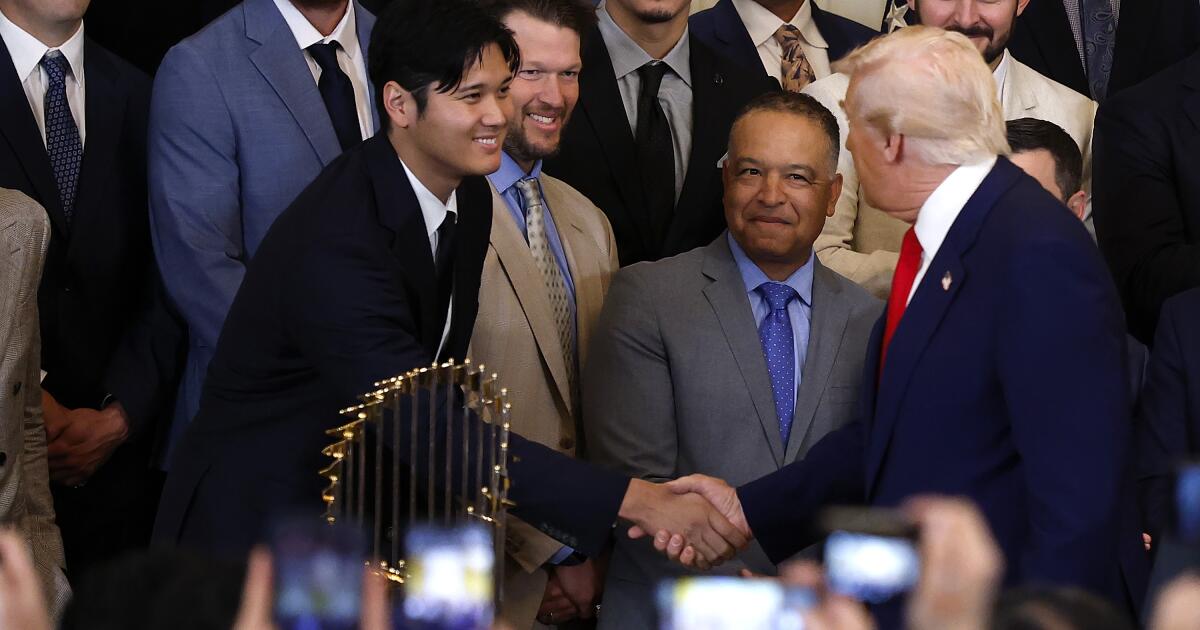
Dodgers scheduled to visit White House in late July to celebrate 2025 World Series win
-

 World18 minutes ago
Former US Olympian pleads not guilty in DC reflecting pool vandalism case
-
 News45 minutes ago
Former Olympian pleads not guilty in reflecting pool vandalism charges
-

 Los Angeles, Ca2 hours ago
Heat advisory, beach hazards in effect as Southern California sizzles
-

 Detroit, MI2 hours ago
Teen on moped hit by car after cruising through stop sign in Detroit
-

 San Francisco, CA3 hours ago
Flight of fancy: San Francisco moves to build private luxury airport terminal
-

 Dallas, TX3 hours ago
Dallas’ digital creator economy is booming. Burnout is too.

