World
France clamps down on Muslim extremists by halting appointment of foreign clerics


A newly enacted law in France aims to reform how Islam is viewed by society.
The law, which bans foreign imams from operating in the country, is an attempt by the government to combat religious extremism in a highly secularized nation.
Foreign imams already in the country will either be sent back to their country of origin or take on new, lower-level positions at local mosques.
The government will appoint religious leaders and others to a body called the Forum of Islam in France, where these officials will help guide France’s Muslim communities and root out any potential elements of radicalization.
FRANCE STRUGGLES WITH SYSTEMIC RACISM AND NEW SECURITY LAW AS PROTESTS ROCK COUNTRY
Students attend a Koran study class at the European Institute of Social Sciences in Saint-Leger-de-Fougeret, central France, Oct. 28, 2020 (Philippe Desmazes/AFP via Getty Images)
President Emmanuel Macron first proposed the initiative in a February 2020 speech that emphasized France’s role in upholding Republican values and warned those values could be undermined by religious extremists. Notably, Macron called out the repressive treatment of women by Islamic extremists, which is antithetical to France’s Republican values of equality.
EU LEADER INSISTS HISTORIC MIGRANT DEAL AIMED AT CURBING FLOW OF ASYLUM SEEKERS ‘DOES NOT COPY THE RIGHT’
Macron’s new initiative ends a program, created in 1977, that allowed several Muslim majority countries to send imams to France for cultural and language courses that are not subjected to French government oversight.
Macron contends Imams who are funded by foreign governments may promote what Macron has called “Islamic separatism,” or the idea that France’s Muslim community wants to replace French law and customs with its own religious laws. Critics argue the body, full of political appointees, will not truly be representative of France’s Muslim population.
Muslims gather in a room in Bordeaux for Eid al-Fitr prayers June 25, 2017. (Mehdi Fedouach/AFP via Getty Images)
“Some worry about how representative this body is of the French Muslim community, and some worry that this is a strategy for the French to control French Muslims,” Elizabeth Carter, an assistant professor of political science at the University of New Hampshire, told Fox News Digital.
“A more cynical perspective would argue that this was Macron’s response to the growing popularity of the far right and an attempt for him to broaden his party’s appeal to far-right voters,” Carter said.
Supporters claim the initiative will help better integrate France’s Muslim community into society and prevent discrimination.
French President Emmanuel Macron (Christian Liewig/ Corbis/Getty Images)
France has struggled with Islamist terrorism in the past and has been a frequent target of terrorist groups. In 2015, French and Belgian nationals with ties to ISIS launched a massive and coordinated terrorist attack in Paris that killed 130 people and wounded nearly 500 throughout the city.
That same year, armed gunmen targeted the office of satirical magazine Charlie Hebdo, killing 12 people, with al Qaeda in the Arabian Peninsula claiming responsibility for the attack. The following year, an ISIS sympathizer drove a truck into a crowd of spectators watching fireworks on Bastille Day in Nice, killing 86 people. Fançois Hollande, French president at the time, ordered retaliatory air strikes against ISIS targets in Iraq and Syria.
Marine Le Pen, president of the French far-right National Rally Party, smiles to the crowd during a meeting in Paris to launch the RN’s campaign for the European elections of May 2019. (Chesnot/Getty Images)
FRANCE LOOKING TO DEPORT IMMIGRANTS WITH EXTREMIST TIES AFTER TEACHER KILLED BY MAN SHOUTING ‘ALLAHU AKBAR’
The attacks, and France’s subsequent response in the Middle East, led to a steady rise in anti-Muslim sentiment throughout France. An estimated 1,910 French citizens would go on and travel to Iraq and Syria to fight for ISIS.
Riot police stand near a burning car in the La Meinau neighborhood of Strasbourg, eastern France, June 30, 2023. (AP Photo/Jean-Francois Badias)
Much like the United States, illegal immigration has become a hot-button issue for French voters. As a secular country, it has struggled with integrating its Muslim population, leaving many feeling marginalized and unrecognized.
As recently as August 2023, France banned traditional Islamic garb from public schools, which many considered a policy to suppress Muslim identity. France passed the Upholding Republican Values law in 2021, which gave the government broad powers to monitor and dissolve religious organizations that promote values that run counter to French Republican values.
Controversially, the law allowed authorities to increase surveillance on mosques and Muslim associations, according to Human Rights Watch.
Muslims represent 10% of the population in metropolitan France, according to the National Institute of Statistics and Economic Studies, and comprise the largest population of Muslims in Western Europe. French public policy focuses on promoting French national identity as a means of integrating its minority populations.
Many times, minority groups have complained that it stifles their nationalities and breeds resentment against their communities.


George Cottrell provided funds for Reform UK leader’s security, drivers, staff and accommodation, Sunday Times reports.
Published On 5 Jul 2026
Nigel Farage received financial benefits from a convicted fraudster in the year before he was elected to parliament, and potentially breached parliamentary rules by failing to declare them, a UK newspaper has reported.
The Reform UK party leader did not declare benefits that included accepting security, drivers, staff and accommodation paid for by George Cottrell, according to the Sunday Times investigation.
list of 3 itemsend of listRecommended Stories
Cottrell, 32, was jailed in the United States in 2017 for his role in a money laundering conspiracy.
The newspaper said Cottrell recruited and paid three staff to work on Farage’s social media before the general election, and has continued to allow him to use a five-storey Georgian townhouse he rented near Buckingham Palace.
A spokesman for Farage said the story was “baseless and contrived”.
“Contrary to the story’s tone, no parliamentary rules have been broken,” he said, as cited by the Reuters news agency.
Josh Babarinde, an MP for Britain’s Liberal Democrats party, wrote to the Parliamentary Commissioner for Standards on Sunday, calling for an investigation into the new allegations.
“Given the value and nature of the support described, there is a serious question as to whether Mr. Farage met his obligations under the Code of Conduct for MPs,” he said in a letter he made public on X. “This is not an isolated concern.”
At the time the support began, Farage was Reform’s honorary president and active as a national political figure.
The MPs’ code of conduct requires new members to declare any benefit worth more than 300 pounds ($400) received in the 12 months before their election if it is “in any way” related to their political activities. If there is doubt about the donor’s motives, it should be declared.
On his election in 2024, Reform UK leader Nigel Farage declared only one benefit from George Cottrell, worth about 9,200 pounds ($12,300), for travel to a conservative conference in Belgium.
The Sunday Times said Cottrell confirmed through lawyers that he had hired staff in Farage’s private office and paid them by bank transfer. The “last payment” for private security came between January and March 2024.
Cottrell pleaded guilty to wire fraud in 2017 after offering to launder money for US federal agents posing as drug dealers. He spent eight months in prison and is seeking a pardon from US President Donald Trump.
Farage is already under investigation by the parliamentary standards commissioner for accepting five million pounds ($6.7m) from cryptocurrency billionaire Christopher Harborne.
He said he accepted the gift to fund his security.

MOUNT VERNON, Va. (AP) — The people who were about to become United States citizens sat in folding chairs on George Washington’s lawn at Mount Vernon on Saturday, 250 years after the Declaration of Independence.
The sun beat down and the well-dressed crowd was a flutter of paddle fans stamped with American flags. Their families clung to the shade of the trees on either side, where one woman had two American flags stuck through her ponytail.
“Well, good morning, everybody,” said Anne Neal Petri, the regent of the Mount Vernon Ladies’ Association.
“Good morning!” an excited crowd returned.
“And Happy Birthday, United States of America!” exclaimed Petri.
There were 150 people from 50 globe-spanning countries sitting in front of the small stage as they prepared to be sworn in as U.S. citizens on the July Fourth holiday and America’s 250th birthday. Among them was U.S. Marine Sgt. Diakaria Sangare from Guinea, who attended in his pressed Dress Blue uniform with three medals pinned to his left breast.
Sangare had served two deployments, and, like all assembled, had gone through the long citizenship process: The test, interviews, green cards and biometrics. Others in the crowd, it was said, came from countries bathed in violence. Some fled persecution.
After a speech about Washington, the crowd was asked to rise for the national anthem.
They did. Their hats came off and their hands covered their hearts. The paddle fans calmed.
The singer belted the words: “And the rocket’s red glare, the bombs bursting in air, gave proof through the night that our flag was still there” — as Sangare held his right hand in a rigid salute, his face sober.
As the song concluded, the soon-to-be citizens clapped and returned to their seats, while another speaker asked them to stand and remain standing when their country was called.
“Albania.”
A woman in the front row with long black hair rose with a broad grin, a small U.S. flag in her hand.
“Bangladesh.”
A man in a black shirt stood. The Albanian woman, looking back, beamed at him.
It went on for 50 countries, through China and El Salvador and Iraq and Mongolia, as people stood, sometimes smiling, sometimes sedate.
At “Morocco,” a man in the back thrusts his fists in the air in support. A young boy looked up at him and then did the same, a little flag in his fist.
Then the crowd, with hands raised, recited an Oath of Allegiance, not so different from the oath Washington signed in 1778.
“Congratulations,” they were told. “You just became U.S. citizens.”
There was applause and laughter, then the Pledge of Allegiance. Sangare, his hand now over his heart, closed his eyes for a moment.
Nearby stood a tulip poplar tree, planted at Washington’s direction 250 years ago, that had lived through America’s history.
The next speaker, historian Douglas Bradburn, pointed it out in his speech before the day’s special guest.
“All the stories that are part of you, now become American stories,” said Bradburn. “When people ask me what are American people like, I now can talk about you, and your stories.”
“The second side of that is that, now, all America’s stories, and our history, are your stories. The father of your country is George Washington.”
The first president, it turned out, was the next speaker.
As he was introduced, the re-enactor stood by a massive draped American flag, a sword scabbard on his hip. Then he donned the stage, doffed his cap to the audience, and began to speak.
“Today the name of ‘American’ belongs to you every bit as much as it does to me,” he said. He spoke to their arduous journeys to this point and their histories, now merged with America.
“So, my fellow Americans, to you, I say simply: ‘Welcome home’.”
Afterward, Sangare, the U.S. Marine, posed for a portrait, hands clasped in front of him, holding the American flag paddle fan, his Marine cap slightly askew.
“I just became a United States citizen,” he said, his emotions pushing out in an earnest smile.
____ Bedayn reported from Austin, Texas.

NEWYou can now listen to Fox News articles!
Tens of thousands of far-left protesters flooded the streets and clashed with police in the Germany city of Erfurt on Saturday as they protested the conservative Alternative for Germany (AfD) party.
Videos showed police beating back agitators with batons and deploying anti-riot ordnance as the demonstrators chanted against the country’s conservative Alternative for Germany (AfD) party in a massive political rally.
Police said over 30,000 people attended the demonstrations, according to the Associated Press (AP), and people could be seen carrying signs reading “Stop AfD Nazis” and “For Diversity, Against Nazis.”
‘YOU’RE DESTROYING YOUR COUNTRIES’: IS EUROPE FINALLY HEEDING TRUMP’S WARNING ON ILLEGAL IMMIGRATION?
Despite the tense clashes caught on video, police told news outlets the demonstrations have been “mostly peaceful,” and claimed they’ve recorded approximately 100 law violations, mostly due to graffiti.
The standoff in the city of Erfurt, Thuringia state, comes as the opposition Alternative for Germany party is soaring in national opinion polls ahead of all other parties. (RALF HIRSCHBERGER / AFP via Getty Images)
The protests coincided with AfD’s party conference and leadership elections during which the party, the second largest parliamentary group in Germany’s Bundestag parliament, re-elected Alice Weidel and Tino Chrupalla as the party co-leaders.
The mass demonstrations delayed AfD’s vote, prompting Chrupalla to criticize the method in which agitators expressed their dissatisfaction.
Thousands of demonstrators flooded a German city on July 4, 2026, blocking major roads and disrupting public transport, in a bid to shut down the annual congress of the conservative AfD party. (RALF HIRSCHBERGER / AFP via Getty Images)
THE OLDEST HATRED IS BACK: HOW IT’S CONSUMING EUROPE AND CROSSING THE ATLANTIC
“There are no peaceful seated blockades. There are no democratic roadblocks. Nor are there any gangs of thugs who deserve the harmless label ‘civil society.’ These troublemakers are the last resort of our political rivals,” Chrupalla said, according to the AP.
Protesters gather before a party convention of Alternative for Germany, or AfD in Erfurt, Germany, Saturday, July 4, 2026. (AP Photo/Ebrahim Noroozi)
Chrupalla also accused the protesters of acting anti-democratically. “They believe they have a monopoly on democracy. To these demonstrators I say: this democracy is just as much our democracy as it is yours.”
A spokesperson for local antifascist group widersetzen explicitly claimed that the group’s intention was to block AfD’s party convention.
PRESIDENT ALEKSANDAR VUČIĆ: EUROPE VILIFIES TRUMP, BUT WE IN SERBIA SEE A FRIEND
“The AfD pursues fascist policies: It wants mass deportations and terror on the streets. At the same time, however, it doesn’t solve a single real problem,” widersetzen spokesperson Lena Raupach told the AP. “It pursues policies that benefit the rich, not ordinary citizens. And we at widersetzen want a society in which all people have equal opportunities and equal security. We want a society based on solidarity.”
AfD, while fighting accusations of extremism from citizens and center-left and center-right politicians in the country’s ruling coalition, rejects the notion that it is extreme, arguing it is “being used as a political instrument by mainstream parties,” according to the AP.
The party has been experiencing a historic surge in popularity in recent years, grabbing over 20% of the national vote in federal elections in 2025 with an eye on capturing even more in the next election. Some federal polls have the party ranked as the most popular in the country today.
CLICK HERE TO DOWNLOAD THE FOX NEWS APP
“We will win. Maybe we’ll be able to govern alone soon,” Chrupalla said Saturday. “That would send the right message to the enemies of democracy out there who wanted to prevent our party convention from taking place.”
Partygoers widely support the conservative moment fashioned by President Donald Trump and the party shares similar stances on social, cultural and domestic issues as the Trump administration, particularly on immigration. Perhaps inspired by Trump’s trademark slogan, one party conference attendee Saturday could be seen sporting a “Make Germany Great Again” hat.
A man is wearing a “Make Germany Great Again” cap at the convention center. The AfD’s national party convention will take place on July 4 and 5 at the Erfurt Convention Center. (Martin Schutt/picture alliance via Getty Images)
-
 Business7 minutes ago
China-backed AI tool behind fake Brad Pitt fight making Hollywood inroads
-
 Entertainment10 minutes ago
Don Was produced the Rolling Stones, Bob Dylan and Ozzy. At 73, he found his voice in Detroit — and the Dead
-
 Politics22 minutes ago
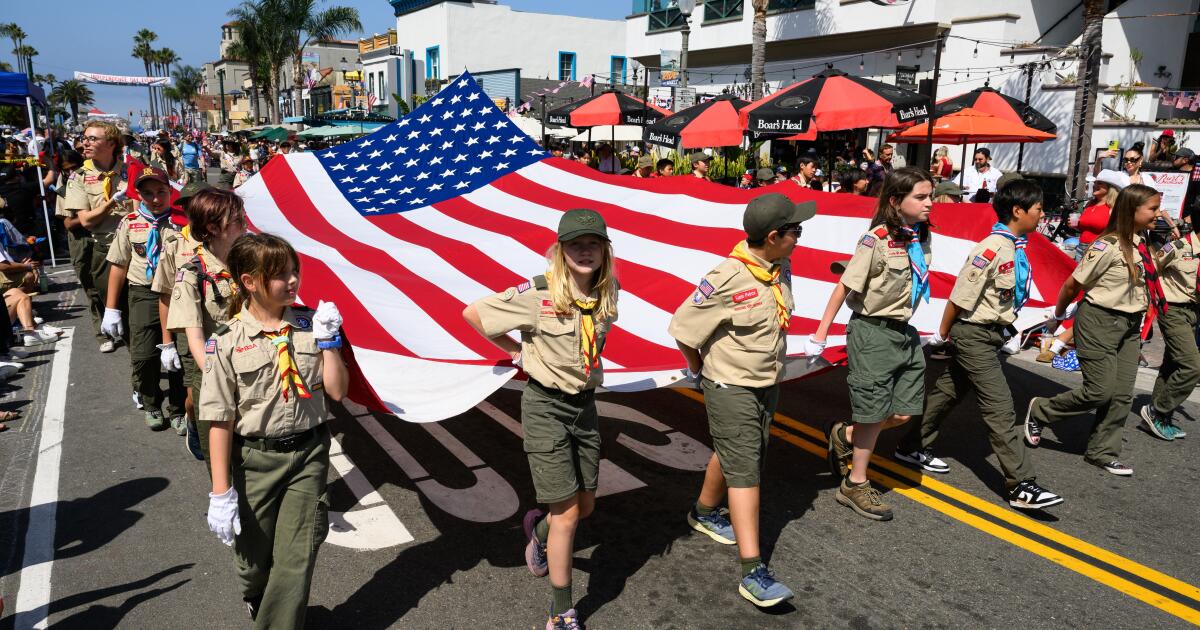
Commentary: Happy Birthday, America! You’ve weathered another rough year
-
 Sports30 minutes ago
Dodgers’ Eliezer Alfonzo praying his sister and stepmother will be found in Venezuela
-

 World40 minutes ago
Reform UK’s Farage failed to disclose funds from convicted criminal: Report
-
 News1 hour ago
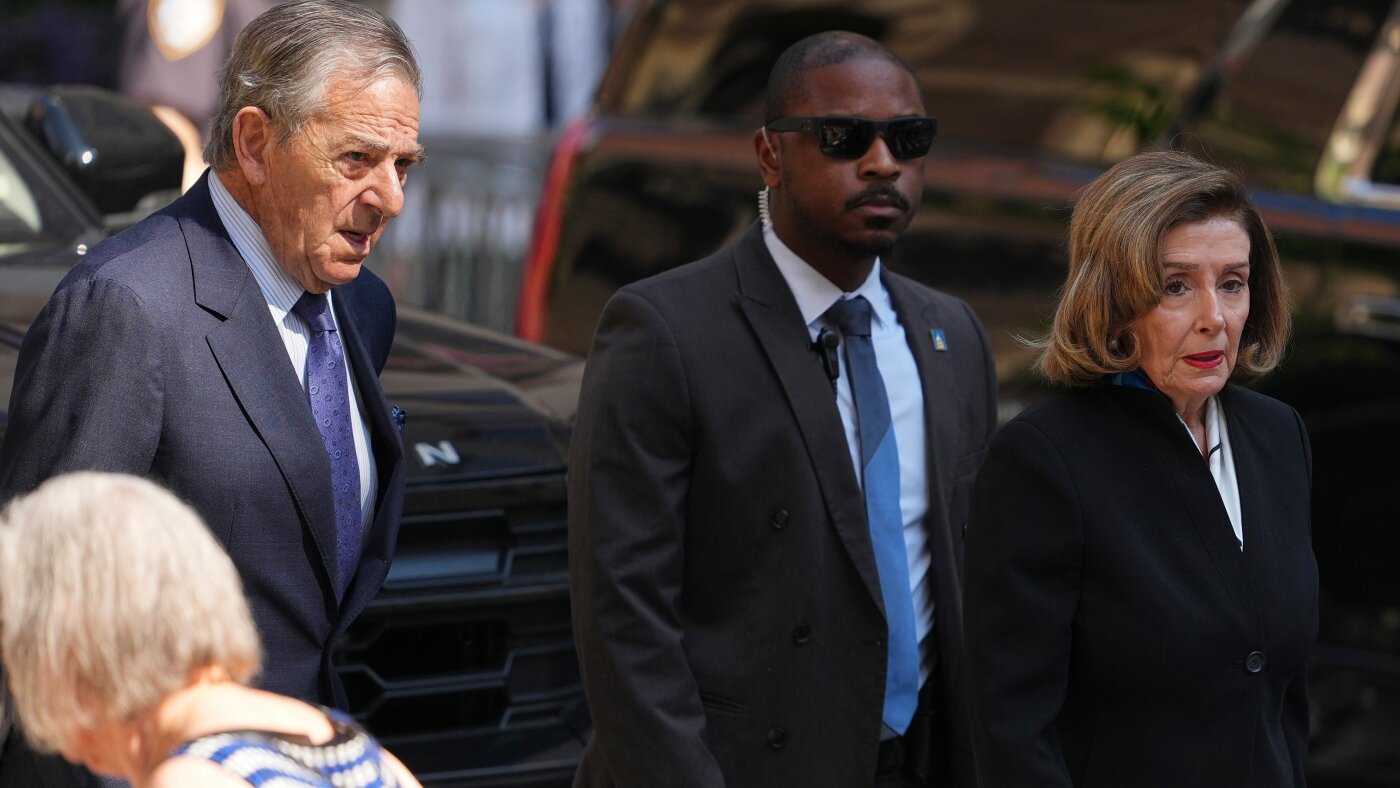
Paul Pelosi in hit-and-run in California, car left with major damage, authorities say
-

 Los Angeles, Ca2 hours ago
Firefighters battle Fourth of July blazes around Los Angeles
-

 Detroit, MI3 hours ago
Storm chances linger into the start of the week across Metro Detroit

