World
Couple separated, kidnapped during Oct 7 Hamas attack finally reunited after hostage ordeal


NEWYou can now listen to Fox News articles!
A couple separated and taken hostage by Hamas from the Nova music festival on Oct. 7, 2023, were reunited Monday after more than two years apart.
Avinatan Or was released from captivity after two years and was reunited with his partner, Noa Argamani, who had also been held hostage in Gaza. Footage posted on social media showed Or getting out of a van and waving to supporters upon his release.
Other videos showed him reuniting with his parents.
“Noa Argamani and Avinatan Or are reunited at last,” an Israel Defense Forces (IDF) post on X stated, accompanied by an image of Or kissing Argamani on the cheek.
ISRAELI HOSTAGES REUNITED WITH FAMILIES IN EMOTIONAL MOMENTS
Avinatan Or was reunited with his girlfriend, Noa Argamani, on Monday after more than two years in Hamas captivity. (Israel Defense Forces)
Argamani, a 27-year-old Israeli student born in China, was rescued in June 2024 during an IDF operation after eight months in Hamas captivity.
Video footage of Argamani being abducted at the festival and screaming while being taken on a motorcycle into Gaza quickly went viral and spread across the globe. Argamani’s mother, who was suffering from brain cancer when her daughter was kidnapped, worried she would not see her again.
Three weeks after Argamani was rescued, her mother passed away.
DOZENS KILLED IN GAZA AS VIOLENCE ERUPTS BETWEEN HAMAS AND ARMED CLANS
Former Hamas hostage Noa Argamani briefs the UN Security Council in New York, NY, on Feb. 25, 2025.
After her release, Argamani advocated for the release of the remaining hostages.
“Being here today is a miracle, but I’m here to tell you we have no time,” Argamani told the U.N. Security Council in February. She spoke about witnessing horrors, not receiving medical care, and being held in dire conditions.
Monday’s return of the remaining hostages in Gaza came after President Donald Trump secured a peace deal with Hamas following more than two years of fighting between the terror group and Israel.
Israeli U.N. Ambassador Danny Danon stands beside freed Hamas hostage Noa Argamani as she holds a poster with her partner, Avinatan Or, who is still being held hostage in Gaza.
On Monday, he traveled to Egypt, where he and several world leaders signed a historic Gaza peace plan following a summit.
The president called it a “tremendous day for the world” and a “tremendous day for the Middle East.”



MOUNT VERNON, Va. (AP) — The people who were about to become United States citizens sat in folding chairs on George Washington’s lawn at Mount Vernon on Saturday, 250 years after the Declaration of Independence.
The sun beat down and the well-dressed crowd was a flutter of paddle fans stamped with American flags. Their families clung to the shade of the trees on either side, where one woman had two American flags stuck through her ponytail.
“Well, good morning, everybody,” said Anne Neal Petri, the regent of the Mount Vernon Ladies’ Association.
“Good morning!” an excited crowd returned.
“And Happy Birthday, United States of America!” exclaimed Petri.
There were 150 people from 50 globe-spanning countries sitting in front of the small stage as they prepared to be sworn in as U.S. citizens on the July Fourth holiday and America’s 250th birthday. Among them was U.S. Marine Sgt. Diakaria Sangare from Guinea, who attended in his pressed Dress Blue uniform with three medals pinned to his left breast.
Sangare had served two deployments, and, like all assembled, had gone through the long citizenship process: The test, interviews, green cards and biometrics. Others in the crowd, it was said, came from countries bathed in violence. Some fled persecution.
After a speech about Washington, the crowd was asked to rise for the national anthem.
They did. Their hats came off and their hands covered their hearts. The paddle fans calmed.
The singer belted the words: “And the rocket’s red glare, the bombs bursting in air, gave proof through the night that our flag was still there” — as Sangare held his right hand in a rigid salute, his face sober.
As the song concluded, the soon-to-be citizens clapped and returned to their seats, while another speaker asked them to stand and remain standing when their country was called.
“Albania.”
A woman in the front row with long black hair rose with a broad grin, a small U.S. flag in her hand.
“Bangladesh.”
A man in a black shirt stood. The Albanian woman, looking back, beamed at him.
It went on for 50 countries, through China and El Salvador and Iraq and Mongolia, as people stood, sometimes smiling, sometimes sedate.
At “Morocco,” a man in the back thrusts his fists in the air in support. A young boy looked up at him and then did the same, a little flag in his fist.
Then the crowd, with hands raised, recited an Oath of Allegiance, not so different from the oath Washington signed in 1778.
“Congratulations,” they were told. “You just became U.S. citizens.”
There was applause and laughter, then the Pledge of Allegiance. Sangare, his hand now over his heart, closed his eyes for a moment.
Nearby stood a tulip poplar tree, planted at Washington’s direction 250 years ago, that had lived through America’s history.
The next speaker, historian Douglas Bradburn, pointed it out in his speech before the day’s special guest.
“All the stories that are part of you, now become American stories,” said Bradburn. “When people ask me what are American people like, I now can talk about you, and your stories.”
“The second side of that is that, now, all America’s stories, and our history, are your stories. The father of your country is George Washington.”
The first president, it turned out, was the next speaker.
As he was introduced, the re-enactor stood by a massive draped American flag, a sword scabbard on his hip. Then he donned the stage, doffed his cap to the audience, and began to speak.
“Today the name of ‘American’ belongs to you every bit as much as it does to me,” he said. He spoke to their arduous journeys to this point and their histories, now merged with America.
“So, my fellow Americans, to you, I say simply: ‘Welcome home’.”
Afterward, Sangare, the U.S. Marine, posed for a portrait, hands clasped in front of him, holding the American flag paddle fan, his Marine cap slightly askew.
“I just became a United States citizen,” he said, his emotions pushing out in an earnest smile.
____ Bedayn reported from Austin, Texas.

NEWYou can now listen to Fox News articles!
Tens of thousands of far-left protesters flooded the streets and clashed with police in the Germany city of Erfurt on Saturday as they protested the conservative Alternative for Germany (AfD) party.
Videos showed police beating back agitators with batons and deploying anti-riot ordnance as the demonstrators chanted against the country’s conservative Alternative for Germany (AfD) party in a massive political rally.
Police said over 30,000 people attended the demonstrations, according to the Associated Press (AP), and people could be seen carrying signs reading “Stop AfD Nazis” and “For Diversity, Against Nazis.”
‘YOU’RE DESTROYING YOUR COUNTRIES’: IS EUROPE FINALLY HEEDING TRUMP’S WARNING ON ILLEGAL IMMIGRATION?
Despite the tense clashes caught on video, police told news outlets the demonstrations have been “mostly peaceful,” and claimed they’ve recorded approximately 100 law violations, mostly due to graffiti.
The standoff in the city of Erfurt, Thuringia state, comes as the opposition Alternative for Germany party is soaring in national opinion polls ahead of all other parties. (RALF HIRSCHBERGER / AFP via Getty Images)
The protests coincided with AfD’s party conference and leadership elections during which the party, the second largest parliamentary group in Germany’s Bundestag parliament, re-elected Alice Weidel and Tino Chrupalla as the party co-leaders.
The mass demonstrations delayed AfD’s vote, prompting Chrupalla to criticize the method in which agitators expressed their dissatisfaction.
Thousands of demonstrators flooded a German city on July 4, 2026, blocking major roads and disrupting public transport, in a bid to shut down the annual congress of the conservative AfD party. (RALF HIRSCHBERGER / AFP via Getty Images)
THE OLDEST HATRED IS BACK: HOW IT’S CONSUMING EUROPE AND CROSSING THE ATLANTIC
“There are no peaceful seated blockades. There are no democratic roadblocks. Nor are there any gangs of thugs who deserve the harmless label ‘civil society.’ These troublemakers are the last resort of our political rivals,” Chrupalla said, according to the AP.
Protesters gather before a party convention of Alternative for Germany, or AfD in Erfurt, Germany, Saturday, July 4, 2026. (AP Photo/Ebrahim Noroozi)
Chrupalla also accused the protesters of acting anti-democratically. “They believe they have a monopoly on democracy. To these demonstrators I say: this democracy is just as much our democracy as it is yours.”
A spokesperson for local antifascist group widersetzen explicitly claimed that the group’s intention was to block AfD’s party convention.
PRESIDENT ALEKSANDAR VUČIĆ: EUROPE VILIFIES TRUMP, BUT WE IN SERBIA SEE A FRIEND
“The AfD pursues fascist policies: It wants mass deportations and terror on the streets. At the same time, however, it doesn’t solve a single real problem,” widersetzen spokesperson Lena Raupach told the AP. “It pursues policies that benefit the rich, not ordinary citizens. And we at widersetzen want a society in which all people have equal opportunities and equal security. We want a society based on solidarity.”
AfD, while fighting accusations of extremism from citizens and center-left and center-right politicians in the country’s ruling coalition, rejects the notion that it is extreme, arguing it is “being used as a political instrument by mainstream parties,” according to the AP.
The party has been experiencing a historic surge in popularity in recent years, grabbing over 20% of the national vote in federal elections in 2025 with an eye on capturing even more in the next election. Some federal polls have the party ranked as the most popular in the country today.
CLICK HERE TO DOWNLOAD THE FOX NEWS APP
“We will win. Maybe we’ll be able to govern alone soon,” Chrupalla said Saturday. “That would send the right message to the enemies of democracy out there who wanted to prevent our party convention from taking place.”
Partygoers widely support the conservative moment fashioned by President Donald Trump and the party shares similar stances on social, cultural and domestic issues as the Trump administration, particularly on immigration. Perhaps inspired by Trump’s trademark slogan, one party conference attendee Saturday could be seen sporting a “Make Germany Great Again” hat.
A man is wearing a “Make Germany Great Again” cap at the convention center. The AfD’s national party convention will take place on July 4 and 5 at the Erfurt Convention Center. (Martin Schutt/picture alliance via Getty Images)

The Italian government is sounding the alarm after 80 vials of fentanyl, a synthetic opioid up to one hundred times more powerful than morphine, were stolen from Rome’s Israelitic Hospital.
ADVERTISEMENT

ADVERTISEMENT
The missing quantity would be enough to produce up to around 20,000 doses potentially destined for illicit use, which in countries such as the United States and Canada has become a national emergency.
Fentanyl is used legally in medicine as an anaesthetic and to treat severe pain, including in cancer patients. But taking this “party anaesthetic” for non-medical purposes has devastating effects. As little as 3 milligrams of the “zombie drug” (as it is known when mixed with xylazine) are enough to kill a person.
In Italy too, its growing spread on the illegal drug market has raised public health concerns, leading to a “National prevention plan against the improper use of fentanyl and other synthetic opioids” presented in March 2024 by the Anti-Drugs Policy Department of the Prime Minister’s Office.
How the fentanyl theft unfolded
The head of the hospital pharmacy reported the theft on 24 June. What is striking is the absence of any sign of forced entry on the safe where the vials were kept, the keys to which are held by several members of staff.
Prosecutors in Rome have opened an investigation. An initial report on the incident has been sent to the criminal court of the capital. The inquiries have been entrusted to the Carabinieri’s NAS unit. The case concerns allegations of theft and possession with intent to supply narcotic substances.
In the meantime, the Ministry of Health – at the instigation of Minister Schillaci – has launched an inspection through its competent offices. The ministry is also preparing “a new circular to further step up checks on the improper use and circulation of fentanyl and on how it is stored in medical and hospital facilities”.
The government’s response
The theft prompted an emergency meeting at Palazzo Chigi, chaired by undersecretary Alfredo Mantovano. During the meeting “the need to ensure compliance with the procedures laid down for the management of high-risk medicines, in order to protect public health and prevent similar incidents from happening again” was reiterated.
“In the coming days,” it was explained, “the monitoring committee on the implementation of the anti-fentanyl plan will be reconvened at Palazzo Chigi, with the aim of ensuring that all the parties involved put in place the necessary safeguards and controls”.
Meanwhile, the Lazio Region has ordered an extraordinary inspection visit to Rome’s Israelitic Hospital to check how the hospital pharmacy manages narcotic drugs.
At the same time, it “announces that it has instructed the territorially competent local health authorities to verify the proper management of narcotic drugs in the region’s various hospitals, thereby extending the control measures to the entire regional territory so as to guarantee the highest safety standards”.
-
 News23 minutes ago
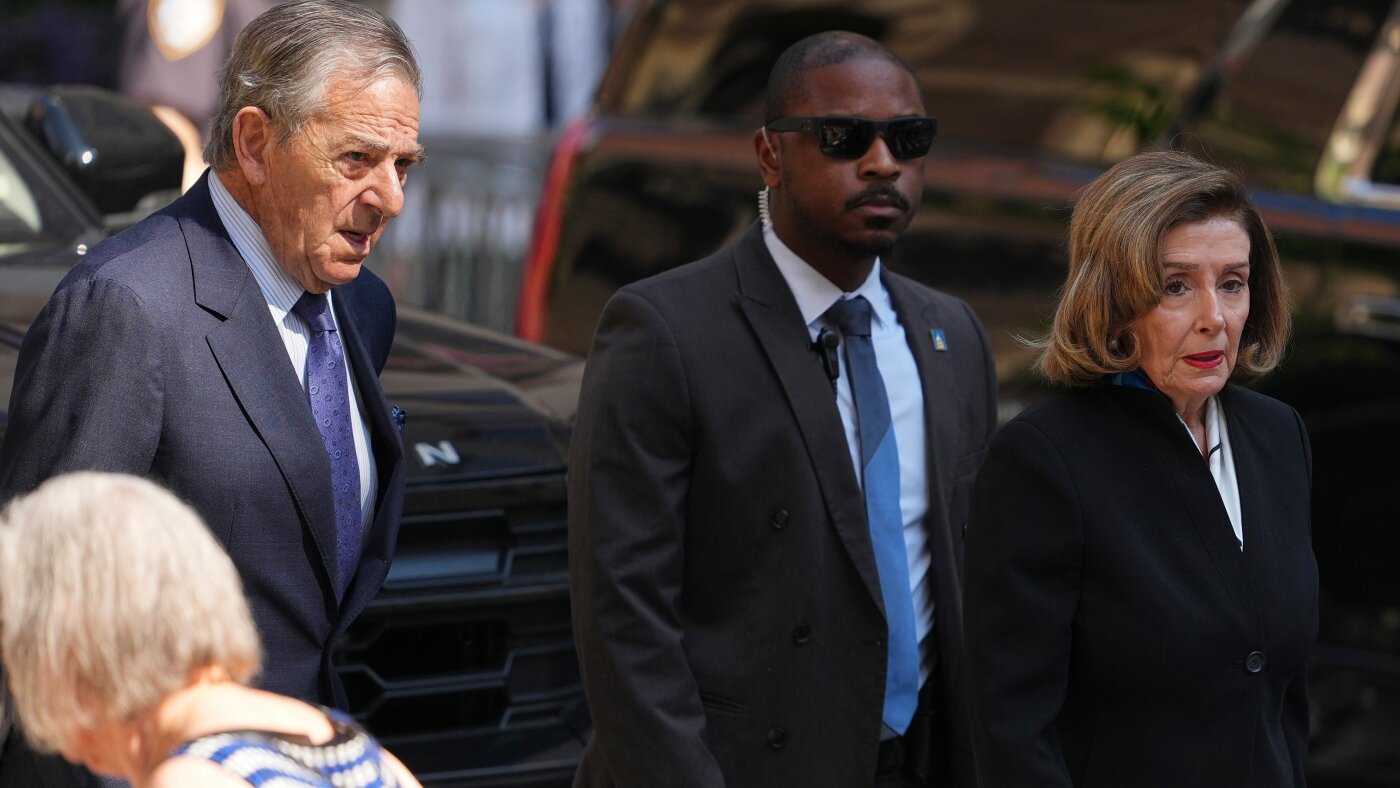
Paul Pelosi in hit-and-run in California, car left with major damage, authorities say
-

 Los Angeles, Ca2 hours ago
Firefighters battle Fourth of July blazes around Los Angeles
-

 Detroit, MI2 hours ago
Storm chances linger into the start of the week across Metro Detroit
-

 San Francisco, CA2 hours ago
Relay for America runs flag from San Francisco to D.C. in message of unity
-

 Dallas, TX2 hours ago
Cowboys newcomer already looks like a waste of money in Dallas
-

 Miami, FL2 hours ago
Police search for suspect after man is shot while on a boat near hotel in Fort Lauderdale on 4th of July
-

 Boston, MA2 hours ago
Sonny Gray shines again, and the Red Sox make it two straight wins at the Angels to start grinding road trip – The Boston Globe
-

 Denver, CO3 hours ago
Aldi expanding into Colorado, applies for permits at two Denver locations

