World
As US and Iran weigh peace deal, stranded seafarers wait in limbo


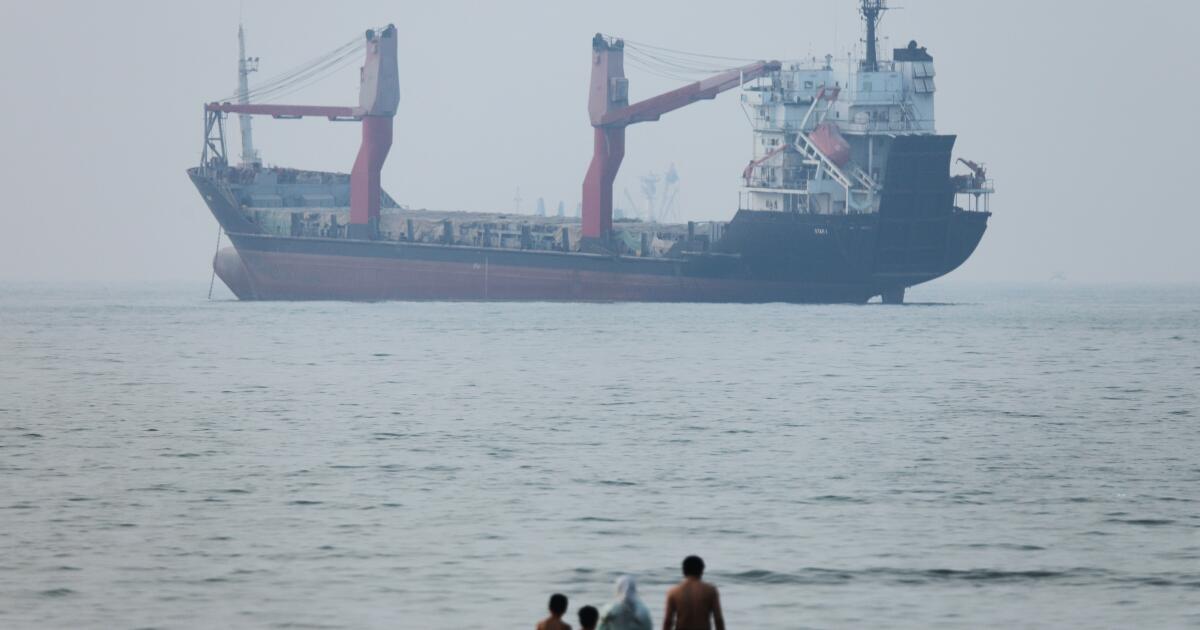
Stranded at an Iranian port for nearly 10 weeks, Indian seafarer Anish has unintentionally become a firsthand witness to the Iran war.
Anish arrived in the Shatt al-Arab waterway on a cargo ship days before United States President Donald Trump launched “Operation Epic Fury” on February 28.
list of 4 itemsend of listRecommended Stories
He has been stuck on the vessel ever since.
“We’ve faced the whole situation here, the war, the missiles,” Anish, who was granted a pseudonym after agreeing to speak on condition of anonymity, told Al Jazeera.
“Our minds are terribly distracted.”
Some of his fellow Indian seafarers have been able to return home by crossing Iran’s 44km land border with Armenia, Anish said, but many others have remained because they are still waiting to get paid.
“Some are stuck because of their Indian agents; they are not getting their salaries,” Anish said, referring to the middlemen who recruit seafarers, manage payrolls and take care of other employee matters on behalf of shipping firms.
“Some are stuck because the Iranian agents say we will not give you the dollars to reach Armenia.”
Anish said he has been subsisting on a diet of potatoes, onions, tomatoes and flatbread, but has heard that food and water on other ships are running low.
Anish’s predicament is one faced by an estimated 20,000 seafarers stranded since Iran in effect shut the Strait of Hormuz in retaliation for the United States and Israel’s attacks on the country.
Before the war, the strait functioned as one of the world’s most critical shipping routes, carrying about one-fifth of global oil and gas supplies, and one-third of the seaborne fertiliser trade.
Despite the announcement of a tenuous ceasefire between Washington and Tehran on April 7, maritime traffic has remained at a standstill amid recurrent attacks in and around the waterway.
US Central Command said on Thursday that it had “intercepted” and “eliminated” inbound Iranian threats after three US Navy guided-missile destroyers came under attack from missiles, drones and small boats while crossing the strait.
Iran’s military said it had retaliated against the US Navy vessels after US forces targeted an oil tanker in its territorial waters.
Tehran also accused Washington of violating their ceasefire by carrying out air strikes on civilian areas, including Qeshm Island.
Throughout the war, Iran has offered ships safe passage through its territorial waters for a fee, while continuing to fire intermittently on commercial vessels.
At the same time, the US has blockaded Iranian ports since April 13 in a bid to disrupt Tehran’s oil exports and access to foreign currency.
UK-based maritime intelligence company Lloyd’s List said on Monday that at least four commercial ships were fired upon since the previous day, while a container ship operated by French company CMA CGM on Wednesday reported that it had come under attack while crossing the waterway.
The United Nations International Maritime Organization estimates that at least 10 seafarers have been killed since the start of the war.
Iran’s merchant marine union reported that at least 44 Iranian seafarers, including dockworkers and fishermen, had been killed as of April 1.
Trump said on Wednesday that US officials held “very good talks” with Tehran and that a peace deal was “very possible”, but it remains unclear how close the sides are to any agreement.
While some ships have managed to exit the Strait of Hormuz during brief lulls in hostilities, each day brings new uncertainty for the civilian crews manning the Gulf’s massive fleet of oil, gas and container ships, according to labour groups.
Last month, Iranian forces detained two foreign-flagged cargo ships and their crew, while the US Navy captured three Iran-linked commercial vessels in the Gulf and the Indian Ocean.
The prospect of being detained on top of being stranded at sea has created an “enhanced state of fear,” said Stephen Cotton, general secretary of the International Transport Workers’ Federation, which represents about 700 unions across 150 countries.
“Since the beginning of the year, we’ve got military forces boarding ships like it’s the 17th century, and that’s terrifying,” Cotton told Al Jazeera.
“It’s kind of crazy, because these are seafarers. These are just workers.”
The IMO has called the situation facing mariners an “unprecedented” humanitarian crisis, though conditions facing workers can vary considerably depending on the shipowner and whether they are unionised.
While seafarers on board vessels operated by major international shipping lines have been receiving hazard pay and other assistance, some seafarers working with smaller operations are struggling to get paid or have their basic needs met, according to Cotton and other seafarers’ advocates.
“The reality is you’ve got two kinds of shipping industries. One is the intercontinental trade – the big gas, the big oil, and the big containers. Then you’ve got the local trade supplying oil, food, water and moving it around the Gulf,” Cotton said, adding that smaller vessels often operate without unions or the “rigorous enforcement of international regulations”.
Saman Rezaei, general secretary of the ITF-affiliated Iranian Merchant Mariners Syndicate, said that many foreign seafarers in Iran work for “irregular agencies” that do not meet international standards.
Crew rotation has become a major pressure point for ships.
Under the 2006 Maritime Labour Convention – an international treaty ratified by 111 countries, including China, India, Japan, Australia, and the United Kingdom – the maximum time a seafarer can be required to serve on board is 12 months.
While seafarers have a legal right to leave their vessel beyond this period, unstable conditions have made repatriation a complicated and expensive prospect.
In some cases, especially on board large cargo ships still at sea, departing crew must first be replaced by incoming employees for safety reasons.
“With the ships unable to move and flights disrupted, many have had no choice but to remain on the ships even after their planned rotation,” John Bradford, a former US Navy officer and executive director of the Yokosuka Council on Asia-Pacific Studies in Japan, told Al Jazeera.
“This keeps them from their families and creates all sorts of social ripple effects even as they continue in a situation that is increasingly stressful.”
‘I told my crew how to run’
Steven Jones, the founder of the “Seafarer Happiness Index,” said seafarers’ self-reported wellbeing score has fallen about 5 percent during the war.
Seafarers have described seeing Iranian drones and missiles flying at low altitude, Jones said.
“One told us: ‘What scares me the most is the thought of an intercepted drone or missile falling on us,’” Jones, who is affiliated with the UK-based Mission to Seafarers charity, told Al Jazeera.
Other seafarers have reported dwindling food supplies and preparing escape plans, Jones said.
“Several senior officers say they have had to prepare evacuation plans for their teams: ‘I told my crew how to run, where to jump from, and what to carry if something happens,’” Jones said, quoting one seafarer.
Earlier this week, Trump announced that the US would begin guiding stranded ships out of the strait from Monday, before suspending the operation less than 48 hours later to pursue peace talks despite ongoing attacks in the waterway.

Even if the strait were to reopen tomorrow, trade flows would take some time to return to normal due to damaged regional infrastructure, maxed-out storage facilities across the Gulf and a backlog of exports, according to shipping and logistics experts.
For the stranded seafarers, there is also the question of finding a safe route out of the strait, where Iran has reportedly laid sea mines.
US officials told The New York Times last month that Tehran had laid the mines haphazardly and was unable to locate all of them.
“There has been a lot of speculation about more precise numbers, but the fact is that we don’t know; uncertainty is central to mine warfare, and creating uncertainty about risk is part of the point of conducting it,” Scott Savitz, a senior engineer at the US-based Rand Corporation who has studied naval mine warfare, told Al Jazeera.
Savitz said that it would be possible to establish an exit corridor in a few days, but clearing the strait of mines could take weeks or even months.
“Iran has stated that it has laid mines in and around the Strait of Hormuz, but it’s possible that they have laid them in other areas,” Savitz said.
The IMO announced in late April that it was working on an evacuation plan that prioritises ships based on humanitarian need, but that “all parties” involved in the conflict would need to refrain from attacks for such an operation to proceed.
“It’s a very dangerous moment,” the ITF’s Cotton said.
“We’re all saying the same – don’t transit unless you know it’s safe – but I don’t think anyone really knows what’s safe any more.”
The longer the war drags on, the higher the risk that ship operators will abandon their vessels without settling all outstanding pay, according to seafarers’ advocates.
“This is a longstanding problem in the region, and as cargo disputes arise or the mechanical condition of vessels deteriorate, then the temptation for ‘bad owners’ is to walk away,” Jones said.
Anish, the Indian seafarer, said he has not been paid by his Dubai-based agent for nine months.
He is supposed to receive a payment in US dollars later this month, but he is worried that his company may withhold the sum.
“My contract finish date is the 20th of May,” Anish said.
“Maybe the company will provide my salary after that,” he said. “I don’t know ”



Veteran politician Andy Burnham has taken another step towards becoming the UK’s next prime minister, after the majority of Labour MPs nominated him to replace Keir Starmer.
ADVERTISEMENT
ADVERTISEMENT
The 56-year-old’s Labour leadership bid was backed by 322 Labour MPs on Thursday and he remains the only person to publicly declare themselves a candidate to replace Starmer, who announced he was quitting last month.
Burnham appeared on course to be crowned Labour leader unchallenged on the first day of nominations.
If Burnham reaches at least 323 nominations then it would no longer be mathematically possible for another challenger to get the 81 signatures required to join the race out of the total of 402 Labour MPs.
“It is all starting to feel very real,” Burnham said in a social media video posted shortly after the process opened on Thursday morning.
Nominations close on 16 July. In the absence of a contest, Burnham will be crowned Labour leader and prime minister in waiting at a special conference the following day.
He would then replace Starmer at 10 Downing Street on 20 July after meeting King Charles, becoming Britain’s seventh prime minister in a decade.
“There’s no one else,” one Labour MP told the AFP news agency on condition of anonymity after nominating Burnham.
Armed forces minister Al Carns, thought to be Burnham’s final remaining potential challenger, ruled himself out of the running late on Wednesday.
He had expressed hope a leadership contest would give the party the “opportunity for a proper debate.”
“But months of internal Labour politics isn’t what the country needs right now,” he said.
Burnham, nicknamed the “King of the North” for winning three consecutive Greater Manchester mayoral elections, has vowed to “bring about the biggest rebalancing of power our country has seen.”
His signature proposal is the creation of a “No. 10 North” to coordinate greater devolution, a reference to the UK prime minister’s address at 10 Downing Street.
Burnham has pledged fiscal discipline and to reduce the country’s ballooning welfare bill, having already sought to calm markets by committing to the government’s current borrowing limits.
But he will face the same challenges that buffeted Starmer’s premiership, notably anaemic growth, a cost-of-living squeeze and an unpredictable US president in Donald Trump.
He has also indicated he could stake out a different path to Starmer on Israel, which enjoyed solid backing from the Labour government even as criticism grew of its war in Gaza.
“I am sorry about that,” Burnham told the Guardian newspaper in an interview published on Thursday. “The response has too often not been good enough. We need to do better.”
Starmer, under pressure for months over policy U-turns and questions about his judgement, announced on 22 June that he was resigning after losing the support of Labour MPs.
His move came after Burnham won a by-election that allowed him to return to parliament to launch a widely expected leadership challenge.
On the day Starmer announced his resignation, Burnham was sworn into parliament, becoming an MP again following his stint between 2001-2017.
Roll the dice
Afterwards, some 200 Labour MPs feted Burnham during a group photo in Westminster, in a clear sign that they expect him to take over.
Former health minister Wes Streeting announced he was dropping his intention to run and backing Burnham.
Burnham, seen as slightly to the left of the more centrist Starmer and more charismatic, is Labour’s most popular politician, surveys show.
Many MPs feel he is the party’s best chance of clawing back support from Nigel Farage’s anti-immigrant Reform UK party before the next general election, expected in 2029.
Reform has led Labour in national opinion polls for well over a year, although the gap has narrowed in recent weeks amid questions over Farage’s finances.
One Labour MP, who asked not to be named, said the party was right to “roll the dice” on Burnham, saying “he couldn’t be worse than Starmer.”
“I hope he’s a breath of fresh air,” the lawmaker told AFP.

NEW YORK (AP) — Launching an artificial intelligence tool to take notes and summarize important information from a virtual meeting can be alluring. Seconds after one of the agents attends an hour-long video conference, it can deliver a recap of key points and outline a to-do list for all the participants.
But the way popular AI notetakers accomplish those tasks makes some people avoid using them. The technology turns everything said during meetings into data. Confidential personnel information, corporate strategies, trade secrets and remarks that could later be seen as incriminating — all of it could end up in the wrong hands.
“There are huge risks to the organization on AI notetakers,” Amy Dufrane, the chief executive of human resources training and certification provider HRCI, said. “I don’t think companies should use it at all.”
An AI notetaker is a software application or device that uses artificial intelligence, speech recognition and large language models to record, transcribe and summarize conversations. The tools are intended to save time and improve participation, but professionals in a number of fields say there are reasons to be wary.
This article is part of AP’s Be Well coverage, focusing on wellness, fitness, diet and mental health. Read more Be Well.
Chief among them is uncertainty about where the collected data is stored and for how long. Privacy advocates worry the companies behind the AI notetakers are creating voiceprints without consent. Voiceprints — a type of biometric profile similar to a fingerprint but tuned to the unique intonations and characteristics of one’s voice — can be used to access restricted or confidential information, including the contents of bank accounts.
Some tech companies resell data from the notetaking tools they created or use confidential meeting transcripts and recordings to train their AI models. There’s also the risk that conversations between an attorney and client could become fair game in legal proceedings; a New York federal judge in February ordered a criminal defendant to provide prosecutors with documents he created for his lawyers because it already had been shared with a third party, which was Anthropic’s Claude.
“People who use AI notetakers, they don’t always know where the data goes,” said Justin Daniels, an Atlanta-based corporate attorney at law firm Baker Donelson. “And in my context, if the data goes anywhere else and they’re not aware of it, that attorney-client-privileged conversation may not be attorney-client-privileged anymore.”
Here are some tips on the etiquette of kicking an AI notetaker out of a meeting, the risks of using one and how to protect yourself.
The first step when you join a meeting is check for bots
When you join a meeting, make it a habit to check whether an AI notetaker is present. It might appear as a meeting attendee, often labeled as an AI notetaker, or a pop-up message on the screen informing participants the meeting is being recorded. The latter could signal the presence of an AI notetaker.
Virtual meeting platforms such as Zoom and Google Meet let users know when recording is underway, but some meeting software does not make it clear when a notetaker is present, according to Thorin Klosowski, the Electronic Frontier Foundation’s senior security and privacy analyst.
Participants also may use personal notetaking devices that are separate from the meeting platform, in which case the other attendees wouldn’t necessarily know a discussion was being recorded and transcribed.
“You hope the other person would tell you that they’re doing that,” Klosowski said. “Asking everyone for consent before doing a sensitive meeting would be the most polite approach to take.”
If you’re unsure whether someone has deployed an AI notetaker, you can ask. You can also state at the beginning that a meeting is not authorized for recording.
A polite way to establish such a boundary is to say, “Our company policy is that this meeting cannot be recorded,” Dufrane suggested. This relieves the employee, such as a salesperson who wants to make a good impression, of having to be the “bad guy,” putting the onus on the company instead, she said.
Another option is to allow the notetaker for part of the gathering but turn if off at the end to dedicate time for more delicate topics.
“I won’t start talking about anything substantive until it’s shut off, because I just don’t want to take the risk,” Daniels said.
Assert your privacy rights to protect voiceprints
Many AI notetakers determine unique acoustic signatures, or voiceprints, for each speaker in the room, said Chris Pluymers, associate attorney at The Dillon Law Group in East Lansing, Michigan. That’s how the companies distinguish one speaker from another, labeling them with monikers “Speaker 1” or “Speaker 2.”
One way voiceprints are used is to verify the identities of bank account holders over the phone. If bad actors got ahold of a person’s vocal signature, they could use it to access files, commit fraud or take over accounts, he said.
Laws in some states govern how voiceprints can be created and stored and provide rights that individuals can assert to object to the use of an AI notetaker during meetings they attend.
In Illinois, voiceprints are considered biometric identifiers, similar to fingerprints, and are covered under the state’s Biometric Information Privacy Act, which requires written notice and informed consent before an AI notetaker or other agent collects voiceprints. The law also mandates a documented data retention schedule and destruction policy, Pluymers said. But most companies using the tools have none of those systems in place, Pluymers said.
“In the world of AI, the world of data and privacy, the world of biometric identification, I don’t think you can have such a lax approach to it,” Pluymers said. “I think getting out ahead of it is crucial.”
Under the Illinois law, employees can say they don’t want to attend a meeting with an AI notetaker until they have assurances of where and why the data is being stored, and when it will be deleted, Pluymers said. They can also ask if there is a policy and written consent form to sign.
If an AI notetaker shows up at a meeting unexpectedly, a participant could say, “I prefer we keep this meeting without AI recording or transcript tools and I’d be happy to take my own notes and share a recap if that’s helpful,” Pluymers suggested. “Just being warm and genuine about it and asking them to respect your wishes.”
Know where your data goes
When working with AI notetaking apps, find out whether the companies that built them retain recordings, transcripts or metadata indefinitely or use them to train AI models, said Danielle Kays, a partner at Fisher Phillips who represents businesses on privacy and employment law matters.
“If there is some sort of speaker ID or voice recognition, really understand what that is and how it works,” Kays said.
Even when content is deleted, metadata about meetings can remain stored with the vendor, meaning sensitive business information could influence how the model behaves and in some cases could be memorized or reproduced, she said.
AI notetakers generate text, and that’s easier for outsiders to search through than video or audio files, according to EFF.
“Storing a bunch of video isn’t easy, it’s costly and hard to look through, but text is much easier to search and cheaper to store,” said Klosowski of the Electronic Frontier Foundation.
___
Share your stories and questions about workplace wellness at [email protected]. Follow AP’s Be Well coverage, focusing on wellness, fitness, diet and mental health at https://apnews.com/hub/be-well
World
Argentinian flight instructor jumps to death from plane, 22-year-old student forced to land alone

NEWYou can now listen to Fox News articles!
A flight instructor jumped to his death out of a small aircraft over Argentina, forcing the student pilot he was teaching to land the plane herself.
Leandro Andrés Bertazzo, 42, was on board a two-seat Cessna 150G on Saturday when he made the decision to jump out over the province of Córdoba, according to CNN, which cited its Argentinian affiliate TN.
“He made this tragic decision on board an aircraft with another person by his side,” Eduardo Álvarez, director of the Flying Parrot Córdoba flying school where Bertazzo worked, told TN. “It’s impossible to think about it or understand it, but the human mind is so complex.”
An undated photo of Leandro Andrés Bertazzo, a 42-year-old pilot who jumped to his death from a plane on Saturday, July 4 in Argentina. (Instagram/Leandro Bertazzo)
PILOT DECLARES MAYDAY BEFORE SEAPLANE COMES DOWN IN NEW YORK CITY’S EAST RIVER
Rosario, the 22-year-old student, later told authorities that Bertazzo told her, “You know what you have to do, carry on,” before taking off his gear, opening the door and leaping out, according to Álvarez.
Opening the door of a plane midair is incredibly difficult. Álvarez said it would be akin to trying to open the door of a car traveling 124 miles per hour.
Cessna 150m FRA150M climbing out after take-off with flaps deployed and hills behind. (aviation-images.com/Universal Images Group via Getty Images)
FRANTIC SEARCH UNDERWAY FOR CREW AFTER BOEING 737 WRECKAGE FOUND BY OFFICIALS
Álvarez said that Rosario managed to land the plane safely, despite being in “complete shock.” There was no damage to the plane, according to TN.
Álvarez noted that Bertazzo had gone on a flight with another student earlier in the day.
A view from the main road of the flight school Bertazzo worked at, Flying Parrot Córdoba. (Google Maps)
CLICK HERE TO DOWNLOAD THE FOX NEWS APP
Álvarez also told TN that Bertazzo had visited a psychiatric institute, something that was only known by his family prior to his death.
Prosecutors in Córdoba will lead the investigation into Bertazzo’s death. The plane he jumped from is now in police custody.
-

 Politics33 seconds ago
Israel shares intelligence warning Iran plotted new assassination attempt against Trump: report
-

 Health8 minutes ago
Parasitic infection causing ‘explosive’ stomach illness exceeds 1,000 cases in northern state
-

 Sports10 minutes ago
London descends into disorder as Morocco fans flood streets after World Cup elimination by France
-

 Technology16 minutes ago
Google turns old phones into cloud servers
-
 Business23 minutes ago
Waymo is starting robotaxi service in San Diego
-
 Entertainment26 minutes ago
‘Children of Blood and Bone’ author won’t see film after feud with star Amandla Stenberg
-
 Lifestyle30 minutes ago
After her son’s death, she found a new purpose. ‘He’s whispering: Mom, this is your path’
-
 Politics38 minutes ago
Iran ceasefire is ‘over,’ Trump says, and orders additional strikes

