Wyoming
The Torture and Killing of a Wolf, a New Endangered Species Lawsuit and Novel Science Revive Wyoming Debate Over the Predator – Inside Climate News


On Feb. 29, Cody Roberts was out hunting on his snowmobile in Wyoming when he crossed paths with a lone gray wolf in the state’s “predator zone,” where wolves can be killed by almost any means and without a license. What happened next made national headlines, and prompted a backlash so fierce that Wyoming’s tourism agency temporarily suspended its practice of advertising state wildlife.
Roberts allegedly ran down the adolescent female wolf with his snowmobile until it was too wounded to flee, taped its mouth shut and dragged the injured animal to show off in the Green River Bar in Daniel, a town between the Bridger-Teton National Forest and the Wind River mountain range, before shooting it to death behind the tavern.
It took almost a month for news of Roberts’ alleged actions to reach the public—KHOL/Jackson Community Radio Station broke the story—but once it did, state officials quickly and forcefully condemned them, with many expressing outrage that, to date, Roberts had paid only a $250 fine for possessing warm-blooded wildlife.
We’re hiring!
Please take a look at the new openings in our newsroom.
See jobs
Sublette County Sheriff K.C. Lehr told Wyofile, a local news outlet, “as a hunter, as a resident of Sublette County, I find those actions very disturbing and unethical,” and added he was looking into whether Roberts could face additional charges and consequences beyond a fine.
Wyoming’s governor, Mark Gordon, weighed in, too, expressing outrage over the story and calling it “absolutely unacceptable” in a series of posts on X (formerly Twitter). Gordon made it clear that Wyomingites do not “condone the reckless, thoughtless and heinous actions of one individual.”
Not everyone agreed with Gordon’s assessment of the attack as an isolated event. Amid the public outcry for Roberts to face a steeper penalty, 10 western environmental nonprofits were already preparing a challenge to the U.S. Fish and Wildlife Services’ February decision not to relist western gray wolves under the Endangered Species Act (ESA).
The challenge stemmed from how gray wolves were managed by Wyoming, Idaho and Montana, which the organizations argued had become “poster children” for politicizing the species’ protections at the expense of the animal’s well being.
Their challenge noted Roberts’ alleged actions. Brooks Fahy, executive director of Predator Defense, a nonprofit that works to protect native predators across the U.S., said that while recent science demonstrates the need for intact wolf packs across the west, Idaho, Montana and Wyoming are “destroying wolf families in the Northern Rockies and cruelly driving them to functional extinction via bounties, wanton shooting, trapping, snaring, even running over them with snowmobiles.”
That the group’s filing came a little over a week after Roberts’ story broke was a coincidence; the organizations had originally petitioned the Fish and Wildlife Service to relist the animals in 2022, and said they had always planned to contest a ruling that didn’t go their way. But the national outrage over the February incident grew into scrutiny of wolves’ treatment in Wyoming, where the animal’s presence has endured lethal skepticism since it was reintroduced to the landscape almost thirty years ago.
The conservation organizations contend that re-listing gray wolves under the ESA, essentially reverting control of the species to the federal government, is the best way for the U.S. to strengthen wolf packs in Wyoming and other western states. But some local conservationists in Wyoming have pushed back on that idea, saying that state-based management policies have kept population numbers in line with federal mandates, and asserting that re-listing wolves won’t remove the true roadblock preventing them from thriving in the state: acceptance from humans. If wolves are to survive long term, they argue, changes to how they are managed must be preceded by dispassionate, science-based conversations about how best to manage the animal.
Part of the argument for wolves’ reintroduction over the last 30 years has included the idea that they fortify, even “heal,” ecosystems that have fallen out of balance in their absence through a phenomenon known as a “trophic cascade.” In Yellowstone National Park, for instance, subscribers to the theory say wolves culled some elk and deer and kept others on the move, reducing overgrazing to improve streamside habitats.
A National Park Service crew examines and collars a sedated wolf on Feb. 21 in Yellowstone. Credit: Jacob W. Frank/NPS
But new studies have cast doubt on the extent and immediacy of the trophic cascades from the wolves’ reintroduction, especially in Yellowstone, suggesting the canines do not yet exist in numbers sufficient to exert a widespread influence on the landscape.
As new science on trophic cascades changes how scientists understand and apply the term, other research is suggesting wolves could have important effects on the atmosphere. A team of researchers from Yale University has begun investigating wolves’ potential impacts on an ecosystem’s ability to store greenhouse gases. In forests especially, wolves may be a key cog in the food web that helps the landscape retain more CO2 than it does in their absence.
The research would play little to no role in how the species is managed under the ESA, but conservationists nationwide could point to it as part of a case for reintroducing wolves to their ancestral homes. But in Wyoming, an extremely conservative state where climate change is politically divisive, these findings might negatively affect how state residents view the species and its benefits to their cherished landscapes.
The new research into trophic cascades and wolves’ ability to help land sequester carbon, along with the Sublette County incident, has complicated Wyoming’s already fraught relationship with the predator. “There’s not an easy answer” as to what Wyoming should do next, said Jess Johnson, head of government affairs for Wyoming Wildlife Federation, a wildlife and sportsman advocacy organization. Nonetheless, “something is probably going to change.”
A Rocky History
Since 1995, when 14 gray wolves were relocated from Canada to Yellowstone, the ancestral habitat from which the species was extirpated nearly a century ago, canis lupus population numbers have steadily risen in Wyoming to the low 300s. In its 2023 annual report, the U.S. Fish and Wildlife Service said there were at least 352 gray wolves roaming the Cowboy State. In the last 23 years, gray wolves have never dipped under federally set population thresholds in Wyoming, though the service estimates only 24 live in the state’s predator zone, where no such population targets exist.
Despite that progress, “the species has yet to achieve self-sustaining populations in much of their historic habitat across vast portions of the Western U.S.,” including Wyoming, the organizations suing the U.S. Fish and Wildlife Service wrote in their challenge. They argued that population estimations in Idaho and Montana were “biased,” leading to “population estimation errors.”

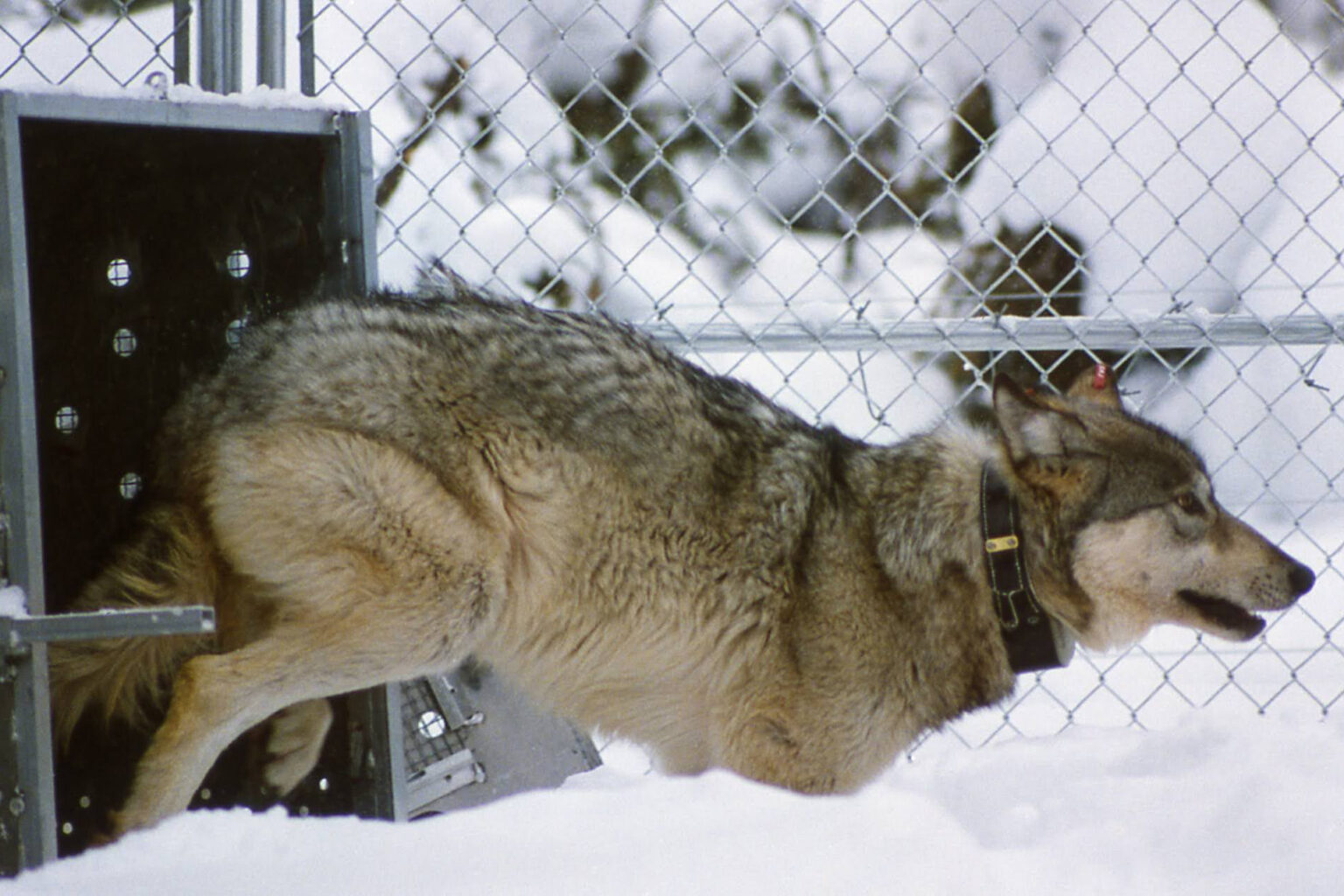

In Wyoming, the main hurdle preventing wolves from becoming self-sustaining, according to the conservation groups, is the state’s predator zone. The organizations say that from 2017 to 2022, humans killed an average of 28 wolves annually in the 85 percent of the state where the animals can be hunted, trapped, poisoned or mowed down with a snowmobile without a license. As a result, “wolf packs are unlikely to persist in the long-term in portions of Wyoming where wolves are classified as a predatory animal,” the conservation organizations wrote in their challenge—echoing a point the U.S. Fish and Wildlife Service has made in the past.
Erik Molvar, executive director of the Western Watersheds Project, one of the conservation organizations that brought the legal challenge, studied wolf and bear interactions with moose in Alaska for his master’s degree in wildlife management, and knows the type of habitat suitable for the species. “Wolves can live anywhere in Wyoming as long as they’re not persecuted,” he said. “Of course, if they get endangered species designation, they can’t be persecuted,” and they will likely begin to flourish in the state’s predator zone.
To Molvar and the conservation organizations suing the U.S. Fish and Wildlife Service, Wyoming “was the original offender” when it came to managing wolves with overly aggressive policies. “It’s certainly emblematic of how inadequate the regulatory mechanisms in states like Wyoming are that you could run over a wolf with a snowmobile and drag it into a bar and show it off and torture it, then take it out back and kill it without any real criminal consequence,” he said. In the nation’s least populous state, wolves and humans are unlikely to clash frequently, and designating such a vast area for wolves to be hunted with impunity makes no sense, he said.
Wyoming, Idaho and Montana “keep playing politics and ignoring the best available science” when it comes to managing wolves, Molvar continued. “The Endangered Species Act is unquestionably the best tool in the tool box” for ensuring the species’ long-term stability in the West, he said.
But not everyone sees the predator zone as only an impediment to wolves’ existence in Wyoming. In fact, Wolves may never have made their way back into Wyoming at all without it, said Johnson.
“It’s not just biological science you have to look at,” when reintroducing and managing a charismatic species like wolves, she said. Regulators, conservationists and members of the public also need to take into account “where they are going to be socially accepted by humans.” For her, the predator zone was a crucial tool planners used to get Wyomingites to tolerate the reintroduction of wolves decades ago.


“Had we not had the approach to management that we did, I don’t think that the state of Wyoming would have managed wolves well at all,” Johnson said.
Johnson was clear that the current statutes governing wolves in Wyoming are far from perfect. “As times change, so must the laws,” she said, and at some point, the state will likely have to have a discussion about how it can support the continued expansion of wolf packs, which may mean reexamining the predator zone.
Although Johnson adamantly supports protecting the species, she doesn’t want to see them put back under ESA, as the conservation organizations suing the Fish and Wildlife Service hope. Instead, legislators in Wyoming need to consider strengthening laws that govern wolves in Wyoming, she said. Such change, even with all the uproar surrounding the Sublette County saga, is not guaranteed.
“We’re scared of rushing that conversation,” she said.
Keeping Every Cog
Shortly after wolves were reintroduced in Yellowstone, stories about the animal’s effect on the park’s vegetation and other wildlife began to circulate. Wolves had helped trees grow taller and restored vegetation to the park’s valleys by scaring away elk from their grazing spots, researchers said. Others believed that by killing coyotes, the wolves caused populations of rabbits and mice to increase, which in turn had effects on eagles, weasels, foxes and bears. Some even said Yellowstone’s rivers were changing in response to the animals’ presence.
Known as trophic cascades—changes towards the top of an ecosystem’s food web that trigger a series of sweeping downstream effects in the environment—the wolves’ transformation of Yellowstone described by researchers, environmental organizations and the media made for hopeful and inspiring stories. But as more time passed, other scientists and the media began questioning the narrative’s accuracy and application to seemingly every corner of the park’s sprawling, complex food web.
Trophic cascades “became true based on, I think, quite weak science,” said Tom Hobbs, a professor emeritus at Colorado State University’s natural resources ecology laboratory. This January, Hobbs and a team of researchers published a 20-year study on growth rates of Yellowstone willows near riparian areas, a tree and an ecosystem believed to have benefited from diminished grazing by elk that didn’t stay put eating in one place long for fear of wolf predation. But the new research appears to show the effects of wolves on Yellowstone’s wider ecosystem may have been overstated.


Hobbs and his team measured grazing rates on riparian willows in two groups. The first contained willows that had been cordoned off from elk grazing and were growing in areas where the research team had built modified beaver dams. The second was comprised of unfenced willows throughout the park that were vulnerable to elk. If wolves were mediating elk behavior enough to diminish their grazing patterns—which, as many had hypothesized, led to changes in the park’s stream architecture—there would be little difference in growth rate between the fenced willows and the unprotected ones.
That was not the case. “Willows grew to heights expected for restored communities only in the presence of dams and reduced browsing,” Hobbs and his team concluded in their paper. “Willows experiencing ambient conditions remained well below this expectation.”
John Pastor, a professor emeritus at the University of Minnesota Duluth’s Swenson College of Science and Engineering, who was not involved with Hobbs’ study, called the paper “a tour de force.” Pastor spent much of his career studying ecosystem ecology and animal behavior, and said this paper shows how restoring Yellowstone to its pre wolf-eradication condition does not appear easily achievable solely by reintroducing the animal.

Though Hobbs’ research is the latest in a series of studies that identify the limits of the trophic cascades sparked by wolves’ reintroduction to Yellowstone, that does not mean the species has no role in its landscape.
“We are saying that predators are very important components of ecosystems and that their removal can lead to changes that are long lasting and they can’t be immediately fixed by predator restoration,” Hobbs said. “Does that mean that predator restoration is not a good idea? No, it doesn’t mean that at all.”
Ecological theory supports the idea that restoring the animal to the landscape could bring benefits, but only “in the fullness of time,” he said. “It goes back to this idea, this lovely quote of Aldo Leopold,” a U.S. Forest Service employee tasked with killing wolves who came to suspect the species was crucial to regulating ecosystems, and later became one of the nation’s most revered conservationists. “‘To keep every cog and wheel is the first precaution of intelligent tinkering.’”
Predators Burying Carbon
Implicit in Leopold’s theory of conservation is the assumption that a tinkerer knows the role each part plays in the whole. But some of the most difficult gears to see turning one another in any landscape are the ones that determine how much carbon ecosystems can sequester. As scientists better understand the extent and immediacy of wolves’ trophic effects in Yellowstone, new science about the effects the predator has on its prey has tried to show that wolves can play an essential role in mediating an ecosystem’s carbon cycle.
In 2016, Oswald Schmitz, a professor of population and community ecology at the Yale School of the Environment, and his colleague Chrisopher Willmers published a paper examining wolves’ effect on boreal and grassland carbon cycles. They estimated the predators’ presence in boreal landscapes sequestered greenhouse gases equivalent to the fossil fuel emissions of 6-20 million passenger cars per year, primarily by managing moose population numbers.


“When moose are highly abundant, they’re damaging to the forest.” Schmitz said. An overabundance of moose means they eat leaves, twigs or pieces of shrubbery that would otherwise decay on the ground, where the soil soaks up its carbon. Instead, the animal eats this debris and exhales the carbon as CO2, Schmitz said, which can enter the atmosphere to contribute to climate change.
“But when you lower the moose population, more organic carbon from the litter and the twigs hits the forest floor, and then more organic carbon gets built up and stored in the surface,” he said. “Wolves have an indirect beneficial effect on carbon storage in the forest because they’re controlling moose browsing.”
Schmitz followed that paper up with another one, published in 2022, that estimated gray wolves in boreal habitats worldwide helped the landscape store about 260 million additional tons of CO2 annually—the equivalent of taking almost 62 million gas-powered cars off the road for a year, according to an Environmental Protection Agency emissions calculator.
Outside of woodlands, Schmitz said the connection between wolves and their grassland prey’s behavior—and consequently their effects on the carbon cycle—is more unsettled. Trophic cascades in places like Yellowstone were overstated, he acknowledged, making it harder to quantify wolves’ impacts on carbon sequestration there.
But the connection between wolves and moose could be easier to define in forests. “Certainly on Isle Royale,” an island forest on Lake Superior that Schmitz used to calculate wolves’ carbon cycle effects, “wolves are one of the main things controlling Moose population density,” said Pastor, who was also not involved in Schmitz’s work, though he did gather data in 1993 that Schmitz used in his 2016 calculations. Pastor cautioned that “there’s still big cycles in moose population density in the presence of wolves,” and other factors like snow levels can impact the two species’ interactions.


“I think he’s making an interesting point,” Pastor said, although he wishes Schmitz had not extrapolated his data from Isle Royale to the entire forest biome. “I think that’s going a little too far,” he said.
Schmitz’s work is still in its early stages, and he said there is much still to learn about animals’ effects on their ecosystem’s carbon cycle, particularly in grasslands. But he still thinks his research is valuable to conversations about how to manage predators. “Having these blanket arguments that wolves are predators and we want more ungulates so we have to shoot the predators—you might have more ungulates, but that could have an undesirable impact on ecosystem functioning,” Schmitz said.
Pastor, like Hobbs and Schmitz, strongly suspects intact, healthier ecosystems are more resilient to climate change. But reintroducing wolves to their historical ecosystems is not at the top of his list of ways for humanity to deal with global warming.
“The best thing to do is get away from fossil fuels. Period,” he said.
‘The Wolf Consistently Loses’
Could refining the timeline and scope of wolves’ trophic cascades, and considering the possibility that the predator helps sequester carbon lead Wyomingites—whose cherished natural landscapes are under threat from climate change—to accept the animal’s presence in their state?
“Unfortunately, I think in a large way, climate change still brings out a healthy amount of deniers in this state” and the rest of the rural west, said Johnson, of the Wyoming Wildlife Foundation. “And then you tie wolves to it and it probably just accentuates that,” she said. Promoting wolves’ benefits to the climate, “would be damaging rather than beneficial.”
But if Wyoming worked to continue providing tools to assuage “conflicts” between wolves and people, usually in the form of livestock predation, state residents would begin to accept the animal, she argued. She believes this work will take time: “In 50 years this is going to be looked at differently.”


Molvar, of Western Watersheds Projects, still views the protections of the ESA as the best way to ensure the species’ short and long term survival in Wyoming. “The place in Wyoming where the wolves have the most social acceptance is Yellowstone National Park, where it is 100 percent illegal to kill a wolf,” he said. “That’s how you get social acceptance.”
While his his organization won’t include research on wolves’ impacts on carbon cycles in its case against the Fish and Wildlife Service, Molvar noted that “if you have large natural areas that are coming back into healthy native ecosystems that are big enough to sustain healthy populations of wolves, then that is going to have a positive effect on carbon sequestration.”
If wolves fully recover, then they no longer qualify for ESA protection. “Hopefully at that point, the states will make different decisions and not engage in policies that drive wolves toward extinction and require Endangered Species Act protections to be reinstated,” he said. “They’re native wildlife, they should be allowed to live wherever they naturally occur.”
To get there, Wyoming has to “swallow our emotions,” when it comes to wolf management, said Johnson, who was appointed this month to a legislative subcommittee tasked with examining statutes governing wolves’ treatment in Wyoming. By continuing to pay ranchers for their losses to wolves, reexamining the predator zone and making policy decisions based on the best available science, the state can have a responsible, relatively dispassionate debate about how best to manage the animal, she contended.
This story is funded by readers like you.
Our nonprofit newsroom provides award-winning climate coverage free of charge and advertising. We rely on donations from readers like you to keep going. Please donate now to support our work.
Donate Now
But after years of politicization and the ongoing saga in Sublette County, Johnson worries that goal is slipping out of reach. On April 30, the U.S. House of Representatives narrowly passed a bill that would remove wolves’ ESA protections in the lower 48 states and prevent future judicial review, a proposal that appears unlikely to pass the senate. The Biden administration does not support the legislation, which it said would preclude “science-based administrative rulemaking processes and wildlife recovery planning.”
“It’s hugely unfortunate for the wolf that humans cannot sit down and have a discussion over management,” Johnson said.
Until that can happen, “the wolf consistently loses.”
This month, the Wyoming Game and Fish Department began hosting meetings to receive feedback on its proposed mortality limit for wolves during this year’s hunting season. Over the course of three to six months, the agency has tentatively allocated for the killing of 38 gray wolves.


Jake Bolster
Contributor
Jake Bolster is a freelance multimedia journalist who covers climate and the environment across the United States.


Wyoming State Historic Sites Superintendent Sharie Mooney Shada made an appearance on Sheridan Media’s Public Pulse to speak on the upcoming Immersion in Crow Culture program at Fort Phil Kearny on July 16.
The event begins at 6 p.m. Thursday, July 16 at the Fort Phil Kearny Interpretive Center.
S. Mooney Shada
The rangers host free, family-friendly evening talks and presentations throughout the summer. Shada said the Native American Student Interpretive Ranger Program has enriched the visitor experience at Fort Phil Kearny. In its fourth year at the fort, the program allows a perspective from the indigenous side of history.
Keep up with events at Fort Phil Kearny by clicking here.
Wyoming
‘Not just coloring tipis,’ experts debate quality of Indian education in Wyoming schools – WyoFile

RIVERTON—Nine years after the Wyoming Legislature passed the Indian Education for All Act, education experts say there is still more work to be done.
“I think it is a key priority across the state. Having grown up in Wyoming as a Native student in an off-reservation school, there was never a priority about learning about either tribe; and I still see that today,” Fremont County School District 21 Superintendent Deb Smith told the Wyoming Legislature’s Select Committee on Tribal Relations. “And I’m well into my 50s. So I think we need to push more.”
When the Legislature passed the Indian Education for All Act in 2017, lawmakers did not create an office of Indian education similar to the ones already in place in states such as Montana. Now, some experts and tribal members say they hope Wyoming will move in that direction in the future. But regardless of the particulars of future steps, reservation school leaders told lawmakers that the Indian Education for All Act needs more support and better integration into Wyoming schools.
“As a Native person, we shouldn’t always have to be the one advocating on behalf of our tribes,” Smith said. “People that are Wyomingites should know. They should be sharing that great history.”
Fremont County School District 14 Superintendent Blakke Bertram agreed.
“When there are questions on our state assessment that are geared towards Indian Ed. for All, then I’ll know that we’ve taken it serious,” Bertram told the tribal relations committee during its June meeting in Riverton. “I feel like I have yet to see that.”
The Legislature, he pointed out, recently passed new requirements for literacy education — and backed it up with grant funds and rulemaking. “So when we say something’s important, when we put support and money behind it, we’re saying it’s important. Have we really done that for Indian Ed. for All?”
Revisions underway
When she takes Lander fourth graders on their annual tour of the Wind River Reservation, Fremont County School District Native American Liaison Lisa McCart said one of the highlights is often the visit to Sacajawea’s grave. Having read “Naya Nuki,” the kids usually know who Sacajawea is — but seeing her grave, and hearing Fort Washakie Schools Librarian Robin Levin explain the history of disputes over her burial place, is special.
Fremont County School District 1 is not among the schools regularly invited to testify at tribal relations meetings. However, district representatives sat down with the Lander Journal in the days following the meeting.
As the Lander schools’ Native American liaison, McCart explained, her job involves keeping track of all of the district’s Native students and working with the district’s curriculum coordinator to coordinate learning and cultural experiences. McCart invites in tribal experts, organizes field trips, and works with extracurricular clubs in addition to helping Native students get to, stay in and feel supported at school.
Not every Wyoming school district has a significant population of Native American students, or a Native American liaison. Schools like those in Lander, which are close to the Wind River Reservation, have a bit of an advantage when it comes to integrating Indian education into their classrooms, the Lander district’s Curriculum Coordinator Deidre Meyer explained.

Scotty Ratliff, a member of the Wyoming Department of Education’s relatively new Native American Education Cabinet and a former legislator, said the Wyoming Department of Education could do more to provide districts with resources, teaching materials and curriculum to support the implementation of Indian Education for All statewide. Not every school in Wyoming, he pointed out, is close enough to the Wind River Reservation to have easy access to tribal experts.
The Indian Education for All Act requires that the state take another look at its social studies standards related to the act every nine years. Last updated in 2018, the state is currently in the process of putting together those new standards, the department’s Native American Liaison Rob Black told legislators.
Meyer worked in the Montana Office of Indian Education for years before moving to Lander and was at one point the principal of Fort Washakie Elementary School. She is among several Fremont County educators represented on the committee revising those standards.
Beyond her role as her district’s Native American liaison, McCart is also a member of the Wyoming Department of Education’s Native American Cabinet. In particular, she’s involved in an Essential Understandings subgroup that will be reviewing the updates to social studies standards currently underway to ensure they adequately incorporate tribal perspectives and Native American culture and history.
Learning language
Accessing Shoshone and Arapaho language classes also can be difficult for students, especially for those seeking successive years of Shoshone or Arapaho to qualify for the highest tier of Wyoming’s Hathaway Scholarship, Native American Education Director Roy Brown said. Brown works for Fremont County School District 25, which oversees Riverton schools. Part of the problem is a lack of qualified teachers, Brown and Fremont County School District 38 Superintendent David Holbert noted. Riverton has only ever offered one year of Arapaho language, Brown explained, which means that the district’s students wanting to take Arapaho can’t meet the high-tier Hathaway requirement of two successive years of a foreign language unless they actually take three years of foreign languages.
There are very few available and certified teachers of the Arapaho language, the group of superintendents explained — and even fewer for Shoshone.

McCart recalled that several years ago, Lander pursued its own attempts to bring Northern Arapaho and Shoshone language classes into the district. But, she said, her district found that there are very few people with the appropriate certifications to teach either language as part of a public school class. One of the ideas that she and Meyer have discussed is bringing in tribal elders or others who are fluent in Arapaho and Shoshone outside of a formal class setting, where they might not need to meet the same certification requirements as a teacher but can still help interested students start to learn.
‘[Not just] coloring tipis’
Bertram also challenged the implementation of the current standards for Indian Education for All, even in schools close to the reservation.
“My kids, they go to a neighboring school district, an off-reservation school district. I’ve seen the work that’s going toward Indian Ed. for All in that school district,” Bertram said. “It is not teaching my daughter, my son, about what Indian Ed. for All stands for and what it means to be a Northern Arapaho or Eastern Shoshone tribal member on our reservation.”
He continued: “We’re talking coloring tipis. That’s the kind of stuff we’re seeing on our off-reservation schools when it comes to Indian Ed. for All. And that’s a border school.”
If the district in question had called, Bertram’s district would likely be willing to work with them to share resources, he said.
“I appreciate his passion,” Lisa McCart said of Bertram’s remarks. However, she added, the superintendents at Fremont County school districts meet monthly, and she isn’t aware of any concerns along those lines having been raised at any of those meetings.
McCart and Meyer explained some of the ways Lander schools work to incorporate Indian Education for All into Lander’s curriculum, including reservation tours, cultural events, and the incorporation of Native American literature, history, and legal texts into classes from kindergarten through 12th grade.
For example, a few years ago McCart worked to bring musician and artist Gabriel Ayala, a member of the Yaqui tribe of Arizona, to Lander schools. Ayala worked with a variety of grade levels, McCart said, including teaching kids at Gannett Peak Elementary about the meanings of different symbols in Yaqui culture through an activity that involved the elementary students selecting symbols that would be meaningful to their family and drawing them on a tipi.
“If we weren’t confident in what we’re doing and trying to do in this district, we wouldn’t be vocal at the state level,” Meyer pointed out. “It’s not just coloring tipis.”
To characterize the district’s approach as such, McCart added, “is disrespectful for the [Native] families that choose to be in this district.”
McCart and Meyer noted that communication is key, and they hope Fremont County and Wyoming school districts can work together to ensure all Wyoming students receive an adequate education concerning tribal peoples and issues. If someone has concerns, they said, they both hope they will bring them to them directly so Lander can work to address those concerns.
Wyoming
At 6,000-year-old crossing, Gov. Gordon OKs Wyoming’s first-ever designated pronghorn migration route

Some Green River Basin pronghorn migrate more than 200 miles. Now, Wyoming has designated the landscapes they move through in an effort to protect the route.
by Mike Koshmrl, WyoFile
SUBLETTE COUNTY — Gov. Mark Gordon heralded Wyoming’s first-ever designation to protect a pronghorn migration corridor — a more than 2 million-acre web of habitat — at Trapper’s Point, which he called a “wonderful passageway.”
“How incredibly valuable it is that you are standing here today,” Gordon told the crowd, “to witness this remarkable moment.”
Gordon commemorated the moment with his feet planted on the narrow bulge of high country that splits the Green and New Fork rivers. Thousands of years ago, the site was a well-used hunting ground for Native Americans — it’s the earliest known killing and processing site for pronghorn in North America. Now it boasts a wildlife overpass.
No pronghorn were to be seen during the especially windy Friday afternoon gathering, which attracted 75 attendees from nearby Pinedale and other western Wyoming communities.
Now Trapper’s Point is officially classified as a “bottleneck” for the Sublette Pronghorn Herd — one of 13 such bottlenecks. That classification is supposed to prevent any surface-disturbing activity, with the intent that pronghorn can keep passing through Trapper’s Point for generations to come.

Protecting the ability of the fleet-footed, tawny-and-white ungulates to migrate is a “key factor” in sustaining their population, Wyoming Game and Fish Director Angi Bruce said.
“This becomes even more important in severe winters or extreme droughts,” Bruce said. “Pronghorn are long overdue for recognition.”
Pronghorn in Sublette, Teton, Sweetwater and Lincoln counties travel a long road — some migrate more than 200 miles to escape harsh winters, trekking south into the lower Green River Basin, a semi-arid sweep of sagebrush steppe between Pinedale and Rock Springs. Then in the spring, they retrace those paths, returning to summer ranges, lush with verdant vegetation, even going as far as Grand Teton National Park.
There was also a long road of bureaucracy to get to this point.
Nearly three decades of effort preceded the formal designation of the migration routes used by the Sublette Pronghorn Herd, which is the farthest-traveling and among the largest pronghorn herds in the West.
Jackson Hole biologists long knew that the valley’s pronghorn left in the winter. But details were hazy on where they went and how they got there until around the turn of the century. Using data from tracking collars, biologists like Joel Berger, Steve Cain, Hall Sawyer and Doug Brimeyer helped delineate the route.
 Wyoming ecologist Hall Sawyer fits a tracking collar onto a migratory pronghorn near the Tetons in 1998. Twenty-seven years later, state wildlife managers are pressing to designate the pronghorn herd’s migration path. Photo: Mark Gocke // Wyoming Game and Fish Department
In 2008, a Bridger-Teton National Forest plan amendment established a portion of the path as the nation’s first designated wildlife migration corridor.
Popularized by its branding as the “Path of the Pronghorn,” the route has received press in national publications like High Country News and the New York Times.
But the southern reaches of the migration through the energy-rich Green River Basin have faced major political opposition since the early 2000s. Wyoming first attempted to protect those travel corridors in 2019, under a policy administered by the Wyoming Game and Fish Department. That effort was halted after a coalition of industry trade groups and counties protested.
Then, in early 2020, Gordon revamped the migration policy with an executive order. Still, the Sublette Pronghorn Herd proposal gathered dust, even as development threatened the route.

Game and Fish revived efforts to protect the migration in late 2023 and early 2024. Biologists pulled together one of North America’s most comprehensive migration datasets, benefiting from approximately two decades of GPS collar information collected from more than 400 pronghorn.
Some controversy followed the process until near the end. There was a debate about whether to designate the migration’s two easternmost segments, in the Red Desert and east of Farson. The Game and Fish Department proposed excluding the routes, but was overridden by its commission. Then Gordon upended that decision, excluding the two segments.
Vetting the migration corridor through a Gordon-appointed working group was the second-to-last step in the designation process.
“Today’s designation demonstrates that voluntary, locally driven conservation works,” said Robb Slaughter, who chaired the group, during the commemoration at Trapper’s Point.
Time will tell if that’s the case. Wyoming’s migration policy is, by design, permissive of development. Private land is exempt from protections, and designation is not an assurance that new stressors won’t be added to the landscape.

“Today is not the end of the process,” Slaughter said. “It’s the beginning of the next chapter. Continued monitoring, adaptive management, research, and cooperation will ensure these recommendations remain effective as conditions change.”
But Friday was the end of the migration designation process. The governor’s informal OK — no signature was needed — was the last step, said Sara DiRienzo, the governor’s deputy policy advisor.
Wildlife advocates celebrated the moment.
“This is historical,” Bruce said. It’s the first effort to protect the full length of a pronghorn migration corridor in the nation, she said.
WyoFile is an independent nonprofit news organization focused on Wyoming people, places and policy.
-

 Wyoming7 minutes ago
Free Crow Culture Program at Fort Phil Kearny
-

 Crypto9 minutes ago
UK investors sue Binance in London for £150 million
-

 Finance14 minutes ago
What the Supreme Court’s campaign finance ruling means for the 2026 election
-

 Fitness22 minutes ago
I pushed myself too hard at the gym – and ended up in the hospital
-

 Movie Reviews29 minutes ago
Young Washington (Christian Movie Review) – The Collision
-

 World40 minutes ago
Neon Closing in on Luca Guadagnino’s Sam Altman Open AI Movie ‘Artificial’ After Amazon Drops Controversial Film
-
 Lifestyle1 hour ago
‘Dead but Dreaming of Electric Sheep’ is full of beautifully written grotesqueries
-

 Technology1 hour ago
Google’s NotebookLM can sum up your research in a TikTok-style clip

