Washington
Should We Celebrate Presidents’ Day, or Washington’s Birthday?


People ask why a few of us presidential junkies would like to see Presidents’ Day changed back to Washington’s Birthday. The technical explanation has to do with a misguided law called HR 15951 that was passed in 1968 to make federal holidays less complicated. The real answer is simply this: George Washington is our greatest president, and too few American children know why.
George Washington earned the respect even of his former enemy, King George III, by doing something exceedingly rare in history: When he had the chance to increase personal power, he decreased it — not once, not twice, but repeatedly. During the American Revolution, Washington put service before self. His personal example was his greatest gift to the nation. It has often been said that the “Father of our country” was less eloquent than Jefferson; less educated than Madison; less experienced than Franklin; less talented than Hamilton. Yet all these leaders looked to Washington to lead them because they trusted him with power. He didn’t need power.
Washington knew that the bold American experiment in self government under the rule of law could survive only if leaders exercised self-restraint and accepted institutional limits on executive power. He believed that leading virtuously was more important than anything he could write or say. This is why Washington has been compared to two great republicans of Ancient Rome — Cincinnatus, who traded his sword for a plow, and Cato the Younger, who died defending the republic against the tyranny of Julius Caesar.
Consider all the times that Washington put service before self. In 1775, when he accepted command of the Continental Army, he promised Congress that he would resign his commission when the war was over. Once the British withdrew, he was true to his word, and surrendered command of an army fiercely loyal to him. In a moving scene before Congress on December 23, 1783 (then assembled in Annapolis, Maryland), Washington pledged loyalty to the civilian government he had served. He thereby established the principle that our nation’s military would always be under civilian rule.
Earlier in the 1780s, Washington had been approached twice by army officers who promised their support if he decided to seize civilian power. In one famous incident in 1782, Col. Lewis Nicola wrote a letter urging Washington to overthrow Congress and become America’s king. The commanding general scolded Nicola the very same day. In 1783, Washington caught wind of officers wanting to stage a coup d’état against Congress. The so-called Newburgh Conspirators were frustrated that Congress was not paying them what had been promised when the nation desperately needed their sacrifice. Washington would not be moved — that die would not be cast. On the Ides of March, he called the men together and sternly reprimanded them for losing faith in the idea of America. The new nation had a chance to succeed only if its leaders and military adhered to the rule of law.
When King George III heard that Washington would resign his commission to a powerless Congress, he told the painter Benjamin West: “If he does that, he will be the greatest man in the world.”
Washington returned home to Mount Vernon in December 1783. Like Cincinnatus, he put down his sword and took up his plow, making him the most trusted man in America. Delegates to the Constitutional Convention of 1787 selected him to be their president, knowing he would not abuse his position to aggrandize himself. And a grateful nation unanimously elected him president of the United States in 1789 and again in 1792, because they knew he would devote all his energies to serving the new nation.
Washington, when convinced that he had done all he could to help the country, retired after two terms as president. True to principle, he relinquished the power that was his for the taking. It was an example of selfless leadership that inspires Americans and the world to this day.
Why don’t more American children know that?
This essay first appeared here in February 2017.
The Imaginative Conservative applies the principle of appreciation to the discussion of culture and politics—we approach dialogue with magnanimity rather than with mere civility. Will you help us remain a refreshing oasis in the increasingly contentious arena of modern discourse? Please consider donating now.
The featured image is a portrait of George Washington in 1795 by Gilbert Stuart, and is in the public domain, courtesy of Wikimedia Commons.



Photo by Elman Studio.
June 30, 2026 (Washington, D.C.) – The Washington Chorus (TWC), DC’s most dynamic choral ensemble, celebrates its 65th anniversary during the 2026-2027 season. Through thought-provoking pairings of classic major choral works, artistic collaborations, and groundbreaking premieres, TWC celebrates its history of providing an inclusive community where choral music connects, reflects, and inspires everyone while continuing its mission of creating transformative musical experiences that bring people together through the joy of choral music.
“Our 65th season showcases TWC’s commitment to honoring choral tradition while embracing the living voices shaping American music today,” said TWC Artistic Director Eugene Rogers. “We look forward to serving the entire D.C. community, bringing new audiences into our special anniversary celebration through this repertoire and outstanding guest artists.”
The season begins with TWC’s guest appearance with the National Symphony Orchestra for Beethoven’s Ninth Symphony, conducted by Gianandrea Noseda at Wolf Trap’s Filene Center on Friday, August 14, 2026 at 8:00 p.m. On Thursday, October 15, 2026 at 7:30 p.m. at Joseph Myerhoff Symphony Hall; Saturday, October 17, 2026 at 8:00 p.m. at Music Center at Strathmore; and Sunday, October 18, 2026 at 3:00 p.m. at Meyerhoff TWC joins Marin Alsop and the Baltimore Symphony Orchestra for John Adam’s On the Transmigration of Souls as part of the BSO’s Alsop Conducts Tchaikovsky’s Pathétique concert.
The Washington Chorus’s own season kicks off with two weekends of A Candlelight Christmas concerts in December, continuing its beloved holiday tradition now reimagined in new venues across the city. This cherished program brings together The Washington Chorus with the National Capital Brass and Percussion Ensemble, alongside award-winning music director, organist, and conductor Paul Byssainthe Jr., soprano Colleen Daly, and jazz-mezzo Christie Dashiell. The program will also feature the premiere of a new work by Evelyn Simpson-Curenton. Blending timeless carols with vibrant new voices, A Candlelight Christmas offers a warm and luminous celebration of the season – honoring tradition while embracing the rich musical spirit of our community. Venue and performance info are listed below.
In the new year, The Washington Chorus presents A Song Flung Up to Heaven: Honoring 65 Years of TWC on Sunday, February 28, 2027 at 3:00 p.m. at DAR Constitution Hall. The program juxtaposes two major works from contrasting origins – Nkeiru Okoye’s When the Caged Bird Sings and Poulenc’s Gloria – that treat sacred themes with a striking blend of reverence and theatricality. Together, these two major works meld European and American musical traditions into a powerful, life-affirming concert experience with a deep connection to spiritual rituals, while each composer’s innovation imbues them with new discoveries and uncovers mysteries of the human condition.
The centerpiece of this performance is the East Coast premiere of Dr. Nkeiru Okoye’s dramatic work When the Caged Bird Sings – a “musical ceremony” fusing many genres, including opera, musical theater, spoken word, and choral singing, and American musical styles including gospel, spirituals, traditional anthems, and jazz. Okoye’s evocative new piece celebrates the spirit of rising above expectations and transforming adversity into triumph through the milestones in the life of one Black woman. Partly in tribute to the activist and poet laureate Maya Angelou, the work celebrates and explores the transformative ability of the human spirit, commemorating those who have paved a path for future generations. The concert opens with a cornerstone of 20th-century sacred music, Francis Poulenc’s Gloria, which first premiered in 1961, the same year as TWC’s founding.
In May, TWC partners with the National Philharmonic to present Requiem and Renewal featuring Mozart’s monumental Requiem. This will be preceded by Jocelyn Hagen’s large-scale symphonic work, What the Soul Already Knows, on Saturday, May 8, 2027 at 7:30 p.m. at Music Center at Strathmore. Jointly commissioned by Pacific Chorale under the direction of Robert Istad and The Washington Chorus, the work will have its East Coast premiere as part of TWC’s 65th Anniversary Season.
Rooted in an exploration of the sacred – in both the physical world and the unseen – the work invites listeners to reflect on the deep interconnectedness of all life. At its core, What the Soul Already Knows is a meditation on our shared humanity and the potential for beauty that arises when we live in alignment with gratitude, unity, and service. The title received inspiration from the book Sacred Earth, Sacred Soul by Celtic spiritual teacher John Philip Newell, whose writings illuminate the sacred as present not only in heaven, but within the earth and all living beings. Both Hagen’s and Mozart’s works are meditations on the soul in a program that asks: What is the soul, what is sacred, and how should we live – before and beyond death?
Closing the season is a theatrical version of Giuseppe Verdi’s Requiem with the Baltimore Symphony Orchestra and conducted by its Artistic Director Jonathon Heyward on Friday, June 11, 2027 at 8:00 p.m. at Joseph Meyerhoff Symphony Hall; Saturday, June 12, 2027 at 6:00 p.m. at Music Center at Strathmore; and Sunday, June 13, 2027 at 3:00 p.m. at Joseph Meyerhoff Symphony Hall. This staged performance of Verdi’s masterpiece is our third collaboration with Heyward and the BSO’s multi-year Verdi Opera Initiative.
Performance Information
Beethoven’s Ninth Symphony
Friday, August 14, 2026 at 8:00 p.m.
Filene Center, Wolf Trap | 1551 Trap Road | Vienna, VA 22182
Tickets: $57 – $132
Link: wolftrap.org/show/26filene/081426/
Program:
Beethoven – The Consecration of the House – Overture
Beethoven – Elegiac Song, Op. 118
Beethoven – Symphony No. 9
Artists:
National Symphony Orchestra
Gianandrea Noseda, conductor
Tessa McQueen, soprano
Cecelia McKinley, alto
Demetrious Sampson, tenor
Jonathan Patton, baritone
The Washington Chorus
Eugene Rogers, artistic director
_______________________________
Alsop Conducts Tchaikovsky’s Pathétique
Thursday, October 15, 2026 at 7:30 p.m.
Joseph Meyerhoff Symphony Hall | 1212 Cathedral Street | Baltimore, MD 21201
Saturday, October 17, 2026 at 8:00 p.m.
Music Center at Strathmore | 5301 Tuckerman Lane | North Bethesda, MD 20852
Sunday, October 18, 2026 at 3:00 p.m.
Joseph Meyerhoff Symphony Hall | 1212 Cathedral Street | Baltimore, MD 21201
Tickets: Subscriptions are on sale now, with single tickets on sale August 2026
Link: my.bsomusic.org/20342/20381
Program:
Barber – Adagio for Strings
John Adams – On the Transmigration of Souls
Tchaikovsky – Symphony No. 6, “Pathétique”
Artists:
Baltimore Symphony Orchestra
Marin Alsop, conductor
The Washington Chorus
Eugene Rogers, artistic director
_______________________________
A Candlelight Christmas
Saturday, December 11, 2026 at 3:00 p.m.
Sunday, December 12, 2026 at 3:00 p.m.
Cramton Auditorium, Howard University | 2455 6th St NW | Washington, DC 20059
w/Howard University Chorale
Friday, December 18, 2026 at 7:30 p.m.
Saturday, December 19, 2026 at 11:00 a.m. & 3:00 p.m.
Lisner Auditorium, George Washington University | 730 21st St NW | Washington, DC 20052
Monday, December 21, & Tuesday, December 22, 2026 at 7:30 p.m.
Music Center at Strathmore | 5301 Tuckerman Lane | North Bethesda, MD 20852
Link: thewashingtonchorus.org/2026-27-season
Program:
Evelyn Simpson-Curenton – NEW WORK (World Premiere)
Artists:
Eugene Rogers, conductor
Christie Dashiell, soloist (Dec. 11, 12, 21 & 22)
Howard University Concert Choir (Dec. 11 & 12)
Eric Poole, conductor
National Capital Brass and Percussion Ensemble
Paul Byssainthe Jr., organ & piano (Dec. 18 -22)
Reservoir High School (Dec. 18 & 19)
Gregory Knauf, conductor
South Loudon Youth Chorale (Dec. 21 & 22)
Laura Lazarevich, conductor
_______________________________
A Song Flung Up to Heaven: Honoring 65 Years of TWC
Sunday, February 28, 2027 at 3:00 p.m.
DAR Constitution Hall | 1776 D Street NW | Washington, D.C. 20006
Link: thewashingtonchorus.org/2026-27-season
Program:
Poulenc – Gloria
Nkeiru Okoye – When the Caged Bird Sings
Artists:
Eugene Rogers, conductor
Denyce Graves, narrator
Cyrus Chestnut, piano
Angela Brown, soprano
Christie Dashiell, jazz mezzo
Issachah Savage, tenor
Michael Preacely, baritone
The Washington Chorus
Howard University Chorale
Dr. Eric Poole, director
_______________________________
Requiem and Renewal
Saturday, May 8, 2027 at 7:30 p.m.
Music Center at Strathmore | 5301 Tuckerman Lane | North Bethesda, MD 20852
Tickets: Single tickets are on sale beginning Thursday, July 23, 2026
Link: nationalphilharmonic.org/event/what-the-soul-already-knows-requiem-renewal/
Program:
Jocelyn Hagen – What the Soul Already Knows
Mozart – Requiem in D Minor
Artists:
National Philharmonic
The Washington Chorus
Eugene Rogers, conductor
Rabihah Dunn, soprano
Ashley Dixon, mezzo-soprano
Brian Giebler, tenor
Alan Williams, baritone
_______________________________
Heyward Conducts Verdi’s Requiem
Friday, June 11, 2027 at 8:00 p.m.
Joseph Meyerhoff Symphony Hall | 1212 Cathedral Street | Baltimore, MD 21201
Saturday, June 12, 2027 at 6:00 p.m.
Music Center at Strathmore | 5301 Tuckerman Lane | North Bethesda, MD 20852
Sunday, June 13, 2027 at 3:00 p.m.
Joseph Meyerhoff Symphony Hall | 1212 Cathedral Street | Baltimore, MD 21201
Tickets: Subscriptions are on sale now, with single tickets on sale August 2026
Link: my.bsomusic.org/overview/20358
Program:
Giuseppe Verdi – Requiem
Artists:
Baltimore Symphony Orchestra
Jonathon Heyward, conductor
The Washington Chorus
Eugene Rogers, artistic director
___________________________
About The Washington Chorus
The Washington Chorus (TWC) is one of the foremost symphonic choruses in the nation and a cultural leader in our nation’s capital—creating joyous and transformative choral music since 1961. TWC is noted for the superb artistry of its performances and recordings of the entire range of the choral repertoire. A three-time nominated and two-time Grammy Award-winner, the 220-voice Chorus presents performances annually across the DMV region. TWC is also a longtime artistic partner and collaborator with many of the nation’s leading organizations and artists, including the National Symphony Orchestra (NSO), National Philharmonic (NatPhil), Washington Performing Arts (WPA), and the Baltimore Symphony Orchestra (BSO). TheWashingtonChorus.org
About Eugene Rogers
Lauded for leading performances of “pure magic” (Washington Post), conductor Eugene Rogers is at the vanguard of American musicians, recognized for his musical and educational leadership around the world. Rogers is a committed conductor, teacher, arranger, and industry thought leader, championing timely new works, bringing historically overlooked music to life, and supporting next-generation talents.
Rogers is a two-time Michigan Emmy Award winner, a 2017 Sphinx Medal of Excellence recipient, and was nominated for a Grammy Award in 2015. Musical America magazine has named him one of the top music industry professionals, and his work has been profiled on CNN, PBS, and on radio stations and in print and online publications across the world.
Since 2020, Rogers has served as Artistic Director of The Washington Chorus. He is also the Founding Director for EXIGENCE, a professional vocal ensemble affiliated with the world-renowned Sphinx Organization, highlighting artistry within Black and Latinx communities. Alongside his own appearances as guest conductor for orchestra, chorus, and opera, he has also proudly acted as chorus master to leading conductors including Gianandrea Noseda, Marin Alsop, Jonathan Heyward, Joe Hisaishi, and James Conlon.
Rogers is a Professor of Music and the Director of University Choirs at the University of Michigan School of Music, Theatre, and Dance. He is a former board member of Chorus America and is the former national chair of the Diversity Initiatives Committee for the American Choral Directors Association. Rogers is also active as an arranger, with publications including the Eugene Rogers Choral Series with ECS Publishing and the EXIGENCE Choral Series for Mark Foster Publishing.


WASHINGTON (7News) — D.C. is looking forward to an economic boost from added tourists this summer.
Tourism numbers for the America 250 celebration are looking positive. Hotel bookings are up, as D.C. prepares to celebrate America’s birthday.
The National Mall is ground zero for the 4th of July festivities, with the Folklife Festival, the 4th of July Parade, fireworks and free museums. Plus, this year, there is an extra emphasis on historic and cultural exhibits. 50 million visitors are estimated to inject millions into the local economy.
SEE ALSO | ‘Packed to the brim’: Trump says 45K guests attend Great American State Fair rally
“It’s very hard right now for us to tell you exactly what the economic impact is. overall, events like this, we typically don’t know the impact until after the event has taken place,” said Elliott Ferguson, Destination DC CEO.
According to Destination DC, 27.2 million people visited D.C. in 2025, up 20,000 visitors from the year before. They spent almost $12 billion, bringing in $2.5 billion in tax revenue and creating more than 114 thousand jobs.
SEE ALSO | World Cup delivers win for America’s economy, image
International visitation declined by 4%.
This summer of 2026, hotel bookings are up. More than two dozen hotels have DC250 packages, hoping to attract overnight guests. Luxury hotels are reporting record packages.
Visitors to the District pump billions directly into the local economy, accounting for over $11.4 billion in recent annual visitor spending and generating $2.3 billion in local tax revenue. And there’s a strong demand for the July 4 period.
D.C. has also secured 18 conventions for 2026, estimated to bring in $317(m) according to Exhibitor Online. This influx saves the average D.C. household more than $3,600 in taxes.
“As we look at the events with America’s 250 and the events that this Trump administration is bringing to the city, it has been positive for the industry,” Ferguson added.
Major openings are adding to the expected summer tourism boom, including the National Geographic Museum, renovations to the Air and Space Museum, and the new Lincoln Memorial Undercroft exhibit. The Freedom 250 Grand Prix of Washington, D.C., will take place Aug.22 to 23, 2026, marking the firstever IndyCar series race on the National Mall.
These tourism dollars are critical, saving the average D.C. household more than $3,600 in taxes, as D.C. is facing headwinds from reductions to the federal workforce and commercial real estate challenges.

Bagel shop manager Fernando Mejia was arrested by federal agents just over a year ago in the Port Washington store’s parking lot. Since then, including Monday evening, members of the Port Washington community have kept a weekly vigil to honor Mejia, who they consider one of their own, and bring attention to how his abrupt arrest, and ultimate deportation, left a void in his family, at his workplace and among anyone in town who knew him.
For 52 consecutive Mondays, they have flocked to the Main Street side of the Port Washington Long Island Rail Road station as a tribute to Mejia and their other immigrant neighbors who have been arrested by U.S. Immigration and Customs Enforcement agents and never returned home. The weekly 7 p.m. effort, dubbed the “Port Shines a Light in a Sea of Darkness” vigil by organizers, began a few weeks after Mejia’s June 12 arrest and has continued, even after he agreed to self deport and return to family in his native El Salvador.
Vigil co-organizer Jeff Seigel, 68, told the crowd of about 75 people — many toting handwritten protest signs — that Mejia was “doing well, although well is a relative term.”
Mejia is unable come back to Port Washington to see his teenage daughter, who stood in the crowd Monday evening and who Seigel said flies to El Salvador for visits.
Fernando Mejia was arrested by federal agents on June 12, 2025 outside the Port Washington bagel shop he managed. Credit: Courtesy: Lauren Wax
“He came here when he was about 20 years old, and here in the United States is where he became a man,” Seigel, 68, said. “He worked very hard, always. And it is here in the United States where he became a father. … After five months in detention, he could no longer wait to see if the immigration court would rule in his favor.”
Mejia, the former manager of Schmear Bagel & Cafe on Main Street, one block west of where each vigil is held, was one of about 3,000 Long Islanders arrested by federal immigration agents through March 10 as part of President Donald Trump’s ramped-up deportation push since his return to power, Newsday previously reported.
Mejia had just started his car in the bagel shop’s parking lot about 6:30 a.m. on June 12 to make a delivery when federal agents converged and placed him under arrest. Over the months that followed, Mejia bounced from facility-to-facility — first in Manhattan, then in Newark, Louisiana and Miami. He does not have a criminal record, his attorney, Bryan Richard Pu-Folkes, previously told Newsday. Pu-Folkes said at the time Mejia was likely detained due to a January 2006 deportation order from the Executive Office for Immigration Review for unlawful presence in the country.
Pu-Folkes did not immediately return a phone message Monday seeking comment. Mejia could not be immediately reached for comment.
The weekly efforts help community organizers raise awareness and funds for legal fees and even food for immigrants in the community. Another goal, said Stan Lacy, also a vigil organizer, is distributing whistles throughout the community. As Lacy and other members of Port Washington’s Rapid Response Network drive around Port Washington and encounter ICE agents, they blow whistles to alert immigrants of their presence.
After a trio of arrests “a little over a month ago,” ICE’s presence has been “relatively quiet,” he said.
Fellow organizer Stacey Mellus told Newsday the weekly vigils sometimes draw immigrants thankful for the community support, but not so much “when more ICE activity is in the area, when the climate gets a little more hot.”
“I witnessed one of those abductions here, you’re never going to get over something like that,” Mellus, 50, of Port Washington, said. “I’m never going to get over seeing people separated from their families, people yelling ‘don’t take my husband.’ “
-

 Technology3 minutes ago
Warehouse robots move packages without human handoff
-
 Business10 minutes ago
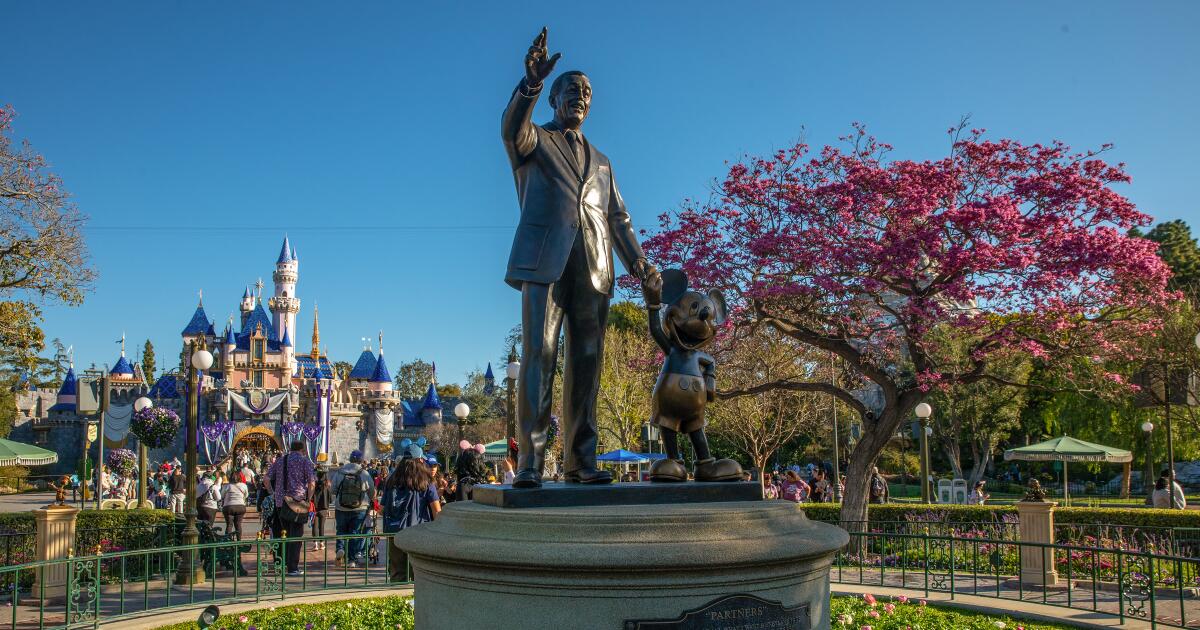
Disneyland to offer $59 evening tickets next month
-
 Entertainment12 minutes ago
After Amazon drops OpenAI movie ‘Artificial,’ film finds new home at Neon
-

 Lifestyle18 minutes ago
ICICLE: Capturing Interest in Chinese Brands
-
 Politics25 minutes ago
Newsom signs off on 100% California tax for money from Trump’s $1.8-billion ‘slush fund’
-
 Science27 minutes ago
After bold pledge, EPA shelves microplastics testing in U.S. drinking water
-
 Sports33 minutes ago
Walter Alston, Dave Roberts and everyone in between: The 10 managers in L.A. Dodgers history
-

 World43 minutes ago
World’s oceans experience hottest June ever, scientists say more heat ahead

