Washington
How Washington’s crossing of the Delaware presaged a changing world


Spend some time staring at the famous painting “Washington Crossing the Delaware,” and you can’t miss the ice. It’s everywhere. Cold weather became part of Washington’s military strategy, says Alex Robb, an educator at Washington Crossing Historic Park outside Philadelphia. “It does a lot to impede the crossing and endanger the whole operation,” he said, “but it actually becomes our shield.”
At the end of 1776, after a string of losses, Washington’s army was on the verge of collapse. But Robb says that on Christmas, with ice forming in the Delaware River, the enemy assumed it was too dangerous for the Americans to cross.
They were wrong … and the cold weather handed Washington the element of surprise. His victory at Trenton was a sign that the war could still be won.
Robb said, “Looking back, had the weather proven more mild, they most definitely would’ve encountered resistance outside Trenton.” Just a few degrees made the difference between winning and losing a battle.
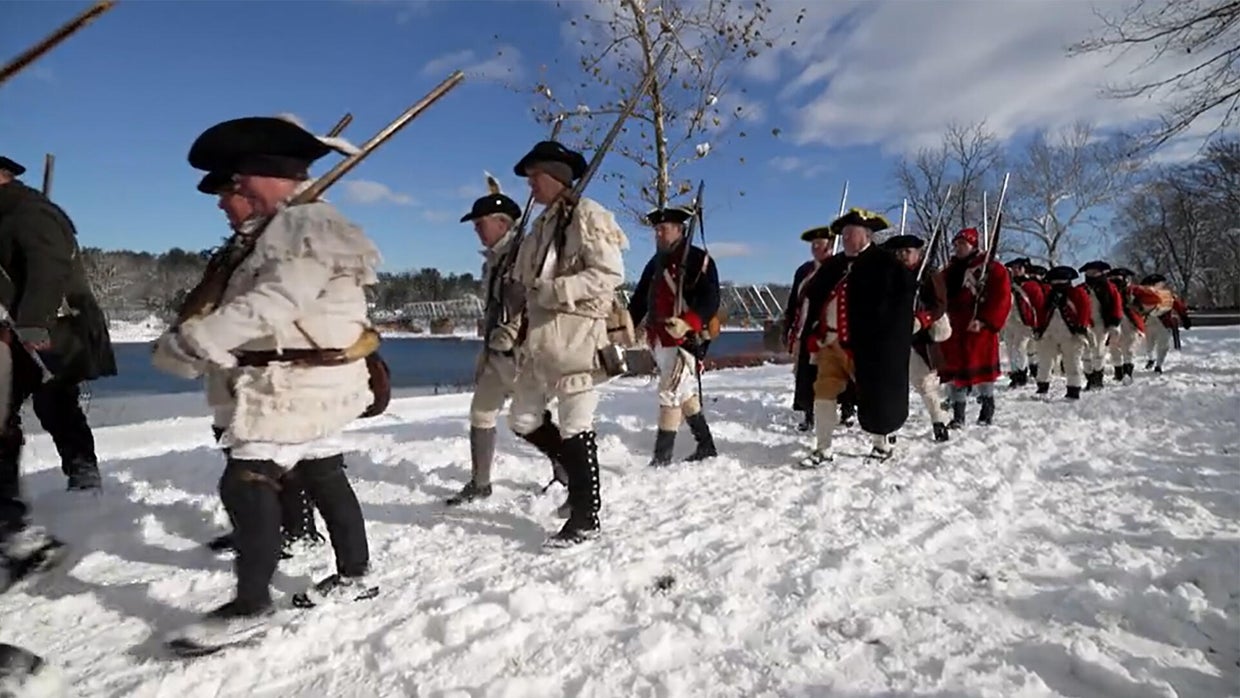
At that time, Americans were used to colder winters. We know that from Thomas Jefferson’s meticulous, handwritten weather records. But since then, winter has gotten warmer. “Ever since Washington was here, there has been a steady increase,” said Jen Brady, a data analyst at the science non-profit Climate Central. Their research shows that average winter temperatures in the Philadelphia area have gone up and down over the years. But overall, they are now 5.5 degrees warmer than they were in 1970.
As for the current weather conditions around Washington Crossing, Pa., Brady said, “It will continue to snow. There will continue to be cold in cold places. But there will be less of it.”
“It’s a time machine”
The best evidence of our changing climate comes from ice cores – long tubes of ice extracted out of glaciers in Greenland and Antarctica. And inside the ice core are perfectly-preserved air bubbles. The deeper you drill, the older the bubbles. “It’s this sort of magical way of going back in time,” said Eric Steig, a glaciologist at the University of Washington in Seattle. “It’s a time machine.”
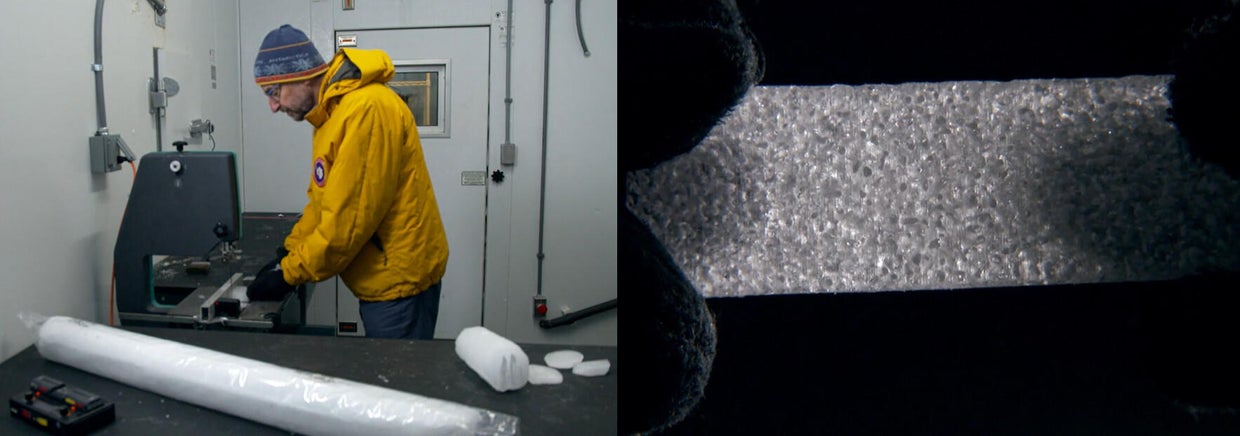
Steig showed us one ice core that dates from 1776, containing tiny pockets of air from that time. “So, like, you’re breathing a little bit of the air that George Washington breathed,” Steig said.
Those bubbles contain carbon dioxide, a gas that helps regulate Earth’s temperature. And for 800,000 years the carbon levels found in ice cores have gone up and down, but never above 300 parts per million – not until around 1800, when they started to take off.
What changed at that point to make that spike? “We began burning fossil fuels, and we’re doing it really fast,” Steig said.

Since the Industrial Revolution, which began around the time of the American Revolution, our cars, factories, and power plants have been burning oil and gas and emitting massive amounts of carbon dioxide. That has led to warmer temperatures, which can intensify extreme floods, droughts and fires.
Steig said, “It would seem to me it’s good for people to understand things have changed, and will continue to change, and have an understanding of what to expect going forward.”
So, it turns out, around the time Washington looked out on the icy Delaware, there were two important pictures coming into focus: One, the story of America; the other, the beginnings of climate change.
And both continue to shape our world.
What would Washington say if he showed up in 2026? Steig replied, “You pluck somebody from that time period, they would see things having changed quite dramatically.”
For more info:
- Alex Robb, Washington Crossing Historic Park, Washington Crossing, Pa.
- Jennifer Brady, senior data analyst and research manager, Climate Central
- Eric Steig, glaciologist, College of the Environment, University of Washington, Seattle
- Thanks to Martin Froger Silva, University of Minnesota Climate Adaptation Partnership, and the U.S. Ice Drilling Program
Story produced by Robert Marston. Editor: Chad Cardin.
See more:



Vivas, 25, hit .270 with 21 doubles, a triple, four home runs, 43 RBI, 64 walks, 12 stolen

The Second Round of the women’s 2026 NCAA Tournament continues Sunday with a slate featuring No. 3 TCU vs. No. 6 Washington on the eight-game schedule.
Here is the latest on Sunday’s March Madness matchup, including expert picks from reporters across the USA TODAY Sports Network.
USA TODAY Sports has a team of journalists covering the women’s NCAA Tournament to keep you up to date with every point scored, rebound grabbed and game won in the 68-team tournament.
USA TODAY Studio IX : Check out our women’s sports hub for in-depth analysis, commentary and more
Join the USA TODAY $1 million Bracket Challenge
No. 3 TCU vs No. 6 Washington prediction
- Heather Burns: TCU
- Mitchell Northam: TCU
- Nancy Armour: TCU
- Cydney Henderson: TCU
- Meghan Hall: TCU
No. 3 TCU vs No. 6 Washington odds
- Opening Moneyline: TCU (-520)
- Opening Spread: TCU (-9.5)
- Opening Total: 125.5
How to Watch TCU vs Washington on Sunday
No. 3 TCU takes on No. 6 Washington at Schollmaier Arena in Fort Worth on March 22 at 10:00 p.m. (ET). The game is airing on ESPN.
Stream March Madness on Fubo
2026 Women’s NCAA Tournament full schedule
- March 18-19: First Four
- March 20-21: First Round
- March 22-23: Second Round
- March 27-28: Sweet 16
- March 29-30: Elite 8
- April 3: Final Four
- April 5: National Championship

WEST PALM BEACH, Fla. (AP) — The Washington Nationals released right-handed pitcher Drew Smith on Saturday.
Smith, 32, had signed a minor league deal with an invitation to major league camp after missing the entire 2025 season to recover from Tommy John surgery. He went 1-1 with a 3.06 ERA and two saves in 19 relief appearances with the New York Mets in 2024.
Smith has gone 12-13 with a 3.48 ERA and five saves in 191 career games, all with the Mets.
___
AP MLB: https://apnews.com/hub/mlb

Pistons’ old rivals arrive in Detroit on hot streak, looking like NBA title contenders

San Francisco Giants Offseason Moves That Already Look Smart, and Dumb

Golden Knights edge Dallas 3-2 on late goal, deny Stars’ bid to clinch a playoff berth

Sebastian Korda stuns world No. 1 Carlos Alcaraz at 2026 Miami Open | Tennis.com

Will President Trump send ICE agents to Boston’s Logan Airport?

Florida High School Football Rankings: Top 25 teams – Oct. 21

How old is Bo Nix? What to know about Oregon quarterback ahead of 2024 NFL Draft

Cleary's 21 help Le Moyne down Central Connecticut State 69-64 in OT

99th annual Pony Swim held in Virginia

Indiana Members Credit Union announced as new anchor tenant at Bottleworks District

Video: ICE Agents Will Be Deployed to U.S. Airports, White House Confirms

Schumer knocks Trump on Iran, plan to send ICE to airports: ‘Asking for trouble’

‘Risk of escalation is extremely high as Iran shows it can retaliate’

Immigration agents deploying to airports under border czar as TSA staffing falls short | CNN Politics

Video: Former F.B.I. Director Robert Mueller Dies at 81
-

 Detroit, MI4 days ago
Drummer Brian Pastoria, longtime Detroit music advocate, dies at 68
-

 Oklahoma1 week ago
Family rallies around Oklahoma father after head-on crash
-

 Nebraska1 week ago
Wildfire forces immediate evacuation order for Farnam residents
-

 Georgia7 days ago
How ICE plans for a detention warehouse pushed a Georgia town to fight back | CNN Politics
-

 Alaska1 week ago
Police looking for man considered ‘armed and dangerous’
-
 Science1 week ago
Federal EPA moves to roll back recent limits on ethylene oxide, a carcinogen
-

 Movie Reviews4 days ago
‘Youth’ Twitter review: Ken Karunaas impresses audiences; Suraj Venjaramoodu adds charm; music wins praise | – The Times of India
-

 World1 week ago
Thousands march worldwide in solidarity with Palestine, Iran on al-Quds Day