President Russell M. Nelson, the 100-year-old leader of The Church of Jesus Christ of Latter-day Saints, may not know when Jesus is coming.
“But I do know,” he said in a recorded talk shown during Sunday’s afternoon session of General Conference, “that the Lord is prompting me to urge us to get ready for that ‘great and dreadful day.’”
On this hair-raising note, the centenarian announced 15 locales for new temples:
• Reynosa, Mexico.
Advertisement
• Chorrillos, Peru.
• Rivera, Uruguay.
• Campo Grande, Brazil.
• Porto, Portugal.
• Uyo, Nigeria.
Advertisement
• San Jose del Monte, Philippines.
• Nouméa, New Caledonia.
• Liverpool, Australia.
• Caldwell, Idaho.
• Flagstaff, Arizona.
Advertisement
• Rapid City, South Dakota.
• Greenville, South Carolina.
• Norfolk, Virginia.
• Spanish Fork, Utah.
The list is noteworthy for including more cities outside of the United States than within — a reflection, at least in part, of the Utah-based faith’s ongoing globalization.
Advertisement
The new additions propel the number of Latter-day Saint temples announced by Nelson to an even and historic 200 — and the total tally of such existing and planned edifices to 382. Nearly 53% of these temples have been named during his presidency.
From Sunday’s announcement, New Caledonia, a French territory in the South Pacific, will be getting its first Latter-day Saint temple.
The same goes for South Dakota.
(The Salt Lake Tribune; The Church of Jesus Christ of Latter-day Saints) Church President Russell M. Nelson, center, surrounded by recently constructed temples in Utah, Wyoming, and Argentina. He has announced 200 temples during his presidency.
In contrast, the Spanish Fork Temple will be the ninth for Utah County alone.
Advertisement
The Beehive State currently has 21 temples in operation, five under construction, two under renovation (including the historic Salt Lake Temple) and now four that have been announced and await a groundbreaking — or 32 in all.
Of the all the newly announced temples, one — Spanish Fork — was foretold by independent researcher Matt Martinich, who tracks global membership trends at ldschurchgrowth.blogspot.com. Others Martinich got within striking distance included Uyo, Nigeria, and San Jose del Monte, Philippines.
Besides announcing those 200 temples, the centenarian prophet-president dedicated the church’s 200th operating temple last November in Tooele.
For members, these sacred buildings represent Houses of the Lord and, unlike their more common meetinghouses, places where devout members participate in their highest religious rites such as eternal marriage.
SALT LAKE CITY (KUTV) — The 2025-2026 winter season isn’t quite over, but it’s no secret that it’s been a rough one when it comes to snow. Right now, statewide snowpack numbers are hovering around 60% of the median.
But you don’t have to know those numbers to understand what a strange winter it’s been.
“It’s kind of good,” said Carrie Stewart, who lives in Salt Lake City. “I mean, I like it because I like a milder climate. But I realize this summer is going to be hard.”
MORE | Snowpack
“I’m not sad I’m not shoveling,” said Sally Humphreys of Salt Lake City. “But it’s definitely worrying.”
Advertisement
State water officials are also worried. The clock is ticking to bulk up those snowpack numbers.
“We’re running out of time to get the snowpack that we need,” said Jordan Clayton, supervisor of the Utah Snow Survey. “We have about 40 or so days until our typical snowpack peak.”
There is still some time to make up lost ground, but the odds aren’t great. Clayton estimates a 10% chance of reaching normal by the end of the season.
“Those are terrible odds,” he said.
In fact, the odds of having a record low snowpack are greater, sitting at 20%. It’s a grim reality that has officials looking toward the summer anxiously.
Advertisement
“I would expect to see watering restrictions outdoors for a lot of places,” said Laura Haskell, Utah’s drought coordinator.
It’s unknown what the next few weeks will bring, but if Haskell had to guess, she doesn’t see state reservoirs filling up much from where they are now.
“In the spring when that runoff hits, we do get a noticeable peak in our reservoir storage,” Haskell said. “The water just starts coming in. But this year, we don’t anticipate getting that.”
Haskell says we have enough reservoir storage to likely make it through the summer, but there are other implications to worry about.
Our autumn season was pretty wet. That led to decent soil moisture levels, which can then lead to higher vegetation growth.
Advertisement
“If we then have a snowpack that melts out really early, we’ll have a longer than normal summer, if you will, with forage growth that might dry out, and so that’s kind of a bad recipe for promoting fire hazard,” Clayton said.
Utahns have dealt with low snowpack levels in the past. Many Utahns are familiar with their lawn turning brown because of water restrictions.
“We’ll probably just let it go that nice, sandy, golden color that it gets in the summer in a dry climate,” said Dea Ann Kate, who lives in Cottonwood Heights.
As we wait to see what the next few weeks bring, people like Carrie Stewart are just reflecting on an unusual winter.
“It is worrying,” she said. “We need snow. We’ve only shoveled once this season, and that’s very unusual.”
Advertisement
Water officials are now hoping for something else unusual: climbing out of the snowpack hole that’s been created.
“But there are no times going back where the snowpack totals for the state were close to where they are right now, and we ended up actually at a normal peak,” Clayton said. “So while it’s possible, it’s very unlikely.”
SALT LAKE CITY — The presence of federal immigration agents tracking immigrants has increased in Salt Lake County-area courtrooms since mid-February as have complaints about how they’re carrying out their duties.
United States Immigration and Customs Enforcement agents may have carried out operations at the Matheson Courthouse in Salt Lake City, according to Lacey Singleton, a public defender who’s regularly at the facility.
“Now it is like they are there all the time … They just basically hang out, and they’re either sitting in the courtroom, or they’re lurking in the hallways,” she said. They wear normal street garb, she said, but for regulars in the courtroom, “they stand out.”
Immigration enforcement action at courthouses around the country has become “a cornerstone” in the efforts of the administration of President Donald Trump to detain and deport immigrants in the country illegally, according to the American Immigration Council, an immigrant advocacy group. Since an arrest of one of Lacey’s clients around Feb. 12 or 13, she and others say, the practice has become more and more common in Utah.
Advertisement
ICE didn’t respond to a KSL query seeking comment, but the practice aligns with the Trump administration’s push to crack down on illegal immigration. Agency guidance notes that the people ICE seeks may appear in courthouses to address unrelated criminal and civil matters, and that such facilities are typically secure.
“Accordingly, when ICE engages in civil immigration enforcement actions in or near courthouses, it can reduce safety risks to the public, targeted alien(s) and ICE officers and agents,” reads a May 27 memo on the matter.
Critics, though, say immigration agents’ efforts can be disruptive and could spur immigrants, otherwise trying to resolve their legal issues, to steer clear of court, jeopardizing their cases. As word spreads of the activity, it could also spur fearful immigrant witnesses and crime victims to steer clear of the legal system, Lacey worries.
Salt Lake County Sheriff Rosie Rivera brought the issue up at a Salt Lake County Council meeting on Tuesday, saying her office has received “multiple complaints” about ICE agents’ activity in Salt Lake County courthouses, where sheriff’s officials, serving as court bailiffs, provide security.
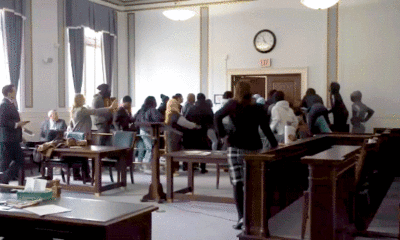
U.S. agents have ratcheted up immigration enforcement action at Utah courthouses, prompting criticism from some. The photo shows attorney Lacey Singleton, center, questioning a suspected agent recently at Matheson Courthouse in Salt Lake City. (Photo: Salt Lake City Bail Fund)
Part of the problem, she said, is that the agents typically wear plain clothes and don’t identify themselves, not even to bailiffs. Another issue relates to the actual process of taking an immigrant into custody, which Rivera says should occur outside of public view with the suspects’ lawyers present.
Advertisement
In one instance, she said, a bailiff heard a scuffle and thought someone was getting assaulted, only to find out it was ICE agents detaining somebody.
A bailiff and an ICE agent subsequently “got into a verbal altercation,” Rivera said. “We are addressing that issue, but I want you to understand, these deputies are put in a really tough situation, and in this situation, I understand how he could get to that point where he had no idea who they were, and he was trying to make sure that somebody wasn’t being assaulted at the time.”
Video from last week, posted to social media by the Salt Lake City Bail Fund, shows Lacey walking past a suspected immigration agent at the Matheson Courthouse, asking for identification but getting no reply. The Salt Lake City Bail Fund, critical of ICE activity, sends observers to the Matheson Courthouse to monitor the agency’s activity.
“That’s a problem because it’s like, who are you?” Lacey said. “For all I know, you’re some random dude who is just, like, off the street and participating in kidnapping people.”
Video supplied to KSL shows an incident outside Riverton Justice Court on Wednesday — four apparent immigration agents in plain clothes wrestling on the ground with an apparent suspect they were trying to take into custody.
Advertisement
“Don’t resist,” someone off-camera says in Spanish while filming the incident. “Son, don’t resist. Calm down. They’re going to hurt you more.”
The woman asks for his name and contact info after the agents cuff him and take him to a nearby car, while another man on the scene shouts at the officials and berates them. “You guys are disgusting,” the man says.
Anna Reganis, a public defender with the Salt Lake Legal Defender Association, like Lacey, said immigration agents detained a man at Salt Lake City Justice Court on Wednesday. She didn’t witness the actual detention, but heard the aftermath.
“All of a sudden, in my courtroom, we could hear from the lobby blood-curdling screams,” Reganis said. She went to the main lobby, finding a woman holding her infant baby “just inconsolably screaming and crying.” Turns out the woman had gone to the courthouse with her husband, and he had just been detained by immigration agents.
Read more:
Lacey maintains that the people the ICE agents seem to be pursuing aren’t the most hardened of criminals, which the Trump administration said would be the focus when the crackdown started. Reganis echoed that, noting that those with business in the Salt Lake City Justice Court face relatively minor offenses.
Advertisement
“Myself and my co-workers all had a bit of a wake-up call because we kept telling ourselves that this wasn’t going to happen at the justice court because all of our cases are class B and C misdemeanors and infractions,” she said.
The Salt Lake City Bail Fund launched training sessions late last year for volunteers to serve as courthouse observers, particularly at the Matheson Courthouse. Liz Maryon, who helps oversee the effort, foresees another round of training to get more help. “We’re currently working on expanding our capacity so that we can be there every day,” she said.
The Key Takeaways for this article were generated with the assistance of large language models and reviewed by our editorial team. The article, itself, is solely human-written.
SALT LAKE CITY — Iranians in Utah said Sunday they were celebrating and grateful for U.S. military action against Iran after nearly 47 years of the Islamic Republic regime.
They expressed hope for a future that might bring greater freedom to the people of that country.
“Thank you, Mr. Trump, for helping us,” said Kathy Vazirnejad as she sat inside Persian restaurant Zaferan Café. “The 21st of March is our New Year. For our New Year’s, we do exchange presents and I think President Trump gave us the best gift as any for this year in attacking this government and killing all of those people.”
Vazirnejad moved from Iran to Utah in 1984, graduated from the University of Utah, and obtained U.S. citizenship.
Advertisement
She said the regime was oppressive and “vicious.”
“They’re just a devil,” she said. “I mean, it’s a government that kills its own people.”
Though she has continued to return to Iran to visit family, she said those visits had become increasingly tense and uncertain, even though most Iranians opposed their own government.
“I have a dual citizenship, Persian passport and an American passport,” Vazirnejad explained. “It’s hard. Each time I go there to the airport, I’m showing them my Persian passport and I’m like, ‘Oh my gosh, if they see I’m very active in my social media against the government?’”
Numerous other Iranians shared similar stories of their departure from their homeland, including Ramin Arani, who once served for two years in the Iranian army at the age of 18.
Advertisement
“It was right after the Iran and Iraq war and I was part of the team that was cleaning the war zone basically in terms of unexploded shells and land mines and all that,” Arani explained. “I put my life on the line for the sake of my country, although I was not treated as a first-hand citizen.”
Arani said when he left Iran, he migrated to the U.S. and graduated from the University of Utah with an engineering degree.
“Every day, I appreciate the opportunity that was provided to me,” Arani said.
He said for decades, Iranians didn’t believe the day would come when much of the Islamic Republic’s leadership would be taken out in military strikes.
“I believe we are watching history unfolding,” Arani said. “Potentially, the course of history is about to change.”
Advertisement
What that change looks like exactly remains largely uncertain, though there has been much discussion about potential regime change or the Iranian people taking matters into their own hands.
“Regime change is, you know, a be-careful-what-you-wish-for,” said Amos Guiora, a University of Utah law professor and Middle East analyst with family in Israel. “I say, ‘regime change,’ I get the phrase, but how it comes about, time will tell.”
Guiora questioned how long the U.S. intended to stay involved and what the endgame truly is.
“There’s an expression in Hebrew, if I may—zbang ve’ga’mar’no—which means ‘it ends just like that’—that’s not how these things end and obviously there are political calculations,” Guiora said.
He said he feared for the potential loss of life if boots-on-the-ground are ultimately required.
Advertisement
“(If) any of these things turn into a war of attrition, that would be horrible,” Guiora said.
Guiora, however, said he saw the obvious benefit of different leadership in Iran.
“You know, a shah-like Iran that would not be focused on the support of terrorist organizations and committing acts of terrorism—I think that would be a win-win for the world,” Guiora said.
Arani said if regime change does happen in Iran, he would like to see a constitutional monarchy take root like those in Great Britain and elsewhere in Europe.
“Sweden, Norway, these are all systems that are democratic, or I call them semi-democratic and they still have a monarch, which is a continuation of their culture,” Arani said.
Advertisement
Arani talked of the rich and proud long history of Iran, dating back thousands of years, and he believed there is much of that to share with the world today.
“The culture of Iran that is hidden underneath the layers of history I’m talking about, it’s all about light,” Arani said. “Iranian culture, the real one I’m talking about, is all about appreciating life, not ‘death to this,’ ‘death to that.’”
Vazirnejad believed as many as “85 percent” of Iranians supported the return of the shah’s family to Iran to lead, and she predicted a future where Iran is a partner with the U.S. and Israel.
She suspected that maybe one in five Iranians who left Iran because of the regime might consider returning permanently to the country under new leadership.
“It’s going to be very good,” she said. “Hopefully, we are celebrating the New Year with (the Islamic Republic) gone and hopefully by next year, the New Year’s 21st of March, we all go back to Iran, at least to visit.”