Utah
How Jaren Kump used extra eligibility to earn a master’s degree that he hopes will help retiring college athletes

This article was first published in the Ute Insiders newsletter. Sign up to receive the newsletter in your inbox each Wednesday night.
Jaren Kump is a rarity in the modern age of college sports.
The former Utah offensive lineman spent six consecutive years with the Utes, playing every spot on the offensive line along the way.
Kump was a staple on the offensive line from the beginning, starting all five games during the COVID-19-shortened season in his freshman year. Over the years, he played wherever he was needed, and by the 2024 campaign, locked down the starting center job — a position he held through his senior season with the Utes.
Kump credited the positional versatility he experienced during his college career for helping him become a better lineman.
“It helped me a lot, especially playing center, having to be the quarterback of the offensive line, having to communicate every single play, having to read defenses and make adjustments based off what we see, based off game plan, based on whatever play we’re doing, situation,” Kump said.
“And then knowing exactly how my other guys, how their technique and what they’re seeing, knowing exactly what their game is also like, having done it myself, helped a ton.”
Kump, one of the oldest players on Utah’s roster, originally committed to the Utes back in 2017 out of Herriman High.
“I felt like it was the best place for me in terms of football and whatnot. When I told Utah I was going to come there and I signed my letter of intent there, it was important to me that I kept my word,” Kump said.
After serving a mission for The Church of Jesus Christ of Latter-day Saints in Brazil, Kump arrived back in Salt Lake City ahead of the 2020 season, which, due to the COVID-19 pandemic, would be a season like no other.
Over half of Utah’s games were canceled. Due to the circumstances, every player that was on the roster for that season received an extra year of eligibility.
Kump’s career would hit another bump in the road in 2021. After starting in every game in 2020 at right tackle, Kump started four of Utah’s first five games before suffering a season-ending injury.
Over his next four seasons, Kump was a key part of Utah’s success along the offensive line, and remained loyal to the Utes, even as offers from other schools came.
“Throughout my time at Utah for six years, of course, there was opportunity to go somewhere else and maybe make more money. And me and my wife, of course, we had conversations about that,” Kump said. “I think being responsible adults, there is room for conversation in that.”
In the end, Kump and his wife, Sydney, decided they’d only consider leaving Utah if Kump wasn’t getting enough playing time.
“Leaving for NIL purposes or stuff like that, we felt like that wasn’t the right thing to do. Plus, Utah did a good job at taking care of us anyway. We fell in love with Utah and we wanted to stay because we wanted to keep our word. That was the right thing to do,” Kump said.
Staying at Utah gave Kump the opportunity to be part of some of the highest peaks in Utah football history, including back-to-back Pac-12 championships in 2021 and 2022. Kump pointed to Utah’s 43-42 win over USC in 2022 as one of his favorite moments as a Ute, saying he had never heard Rice-Eccles Stadium as loud as it was when Cam Rising scored the game-winning two-point conversion.
Kump’s final game at Rice-Eccles, a 51-47 comeback win over Kansas State, is another memory he’ll cherish from his Utah career.
“That was another moment I heard Rice-Eccles Stadium erupt in the way that it’s known. Those are two moments I will never forget,” he said.
A high school coach gives Kump direction
As he began college, like a good chunk of university students, Kump didn’t know what he wanted to do post-football. He called his high school strength coach for advice, and in a lengthy conversation, he suggested that Kump could become a strength coach like him.
“Leaving for NIL purposes or stuff like that, we felt like that wasn’t the right thing to do. Plus, Utah did a good job at taking care of us anyway. We fell in love with Utah and we wanted to stay because we wanted to keep our word. That was the right thing to do.”
— Utah center Jaren Kump
“He explained to me, ‘You love training. Every time you come in, you’re passionate about what you do, you’re passionate about learning why you’re doing things, so why don’t you go and study for that?’ I’m like, ‘That’s a great idea,’ and so strength and conditioning is the kind of motivation to pursue kinesiology,” Kump said.
While some, including this reporter, might have thought that Kump’s extensive experience with strength and conditioning, injury management and personal training from college football would give him a leg up in the classroom, he said that it was actually the reverse.
“Being able to understand why we’re doing things really helps a lot when undergoing training and having to make adjustments based off of, say, injury or, say, tweaks here and there,” Kump said.
Though his first two years at Utah were anything but ideal on the field, he turned a negative situation to a positive one off the field, deciding to pursue a master’s degree with his two years of extra eligibility after graduating with his bachelor’s degree in kinesiology in 2023.
“I’m already here. I got a couple more years left. Might as well shoot for a master’s degree because if I don’t try to shoot for it, I know I’ll regret it for the rest of my life,” Kump said.
‘Be where your feet are’
In an era of college football where players are making big money and the sport is more and more professionalized with each passing year, it’s easy to forget that the players are full-time students as well.
Combining essentially a full-time job in college football with the intensive nature of a master’s program isn’t easy. According to Utah health and kinesiology associate professor Tanya Halliday, just 3% of Division I athletes pursue a graduate degree.
Kump segmented his two lives in his mind, which helped him manage his time well.
“Being where your feet are is something I learned while being a student-athlete as well. When I’m in school, when I’m doing my graduate studies, I’m working on my thesis, I’m not a football player. I’m 100% a student, I’m 100% a graduate student or whatever that entails,” Kump said.
“I’m not thinking about football, I’m not thinking about the mistakes I made in practice, I’m not thinking about how I can correct them, I’m 100% a student. And the same goes for football. You be where your feet are.”
With his background as a football player, Kump’s master’s degree thesis fittingly focused on the health and wellness challenges that Division I athletes face as they retire from sports.
“There’s a lot of data out there to suggest that student-athletes, as they retire, especially on the Division I level,” Kump said. “They’re experiencing a typhoon, a lot of negative health consequences and those include things such as lower rates of physical activity and even fitness compared to their nonathletic counterparts, a lower quality of nutrition and knowledge, an increased effect on their injuries, on their prolonging injuries as they continue into retirement and even increased rates of obesity.”
There’s also the mental health aspect, including a decreased sense of self-identity and mood.
Over the course of his master’s degree, Kump was able to survey hundreds of student-athletes to find out more about these health outcomes.
“A big piece that we saw is current student-athletes are anticipating the challenges of retirement very accurately based on the lived experiences of former student-athletes,” he said. “That would tell us that these student-athletes are kind of seeing these challenges coming. It’s not like they’re experiencing anything drastically different versus what they expected.”
Another big finding for Kump was the decline in self-efficacy of retired athletes.
“I would say the biggest challenge of what they saw was their self-efficacy in different areas, especially in self-efficacy and being able to manage their sport-related injuries. That was a huge piece that we saw as a challenge to them,” Kump said.
That showed up in other areas, like maintaining a physical health program and managing their mental health.
According to an article from University of Utah Health, this project is just beginning. Later, another student will build on Kump’s findings, using the data to “develop a deeper qualitative study and continue the work.”
Continuing his football dream in Chicago
Ahead of the NFL draft, Kump had a busy month. He trained for and participated in Utah’s pro day in front of NFL scouts, spoke with NFL teams and even got in some training sessions with Utah offensive line coach Jordan Gross and offensive lineman Isaiah Kema.
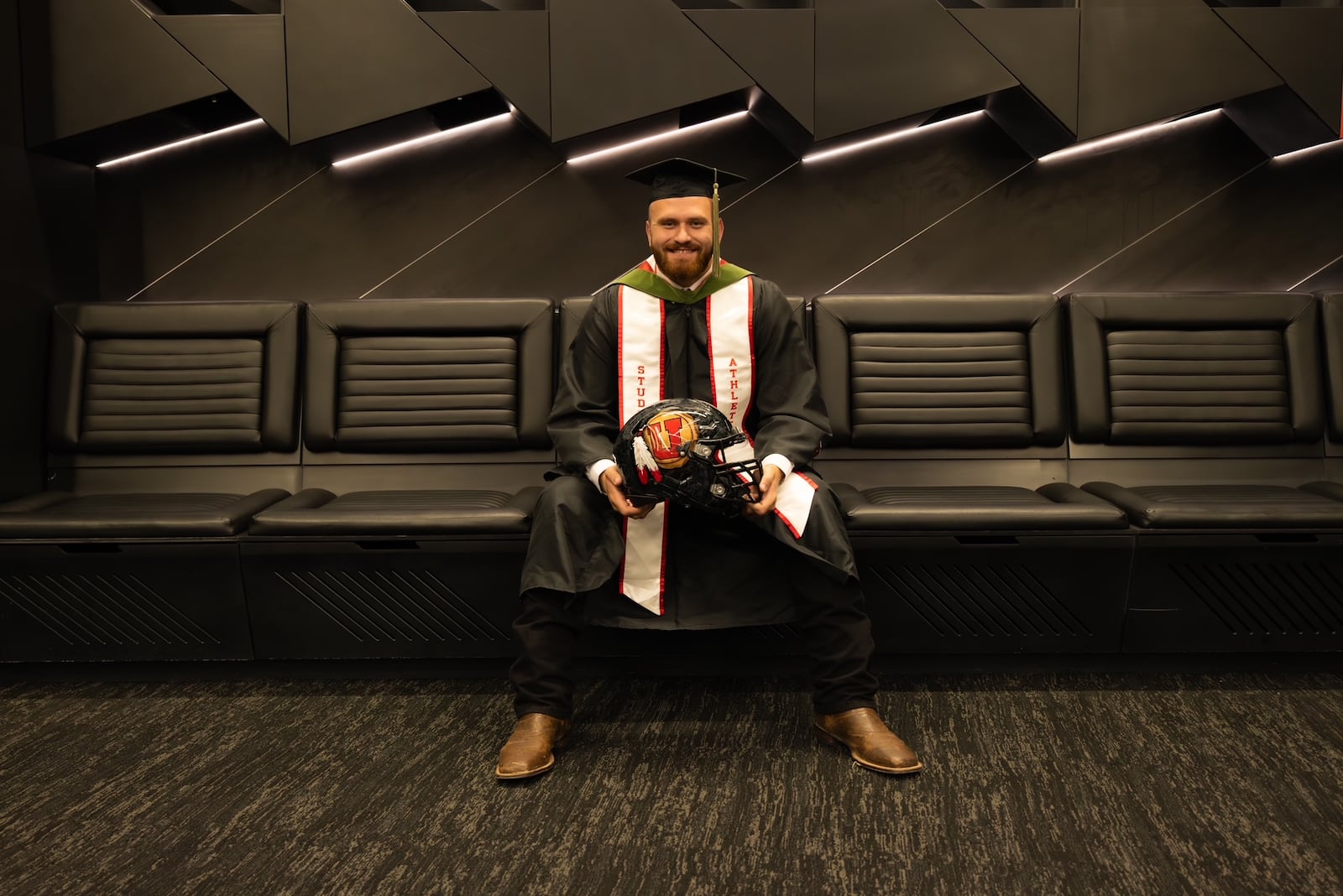
Just days before the NFL draft, Kump received his master’s degree in kinesiology — a major achievement.
“The thing that I found probably most rewarding was honestly getting it done, feeling relieved of getting it done, doing what I knew was going to be very, very difficult, but I knew that I could do it if I really put my mind to it,” Kump said.
Over the three days of the NFL draft, Kump experienced a roller coaster of emotions.
“Anywhere between excitement, anger, frustration, a little bit of sadness,” he said.
Though he was not selected in the seven-round draft, he was the first Ute to sign an NFL free-agent contact, inking a deal with the Chicago Bears.
“As soon as we made a deal with the Chicago Bears, it was just a sense of relief. It felt like a weight was lifted off my shoulders and just washed away down the river. I’m super relieved and I’m excited for the opportunity now that we have an exact pinpointed place that we’re going, I can kind of focus on that now,” Kump said.
The whirlwind is just beginning for Kump. He’s packing up and moving to Chicago, where the Bears will hold rookie mini-camp at the start of May. At the end of May, the Bears will have team OTAs, followed by team-wide mini-camp in June.

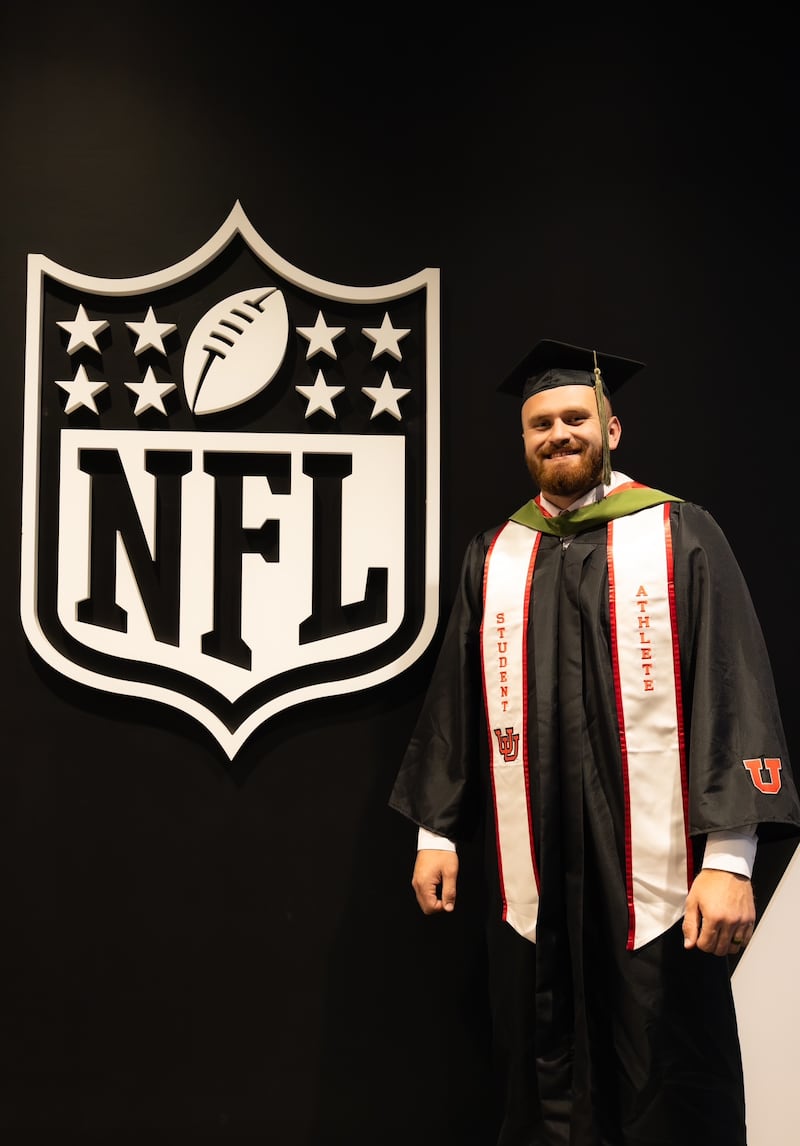
This time period is critical for Kump, who is trying to make the active roster.
“I’m very excited to go and just work my tail off and to be able to hopefully make a name for myself to get a roster spot,” he said.
Kump arrives in Chicago with a wealth of experience from his six seasons in college, and he feels like playing at Utah has set him up well for the NFL experience.
“I would say from what I understand, how the NFL structures practices and layout of everything and coaching styles and how decisions are made, a common theme I keep hearing from older guys that come back and talk to us is that it’s very similar to how Utah runs things and it helped prepare them in ways that they didn’t understand, they didn’t know at the time when they were in college,” Kump said.
Kump hopes he will have a lengthy NFL career, but when his time to retire from football comes, he plans to still be around the sport, putting his degree to use as a strength and conditioning coach or a position coach.
“After my football career, hopefully that lasts for some years, but whenever that is, either strength and conditioning or I’ve even thought about being a position coach. … I do know that having a master’s degree does help with that as well, having that on your résumé,” Kump said.

In case you missed it
Former Ute offensive tackle Spencer Fano was selected by the Cleveland Browns with the No. 9 pick in the 2026 NFL draft, while fellow offensive tackle Caleb Lomu was selected by the New England Patriots with the No. 28 pick.