West
Trump visits California after ripping 'idiot' Newsom on wildfire; critics bash crime, homelessness, spending

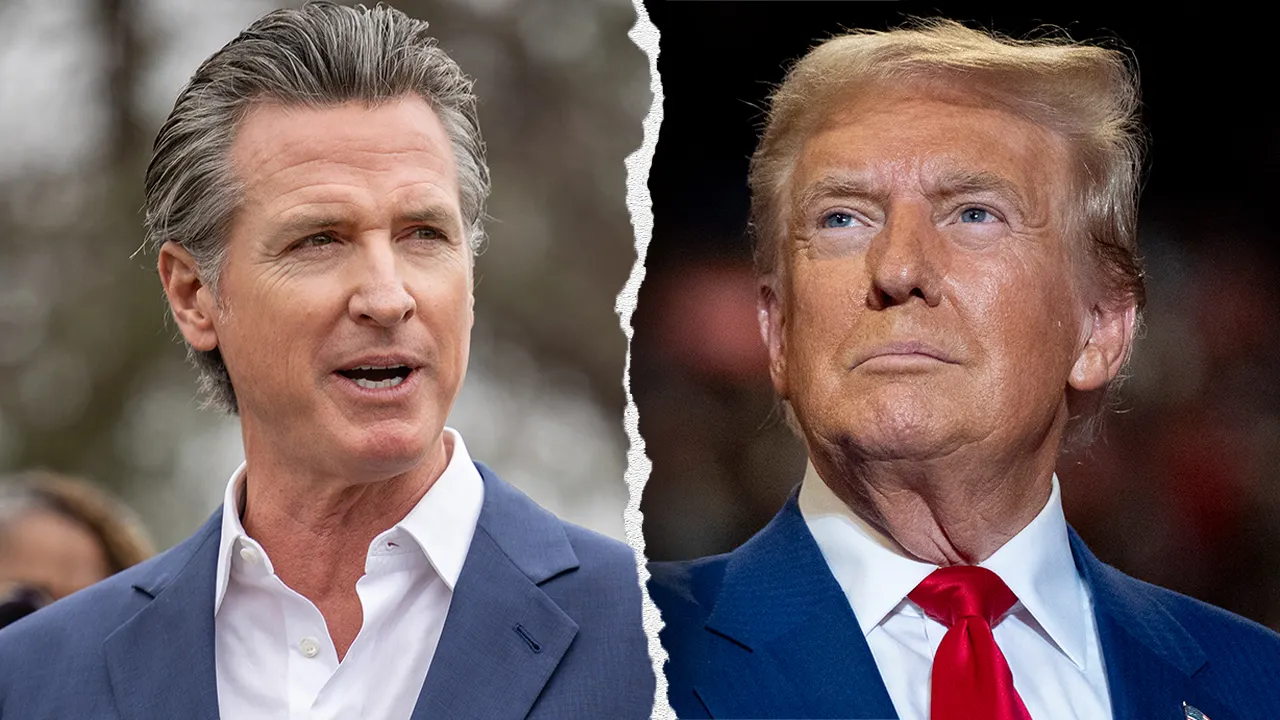
During his inaugural address, President Donald Trump criticized California’s response to the Los Angeles wildfires ahead of his Golden State visit to survey the damage on Friday.
Trump has been vocal of his disapproval of the way California Gov. Gavin Newsom and Los Angeles Mayor Karen Bass have handled the fire response, accusing them of “gross incompetence,” even suggesting that Newsom resign as governor.
During Trump’s visit to California Friday, Newsom greeted the president at the bottom of Air Force One.
“Thank you first for being here. It means a great deal to all of us,” Newsom told Trump after they met on the tarmac of LAX in Los Angeles just after 3 p.m. “We’re going to need your support. We’re going to need your help.”
Newsom and Trump face off on Los Angeles tarmac. (Pool)
US President Donald Trump and First Lady Melania Trump tour a fire- affected area in the Pacific Palisades neighborhood of Los Angeles, California, on January 24, 2025. (MANDEL NGAN/AFP via Getty Images)
In his first televised sit-down interview with Fox News host Sean Hannity since returning to the White House, Trump ripped Newsom for his leadership leading up to the deadly wildfires and his defense of sanctuary cities.
“If you actually polled the people, they don’t want sanctuary cities,” Trump told Hannity. “But Gavin Newsom does, and these radical left politicians do. I watched Gavin Newsom try to answer that question. He looked like an idiot. He was unable to answer.”
Trump claimed the lack of forest management and Newsom’s reported refusal to allow stormwater from the north to flow down freely to Southern California helped contribute to one of the most destructive wildfires in the state’s history.
Izzy Gardon, director of communications for Newsom’s office, previously combated criticism of the governor’s wildfire handling in a statement to Fox News Digital.
“The Governor is focused on protecting people, not playing politics, and making sure firefighters have all the resources they need,” Gardon said.
On Thursday, Newsom signed off on a relief package where the state will spend $2.5 billion to help with the Los Angeles wildfires recovery.
“This is about distilling a sense of hopefulness,” Newsom said during a news conference.
Newsom’s administration added that the state expects to be reimbursed by the federal government for the disaster relief funding.
“We are glad President Trump accepted the governor’s invitation to come to Los Angeles,” Newsom’s office told Fox News Digital earlier this week. “We are glad he took our invitation to heart.”
Newsom told FOX 11 Los Angeles on Thursday that he had not heard anything from the White House about Friday’s trip, and that he had not spoken to Trump since he left office in 2021. The governor said he was planning to meet Trump when he arrives, though.
“I look forward to being there on the tarmac to thank the President, welcome him,” Newsom told FOX 11. “And we’re making sure that all the resources he needs for a successful briefing are provided to him.”
Before leaving the White House on Friday morning, Trump told reporters, “I think we’re going to have a very interesting time.”
Trump’s criticism of California and Newsom’s leadership in the state spans years, with the president singling out forest management, sanctuary cities, homelessness, crime and spending as contributing factors to the state’s condition.
Mel Gibson calls out ‘monumental mismanagement’ of LA fires by California government after losing his home
Trump is not the only person ripping Newsom for what is happening in California.
In the aftermath of the deadly Los Angeles wildfires, actor Mel Gibson, along with a number of other elite residents, accused Newsom and elected officials of mishandling the prevention and response to the disaster.
“As a citizen here, Newsom and [Los Angeles Mayor Karen] Bass, they want us to trust them to reimagine the city, our city, and how they think it should be. I mean, look at what they’ve done so far to this town,” Gibson said in a previous exclusive interview with Fox News contributor Raymond Arroyo.
“You got nothing but rampant crime, acute homelessness, high taxes, mismanagement of water, firefighters, defunding the department, and we’re supposed to trust them with millions of dollars to sort of remake where we live? It’s our city, it’s the city of the people, and they have another plan. … There’s still people from the Woolsey Fire still living in trailers. … When have you ever seen the government ‘build back better’? … At the very least, it’s insensitive.”
MEL GIBSON CALLS OUT ‘MONUMENTAL MISMANAGEMENT’ OF LA FIRES BY CALIFORNIA GOVERNMENT AFTER LOSING HIS HOME
The Palisades Fire ravages a neighborhood amid high winds in the Pacific Palisades neighborhood of Los Angeles, Jan. 7, 2025. (AP Photo/Ethan Swope)
The massive and deadly fires broke out in the Los Angeles area on Jan. 7, forcing tens of thousands of residents to flee for safety as their homes and businesses were destroyed.
Gibson also told Arroyo the elected officials’ mismanagement is another reason why Americans continue to flee the city.
Other celebrities, including Justine Bateman, called out Newsom and other Los Angeles officials to be removed from office because of the fires.
The governor’s office previously shared a letter addressing water hydrants running out of water, stating that “while overall water supply in Southern California is not an issue, water mobility in the initial response was an issue.”
“That is why @CAGovernor Newsom has ordered a full, independent review of LADWP. This cannot happen again,” the post read.
California GOP leaders call for accountability after state can’t account for $24B spent on homeless crisis
Prior to the Los Angeles wildfire crisis, California leadership were being scrutinized for not being able to explain what happened to $24 billion meant to curb the homelessness issue.
California GOP leaders are calling for more accountability after the state auditor found that despite roughly $24 billion spent on homeless and housing programs during the 2018-2023 fiscal years, the problem didn’t improve in many cities.
The report also uncovered that the California Interagency Council on Homelessness (Cal ICH), which is responsible for coordinating agencies and allocating resources for homelessness programs, stopped tracking whether the programs were working in 2021.
CALIFORNIA GOP LEADERS CALL FOR ACCOUNTABILITY AFTER STATE CAN’T ACCOUNT FOR $24B SPENT ON HOMELESS CRISIS
Gov. Gavin Newsom; people at a homeless encampment in California (Getty Images)
The audit found it also failed to collect and evaluate outcome data for these programs due to the lack of a consistent method.
California Assembly Republican Leader James Gallagher laid the blame on the Newsom administration.
“This is standard Gavin Newsom – make a splashy announcement, waste a bunch of taxpayer money, and completely fail to deliver,” Gallagher said in a statement to Fox News Digital.
“Californians are tired of the homeless crisis, and they’re even more tired of Gavin’s excuses. We need results – period, full stop.”
Despite the audit’s findings, Cal ICH said it has made improvements in data collection after AB 977 took effect on Jan. 1, 2023.
In a previous statement, Newsom’s office said, “The State of California’s doing more than ever. We’ll continue to do more. But this will be my final words on this: If we don’t see demonstrable results, I’ll start to redirect money. I’m not interested in status quo any longer. And that will start in January with the January budget. We’ve been providing the support to local government that embraces those efforts and focuses on a sense of urgency — and we’re going to double down. If local government is not interested, we’ll redirect the money to parts of the state, cities and counties that are.”
Biden admin sends billions to California’s over-budget, behind-schedule ‘train to nowhere’
Adding to the list of missteps made by California leadership: the decades-delayed and over-budget “train to nowhere.”
California Republicans have reported that the state’s long-awaited high-speed rail network is nearly $100 billion over budget and decades behind schedule.
Former Republican California Gov. Arnold Schwarzenegger, who left office in early 2011, first introduced the high-speed rail system project, and his Democrat successor, Gov. Jerry Brown, continued the project.
Shortly after taking office in 2019, Newsom acknowledged in his first State of the State address that he would scale the project down from its original ambitious plan, saying it would cost too much and take too long to stay the course.
Months later, the Trump administration penned a scathing letter to California, informing the state that it was rescinding the multibillion-dollar grant awarded for the project under the Obama administration.
BIDEN ADMIN SENDS BILLIONS TO CALIFORNIA’S OVER-BUDGET, BEHIND-SCHEDULE ‘TRAIN TO NOWHERE’
Ongoing construction of the California bullet train project is shown in Corcoran, left, and Hanford. (Getty Images)
However, in June 2021, the Biden administration said it would reverse the decision and restore the funding. The Biden administration then sent California more than $3 billion in federal taxpayer funds in 2023.
In December 2024, several prominent California Democrats called on the U.S. Department of Transportation to approve a grant application for $536 million in federal funds to move forward with the project.
If approved, the federal funds will be boosted by $134 million in state money from California’s “cap & trade” program, according to the Sacramento Bee.
The project was originally planned as a $33 billion project consisting of 1,955 miles of railway connecting San Francisco to Los Angeles. Since then, the cost has ballooned to $113 billion and the project’s scope has been dramatically scaled down to a 171-mile railway connecting Bakersfield, Fresno and Merced that isn’t expected to be operational until 2030.
Overall, if the project is completed in 2030, it will have taken a decade longer than expected while costing $80 billion more and being 91% smaller than originally planned. Because of its repeated shortfalls, the project has been dubbed by critics as the “train to nowhere.”
Newsom’s office did not immediately provide a response.
Proposition 36 overwhelmingly passes in California, reversing some Soros-backed soft-on-crime policies
During the presidential election, Trump went after his opponent, former Vice President Kamala Harris, on the decades-old criminal justice policy crippling California.
Harris was not actually involved with pushing Prop 47 and did not take a stance on the issue throughout the campaign.
The ballot measure overwhelmingly passed in the deep-blue state and rolled back some of California’s most controversial soft-on-crime policies.
Proposition 36, the Homelessness, Drug Addiction and Theft Reduction Act, sought to undo portions of Proposition 47 by increasing penalties for some crimes, including classifying the possession of fentanyl as a felony.
PROPOSITION 36 OVERWHELMINGLY PASSES IN CALIFORNIA, REVERSING SOME SOROS-BACKED SOFT-ON-CRIME POLICIES
Business and police in California (Getty Images)
When Proposition 47 passed in 2014, it downgraded most thefts from felonies to misdemeanors if the amount stolen was under $950, “unless the defendant had prior convictions of murder, rape, certain sex offenses, or certain gun crimes.”
Proposition 47 also reclassified some felony drug offenses as misdemeanors.
The initiative has been blamed by law enforcement officials and businesses for the rise in theft and smash-and-grabs that plagued California in the years since the COVID-19 pandemic.
Newsom remained opposed to the effort, saying it “takes us back to the 1980s, mass incarceration.”
He also touted that California’s $950 threshold is the “10th lowest, meaning tougher than states like Texas ($2,500) or Alabama ($1,500) or Mississippi ($1,000).” His office noted that “Prop 47 did not change that threshold and neither did Prop 36.”
California unemployment fraud scandal grows to $11 billion, with another $20 billion under scrutiny
California Labor Secretary Julie Su attempted to put the blame on Trump’s first administration for “failing to provide guidance to foil sophisticated unemployment schemes” after state officials reported that at least $11.4 billion in unemployment benefits paid during the COVID-19 pandemic involved fraud.
Officials added that another $20 billion in possible losses was also being investigated.
In January 2021, Su said that of the $114 billion the state paid in unemployment claims during the coronavirus pandemic, 10%, or $11.4 billion, involved fraud and another 17% was under investigation.
CALIFORNIA UNEMPLOYMENT FRAUD SCANDAL GROWS TO $11 BILLION, WITH ANOTHER $20 BILLION UNDER SCRUTINY
Gov. Gavin Newsom speaks during a press conference in Fontana, Calif., on Feb. 17, 2022. (Watchara Phomicinda/MediaNews Group/Press-Enterprise via Getty Images)
“There is no sugarcoating the reality,” Su said in a previous press conference. “California has not had sufficient security measures in place to prevent this level of fraud, and criminals took advantage of the situation.”
Nearly all the fraudulent claims were paid through the federally supported Pandemic Unemployment Assistance program. The program was approved by Congress to provide unemployment assistance to those who usually wouldn’t be eligible, such as independent contractors.
Officials added that the program’s broad eligibility requirements made it an easy target for criminals, including from Russia and Nigeria. In December, 21,000 prisoners scored more than $400 million from the state, including 100 prisoners on death row.
“It should be no surprise that EDD was overwhelmed, just like the rest of the nation’s unemployment agencies,” Su said. “As millions of Californians applied for help, international and national criminal rings were at work behind the scenes working relentlessly to steal unemployment benefits using sophisticated methods of identity theft.”
The governor’s office did not immediately provide a response.
Fox News Digital’s Brie Stimson, Aubrie Spady, Bradford Betz, Stephanie Giang-Paunon, Morgan Phillips, Thomas Catenacci, Jamie Joseph and Charlie Creitz contributed to this report.
Stepheny Price is writer for Fox News Digital and Fox Business. Story tips and ideas can be sent to stepheny.price@fox.com
Read the full article from Here


WASHINGTON ― Montana Republican Senate nominee Kurt Alme, who previously served as his state’s U.S. attorney, cut a plea deal in 2020 that allowed a tribal police officer who sexually abused a 6-year-old girl to serve less than a year in prison and avoid being registered as a sex offender.
Alme, who has President Donald Trump’s backing in his bid for Senate, served as Montana’s U.S. attorney in two stints. Trump appointed him both times; Alme served in the role from September 2017 through December 2020, and then again from March 2025 through March 2026.
Alme oversaw the case of Mychal Thomas Damon, who was indicted in June 2019 by a grand jury on one count of abusive sexual contact with an individual under 12, which carries a maximum punishment of a lifetime in prison, a $250,000 fine and no less than five years to a lifetime of supervised release. The average sentence for this crime is less severe, but still significant: 62 months in prison, no fine and 143 months of supervised release, based on an analysis of 2025 data provided by the U.S. Sentencing Commission.
Damon, 28, had admitted he touched the 6-year-old’s genitals. But in February 2020, Alme’s office filed a plea deal in his case that reduced his charge to felony child abuse.
The changes in the plea deal raised the alleged age of the victim from below 12 to below 14, stripped out the language of sexual intent and moved the offense out of the federal sex crime framework, meaning Damon would no longer be required to register as a sex offender. It jointly recommended Damon be sentenced to the time he’d already served of 324 days, and required only a sex offender evaluation. Alme’s name appears on the bottom of the document, along with a signature by his assistant U.S. attorney, Cassady Adams.
In June, Alme filed a sentencing memorandum that described Damon’s conduct, which included details of him touching the child’s vagina with skin-to-skin contact, and the adverse effect it had on her mental health. Local reporting at the time said the victim had told a therapist “Mychal touched me” and hurt her by putting his fingers in her “hoo hoo.”
Ten days later, Alme announced Damon was being sentenced to time served of 324 days and two years of supervised release. As of June 2026, Damon is not listed in the national sex offender registry or in Montana’s Sexual or Violent Offender Registry.
It’s not clear why Alme reduced the charges against Damon as significantly as he did. During part of his tenure as U.S. attorney, his office declined 64% of sexual assault cases. He conceded in a 2019 interview that this “is something that has to be worked on,” and noted that a lot of these cases are declined due to “weak or insufficient evidence.”
Asked what happened in Damon’s case, an Alme campaign spokesman on Thursday lashed out at unnamed Democrats for trying to make him look bad.
“Kurt’s liberal opponents are twisting the facts to manufacture a fake narrative that exploits crimes against women and children,” said Alme’s spokesperson. “Department of Justice policy required defendants to plead to the most serious charge readily provable from the evidence. Kurt strongly supported the Multi-Disciplinary Teams on our Native American reservations, led by his office, to support investigations of crimes against children and to support victims.”
His spokesperson also pushed back on the idea that Alme unreasonably declined a large number of sexual assault cases during his tenure as U.S. attorney.
“Kurt’s office prosecuted every viable sexual abuse felony referred to it and pursued the most serious charge readily provable from the evidence,” the spokesperson said. “Many ‘declined’ cases were to allow more appropriate tribal prosecutions ― they were not dropped. Kurt will bring his years of experience prosecuting criminals and working with the Sexual Assault Response Teams on our Native American reservations to the U.S. Senate to strengthen investigations, support victims, and better protect women and children.”
The campaign pointed HuffPost to a 2010 report by the Government Accountability Office that found the most common reason for U.S. attorney’s offices to decline sexual abuse cases referred in from Indian country was “weak or insufficient admissible evidence.” It also highlighted statements of support for Alme in an October 2025 press release by Sen. Steve Daines (R-Mont.), when he celebrated Alme being confirmed as U.S. attorney.
Alme is currently running for Daines’ Senate seat, and Daines went out of his way to clear the path for him. In a stunning and orchestrated maneuver, the two-term senator in March abruptly withdrew from reelection as Alme filed to run for his seat, minutes before the state’s filing period closed. Daines’ last-minute change-up was an effort to block potential Democrats or any major Republican challenger from jumping into an open Senate race.
Alme is taking on Democrat Alani Bankhead and independent candidate Seth Bodnar in the November election. Bankhead and Bodner have been duking it out for weeks, with each appealing to different factions of the Democratic party and calling on the other to drop out.
Bankhead, a retired Air Force officer, unexpectedly won the Democratic primary earlier this month, boosted by grassroots supporters and more than $2.5 million in outside money from a progressive veterans’ PAC. But Bodnar, a former University of Montana president who did not appear on the primary ballot, has bipartisan endorsements from prominent establishment figures, including former Democratic Sen. Jon Tester and former Republican Gov. Marc Racicot. He’s also significantly outraised Bankhead and Alme.
This Senate seat is rated “solid Republican” by the nonpartisan Cook’s Political Report, meaning Alme is well-positioned to win the general election. But this race would be more competitive if Bodner and Alme were going head to head, without Bankhead in the running.
Nevada
Voting rights advocates score three legal victories but remain on alert against election threats


Did the Drug Enforcement Agency break the law and gamble with public safety when it permitted large quantities of fentanyl pills to be trafficked in New Mexico in the hopes of getting a larger drug-trafficking bust?
That is the question at the heart of an explosive story published in the Associated Press, based on information provided by a former DEA agent turned whistleblower; the whistleblower filed a complaint in 2023 that claimed agents had allowed hundreds of thousands of fentanyl pills into Albuquerque – a city still reeling from the opioid crisis while many others across the country are seeing overdose rates decline.
“We poisoned our community to make cases,” DEA special agent David Howell told the outlet. “Through our own willful blindness, we get to say, ‘We don’t really know what happened to the drugs.’ But we 100% got people killed.”
Howell told the AP that, in some cases, the DEA had detailed intelligence about drug deliveries, including precise pill counts in shipments to Albuquerque.
DEA agents deciphered coded chatter over cellphones and closely surveilled a transaction of 74,000 fentanyl pills at a mobile home park in Albuquerque in June 2023, according to documents reviewed by AP. Days earlier, another shipment had also gone without seizure.
“We did nothing but sit back and watch,” Howell said.
One kilogram of fentanyl, which equates to thousands of pills, has the potential to kill 500,000 people, per the DEA’s own reporting.
The DEA has since challenged the AP’s reporting, saying in a statement to the Guardian that “public descriptions suggesting that DEA knowingly permitted fentanyl to reach communities are false and fundamentally mischaracterize the facts”.
“The cases in question involved complex, court-authorized Title III investigations in which agents and prosecutors conducted real-time surveillance, intelligence gathering, and operational analysis targeting larger drug trafficking organizations,” it added.
The agency further said that in “operational decisions in investigations like this, DEA is mandated to coordinate investigative decisions with USAO (offices of US attorneys) leadership to ensure investigative steps are carefully coordinated to prevent harm to the public” and the decisions it had made “were lawful, reasonable under the circumstances, and consistent with department guidance”.
Nonetheless, in a subsequent statement, the DEA asked the US justice department’s internal watchdog – the office of inspector general – to investigate Howell’s complaint.
Meanwhile, New Mexico attorney general Raúl Torrez announced Friday the opening of a formal investigation into allegations.
“If those allegations are accurate, the consequences for New Mexicans were not abstract. They were fatal,” Torrez wrote in his letter to governor Michelle Lujan Grisham. “New Mexico already ranks among the states hardest hit by fentanyl overdose deaths, and the families who have lost children, siblings, and parents to this crisis deserve a full accounting of what the federal government knew, what it did, and what it failed to do.”
Torrez said he was “committed to pursuing every appropriate legal avenue to hold the responsible parties accountable” but warned while federal agents “are not above the law, the supremacy clause of the United States constitution provides substantial protections for federal employees acting within the scope of their authority”.
But the report has raised question about whether the US’s premiere drug enforcement agency underplayed the threat of fentanyl.
Additionally, there are questions about whether they have focused too much on largely Mexican criminal groups behind the trade instead of local or retail distribution and the tens of thousands of overdose deaths attributed to it.
While drug fatalities have fallen by 24% from roughly 105,000 in 2023 to 79,384 in 2024, the downward trend has not been seen in all regions – including in New Mexico, particularly along the Rio Grande valley, with its long history as a trans-shipment route for Mexican black tar and brown heroin. For decades, the Los Alamos dormitory town of Española, 80 miles north of Albuquerque, was known as the heroin-addiction capital of America.
But the issue was largely localized. Addiction soared in the area with the relaxation of the opiate prescription practices in the late 1990s. When those gates were closed 15 years later, Mexican cartels switched from costly heroin production to the cheap, synthetic and more unpredictable fentanyl.
Overdose deaths in New Mexico increased 23% over the past year, marking the second consecutive year the state led the nation in overdose mortality. During the first half of 2025, three north-east counties, Rio Arriba, Santa Fe, and Taos, saw drug-related emergency room visits increase by as much as 204%, according to the New Mexico department of health.
Howell was uncovered as the author of the complaint to the justice department’s office of professional responsibility after reporters noticed the redactions had missed the last letter of his name; they contacted DEA agents who had worked in Albuquerque on LinkedIn. He reportedly paid a price for making the complaint – getting relegated to desk duty and getting docked in his performance evaluations.
Internal records also show prosecutors barred him from testifying in federal court, citing his “pattern of refusing to heed” admonitions to allow drugs to go without seizure during long-term investigations.
Alex Uballez, who served as US attorney in New Mexico from 2022 through 2025, told the AP that drug shipments had been allowed to go through without seizure as part of a broader effort to gather intelligence and build cases against major drug traffickers.
“The bigger fish are worth catching,” he said, “And that will save more lives.”
The finding that federal agents allowed hundred of thousands of pills to be distributed in Albuquerque has sent political shockwaves through the state.
Governor Lujan Grisham called the DEA’s actions “reckless and dangerous” and urged the New Mexico attorney general’s office to prosecute anyone responsible, “regardless of whether they are a federal agent or not.” Grisham also told the Albuquerque Journal that the result of this influx of pills was “hundreds of New Mexican parents burying their kids. Hundreds of New Mexican kids growing up without stable parents. All while the federal government stood by.”
A Democrat who is facing a re-election contest with former interior secretary Deb Haaland, Grisham said she repeatedly petitioned Joe Biden’s administration and federal officials for help with the fentanyl crisis.
“While my administration was doing everything we could to stem the tide of fentanyl coming into our state, the federal government deliberately allowed it to flood in,” she said. “I plan to hold the federal government accountable for this disaster and will explore every possible avenue of action to right these wrongs.”
Albuquerque Mayor Tim Keller said on X that the fentanyl epidemic has “torn through our streets” and “it is disgusting to think that federal authorities may have allowed hundreds of thousands of these deadly pills to move into our community and possibly killed people through their actions.”
Keller said at a news conference on Thursday that DEA had made an “immoral decision” and called it “a huge slap in the face to all of us as New Mexicans”.
Bernalillo county sheriff John Allen, which incorporates Albuquerque, told the Albuquerque Journal that the DEA had been allowed “to feed poison to our community for a bigger case”.
“I agree with getting the big fish and everything, but not when people are dying while we’re doing these investigations,” he added.
In 2017, the Department of Justice issued an internal “fentanyl protocols” guidance that directed federal agents to “seize or otherwise prevent the distribution” of fentanyl “as soon as practicable” and said that “protecting public safety is paramount” irrespective of larger investigations.
But two years ago, the DoJ revised that guidance to give agents more discretion, saying investigators “may exercise discretion in determining whether to take action to prevent the trafficking of fentanyl”, balancing public safety risks against “the benefits to be achieved through preserving the investigation.”
In December last year, Donald Trump issued an executive order designating fentanyl a “weapon of mass destruction” and gave defense secretary Pete Hegseth and then attorney general Pam Bondi broad latitude to use the resources of both departments to combat the scourge.
Empower Oversight, whistleblower organization that now represents Howell, says DEA routinely “walked” fentanyl shipments from at least 2023 to March 2025. As the DEA did, it called on the justice department’s office of inspector general and congressional oversight committees to investigate.
“The same agency that warns the public, ‘one pill can kill’, should not intentionally allow hundreds of thousands of fentanyl pills to hit the streets,” the organization said. “It’s outrageous to put that many lives at risk in hopes of making a big case.”
-

 Louisiana3 minutes ago
Louisiana is epicenter for red snapper fishing in Gulf of America
-

 Maine6 minutes ago
Maine could face $50M in penalties from federal food assistance policy changes
-

 Maryland11 minutes ago
Hutzell: The best, worst and just plain weird of Maryland’s weak primary
-

 Michigan18 minutes ago
Michigan firefighter among 3 killed in Colorado. What we know
-

 Massachusetts21 minutes ago
Who will take care of our older and disabled people? – The Boston Globe
-

 Minnesota26 minutes ago
Allie Lauer Of St. Cloud Tech Claims Clay Shooting Championship With A Score Of 99
-

 Mississippi33 minutes ago
Bobby Harrison: Mississippi Democrats hope they are not saying ‘if’ again after midterm elections
-

 Missouri36 minutes ago
Nick Bolton earns induction into the Missouri Athletic Hall of Fame

