West
This woman bought a dream house with a creek. Her community turned it into a living nightmare


Editor’s note: This is the first story in a series about Taralyn Romero’s property rights battle in Kittredge, Colorado. Read part 2 on Sunday.
KITTREDGE, Colo.– The house next to Bear Creek looked like something out of a fairy tale, growing right out of the earth alongside towering pine trees. Snow covered the ground, pristine except for a few animal tracks. The stream, nearly frozen over, meandered through the piles of white.
“It was pure bliss,” Taralyn Romero recalled. A playground even sat on the other side of the creek that she pictured her partner’s daughter enjoying.
But as the weather started to warm, pure bliss turned into a nightmare. And Romero, pitted against her neighbors and the local government, would soon become the wicked witch of her fairy tale.
SUPREME COURT DECIDES CASE OF CALIFORNIA MAN CHARGED $23,000 BY COUNTY TO BUILD ON HIS OWN LAND
Taralyn Romero looks over Bear Creek toward Kittredge Park. Her house sat on the south side of the creek, with a small slice of property extending to the north bank of the water. (Courtesy of Taralyn Romero)
Romero is a native Coloradan and had been living in Denver when COVID hit. Like so many city dwellers at that time, she decided she wanted more space and rented a house in the mountains. When the lease was up, she wanted to stay rural.
Enter the house in Kittredge, an unincorporated community about 30 minutes outside of Denver with a population just over 1,300 people as of the 2020 Census.
She fell in love with the home on a small slice of property along Bear Creek and moved in along with her partner and his daughter in March 2021. At first, the only trespassers on her land were elk and other animals.
As the snow melted away, fishermen started wading into the portion of Bear Creek that looped through the edge of her property.
Then summer hit. A couple fishermen turned into dozens of people gathering in Kittredge Park as school let out. Families brought their coolers and floaties and spent the day playing in her creek.
They left behind solitary socks and dirty kids’ clothing strewn over logs and tree stumps, empty baby wipes containers, children’s water bottles and a red Hydro Flask adorned with a sticker of a turtle and the words “F— plastic.”
At first, Romero was perplexed. There was no fence or other boundary between the park and her property. Maybe people just didn’t know they were on private land.
So that first summer, Romero says she asked visitors what they were doing there. Some knew the creek — and land next to it — were private, but told her the previous owners had long granted public access to both. Others were driving more than an hour from surrounding areas to get to a park that had a creek next to it, she said, unaware that the water was on private property.
BRENTWOOD BLIGHT: HOW A SUPREME COURT CASE ALLOWED GOVERNMENTS TO SEIZE PROPERTY ON BEHALF OF DEVELOPERS
Romero said dozens of people descended on the portion of Bear Creek that ran through the edge of her property, eager to enjoy the water during the summer. Some told her they knew it was private land, but that the previous owners let the community use it. Others had no idea, she said. (Courtesy Taralyn Romero)
Romero’s immediate concern was potential liability, she said.
“Having a playground where kids are running back and forth and the parents are sometimes distracted on their phones, made me incredibly concerned that I was going to be dealing with a drowning at worst, or someone getting hurt and slipping on the rocks at best,” she told Fox News Digital.
And while most visitors were respectful, she was upset at the mess left behind each day when the crowds finally went home.
Kids and pets dug holes in the creek bank. People broke trees and left trash. Diapers, cigarettes and cans littered the ground.
Romero said she didn’t know what to do. She put up a “no digging” sign, and she set out a table and chairs with a placard reading, “Private Property: Residents and Invited Guests Only.” They went ignored.
Her family was new to a small town and didn’t want to make waves, she said.
“We wanted to make friends. We wanted to fit in,” she said. But even gentle reminders to people that they were on private property and requests to respect the land were met with aggression and “vitriol,” she said.
Uncertainty over property lines
The summer after Romero purchased the home, county officials told community members that they were researching where the property lines stood. The county believed the creek had likely moved since the plat map for Kittredge was created in 1920.
“We don’t know if the creek has meandered onto their property,” Matt Robbins, spokesman for Jeffco Open Space, told local media at the time.
At a September meeting with the Kittredge Civic Association board, Romero and her partner Michael Eymer clarified that the “Residents and Invited Guests Only” sign meant Kittredge residents. An attorney from a nearby community whose children played in Bear Creek said she was considering seeking a temporary restraining order so families could continue using the park until the county determined who the real owners were.
Meanwhile, hostilities continued to grow.
“I got maps thrown in my face. I got cussed out. I got screamed at,” Romero said. “I got threatened, and I got told that it wasn’t my land and that I had stolen it.”
Romero said “bad actors” and “bullies” quickly outnumbered the rest, coming into her backyard specifically to antagonize the family.
“They were not there to play with the kids. They were there solely to scream at us, to cuss at us and to harass us,” she said.
TEXAS GRANDMOTHER JAILED IN ALLEGED POLITICAL RETALIATION WINS AT SUPREME COURT
Taralyn Romero said she was frustrated at the destruction and mess left behind by some families who visited Bear Creek. (Courtesy Taralyn Romero)
‘People lost their damn minds’
After what Romero described as a “trial period” in which she tried to share the land with the community like the former homeowners had done, she was done playing nice.
She strung a rope across her property and put up no trespassing signs.
“When that rope went up, people lost their damn minds,” she said. “It catapulted this situation into a whole other stratosphere.”
She said people started conspiring online and collectively agreed to ignore the rope and “openly trespass.”
Romero felt like she was portrayed “as a villain… someone who didn’t want to watch children have fun.”
“Once it got on to Facebook, it really took off,” she said, escalating from a couple of hundred people to a “full on frenzy” of mob mentality. People from around the country now hated her.
“It really changed the course of my journey… and threw me into an enormous battle, not only with my community, but eventually with my government as well,” she added.
This is the first story in a series about Taralyn Romero’s property rights battle in Kittredge, Colorado. Read part 2 on Sunday.
Read the full article from Here


LARAMIE — Nasir Meyer converted a three-point play with 35 seconds remaining to give Wyoming Cowboys men’s basketball the lead for good, and Wyoming held Air Force Falcons men’s basketball scoreless over the final two minutes to secure a 66-62 victory Saturday night.
The win marked the 13th home victory of the season for Wyoming, which improved to 16-13 overall and 7-11 in conference play.
“Air Force deserves all the credit and let’s talk about a team that has every reason not to fight, but thats why they are Air Force and the cadets and I have a lot of respect for them,” Wyoming coach Sundance Wicks said. “They were not going to quit, and I didn’t drive that message home enough and hats off to Air Force because they deserved to win. We snuck away with a win. Adam Harakow showed when we need him and he was massive for us. Simm-Marten was made big plays and Naz was clutch for us late.”
Advertisement – Story continues below…
University of Wyoming sports coverage
in Southwest Wyoming is supported by these great sponsors:
Wyoming shot 35% from the field and went 7 of 28 from 3-point range, making just two from beyond the arc in the second half. Air Force shot 49% overall and 44% from 3, hitting eight shots from long distance. The Cowboys made 13 of 16 free throws (81%) and scored 22 points off 15 Air Force turnovers while holding a 39-36 edge in rebounding.
Damarion Dennis led Wyoming with 16 points and three assists, going 7 of 8 from the free-throw line. Meyer finished with 14 points and tied a career best with eight rebounds. Adam Harakow added 14 points off the bench on 5-of-6 shooting, his first double-figure scoring game since the first meeting with Air Force. Simm-Marten Saadi had nine points in 13 minutes, and Kiani Saxon grabbed seven rebounds.
Air Force opened with back-to-back 3-pointers to take a 6-0 lead. Meyer scored Wyoming’s first basket, and Leland Walker added a 3-pointer to make it 8-5 with 16 minutes left in the first half.
Wyoming responded with a 9-0 run over nearly four minutes, with Saadi and Harakow each connecting from beyond the arc to give the Cowboys an 11-8 lead with under 14 minutes remaining. Air Force regained a 12-11 advantage as Wyoming went scoreless for more than two minutes.
Harakow’s second 3-pointer pushed the lead to 22-16 with nine minutes left in the half, and Wyoming used a 6-0 run while holding the Falcons without a field goal for more than four minutes to build a 28-18 lead with six minutes remaining. The Cowboys closed the half on a defensive stand, keeping Air Force scoreless for the final two minutes to take a 35-25 lead into the break. Wyoming scored 15 first-half points off turnovers.
The teams traded 3-pointers early in the second half, and Air Force cut the deficit to 40-31 with under 17 minutes left before trimming it to seven 90 seconds later. Walker answered with a 3-pointer to make it 43-33 with 15 minutes to go.
Air Force used a 9-0 run during a stretch in which Wyoming went more than 3 1/2 minutes without a point to pull within one with nine minutes left. The Falcons later tied the game at 51-51 with 5:30 remaining after forcing six straight missed shots.
A pair of free throws by Meyer and a basket from Saadi gave Wyoming a 57-53 lead with under four minutes to play. Air Force answered with three consecutive 3-pointers from Kam Sanders to take a 62-59 lead with two minutes left.
Meyer scored with 90 seconds remaining to cut the deficit to one. On the next trip, he converted an and-one to give Wyoming a 64-62 lead with 35 seconds left. The Cowboys added late free throws to close out the 66-62 win.
Sanders led Air Force with 16 points and nine rebounds, going 4 of 5 from 3-point range. Eli Robinson added 12 points on 5-of-7 shooting.
Wyoming closes its home schedule Tuesday against Nevada Wolf Pack men’s basketball at 8 p.m. as part of a doubleheader with the Cowgirls.
West
LAPD officer hit with felony charges after allegedly skydiving while collecting full disability benefits
NEWYou can now listen to Fox News articles!
Officials on Wednesday accused a Los Angeles police officer of insurance fraud after he allegedly went skydiving multiple times while collecting full disability benefits.
Christopher Brandon Carnahan, 43, of Norwalk, was charged Monday after allegedly exaggerating an on-duty injury sustained in 2023, according to the Los Angeles County District Attorney’s Office.
Carnahan is a veteran officer who has been with the Los Angeles Police Department (LAPD) 18 years, according to WatchTheWatchers.net, citing California public records.
“This case is about honesty and accountability,” Los Angeles County District Attorney Nathan J. Hochman said in a statement.
Christopher Brandon Carnahan appears to skydive at Skydive Elsinore in Lake Elsinore. (District Attorney’s Office for the Los Angeles County District)
“Claiming to be temporarily totally disabled and collecting disability benefits intended for injured workers while engaging in physically demanding activities like skydiving is a crime. This is an officer who knows the law and understands the standards he is sworn to uphold.”
On May 22, 2023, Carnahan claimed he injured his left elbow while on duty and was subsequently placed on temporary totally disabled (TTD) status, officials said.
Police under TTD are entitled to receive 100% of their base salary tax-free for up to a year and then two-thirds afterward if the injury persists.
EX-ERIC ADAMS STAFFER WHO CELEBRATED CHARLIE KIRK ASSASSINATION POCKETED $36K IN BRIBERY, FRAUD CASES: FEDS
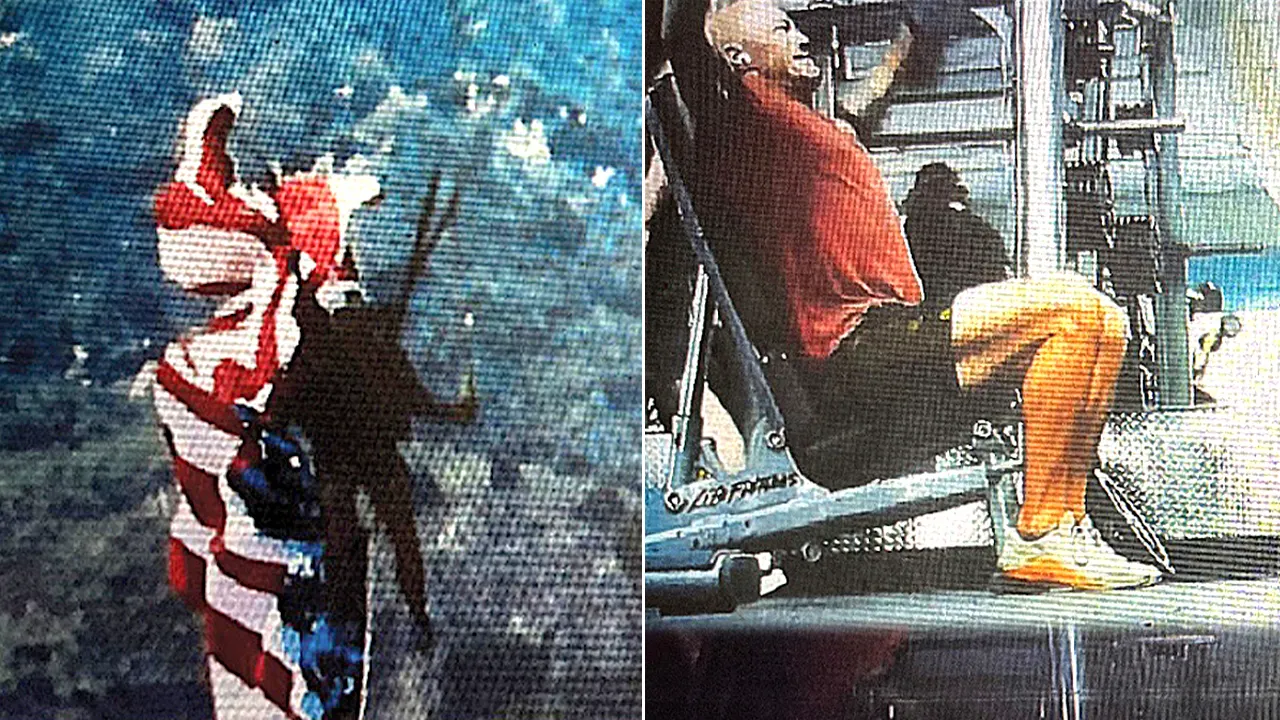
Surveillance footage captures Carnahan working out at a fitness center with dumbbells. (District Attorney’s Office for the Los Angeles County District)
Contrary to claims of being completely disabled, Carnahan allegedly engaged in strenuous physical activity, including working out and completing “many skydives” at Skydive Elsinore in Lake Elsinore, south of Los Angeles.
The District Attorney’s Office also released photos showing what appears to be Carnahan skydiving and exercising at a fitness center. In one image, dated May 23, 2024, the LAPD officer is seen holding dumbbells in a motion that involves his elbows.
CLICK HERE TO DOWNLOAD THE FOX NEWS APP
A Los Angeles Police Department vehicle is parked in the city. (Los Angeles Police Department)
He faces two counts of felony insurance fraud and is being held on $100,000 bail. If convicted, Carnahan could be sentenced to six years in jail.
The LAPD, which is investigating the case, is expected to review Carnahan’s employment status pending the outcome of his criminal trial.
Related Article

Read the full article from Here

She acknowledged that Iranian Americans hold a range of political views, including some who support U.S. intervention, but said she believes the future of Iran should be determined by its people.
“The Iranian people in Iran can decide the future of their country,” she said. “War, I don’t think, is going to help.”
Speaking to the crowd, Mortazavi challenged what she described as a narrative that Iranians broadly support U.S. and Israeli military action.
“They want you to believe that every Iranian … is cheering on the United States and Israel,” she said. “That is unequivocally false.”
She urged attendees to continue organizing beyond the rally and announced plans for additional demonstrations.
Dina Saadeh, an organizer with the Palestinian Youth Movement, said multiple groups mobilized quickly in response to the strikes.
“I’m angered today,” Saadeh told KQED. “People here don’t want to see our country engaged in more endless war.”
Saadeh described the protest as part of a broader effort to oppose sanctions, military escalation and what she called U.S. imperialism. She said participants were calling on elected officials to redirect public funds toward domestic needs.
“People want money for jobs and education, not for war and occupation,” she said.
KQED’s María Fernanda Bernal contributed to this story.

Meyer’s Late Score Lifts Wyoming past Air Force – SweetwaterNOW

Crypto Sector Suffers Exodus of Reliable Retail Investors | PYMNTS.com

Canton High School students find success in personal finance

The Workout Habit That Can Become Harm

Film reviews: ‘How to Make a Killing,’ ‘Pillion,’ and ‘Midwinter Break’

Florida High School Football Rankings: Top 25 teams – Oct. 21

Cleary's 21 help Le Moyne down Central Connecticut State 69-64 in OT

How old is Bo Nix? What to know about Oregon quarterback ahead of 2024 NFL Draft

99th annual Pony Swim held in Virginia

Indiana Members Credit Union announced as new anchor tenant at Bottleworks District

House Republicans push Johnson to go to war with Senate over SAVE Act

Israel FM says Europe too divided, slams Spanish PM

Satellite images provide view inside Iran at war

Video: What the Texas Primary Battle Means for the Midterms

Dems’ potential 2028 hopefuls come out against US strikes on Iran
-

 World4 days ago
Exclusive: DeepSeek withholds latest AI model from US chipmakers including Nvidia, sources say
-

 Massachusetts4 days ago
Mother and daughter injured in Taunton house explosion
-

 Montana1 week ago
2026 MHSA Montana Wrestling State Championship Brackets And Results – FloWrestling
-

 Denver, CO4 days ago
10 acres charred, 5 injured in Thornton grass fire, evacuation orders lifted
-

 Louisiana7 days ago
Wildfire near Gum Swamp Road in Livingston Parish now under control; more than 200 acres burned
-

 Technology1 week ago
YouTube TV billing scam emails are hitting inboxes
-

 Politics1 week ago
OpenAI didn’t contact police despite employees flagging mass shooter’s concerning chatbot interactions: REPORT
-

 Technology1 week ago
Stellantis is in a crisis of its own making