West
Silent on arrival: LA Mayor Karen Bass refuses to answer questions for her absence as wildfires ravage city

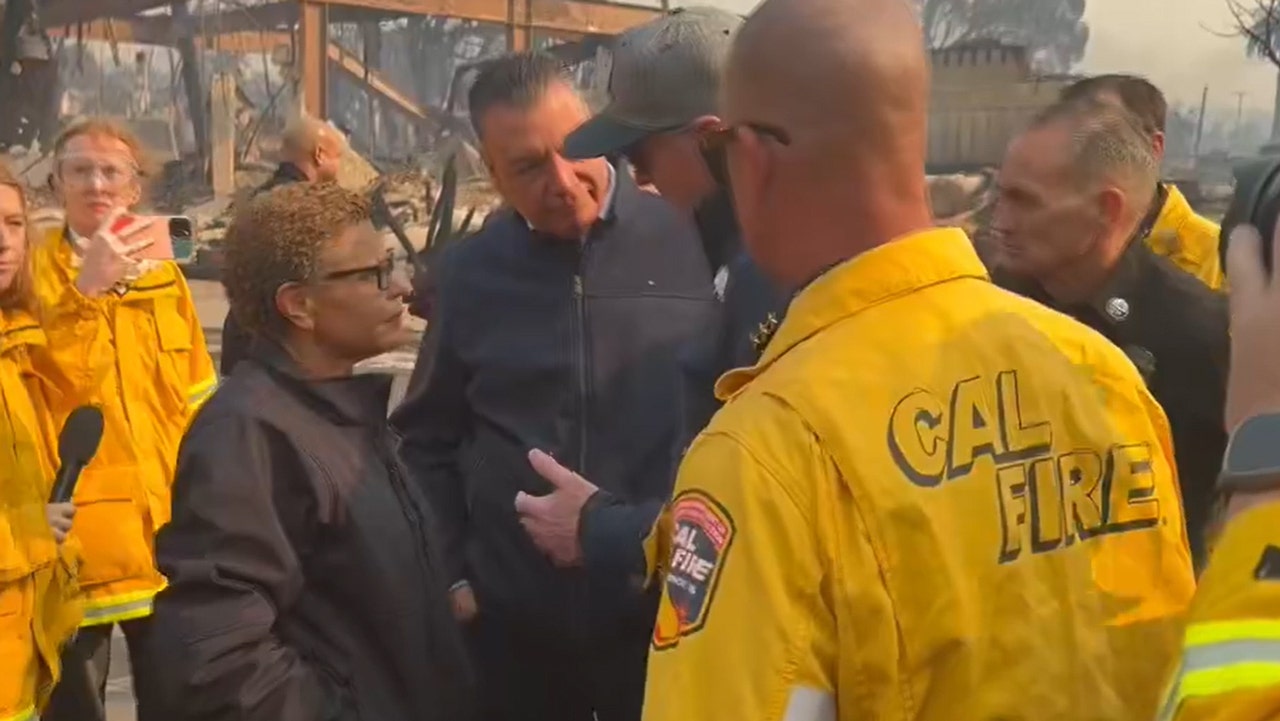
An expressionless Los Angeles Mayor Karen Bass refused to answer reporters’ questions after being pressed on her initial absence as wildfires raged across her jurisdiction.
“Do you owe citizens an apology for being absent while their homes were burning? And do you regret cutting the Fire Department budget by millions of dollars, Madame Mayor?” Sky News reporter David Blevins asked as Bass waited to deplane Wednesday following her trip to Ghana.
“Have you absolutely nothing to say to the citizens today?” he added.
CALIFORNIA WILDFIRES RAGE ACROSS LOS ANGELES COUNTY, FORCING THOUSANDS TO EVACUATE
Los Angeles Mayor Karen Bass listens as Gov. Gavin Newsom speaks while touring fire damage in the city Wednesday. (Mayor Karen Bass / X)
Bass refused to acknowledge the reporter, continuing to ignore questions as she looked at the ground.
“No apology to them? Do you think you should have been visiting Ghana while this was unfolding back home?” he said.
“Madam mayor, let me ask you just again, have you anything to say to the citizens today as you return?” he said.
The Palisades Fire burns a structure in the Pacific Palisades neighborhood of Los Angeles, Wednesday. (AP Photo/Eugene Garcia)
On Wednesday, during a late-afternoon news conference in Los Angeles, Bass said that she took the “fastest route back,” adding that she used a military plane for her speedy arrival.
“I took the fastest route back, which included being on a military plane, which facilitated our communications,” she said, acknowledging that she was thousands of miles away when the first wildfires broke out Tuesday. “So I was able to be on the phone the entire time of the flight.”
LOS ANGELES MAYOR SLASHED FIRE BUDGET LAST YEAR, PRIORITIZED HOMELESS POPULATION
“We are fighting for you and everyone in Los Angeles,” she said, appearing to be reading prepared remarks.
At one point during the news conference, the mayor’s notes appeared to bewilder her, and she mistakenly said: “Emergency information, resources and shelter is available. All of this can be found at URL.”
Bass’ leadership has been in the spotlight as many have blamed her for the disaster, pointing to the massive budget cuts she made to critical firefighting forces that she poured into spending on the city’s homeless population.
For the 2023-2024 fiscal year, Los Angeles budgeted $837 million for the Los Angeles Fire Department (LAFD), which was roughly 65% the size of the homeless budget of $1.3 billion.
From the 2023-2024 to the 2024-2025 budgets, the LAFD’s budget was reduced by $17,553,814 from $837,191,237 to $819,637,423.
Vehicles and a house burn as powerful winds fueling devastating wildfires in the Los Angeles area force people to evacuate, at the Eaton Fire in Altadena, Calif., Wednesday. (Reuters/David Swanson)
Bass’ arrival on the scene comes as wildfires continue to rage in Los Angeles County, leaving hundreds of thousands of residents under evacuation orders.
Los Angeles County Sheriff Robert Luna told Fox News that five people have been killed in the Eaton Fire, as of Wednesday afternoon.
Fox News Digital has reached out to Bass’ office for comment.
Fox News Digital’s Breck Dumas contributed to this report.
Read the full article from Here


Five Norton Sound tribes are asking a federal judge to throw out a key federal permit for a large-scale gold mine proposed in Bonanza Channel, an estuary about 30 miles east of Nome.
The mine, proposed by a Nevada company called IPOP LLC, would dredge roughly 2.7 miles along the channel’s 28-mile estuary bed.
Oral arguments for the case went before a federal judge on June 16 in Anchorage. The tribal governments of the Village of Solomon, Native Village of Council, King Island Native Community, Chinik Eskimo Community and Native Village of White Mountain say that the U.S. Army Corps of Engineers ignored serious environmental and subsistence concerns when it granted the Clean Water Act permit for the proposed mine in 2024.
Erin Colón is an attorney with the environmental law nonprofit Earthjustice. She’s representing the tribes in the case.
“This is the first large‑scale dredging project, mining project in an estuary in Alaska, and it’s a project that every agency that reviewed it had major concerns about what the environmental impacts would be,” Colón said. “That’s Fish and Wildlife Service, NMFS, EPA, and the Alaska District of the (U.S. Army) Corps.”
The tribes filed the lawsuit a little over a year ago. It argues that the Corps violated the National Environmental Policy Act and the Clean Water Act by downplaying impacts to fish and wildlife habitat, migratory birds and marine mammals. And, they say the Corps did not fully consider how around‑the‑clock dredging could disrupt fishing, egg‑gathering and berry‑picking in and around Safety Sound, a critical area for subsistence users.
“It’s not just an estuary where, you know, there aren’t people living nearby, it’s a place with a rich history that is in active use still today,” Colón said.
Colón said tribal members of the Village of Solomon, whose historical homeland overlaps the proposed mining area, filled the courtroom to watch the hearing.

Deilah Johnson is a tribal member, council member and the tribal resources director for the Village of Solomon. She said the Bonanza Channel estuary functions as a year‑round subsistence location for nearby communities and as a place where people teach and pass down cultural practices. She flew into Anchorage from Oregon for the oral arguments, and said she joined more than two dozen other tribal members of all ages in the courtroom.
“Having our youth present with us, teaching them to continue the fight and to continue the important advocacy as our future leaders, I think was also just an incredibly proud moment for us as a community,” Johnson said. “Because that is where they go fishing, that is where they go swimming, that is where we have our own small education classes with our biologists, I mean, that is part of who they are.”
The Village of Solomon has been opposing the large-scale dredge mine since IPOP initially submitted its applications for the project in 2018.
Johnson said this lawsuit is the most recent opposition.
“It constantly feels like we can’t ever let our guard down, no matter what decision was made by who. We have to stay on guard and prepared for anything,” she said.
IPOP was initially denied the Clean Water Act permit by the Corps’ Alaska District office in 2022. The state branch found the project failed to prove it was the least environmentally damaging option, and was not in the public interest. In its statement rejecting the proposal, the Corps noted that less than 1% of permitting applications nationwide are denied, usually because the applicant refused to alter the design, timing or location of the project.
But IPOP filed its own lawsuit against the Corps, arguing the Alaska office acted in bad faith and dragged out the review. The company then filed a modified version of the project with a smaller footprint.
The Corps’ Pacific Ocean Division stepped in, and in 2024 vacated the Alaska District’s denial and issued a permit to the modified proposal.
IPOP’s proposed project
As it stands, the proposed mine would vacuum up the estuary bed, moving 4.5 million cubic yards of material to a nearly 160-acre area of land. IPOP’s permit application says this would turn the area from vegetated shallows to mudflats, but those impacts would be temporary.
Attorneys for the Corps argue that IPOP’s revised project reduces the environmental impacts, and an Environmental Impact Statement typical for large-scale projects permitted by the federal agency is not necessary.
In its written argument, the defense said the area is “expansive” and “mostly uninhabited,” and the impact would be confined to the footprint of the project. Further, they say no “unique subsistence resource” is available within the footprint of the project that couldn’t be found elsewhere and people could subsist in other areas.
The argument states that the Corps determined the Bonanza Channel was not a “particularly productive” area for fishing because of low water levels and higher water temperatures.
But Johnson said that the Corp’s argument effectively sidesteps local expertise and community concerns, and the smaller footprint does not offset the impacts.
“It to me doesn’t make any sense, but they are still claiming that there’s no fish. We proved that there was, and that the Corps didn’t consider the fish that are still with that yardage, regardless of how much smaller they made it,” Johnson said.
IPOP also needs state authorization to mine. A land use permit from the Alaska Division of Mining, Land and Water — within the state Department of Natural Resources — has been denied, and the state recently rejected IPOP’s appeal. Without both the federal and state permits, the company cannot move forward with the project.
Earthjustice attorney Colón said the denial could still be challenged in Superior Court.
“There is no guarantee that the state will stand by its denial, and there’s always a potential that a court could reverse that decision too,” Colón said.
There’s currently no timeline for a ruling, but Colón said she generally expects a written decision within about a year, though it could come sooner.
The U.S Army Corps’ Pacific Ocean Division did not respond to a request for comment for this story. IPOP also could not be immediately reached for comment.
This story originally appeared on KNOM and is republished here with permission.

Key Points:
-
Arizona utilities have begun a siting study to explore building a nuclear facility
-
The project hit a setback when the utilities were denied a Department of Energy grant
-
Dwindling Colorado River water supplies could also challenge new nuclear growth
Arizona leaders are forging ahead with plans for new nuclear energy generation despite ongoing funding woes and water hurdles.
At a June 25 Arizona Corporation Commission workshop, utility companies, universities, local governments and private industry stakeholders demonstrated their preparedness and commitment to turning the state’s dreams for a new nuclear power plant into reality. Arizona’s three largest electric utilities announced ahead of the workshop that they have commenced a siting study to find a potential location for the project.
Arizona Public Service, Salt River Project and Tucson Electric Power are surveying a range of potential sites for a new nuclear plant, including decommissioned coal-fired plants. Commissioners celebrated that announcement at the workshop.
“With the recent announcement that APS, SRP, and TEP have launched a preliminary siting study for potential new nuclear generation in Arizona, we’re seeing real momentum translate into meaningful action,” Commission Chair Nick Myers said in a statement. “The expertise and collaboration shared throughout this workshop will help ensure we’re prepared to seize the opportunities ahead and build a strong foundation for Arizona’s energy future.”
If all goes according to plan, the companies expect to hold community stakeholder meetings later this year near the potential nuclear sites. The companies will then “evaluate technical, financial and other factors” to determine whether to submit an early site permit application to the federal government.
However, the utility companies did hit a snag in their process. They did not receive a U.S. Department of Energy grant they applied for in order to help finance that early site permit application, which would need to be submitted to the U.S. Nuclear Regulatory Commission.
The utilities “will continue to work together to explore future funding opportunities to help mitigate the costs of evaluating potential new nuclear generation,” according to a joint statement. The companies stressed that a new nuclear plant is not a foregone conclusion, and they have not decided whether the potential project would use small modular reactors or large reactors like those at Arizona’s Palo Verde Nuclear Generating Station west of Phoenix.
The June 25 workshop also identified a few other potential obstacles that could slow Arizona’s nuclear energy progress, like supply chain constraints, community backlash and dwindling Colorado River water supplies.
Cuts to Arizona’s Colorado River water allocation could be the most difficult obstacle for the state to overcome in order to pursue a new nuclear plant. Representatives from the Arizona Department of Water Resources and the Arizona Municipal Water Users Association told commissioners that the Colorado River is no longer a reliable water supply and alternatives will likely require significant investments.
Palo Verde uses recycled wastewater to cool its three nuclear reactors and APS has explored using low-quality groundwater for cooling at the plant. But with water likely to become more scarce and more expensive in Arizona, a cooling source for any new nuclear plant could be a significant hurdle.
Proposals attempting to clear the way for new nuclear technologies, like small modular reactors, also did not fare well during this year’s legislative session. Lawmakers introduced six bills that would have preempted local authority or streamlined environmental review processes for small modular reactors, but only one made it to Gov. Katie Hobbs’ desk.
Senate Bill 1418 from Sen. Frank Carroll, R-Sun City West, would have allowed utility companies to bypass the commission’s traditional environmental review process for project siting if the company planned to replace a coal generation unit with a small modular reactor. That bill could have benefited the joint project from APS, SRP and TEP if the companies eventually select small modular reactor technology for the new plant.
However, Hobbs vetoed the bill, arguing it was not in line with the state’s goal to “responsibly reduce barriers to deploying new energy projects quickly.”
“We are not in the business of picking winners and losers in the energy landscape, and while advancements in small modular reactor technologies are promising, they are still emerging,” Hobbs wrote in a veto letter. “Deploying such a catch-all approach for an emerging technology, as laid out in this bill, is irresponsible.”
Nevertheless, a potential new nuclear power plant has broad, bipartisan support in Arizona. And some communities are chomping at the bit to bring the technology to their areas, as Navajo County Supervisor Jason Whiting told commissioners on June 25.
“Northeastern Arizona’s energy communities… want to be part of it,” Whiting said. “They want to be involved with it. They will embrace this discussion and decision with open arms.”


See the best High Desert fireworks through the years
Fireworks have long lit up the California High Desert, from community shows in Victorville and Apple Valley to backyard celebrations that filled the night sky. Revisit Fourth of July moments through the years.
Each year, fireworks light up the sky across the United States for the nation’s Independence Day. With 2026 marking the nation’s 250th birthday, fireworks shows may be a bigger draw.
With California being so fire-prone, the state has strict fireworks laws, but does that mean that people won’t enjoy fireworks without risking jail time on July 4?
Are fireworks illegal in California?
The California Department of Forestry and Fire Protection, or CalFire, is the agency in charge of managing fireworks and classifying which ones are safe to light.
The California Fireworks Law was passed in 1938 and designated the Office of the State Fire Marshal as the only fireworks classification authority in the state, according to CalFire.
The fire marshal’s office classifies fireworks through lab analysis and field testing. It also requires that all parties dealing in fireworks, such as pyrotechnic operators, manufacturers, and retailers, have licensing.
Along with the aforementioned law, the State’s Explosive Law authorizes the fire marshal to “adopt regulations for the safe use, handling, storage and transportation of explosives,” CalFire says.
“Safe and Sane” fireworks are less likely to cause injury and generally mean that the fireworks do not explode or fly, according to the City of Fontana.
There are almost 300 communities in the state that allow “Safe and Sane” fireworks.
It is illegal in the state to sell, transport, or use fireworks that don’t carry the “Safe and Sane” seal or use any in a nonpermitted community. If convicted, you can face a fine up to $50,000, a year in jail or both, according to CalFire.
All other fireworks are considered illegal in the state and are prohibited from being operated by unauthorized parties in most jurisdictions.
Some illegal fireworks include:
- Wire Core Sparklers
- Sky rockets
- Bottle rockets
- Roman candles
- Aerial shells
- Firecrackers
- Other fireworks that explode, go into the air, or move on the ground in an “uncontrollable manner.”
How to safely use fireworks
CalFire has put out a list of safety tips to avoid injury when handling fireworks.
CalFire recommends:
- Use only State Fire Marshal-approved fireworks
- Verify local ordinances before purchasing or using fireworks.
- Always read the directions on labels.
- Children should always have an adult present.
- Only use fireworks outdoors.
- Avoid using fireworks near dry grass or other flammable materials.
- Only light one firework at a time.
- Have a bucket of water and a hose nearby in case of fire.
- During a drought, it is recommended that you use a bucket of reused water to submerge your firework after use to ensure it’s completely extinguished.
- Never place any part of your body directly over a fireworks device when lighting the fuse.
- Back up several feet immediately after lighting a firework.
- Never point or throw fireworks at another person.
- Never attempt to relight or fix fireworks.
- Never experiment with fireworks.
- Do not wear loose-fitting clothing while lighting fireworks.
- Never carry fireworks in your pockets.
Ernesto Centeno Araujo covers breaking news for the Ventura County Star. He can be reached at ecentenoaraujo@vcstar.com, 805-437-0224 or @ecentenoaraujo on Instagram and X.
-

 Indianapolis, IN2 minutes ago
Indianapolis leaders provide public safety update ahead of Fourth Fest
-

 Pittsburg, PA9 minutes ago
Pittsburgh’s Fort Pitt Museum reveals roots of Independence Day
-

 Augusta, GA12 minutes ago
Augusta’s new arena reaches major construction milestone
-
Washington, D.C17 minutes ago
Talking with Ohioans at the Great American State Fair
-

 Cleveland, OH24 minutes ago
Cleveland councilman warns of planned outages coming to city’s west side during high heat
-

 Austin, TX27 minutes ago
Texas court orders porn site to pay $9M bond to unlock domain name
-

 Alabama32 minutes ago
New Alabama school threat law is now in effect. Here’s what families need to know.
-

 Alaska39 minutes ago
Five tribes continue legal battle over controversial IPOP gold mining project near Nome


