West
SF officials might be on the hook for $190m in homeless hotel costs after feds retract COVID funding promises

The city of San Francisco might be forced to foot the bill for homeless hotel costs after federal officials backtracked on promises to fund the effort, according to reports.
Officials in San Francisco believed the $190 million in COVID expenses would be paid by the federal government, which comes at a time when the city’s deficit is projected to reach more than $1 billion in a few years, the San Francisco Chronicle reported. Because Federal Emergency Management Agency (FEMA) typically reimburses municipalities for unexpected expenses during natural disasters and other emergencies, the California city expected the federal government to foot the bill. City officials said the move by FEMA could “pose a significant potential risk” to San Francisco’s budget forecast.
San Francisco and other cities across the state of California housed thousands of homeless people in empty hotels during the COVID-19 pandemic to allow for social distancing. This was an effort to cut down on transmission rates of the virus in homeless shelters and on the streets, the S.F. Chronicle reported. San Francisco reportedly spent more than $423 million sheltering over 5,000 residents in hotels and other “non-congregate” facilities during the pandemic.
$1.7 -MILLION TOILET PROJECT IN SAN FRANCISCO STILL NOT DONE AFTER 15 MONTHS: ‘WHY ISN’T THERE A TOILET HERE?’
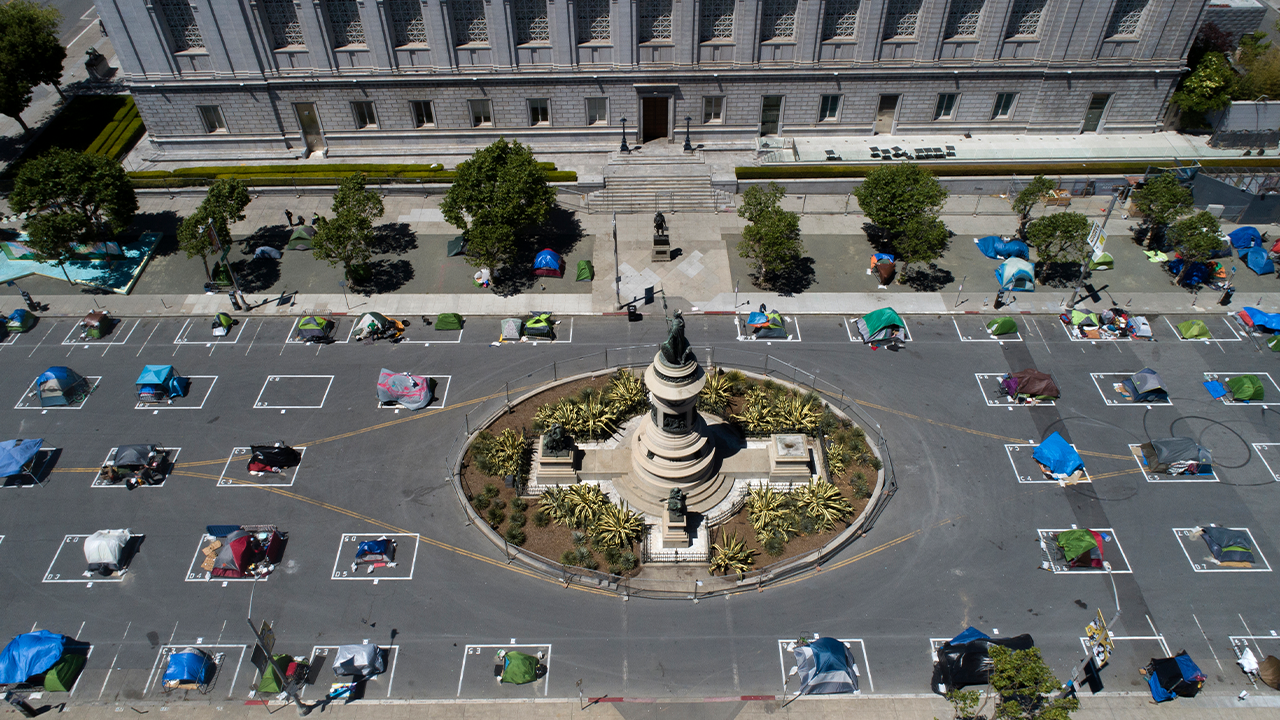
A sanctioned and fenced-in homeless encampment is seen from this aerial view across from City Hall along Fulton Street between Hyde and Larkin Streets in San Francisco, Calif., on Tuesday, May 19, 2020. (Getty Images)
“We are profoundly disappointed that FEMA is changing their plans for reimbursement,” Jeff Cretan, a spokesperson for Mayor London Breed, said.
At first, FEMA said it would reimburse 75% of the costs, then the federal agency told counties it would cover the entire cost of the non-congregate shelter program through July 1, 2022, the S.F. Chronicle reported. After that, they pledged to cover 90% through May 11, 2023.
JOE ROGAN SAYS HE’S GLAD BE LEFT CALIFORNIA BECAUSE STATE WENT ‘FULL COMMUNIST’
But, in October, FEMA officials sent a letter to the California Office of Emergency Services (OES) stating it would not reimburse many hotel stays of longer than 20 days between June 11, 2021, and May 11, 2023, the S.F. Chronicle reported. Bills incurred during this time period could cost San Francisco up to $114 million and more than $300 million for the state of California. The extra $76 million would come into play if FEMA didn’t pay reimbursement claims related to stockpiling vacant hotel rooms.
Officials from both the city controller’s office and the state’s OES have both pushed back on the federal government, arguing FEMA changed its rules years after the fact and stated that if counties had known this was the case, they might have acted differently throughout the COVID-19 pandemic.
“We intend to explore every option available to appeal any claims denied by FEMA Region 9 that we believe to be eligible for reimbursement, based on the guidance in effect at the time,” San Francisco City Controller Ben Rosenfield said Monday.
SAN FRANCISCO SUED OVER GUARANTEED-INCOME PROGRAMS BLASTED BY CRITICS AS RACIST
California OES Director Nancy Ward sent a 95-page memo, which included letters from cities and counties from across California, responding to the change in FEMA policy, calling out the government agency for “inconsistently” applying its non-congregate shelter policies across the country, the S.F. Chronicle reported. She also pointed to numerous statements from FEMA and President Joe Biden where they committed to “fully cover” costs.
San Francisco has sought more than $879 million in reimbursements from the federal government for its COVID response, which includes hotel rooms and other expenses, but the federal government has only reimbursed the city for about $301 million, which includes $148 million for non-congregate sheltering costs, according to the controller’s office, the S.F. Chronicle reported.
Read the full article from Here


Bagel shop manager Fernando Mejia was arrested by federal agents just over a year ago in the Port Washington store’s parking lot. Since then, including Monday evening, members of the Port Washington community have kept a weekly vigil to honor Mejia, who they consider one of their own, and bring attention to how his abrupt arrest, and ultimate deportation, left a void in his family, at his workplace and among anyone in town who knew him.
For 52 consecutive Mondays, they have flocked to the Main Street side of the Port Washington Long Island Rail Road station as a tribute to Mejia and their other immigrant neighbors who have been arrested by U.S. Immigration and Customs Enforcement agents and never returned home. The weekly 7 p.m. effort, dubbed the “Port Shines a Light in a Sea of Darkness” vigil by organizers, began a few weeks after Mejia’s June 12 arrest and has continued, even after he agreed to self deport and return to family in his native El Salvador.
Vigil co-organizer Jeff Seigel, 68, told the crowd of about 75 people — many toting handwritten protest signs — that Mejia was “doing well, although well is a relative term.”
Mejia is unable come back to Port Washington to see his teenage daughter, who stood in the crowd Monday evening and who Seigel said flies to El Salvador for visits.
Fernando Mejia was arrested by federal agents on June 12, 2025 outside the Port Washington bagel shop he managed. Credit: Courtesy: Lauren Wax
“He came here when he was about 20 years old, and here in the United States is where he became a man,” Seigel, 68, said. “He worked very hard, always. And it is here in the United States where he became a father. … After five months in detention, he could no longer wait to see if the immigration court would rule in his favor.”
Mejia, the former manager of Schmear Bagel & Cafe on Main Street, one block west of where each vigil is held, was one of about 3,000 Long Islanders arrested by federal immigration agents through March 10 as part of President Donald Trump’s ramped-up deportation push since his return to power, Newsday previously reported.
Mejia had just started his car in the bagel shop’s parking lot about 6:30 a.m. on June 12 to make a delivery when federal agents converged and placed him under arrest. Over the months that followed, Mejia bounced from facility-to-facility — first in Manhattan, then in Newark, Louisiana and Miami. He does not have a criminal record, his attorney, Bryan Richard Pu-Folkes, previously told Newsday. Pu-Folkes said at the time Mejia was likely detained due to a January 2006 deportation order from the Executive Office for Immigration Review for unlawful presence in the country.
Pu-Folkes did not immediately return a phone message Monday seeking comment. Mejia could not be immediately reached for comment.
The weekly efforts help community organizers raise awareness and funds for legal fees and even food for immigrants in the community. Another goal, said Stan Lacy, also a vigil organizer, is distributing whistles throughout the community. As Lacy and other members of Port Washington’s Rapid Response Network drive around Port Washington and encounter ICE agents, they blow whistles to alert immigrants of their presence.
After a trio of arrests “a little over a month ago,” ICE’s presence has been “relatively quiet,” he said.
Fellow organizer Stacey Mellus told Newsday the weekly vigils sometimes draw immigrants thankful for the community support, but not so much “when more ICE activity is in the area, when the climate gets a little more hot.”
“I witnessed one of those abductions here, you’re never going to get over something like that,” Mellus, 50, of Port Washington, said. “I’m never going to get over seeing people separated from their families, people yelling ‘don’t take my husband.’ “
Wyoming
At 6,000-year-old crossing, Gov. Gordon OKs Wyoming’s first-ever designated pronghorn migration route

Some Green River Basin pronghorn migrate more than 200 miles. Now, Wyoming has designated the landscapes they move through in an effort to protect the route.
by Mike Koshmrl, WyoFile
SUBLETTE COUNTY — Gov. Mark Gordon heralded Wyoming’s first-ever designation to protect a pronghorn migration corridor — a more than 2 million-acre web of habitat — at Trapper’s Point, which he called a “wonderful passageway.”
“How incredibly valuable it is that you are standing here today,” Gordon told the crowd, “to witness this remarkable moment.”
Gordon commemorated the moment with his feet planted on the narrow bulge of high country that splits the Green and New Fork rivers. Thousands of years ago, the site was a well-used hunting ground for Native Americans — it’s the earliest known killing and processing site for pronghorn in North America. Now it boasts a wildlife overpass.
No pronghorn were to be seen during the especially windy Friday afternoon gathering, which attracted 75 attendees from nearby Pinedale and other western Wyoming communities.
Now Trapper’s Point is officially classified as a “bottleneck” for the Sublette Pronghorn Herd — one of 13 such bottlenecks. That classification is supposed to prevent any surface-disturbing activity, with the intent that pronghorn can keep passing through Trapper’s Point for generations to come.

Protecting the ability of the fleet-footed, tawny-and-white ungulates to migrate is a “key factor” in sustaining their population, Wyoming Game and Fish Director Angi Bruce said.
“This becomes even more important in severe winters or extreme droughts,” Bruce said. “Pronghorn are long overdue for recognition.”
Pronghorn in Sublette, Teton, Sweetwater and Lincoln counties travel a long road — some migrate more than 200 miles to escape harsh winters, trekking south into the lower Green River Basin, a semi-arid sweep of sagebrush steppe between Pinedale and Rock Springs. Then in the spring, they retrace those paths, returning to summer ranges, lush with verdant vegetation, even going as far as Grand Teton National Park.
There was also a long road of bureaucracy to get to this point.
Nearly three decades of effort preceded the formal designation of the migration routes used by the Sublette Pronghorn Herd, which is the farthest-traveling and among the largest pronghorn herds in the West.
Jackson Hole biologists long knew that the valley’s pronghorn left in the winter. But details were hazy on where they went and how they got there until around the turn of the century. Using data from tracking collars, biologists like Joel Berger, Steve Cain, Hall Sawyer and Doug Brimeyer helped delineate the route.
 Wyoming ecologist Hall Sawyer fits a tracking collar onto a migratory pronghorn near the Tetons in 1998. Twenty-seven years later, state wildlife managers are pressing to designate the pronghorn herd’s migration path. Photo: Mark Gocke // Wyoming Game and Fish Department
In 2008, a Bridger-Teton National Forest plan amendment established a portion of the path as the nation’s first designated wildlife migration corridor.
Popularized by its branding as the “Path of the Pronghorn,” the route has received press in national publications like High Country News and the New York Times.
But the southern reaches of the migration through the energy-rich Green River Basin have faced major political opposition since the early 2000s. Wyoming first attempted to protect those travel corridors in 2019, under a policy administered by the Wyoming Game and Fish Department. That effort was halted after a coalition of industry trade groups and counties protested.
Then, in early 2020, Gordon revamped the migration policy with an executive order. Still, the Sublette Pronghorn Herd proposal gathered dust, even as development threatened the route.

Game and Fish revived efforts to protect the migration in late 2023 and early 2024. Biologists pulled together one of North America’s most comprehensive migration datasets, benefiting from approximately two decades of GPS collar information collected from more than 400 pronghorn.
Some controversy followed the process until near the end. There was a debate about whether to designate the migration’s two easternmost segments, in the Red Desert and east of Farson. The Game and Fish Department proposed excluding the routes, but was overridden by its commission. Then Gordon upended that decision, excluding the two segments.
Vetting the migration corridor through a Gordon-appointed working group was the second-to-last step in the designation process.
“Today’s designation demonstrates that voluntary, locally driven conservation works,” said Robb Slaughter, who chaired the group, during the commemoration at Trapper’s Point.
Time will tell if that’s the case. Wyoming’s migration policy is, by design, permissive of development. Private land is exempt from protections, and designation is not an assurance that new stressors won’t be added to the landscape.

“Today is not the end of the process,” Slaughter said. “It’s the beginning of the next chapter. Continued monitoring, adaptive management, research, and cooperation will ensure these recommendations remain effective as conditions change.”
But Friday was the end of the migration designation process. The governor’s informal OK — no signature was needed — was the last step, said Sara DiRienzo, the governor’s deputy policy advisor.
Wildlife advocates celebrated the moment.
“This is historical,” Bruce said. It’s the first effort to protect the full length of a pronghorn migration corridor in the nation, she said.
WyoFile is an independent nonprofit news organization focused on Wyoming people, places and policy.
San Francisco, CA
San Francisco rolls out heightened security measures ahead of World Cup knockout match, 4th of July

The city of San Francisco is taking heightened police and security measures in advance of two major events in the Bay Area this week – the 4th of July and the first knockout round of the FIFA World Cup.
Mayor Daniel Lurie hosted a press conference Monday to address the public on how the city plans to manage the overlapping swarms of soccer fans and 4th of July revelers.
“No matter the occasion, our top priority, and my top priority, remains the same: keeping San Francisco residents and visitors alike safe,” said Lurie.
The two events would be major draws for crowds independently, but combined, and with special occasions marking both, the city wants to ensure that security is a top priority.
The World Cup has already brought hundreds of thousands of people from across the country and the world to the Bay Area, but this week’s game at Levi’s Stadium in Santa Clara is especially notable for the San Francisco as the host city and the United States as a host nation. The stadium, renamed San Francisco Bay Area Stadium for the duration of the World Cup, will host the knockout round match between the U.S. and Bosnia and Herzegovina on Wednesday.
Official fan zones and watch parties for the U.S. match, as well as for Mexico’s match against Ecuador on Tuesday, will be held at multiple locations in San Francisco, including at Thrive City at the Chase Center and at the Pier 39 Fan Zone.
This year’s 4th of July in San Francisco, which already boasts large crowds across the city each year, will have another draw as the city prepares to celebrate the nation’s 250th birthday. The city will be hosting a fireworks show on the Golden Gate Bridge on Saturday night – only the third time that pyrotechnics have ever been set off from the iconic San Francisco landmark. Fireworks will be launched off the two towers of the bridge and from barges in the water.
The Golden Gate Bridge show will be the only official one in the city – fireworks are illegal in San Francisco.
Authorities advised attendees to use public transportation and to leave plenty of time on both ends of their travel for traffic and delays. Caltrans has announced road closures and detours on U.S. Highway 101 and the entire Golden Gate Bridge for the fireworks show.
San Francisco Police Chief Derrick Lew said the department is collaborating with multiple state and local agencies to keep people safe, and that police officers have had their days off cancelled to meet the staffing needs that July 4 will require.
“This week will be safe because that’s what we’ve been doing every day,” Lurie said. “It is a glorious time to be here in San Francisco.”
Lurie cited past heavily attended events like Sunday’s San Francisco Pride Parade and Super Bowl 60 in February as examples of the city’s successful management of major crowds.
-
Washington21 seconds ago
Port Washington weekly vigils honor community members arrested by ICE
-

 Wisconsin5 minutes ago
3 dead after crash involving UTV, truck in western Wisconsin
-

 West Virginia12 minutes ago
Judge blocks West Virginia SNAP soda ban, restoring benefits for soft drinks
-
Wyoming15 minutes ago
At 6,000-year-old crossing, Gov. Gordon OKs Wyoming’s first-ever designated pronghorn migration route
-
Crypto20 minutes ago
Consumer alert issued for Bitcoin cryptocurrency ATMs
-

 Finance27 minutes ago
Shanghai needed as finance hub, as Hong Kong ‘not enough’: proposal
-

 Fitness30 minutes ago
This unspectacular full-body exercise could be the secret to long-term fitness
-

 Movie Reviews42 minutes ago
‘The Invite’ Movie Review – Spotlight Report


