Seattle, WA
Amazon in Seattle: The Role of Business in Causing and Solving a Housing Crisis


BRIAN KENNY: When the Klondike Gold Rush swept the nation in 1896, the tiny lumber town of Seattle became a bustling city almost overnight. On the heels of the Gold Rush came a shipbuilding boom, followed by a post-war bust and the great depression. Then Boeing to the rescue, as Seattle became the epicenter of aircraft manufacturing for the US forces in World War II. Decades later, Boeing passed the baton to Microsoft, and Seattle found itself at center stage for the burgeoning tech boom. In the ensuing years, Seattle would become the launch pad for other global brands like Starbucks and Nordstrom’s. But the biggest by far is Amazon. Since launching in 1994, Amazon has invested four and a half billion dollars in the city where it currently employs 55,000 people.Most cities would love to have an Amazon in their midst, but as the Gold Rush taught us all those years ago, not all the glitters is gold. Today on Cold Call, we welcome professors Paul Healy and Debora Spar to discuss their case, “Hitting Home, Amazon and Mary’s Place.” I’m your host, Brian Kenny, and this is Cold Call on the HBR podcast network. Paul Healy’s research covers a range of topics including white-collar crime, governance, business ethics, and financial analysis. Debora Spar studies issues of gender and technology and the interplay between technological change and broader social structures. Welcome both. It’s great to have both of you here.
DEBORA SPAR: It’s a great pleasure. Thanks.
PAUL HEALY: Thank you, Brian.
BRIAN KENNY: And Paul, thank you for joining us from Barcelona. This is good of you to give us your time. Paul, I’m going to ask you to kick us off here by telling us what the central issue is in the case and what your cold call will be. I know you haven’t taught the case yet, but when you have an opportunity to teach it in class, how are you thinking of starting the conversation?
PAUL HEALY: So, my interest in the case was exposing our students to the question of homelessness in the country and around this question of equity that you raised. My sense is that most of our students haven’t spent a lot of time thinking about it. And so, I thought that a case like this will be a great way for them to start to think about what their responsibilities are, how do companies they work for, what are their responsibilities and really how do we as a society address this problem, this homelessness that seems to be so intractable in the United States.
So, what would I ask? I think I might start actually by asking students, does anyone know someone who has been homeless at some point in their life? And then I think I would really want to start by digging into this question, why is homelessness such an intractable problem in the United States? And get the students to start thinking about that question, what causes it? Why is it we don’t seem to be able to get our hands around solving it?
BRIAN KENNY: Deb, let me turn to you for a moment and ask, you and Paul wrote this case together. I’m wondering why did you decide to write it? Why was it important to you to pick up this topic?
DEBORA SPAR: Well, it’s so interesting now because we wrote it a couple of years ago and right around the same time, Paul and I were also working together on what has become a new required course in the first year curriculum on the social purpose of the firm. What that course is really about is probing the boundaries between the firm and the state. So, what is the appropriate role of the firm in society and what kind of assets do firms bring to attack societal problems, and what is the appropriate role of the state? And I think this case even more so than I would’ve imagined at the beginning, it hits that nail right on the head because I think my opening question would be something, and I would probably frame it more cynically than Paul because he’s a less cynical person than I am. I would probably ask something like, “Why in heaven’s name is Amazon working on homelessness?” Which historically has been an issue that communities worried about and churches worried about and governments worried about. But you don’t think of a delivery company being involved in homelessness. So, I think it really blows open this issue of: what should firms be doing and how should we as citizens and consumers, how should we think about a company like Amazon when it gets involved in a problem like homelessness?
BRIAN KENNY: Paul, you talked about the intractability of homelessness in the United States, and I’m wondering if you can just give us a little bit more of view into what that situation looks like. We have by far the largest economy in the world. It would seem that we shouldn’t have anybody who’s homeless, but we do. We have a lot of homeless. Can you talk a little bit about that?
PAUL HEALY: So just as a bit of context here, Seattle has the third most homeless people in the country behind Los Angeles, and it’s a much smaller city, obviously. And if you look at the people that are homeless, a substantial portion of them are families with children. So, why does it happen? Well, I think that we don’t have much of a social safety net in the United States. It’s just not part of our norm, our infrastructure. And then I think there’s a lot of things that sort of go into making it the perfect storm. We deregulated mental health many years ago and we said we were going to do so, and we were going to provide support services for the people with mental health problems. And we really never did.
In large cities, the cost of housing has really exploded as companies like Amazon, and I’m not blaming Amazon, but one consequence of the tech boom and the boom in cities is that the price of housing in large cities has really escalated dramatically. And that’s really priced out a lot of low-income people. And then on top of that, I think that we haven’t had the willingness–people living in inner cities–to really change zoning laws to lead to more housing and the building, creation of more housing and low-income housing or just regular housing in cities and suburbs. And then I think that the last piece is also important, and that is that people who are homeless really don’t have a political voice. They’re not the sort of people with political power. And so, their problems get largely sidelined unless, somehow they become more mainstream.
BRIAN KENNY: But what role should government be playing? Shouldn’t they be more involved in this situation?
DEBORA SPAR: Homelessness is a particularly complicated problem. It’s a problem of health, it’s a problem of real estate, it’s a problem of policing. It’s a problem sadly, of drug over usage. And for sure one would like government to be a big part of it as it is in many other countries in Europe, not that they’re wonderful places, but you tend to have more low-income housing that’s heavily subsidized. But it’s not clear that government alone can solve the problem. But apologies if this is jumping ahead a little bit, in order for government to solve the problem, part of what they have to do is change zoning laws, which are running into the societal issues that Paul was talking about. But part of what they have to do is raise taxes or they have to generate the revenue because building housing and building social services is expensive. And I think that’s, again, one of these complicated ironies in the case is that on the one hand, Amazon and some of the other companies are stepping up to the plate to give a lot of charitable monies to address homelessness, but they’re fighting against the taxes which would enable the government to address homelessness. There are no magic wands here. The government is going to have to have money in order to address the problem.
BRIAN KENNY: Yeah, and we’re going to talk about that, how they’re using their leverage in ways that would benefit them. But at the same time, there’s a lot of irony in the whole story. Amazon has transformed Seattle, obviously I alluded to that in the introduction in ways good and bad. And I remember a few years ago they had a sweepstakes where they were going to open up a new headquarters in the US and they had mayors all over the United States clamoring to have Amazon located there. What would you tell a mayor who was thinking about having Amazon relocate to their city?
DEBORA SPAR: Well, ironically, one of my friends was the deputy mayor and was deeply involved in this. And even while she was going through it, I mean it is this double-edged sword because if you’re a mayor, if you’re a community leader, you kind of have to want this investment because it brings… I forget how many tens of thousands of jobs, it’s going to drive up property values and it’s going to bring more espresso bars to a community. By the same token, it is going to make the cost of living in these cities way more expensive, exactly has happened in the case of Seattle. It’s going to increase traffic congestion, it’s going to increase demand for the public schools. So, it’s one of these birds, if you catch it, you’re then left with a lot of problems. But nevertheless, as we saw every mayor in the country was racing after that.
BRIAN KENNY: Sure. Of course. Paul, talk a little bit more about Seattle. I’m wondering what the economics are of living in the city of Seattle. What do you need to earn?
PAUL HEALY: I’m not sure exactly what you need to earn, Brian, but I know it’s a lot more than the minimum wage. And I think the average Amazon worker is earning $110,000 a year, and the average other worker is earning more like $55,000 a year, which by US standards that’s probably enough to get by or just get by in a city like Seattle or if you’ve got a family, it may not be enough to get by. There are certainly plenty of people who aren’t making that, and for them, that’s going to make it very difficult to rent a home or rent an apartment in Seattle.
BRIAN KENNY: So, did Amazon see themselves in any way as being the cause of the problem here? Did they come to the table, I guess willingly or were they kind of pushed into this role? What’s the dynamic there?
DEBORA SPAR: Well, I think my sense, and Paul may have a different one, but I think it’s very human. People rarely see themselves as causing problems, particularly when there are problems that are multifactorial. Nobody caused, no single entity caused the problem of homelessness. It was a failure or complications on so many levels. So, I don’t think Amazon saw themselves in any way as the cause, I think they did see themselves and to their credit as being part of the solution, but the solution they chose was a charitable one rather than a… How should we call it, a governmental or a contribution to society-based one. But I don’t know, Paul may have a different sense of that.
PAUL HEALY: I think that also, Deb, picking up on that, oftentimes companies, and I suspect… I don’t know for sure, but I suspect that many people in Amazon would say to themselves that the government actually hasn’t proved that they can solve this problem. And the government’s not proven to be very effective in solving this problem. And we need the private sector to provide a little bit of support and to help do it. And I think that they’re probably learning over time that it’s a much more intractable problem than they had thought and that they’re no more effective at doing it than the government.
DEBORA SPAR: And if I could, I want to go back to the example that Paul raised earlier about what’s happened to Whole Foods in San Francisco because I think it touches on a broader problem. And we saw this recently at an event we held in Latin America, where for many decades the wealthy industrialists in Latin America and elsewhere have said issues like economic inequality, they’re not our issue. Our job as business people is to generate growth, generate jobs, and the government takes care of redistribution. But that view in Latin America, and I suspect in Seattle and San Francisco, is starting to change because when the problems of inequity become so severe that you’re closing your stores and your employees don’t want to come to work, it becomes part of not even the responsibility of the corporation, but it becomes part of its business. And again, I think that’s what this case… All good cases are a bit extreme examples of a problem. I think Seattle and San Francisco are the extreme examples of a broader problem we’re seeing.
PAUL HEALY: And I think on top of that, I think you are also seeing employees of many companies saying, “We’re not happy, we’re not comfortable. This isn’t the community we want to be part of.” And so, that puts more pressure on the company to say, “Well, how do we fix this problem? How do we make this better?” Because we want to attract the best people. And if we’re now no longer as an attractive location because of homelessness in our community, we need to fix that or at least be seen as contributing to fixing it.
BRIAN KENNY: So, what was Amazon’s way to fix this? We haven’t talked about Mary’s Place. That’s obviously a central part of the story as well. What is Mary’s Place and how has Amazon engaged with them?
DEBORA SPAR: Well, Mary’s Place is a wonderful, fairly traditional example of a nonprofit approach to a social problem. So, Mary’s Place was started by a woman who had experienced poverty and homelessness in her youth and had wanted to address that for other people. And so, it’s a classic kind of church-basement-based nonprofit that from everything we know has done a great job, has built hundreds of beds and taken care of hundreds of people, primarily women and children. And so, they were a great partner for a company like Amazon that wanted to do good. And it gave Amazon the ability, not initially to build a homeless shelter themselves, that’s not their business, but to support an organization that was already in that business. So, pretty straightforward in that regard.
BRIAN KENNY: Okay. So how are they working together? I guess, I’m trying to get a more vivid picture of how involved is Amazon in the day-to-day operations of Mary’s Place.
PAUL HEALY: So, Amazon doesn’t get involved in the day-to-day. But what Amazon did was it built a homeless facility that Mary’s Place operates and they built it within its campus. So, it’s not part of the corporate headquarter building, but it’s within the campus. You build a homeless shelter that Mary’s Place operates for a hundred people or something like that, a couple hundred people.
BRIAN KENNY: So, that’s an interesting approach though. Why would they choose to build it right in their midst?
PAUL HEALY: I don’t know the answer to that to be quite honest, but I think it does demonstrate their commitment and it makes it more visible to people that they’re doing something.
DEBORA SPAR: And I think that’s exactly right. And I think also, even though Amazon is not in the social services business, they’re kind of in the real estate business and they were building, they had some additional space. It was probably… We don’t have the numbers. It’s probably a little bit more economically efficient if you’re already putting up a building to put up an adjacent building. So, I think it was more than a sort of traditional but a sensible way for them to contribute to what was still a separately operated nonprofit organization.
BRIAN KENNY: And the case, to your point, Paul earlier, the case does mention that employees would like to have that proximity to see this work unfolding in front of them. It makes them feel like the problem is being addressed to some extent. And so, that’s also another benefit for it. Let’s get back to the tax issue that you mentioned earlier, and the ability of a firm like Amazon to influence policy. We know that firms are doing this all the time. They’ve got lobbyists, there’s always a presence at the federal, state and probably local levels by these firms. Can you describe a little bit about the dynamic with the tax situation in Seattle?
DEBORA SPAR: Yeah, so I mean it’s a fairly classic case of what happens in civic arguments. So very few companies ever want to pay more taxes. It’s just not part of the rule book. And governments tend to want to tax corporations because they need and want the revenue. And particularly in a place like Seattle, where you’ve had this influx of not only very wealthy corporations, but very visible, very well-known corporations, it’s hard to imagine any city government not wanting to get more money from these corporations. And it’s not hard to imagine corporations like Amazon not wanting to pay it.
But I think what the case tries to tease out without calling anyone villainous in this story, because I don’t think anybody is, is that there is an irony that Amazon is anxious to spend the same money on philanthropy, that they’re fighting tooth and nail not to pay in taxes. Now maybe they’re making a conscious, explicit decision that we trust the nonprofit provider more than we trust the city government. And that may be a valid decision. It’s also one that I think we as citizens should be worried about. Because we do have a system that’s set up for governments to provide social services. And if we’re going to choose a model that’s instead a combination of for-profits and nonprofits, it’s a very different model that I’m not sure we as a country have sort of bought into.
BRIAN KENNY: Yeah, yeah. Could they apply the same kind of leverage though to the tax situation? Could they redirect that energy into saying, “Hey, we want to change the housing policy? What can we do to work together?”
DEBORA SPAR: I think they probably could. And I think the case touches a little bit that some of the other companies in the area, particularly Microsoft, seem to have been playing that route, actually trying to work with the government to help raise taxes and to build better kind of housing. But again, there’s no perfect solution here.
BRIAN KENNY: Right, right. We’ve talked a lot about Amazon. We haven’t talked specifically about Jeff Bezos, but the case does mention Jeff Bezos and the way that he started to engage in this. Paul, can you describe that a little bit?
PAUL HEALY: We wrote this as a field case, so I don’t have any deep insight as to what Jeff Bezos was thinking about this, but I’m sure given his centrality to the company that he was involved in both the lobbying of the town government, the local government to avoid the taxes, but also seeing this perhaps as a way of trying to solve the problem. So, I am sure his fingerprints are on that.
DEBORA SPAR: And this too, and again, repeating Paul, we don’t know anything about Jeff’s personal motives here, but if you look at it from the sort of macro level as I tend to do, I think this is an issue that deserves attention because where we are in society right now is that we kind of seem to think it’s okay for people like Bezos and name your other favorite billionaire to generate billions and billions of dollars and then give it away in philanthropy, which of course is fun, right? And you get to be a hero, you make all that money and Bezos has to give away all… Nobody can spend as much money as he has, but that’s a very different model than the one we had perhaps in the 1950s where companies paid more in taxes, the CEOs made less and they did less philanthropy. So, I’m a little worried about this sort of hero model rather than the civic engagement model.
BRIAN KENNY: Yeah. That makes a lot of sense. So, I’m wondering, just in all the work that you’ve done, Deb, looking at firms and the role of firms in society, is there a model that makes the most sense where it comes to this? So, is it somewhere in between the Amazon model and maybe the Microsoft model?
DEBORA SPAR: Yeah. If I dare to be optimistic, I think the US is moving a little bit more towards a model of, perhaps out of fear, that companies, including Silicon Valley companies, that 20 years ago just wanted government to go away are now saying, “No, we actually need a working government.” Forget whether it’s Republican or democratic, we need a functioning government. We need government to take care of homeless people. We need government to educate children and we need government to build roads. And what we’re hearing in our other work dealing with alumni and other business leaders is increased sense of, yes, we need government to work, and what can we do as business people? Again, not to support a particular party or particular candidates, to just make sure that we have good people in government and that government, particularly at the local level, that we can start to build local coalitions to focus on these apolitical, social structures. Think of it as infrastructure, both social infrastructure and physical infrastructure. We need those things to work.
BRIAN KENNY: Right. The commons as we’ve talked-
DEBORA SPAR: Exactly.
BRIAN KENNY: About here quite a bit.
DEBORA SPAR: We need the commons to work.
PAUL HEALY: And I would add on top of that, that one of the nice things about having local governments start to work on these problems is that you allow much more innovation to take place. Rather than having one idea of being tried across the country, you can allow multiple ideas to look to work on these problems and see which ones actually start to make a difference.
BRIAN KENNY: Yeah. Paul, the case does talk about the public reaction to this and frankly the cynicism. And we know that there are a lot of cynics out there, particularly questioning the motivation of a firm like Amazon and why would they do this? And to your point earlier, Deb, about isn’t the business of business to make money. So, what would you say to somebody who’s cynical about Amazon’s efforts here?
PAUL HEALY: So, I would say that you should keep encouraging Amazon to try to play a positive role in addressing this problem. That in fact, the problem’s not going to go away if we don’t all play our part and Amazon is going to have to play a part, but it’s not just Amazon. There is going to need to be support and work at the government level. Nonprofit organizations are going to have to be involved. And I think that especially for something like homelessness, we individuals who like our local environment and don’t want to change it are going to have to decide that we’re willing to give up our quarter-acre section with plenty of space around us and have a little bit more congestion in inner cities or closer to the cities to make sure that we have more availability of housing and that people can afford to buy housing at a regional or rent housing at a reasonable rate. Amazon’s not going to be able to solve the problem. So, I think you need all the constituents to decide that it’s an important problem and be willing to make some sacrifices to do it.
BRIAN KENNY: Yeah. And I think Amazon’s sort of self-awareness now that they’ve engaged in this and they see just how difficult it is, throwing money at the situation probably is never going to be the right solution.
DEBORA SPAR: And my sense… And this is literally only from reading the newspapers, but my sense is as they’re now building their second headquarters in Arlington, Virginia, that they have gone into it with more of a capacious sense of working with the local community, the school boards, to try and address the problem, bringing in all of these players rather than letting the problem evolve to a point where they sort of have to get pulled in a more of a savior role.
BRIAN KENNY:
Right.
PAUL HEALY: Yeah. And there’s an organization that was started a few years ago called We Are In, which is a conglomeration of Amazon, the Gates Foundation, Microsoft, many of the big players in Seattle. And they were willing to commit a lot of money to help homelessness, but it collapsed. So, I think there’s a sort of humility that comes from having tried this and realizing it is actually a very difficult problem and it’s going to need everyone to really be involved to make a difference.
BRIAN KENNY: I’ve got one question left and I’ll ask the same question of each of you, and maybe I can ask you to start, Deb. What lessons can business leaders learn from Amazon’s approach to this problem?
DEBORA SPAR: There’s a bunch of lessons here, but I think it is that in lessons, unless business… And particularly high profile businesses, unless they see part of their responsibility as being an engagement, a healthy engagement with their communities, it’s going to wind up biting them. And so, they need to think about their role in the community, which historically has been what business has done. They need to think about that civic role from the outset rather than waiting until the problems emerge.
BRIAN KENNY: Paul, what do you think? What can business leaders learn from the case?
PAUL HEALY: A couple of lessons. One is you can applaud Amazon if you’re a business leader for being aware of the problem. Because I think a lot of companies don’t even see the problem. And I think you can give Amazon some credit for trying to address it and recognizing that they do feel that they’ve got a civic responsibility here, which I think a lot of companies don’t think about enough. So, I think there’s a lesson there for companies to start thinking about if Amazon cares about this, should we be thinking about it? And then the third would be perhaps a sense of humility. Amazon hasn’t been able to solve this problem. It’s solved a lot of the problems, and it’s been able to do pretty remarkable things. It hasn’t solved this problem, and which just goes to demonstrate the problem’s intractability, and a level of humility for companies in these sorts of situations I think is worth noting.
BRIAN KENNY: Yeah. Debora Spar, Paul Healy, thank you for joining me on Cold Call.
DEBORA SPAR: Thank you, Brian.
PAUL HEALY: Thank you.
BRIAN KENNY: If you enjoy Cold Call, you might like our other podcasts, After Hours, Climate Rising, Deep Purpose, IdeaCast, Managing the Future of Work, Skydeck, and Women at Work. Find them on Apple, Spotify, or wherever you listen, and if you could take a minute to rate and review us, we’d be grateful. If you have any suggestions or just want to say hello, we want to hear from you. Email us at coldcall@hbs.edu. Thanks again for joining us. I’m your host, Brian Kenny, and you’ve been listening to Cold Call, an official podcast of Harvard Business School and part of the HBR Podcast Network.


SEATTLE — Seattle Mayor Katie Wilson is wading into a series of high-profile Democratic primaries, backing progressive challengers against longtime state lawmakers in a move that could test both her political reach and Seattle’s relationship with Olympia.
Wilson has endorsed several local candidates, including Ron Davis in the 46th Legislative District and Hannah Sabio Howell in the 43rd District. Both are running from the left against veteran Democratic legislators, including Senate Majority Leader Jamie Pedersen.
The endorsements come as Democrats in Washington state face a series of intraparty challenges, with younger and more progressive candidates arguing that longtime lawmakers have not moved quickly enough on affordability, housing, taxation and social services.
An image of Mayor Wilson and Gov. Bob Ferguson giving an update on how the World Cup matches have played out so far in Seattle. (KOMO)
Political analyst Sandeep Kaushik called Wilson’s decision “a high-risk roll of the dice,” saying she is not only challenging veteran Seattle Democrats but also potentially putting at risk the city’s relationship with state leaders in Olympia.
“It’s definitely going to be” a test of her political influence, Kaushik said, noting that Pedersen can point to a long list of progressive credentials, including work on LGBTQ rights and the state’s new millionaires’ tax.
Wilson’s endorsements follow a national trend in which progressive candidates have tried to build momentum by challenging establishment Democrats in deeply blue areas. Kaushik said the timing did not appear coincidental, coming shortly after New York City Mayor Zohran Mamdani endorsed several candidates who went on to win their races. But he also noted a key difference: Wilson won Seattle’s mayoral race by a much narrower margin and has faced a bumpier start in office.
Davis, who is running against Rep. Gerry Pollet in the 46th District, said he entered the race after working on statewide housing legislation and deciding Olympia was a place where he could make a larger impact.
“Urgency” has been missing in Olympia, Davis said, arguing that too many lawmakers treat the job as a side role while families struggle with the cost of living. He said he wants the state to move faster on housing, transit, Sound Transit accountability, and progressive taxation.
Davis said Wilson’s endorsement matters because of her role in Seattle’s JumpStart payroll tax and broader progressive organizing.
“Katie Wilson is one of the people who has done more to bring taxation on the rich in Washington state than anyone else,” Davis said, calling JumpStart a measure that “broke the legal dam” for other forms of progressive taxation.
Davis also defended a challenge from the left after Democrats delivered the millionaires’ tax, saying internal competition is healthy and necessary.
“I think it’s needed,” Davis said. “There needs to be disagreement, and there needs to not be a cling to the status quo.”
According to a Washington Public Disclosure Commission candidate finance chart, Democrat William Dreher has raised about $258,000 in the race and spent $21,000. Davis has raised about $140,000 and spent $26,000.
Pollet has raised about $96,000 and spent $14,000.
Kaushik noted that Dreher, a prosecutor who worked on cases connected to the Jan. 6 attack on the US. Capitol, makes that race a three-way contest.
In the 43rd District, Sabio-Howell is challenging Pedersen, one of the most powerful Democrats in the Legislature. Sabio-Howell said she is running because the affordability crisis has worsened under current leadership.
“I believe in Washington’s potential to be the best place in the country to build good lives if we can afford it,” Sabio Howell said. “Status quo leaders, career politicians who have been in office as the crisis of affordability has only gotten worse, are not the people who are going to make an affordable future possible.”
Sabio Howell acknowledged the millionaires tax as a “historic win,” but argued it came only after a severe budget deficit forced lawmakers to act. She said progressive leadership from the 43rd District should have pushed for the policy earlier.
She also rejected arguments from large employers that Washington has reached a tipping point on taxes, comparing the current debate to warnings made during the fight for a $15 minimum wage. Sabio-Howell said voters have repeatedly shown support for funding social services through measures such as the capital gains tax, the Climate Commitment Act and the Long Term Care Act.
Sabio-Howell said Wilson’s endorsement aligns with her campaign’s focus on affordability, housing, schools, public transit and shifting political power away from corporate interests.
The fundraising gap in the 43rd District remains significant. The PDC chart shows Pedersen has raised about $348,000 and spent $77,000. Sabio-Howell has raised about $82,000 and spent $23,000. A third candidate, Heather-Marie P. Wilson, reported no contributions or expenditures on the chart.
Wilson did not return a request for comment.
The Washington State Labor Council also issued a statement, “Jamie Pedersen is the most progressive Senate Majority Leader we have ever had, delivering on major progressive priorities like progressive tax reform and rent stabilization when previous majority leaders couldn’t. If he is not re-elected, the next majority leader will most likely be less progressive and less willing to tackle the toughest problems. Campaigning is an extended job interview and Pedersen has demonstrated he can do the job effectively and in-line with his district’s values. Our unions and community allies should be united in fighting back against a right-wing authoritarian government, not divided against legislators like Jamie Pedersen and Gerry Pollet, who have strong progressive voting records. We have a common foe: the conservative forces in Washington seeking to take over our State Supreme Court, attack our trans community, and repeal the Millionaire Tax and force deep cuts to education and healthcare.”
His campaign also cited a statement from Katy Ozog, the Executive Director of the Washington Senate Democratic Campaign, “Jamie Pedersen is the most progressive Senate Majority Leader in state history, and the author of landmark legislation like the Millionaires Tax, a champion for affordability measures like rent stabilization, and a leader in the fight for LGBTQ+ equality. He is proud to be the only candidate in the race to have sole endorsements from labor unions and Planned Parenthood.”
Kaushik said the broader picture is a Democratic Party “at war with itself” in Washington, with younger, outsider candidates challenging incumbents they view as part of a failed establishment.
“The mayor doesn’t see herself as just another typical Democratic politician,” Kaushik said. “She very much sees herself as part of and a leader of a movement, a progressive political movement that really aims to take over and change the Democratic Party.”
Whether Wilson’s endorsement can help deliver victories for those challengers remains uncertain. Her allies see the move as part of a broader push for progressive leadership at every level of government. Her critics may view it as an unnecessary risk at a time when Seattle still depends on Olympia for housing, transportation, public safety, and budget support.
For now, the races offer a clear test of whether Wilson’s narrow mayoral victory has grown into broader political power or whether longtime Democratic incumbents can withstand a challenge from their own left flank.

The Seattle Seahawks are the defending champions, but that doesn’t mean their rookie class isn’t important.
If anything, it means the rookie class is more important because these first-year players will have to play at a very high level right from the jump in their careers. The Seahawks’ rookie class is going to be expected to help the team win a Super Bowl by replacing some key players on the roster.
“The world champion Seahawks, as I saw it, had three clear areas that became needs this offseason: running back, safety and corner, with the departures of Kenneth Walker III, Coby Bryant and Tariq Woolen,” Sports Illustrated reporter Albert Breer wrote.
“Accordingly, running back Jadarian Price, safety Bud Clark and corner Julian Neal were their first three draft picks, and all three will be guys to watch in late July and August. And another storyline, one that’ll tie back to Price, will be Zach Charbonnet’s return from a torn ACL.”
Jadarian Price
With Zach Charbonnet tearing his ACL during the divisional round game against the San Francisco 49ers back in January, first-round pick Jadarian Price will be thrown into the limelight in Week 1, assuming he gets through training camp in full health.
This will be an excellent opportunity for Price to get early reps, especially considering he was a backup in college to Jeremiyah Love, the No. 3 overall pick in the draft. He’ll compete with George Holani in training camp for the starting job against the New England Patriots on Sep. 9.
Bud Clark
Clark shouldn’t be expected to start over Julian Love and Ty Okada, but he should still have a handsome role in the secondary. Last year, the secondary proved how important depth is, and everyone in Seattle’s back line can play at a high level.
Clark is taking over for Coby Bryant, who signed with the Chicago Bears back in March. Those are tough shoes to fill, but Clark will be given an opportunity to show why he was a second-round pick.
Julian Neal
The Seahawks won’t have Riq Woolen this season after he signed with the Philadelphia Eagles. Josh Jobe and Nick Emmanwori will also need to fill in for Woolen’s absence, but third-round pick Julian Neal will have to shoulder some of the responsibility as well.
Woolen played in 78 percent of the team’s defensive snaps last season, which means Neal could hear his number early and often if he has a strong showing in training camp.
— Enjoy free coverage of the Super Bowl champions from Seattle Seahawks On SI —
Sign Up For the Seahawks Daily Digest – OnSI’s Free Seattle Seahawks Newsletter
 Add us as a preferred source on Google
Follow

PHOTOS BY OLIVER HAMLIN FOR WEST SEATTLE BLOG
Hundreds of people spent Sunday admiring and photographing the 12 gardens spotlighted on this year’s West Seattle Garden Tour. Among them was WSB contributing photojournalist Oliver Hamlin, who presents a scene from each garden (including some of the gardeners. First, at Garden A, “A Show of Northwest Natives“:
Charles Anthony, who created Garden B, “Salish Sea Sanctuary,” posed with his Japanese Maple:

Garden C, “Heron Cove,” has its namesake standing sentinel:

Below are Debra Montgomery and Lee Kelly; she bought the “Heron Cove” house 7 years ago and inherited Lee, who has been the gardener for 40 years. She said the previous homeowners sought out a buyer who wouldn’t tear down the house and would keep caring for the garden, which she and Lee both now do.

Garden D was described as “Small Spaces, Big Moments”:

Below (L-R) are the gardeners behind Garden D, Laird Applegate and Brian Pelzel:

Garden E was “From a Sprawling Lawn and One Tree to …”

Blackberries are often the bane of a gardener’s existence, but in Garden F, “Transformation,” they were beautiful:

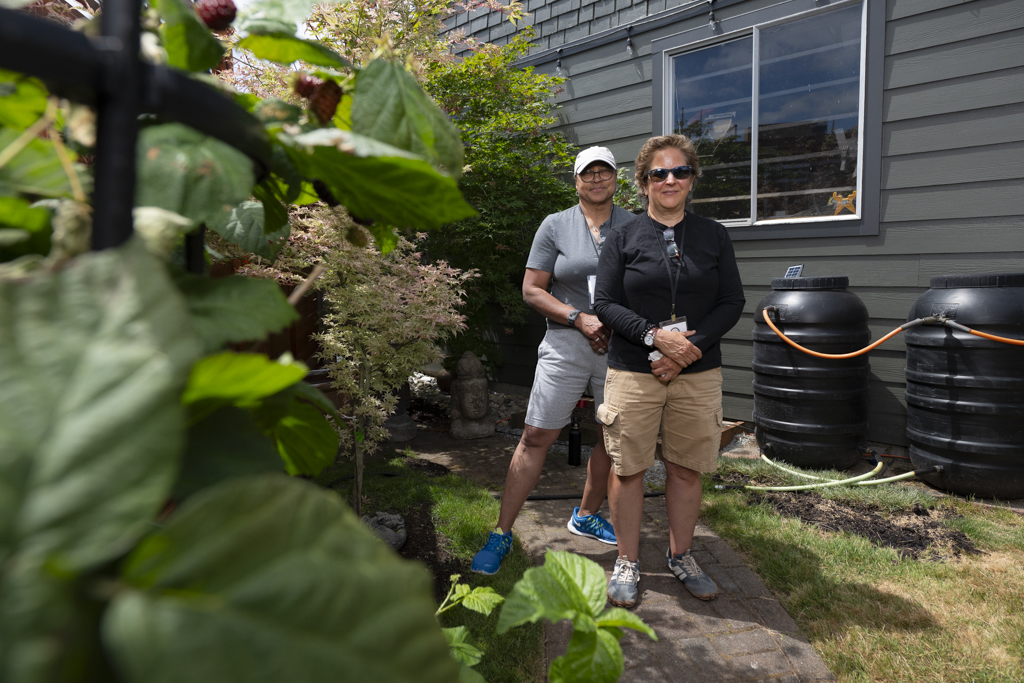
Garden F’s (L-R) Diane Elie and Raquel Gonzalez store water in 60-gallon rainbarrels and told Oliver that it fills most of their irrigation needs:
At Garden G, “Hidden Gem,” Julie Robinson-Jasper and Maple the dog are seen through a mirror surrounded by star jasmine at Garden G, “Hidden Gem”:

Another scene from Garden G:

Garden H, “Behind the Fences,” sported an arch of bittersweet nightshade:

A clawfoot bathtub graced Garden I, “A Fresh Look for A Once-Beloved Garden“:

Garden J, “Garden of Many Rooms,” was conducive to wandering:

Garden K offered onlookers “Plants from Around the World“:

And Garden L, “Conifer Corner,” featured a 75-year-old wisteria:

(Read details of each garden here.) The West Seattle Garden Tour is organized by a nonprofit that uses the proceeds to support other nonprofits – here are this year’s grant recipients; see how to apply for one of next year’s grants by going here (July 15 is the deadline).
-
 News16 minutes ago
What the Supreme Court did on the final day of its term
-

 Los Angeles, Ca2 hours ago
Los Angeles County man convicted of sex trafficking, abusing woman he was dating
-

 Detroit, MI2 hours ago
Detroit Tigers tee off on New York Yankees with 5 homers in win
-

 San Francisco, CA2 hours ago
Popular brewery shutters San Francisco location amid industry woes
-

 Dallas, TX2 hours ago
Eight arrested after repeated attempts to enter World Cup matches without tickets
-

 Miami, FL2 hours ago
Reports: Heat add potent bench scorer in Tim Hardaway Jr.
-

 Boston, MA2 hours ago
Boston Pops gearing up for major July 4th celebration: ‘You only turn 250 once’ – Boston News, Weather, Sports | WHDH 7News
-

 Denver, CO2 hours ago
Colorado wildfires destroy more than 100 structures, force more evacuations

