West
San Jose State volleyball coach with transgender player says politics plays into opponents forfeiting

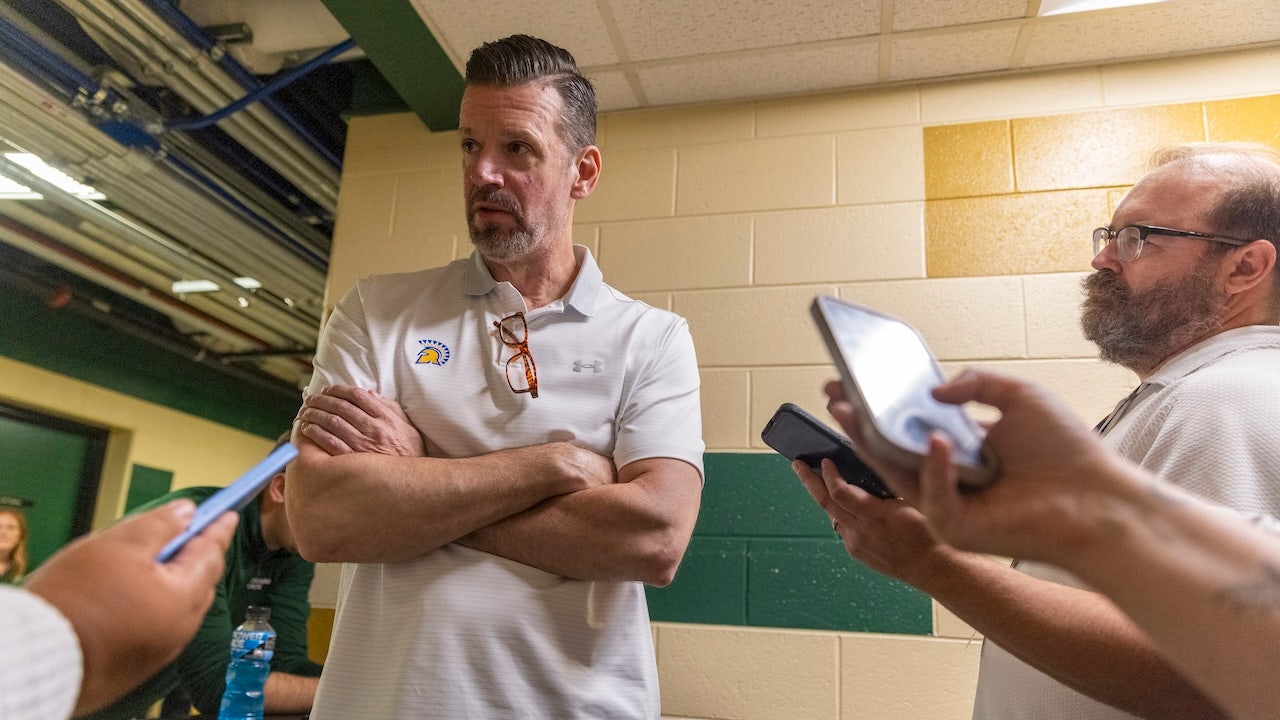
The San Jose State women’s volleyball team lost to Colorado State on Thursday night in one of its rare non-cancelled games in recent weeks. Head coach Todd Kress said he even considered thanking Colorado State coach Emily Kohan just for agreeing to play his team, as the program is currently at the center of a national controversy.
Four of San Jose State’s scheduled opponents – Boise State, Southern Utah, Wyoming and Utah State – all forfeited their games to the Spartans amid an ongoing lawsuit by one of its players over the presence of a transgender player on the team.
“I walked up to Emily tonight, and I was like, ‘Should I say thank you for playing us?’ I seriously meant that because, of course, we’re disappointed that we’re losing opportunities to play, but it’s not just us that are losing opportunities to play. It’s the people choosing not to play us, and that’s very unfortunate when it comes to these young women that have earned the right to step on the court and play,” Kress said in a postgame press conference, as seen in documents obtained by Fox News Digital.
Colorado State University police behind the San Jose State University Spartans’ bench monitor Moby Arena during an NCAA Mountain West women’s volleyball game between the Spartans and the Colorado State Rams in Fort Collins, Colo., on Thursday, Oct. 3, 2024.
San Jose Redshirt junior Blaire Fleming, who had 14 kills but with 10 errors on Thursday night, is a transgender athlete who has played for San Jose State since 2022 after transferring from Coastal Carolina. Meanwhile, junior Brooke Slusser, who joined the team in 2023 after transferring from Alabama, joined in a lawsuit against the NCAA, headed by former college swimmer and OutKick contributor Riley Gaines, over the governing body’s current policies on gender identity. Slusser cited her experience with Fleming when she joined the lawsuit.
WOMEN’S VOLLEYBALL TEAM WITH TRANSGENDER PLAYER GETTING POLICE PROTECTION AMID INTENSE BACKLASH
Slusser claimed that she had not been aware that Fleming was transgender, despite sharing rooms together on team trips, per the court documents. Slusser also expressed safety concerns for opponents playing against Fleming. Slusser’s complaint said that she and the other players on the team “could not fully protect themselves” from Fleming’s volleyball spikes.
Idaho governor Brad Little, Utah governor Spencer Cox and Wyoming governor Mark Gordon commended the four universities in their respective states over the decisions to forfeit their games against San Jose State amid the controversy.
Kress said he believes that the role of government has impeded his team’s ability to play the matches on its schedule.
“We’re in a position where it appears that government and politics has kind of intertwined itself with college sports. And the one thing that I love about college sports, it’s always been a safe haven for me, that’s one area that government I don’t think should be involved. And it seems that some of those decisions are being made at levels to where they’re denying their student athletes as well, which is then denying our student athletes,” Kress said.
Many states have taken legislative action over the past year aimed to keep transgenders out of women’s sports, including the Defending Women’s Sports Act, which Little issued an executive order for his states to carry out in August.
However, most of these actions are in response to attempted Title IX changes by the Biden-Harris administration. In April, the Biden administration issued a sweeping rule that clarified that Title IX’s ban on “sex” discrimination in schools covers discrimination based on gender identity, sexual orientation and “pregnancy or related conditions.”
GOP GOVERNOR REVEALS WHY HE ORDERED SCHOOLS TO BAR TRANSGENDERS FROM GIRLS SPORTS
U.S. President Joe Biden holds hands with Vice President Kamala Harris (R) during a ceremony honoring the Golden State Warriors on January 17, 2023, in Washington, D.C. The Warriors won the 2022 NBA Championship. (Photo by Win McNamee/Getty Images) (Getty Images)
The rule took effect Aug. 1, and, for the first time, the law stated that discrimination based on sex includes conduct related to a person’s gender identity. The Biden administration insisted that the regulation does not address athletic eligibility. However, multiple experts presented evidence to Fox News Digital in June that Biden’s claims that it would not result in biological men participating in women’s sports weren’t true and that the proposal would ultimately put more biological men in women’s sports.
The Supreme Court voted 5-4 to reject a Biden emergency request to enforce portions of that new rule that includes protection from discrimination for transgender students under Title IX, after more than two dozen Republican attorneys general sued to block the Title IX changes in their own states.
Now, with states like Idaho taking countermeasures against these amendments, Little may have to prepare for even further countermeasures at the federal level in the event of a Harris victory this November.
“We’ll cross that bridge when we come to it,” Little told Fox News Digital in an exclusive interview when asked whether he expects a Harris victory to result in his schools losing federal funding due to the order he just passed. “From a national standpoint, there are radical little groups that want to implement changes in the rules that we have already.”
Meanwhile, Kress will look to navigate his team’s season in a landscape of different state laws impacting his team’s schedule. Kress added that the situation involving the game cancelations, the lawsuit and national controversy have impacted the mental well-being not only of Fleming, but the team as a whole.
One of Fleming’s teammates joined several other female athletes in suing the NCAA for Title IX violations. (San Jose State University)
“I talked to all of our students. You know, I am a father first, right? I had two boys of my own, and I know that mental health is a real thing, and I know that my kids get through it, and so I think that’s the first thing I look out for, is protecting physical and mental health. Do I talk with Blaire? She is taking the majority of the heat, but all of our athletes are taking some of this. So, you know, I’m really trying to talk to all of our student athletes and see how they’re doing,” Kress said.
Things have gotten to the point where university police have been assigned to provide added security to the team in response to negative attention it has received recently, a San Jose State spokesperson told Fox News Digital on Thursday.
Blaire Fleming, a redshirt senior at San Jose State University, plays as an outside and right-side hitter on the women’s volleyball team. (San Jose State University)
Still, San Jose State was technically undefeated going into Thursday night, as the forfeits by the other programs counted as wins for the Spartans by default. They are now 9-1 with a 3-1 conference record. The forfeits don’t count toward the team’s NCAA resume, but Fleming’s skills and spiking ability may be just one advantage that could help the team reach the tournament, as Kress believes the tension in the locker room might not be “a bad thing” from a competitive standpoint.
“Sometimes tension is not necessarily a bad thing, and I’m not saying that there is. But you know, when you do have tension or you do have confrontations, I mean, I’m a person that believes that from confrontation, good things usually happen. We settle our differences, and we work through it,” Kress said.
“The last thing that I would want is there’s the white elephant in the room, and there is no tension, we don’t address it, and we never move past it, right? So I think there may be tension, but it dies. If we’re in a meeting room and there’s tension, it dies there. If there’s tension on the court, it dies there. We really don’t let the boundaries cross over, and that’s how I think we’ve been so successful thus far.”
Follow Fox News Digital’s sports coverage on X, and subscribe to the Fox News Sports Huddle newsletter.
Read the full article from Here


The recent strike and killing of a pregnant fin whale by a cruise ship in the Gulf of Alaska tragically highlights decades of inaction by the federal government and shipping industry to enact reasonable measures to reduce this risk. Such whale protection measures include vessel speed reductions, or VSRs, to 10 knots or less and bow watches posted in designated whale habitat. A voluntary vessel speed reduction off California has reportedly reduced ship-whale strikes by half, while also reducing underwater noise, fuel use and harmful stack emissions.
While technological options to detect and avoid whales, such as thermal imaging infrared cameras, forward-looking sonar, sonic pingers and passive acoustic monitoring, are useful, the best way to reduce the risk of ship-whale strikes is slower speed and a posted bow watch.
Similar to speed limits for cars in school zones when children are present, ship speed reductions give both a ship crew and whales more time to detect each other and avoid a collision. They also reduce the risk of more serious or fatal injuries if a collision occurs.
We know that the number of whales actually observed killed by ships is just the tip of the iceberg in terms of total mortalities. To be detected, usually a struck whale must remain pinned across the bow of a ship and carried into port. Studies have estimated that whale mortalities unobserved offshore compared with those observed are anywhere from 7-to-1 to 25-to-1. Given the thousands of whales and ships overlapping in Alaska waters each year, it is more than likely that hundreds of whales have been struck and killed here.
It is important for the public to know the record of failure by government and industry to reduce this risk.
Beginning in 2009, I proposed to the incoming Obama administration that it enact greater protections for Unimak Pass in the eastern Aleutians and Bering Strait, including ship-whale strike reduction measures. I reiterated this specific ship-whale strike reduction request in 2013, 2018, 2021 and 2022. Each time, the federal administration declined to act.
Additionally, in 2022, I proposed directly to the Prince William Sound tanker owners that they enact voluntary speed reductions to reduce the risk of whale strikes. These huge oil tankers steam year-round directly across the paths of hundreds of whales. In June 2009, the Exxon tanker Kodiak entered Valdez with a dead humpback whale stuck on its bow.
I then proposed to the National Oceanic and Atmospheric Administration and the PWS Regional Citizens Advisory Council that they press the tanker owners to adopt voluntary whale protection measures.
NOAA convened an informative technical workshop on the issue but declined to take any action, presenting a flawed assessment of the risk. In response to a formal scientific integrity complaint I filed with the agency, the NOAA National Appeals Office directed its Alaska staff to provide a supplemental assessment of the ship-whale strike risk in PWS that corrected some, but not all, of its previous flawed assessment. The agency continued to decline to take any action.
In July 2024, the PWSRCAC sent a letter to tanker owners asking them to consider adopting a speed reduction in PWS, which the tanker owners declined the following month, saying they would only “follow the guidance, direction, and regulations provided by NOAA/NMFS on this matter.”
In March 2023, two organizations I am associated with, Public Employees for Environmental Responsibility and The Ocean Foundation, submitted a proposed rulemaking to NOAA asking the agency to adopt a nationwide protocol to reduce whale strikes by ships
The petition proposes that the agency designate critical whale safety zones in all U.S. waters in which ships would be required to slow to 10 knots during the day, 8 knots in low visibility, such as nighttime, fog or heavy weather, and post bow watches to detect whales ahead. Neither the Biden nor the Trump administration responded to the petition, the latter saying earlier this year only that “NMFS is still considering the 2023 petition.”
After two suspected ship strikes on whales in Icy Strait in August 2024, I urged the Cruise Lines International Association with its 59 member companies, to adopt voluntary speed reductions and other whale-strike reduction measures in critical Alaska whale habitats. The cruise ship association ignored the request.
Again in February of this year, I urged the Cruise Lines International Association and NOAA to enter into a memorandum of agreement specifically to reduce the risk of whale strikes this summer in Alaska. In a Feb. 20 email, the cruise association responded: “In addition to specialized training for crew, cruise lines have agreed to the voluntary slowdown of vessels in sensitive areas or when marine life is observed/present. Cruise lines also use methods and technologies such as bow-positioned observers and online monitoring and reporting apps to carefully navigate in ways that are respectful and protective of marine mammals.”
When I pressed them for details on these vague, questionable assertions and reiterated our proposed memorandum of agreement between the Cruise Lines International Association and NOAA, the cruise association went silent. Later that month, NOAA’s Alaska regional director responded to the proposal: “Here in Alaska, we continue to engage with the cruise industry to reduce the risk of vessel strikes (e.g., encouraging the use of Whale Alert). Due to reduced capacity we’re quite limited in our ability to do more proactive work with the cruise industry at this time.”
After the fin whale was struck and killed by the Ovation of the Seas in the Gulf of Alaska last month, I again pressed NOAA and the Cruise Lines International Association to enter into a memorandum of agreement to reduce such risk, suggesting that important whale safety zones in Alaska waters that need strategic vessel speed reductions include at least Icy Strait, Prince William Sound, Resurrection Bay/Kenai Fjords, Unimak Pass and Bering Strait.
The cruise association has yet to respond, and NOAA’s regional director said simply that they are reviewing the situation and potential next steps.
Tragically, there is still no commitment by the shipping industry or government to address this issue in Alaska. While these same ship owners participate in voluntary whale-strike reduction measures elsewhere, they refuse to do so here in Alaska.
As these ship owners remain unwilling to remedy this voluntarily in Alaska, it is time that NOAA adopt our 2023 proposed rulemaking requiring them to reduce this risk to whales here in Alaska and across the nation.
Alaska whales, who share their ocean home with us terrestrial primates on ships, deserve nothing less.
Rick Steiner is a marine conservation biologist in Anchorage, former marine professor at the University of Alaska and board chair of Public Employees for Environmental Responsibility.
• • •
The Anchorage Daily News welcomes a broad range of viewpoints. To submit a piece for consideration, email commentary(at)adn.com. Send submissions shorter than 200 words to letters@adn.com or click here to submit via any web browser. Read our full guidelines for letters and commentaries here.


Odds of winning the Powerball and Mega Millions are NOT in your favor
Odds of hitting the jackpot in Mega Millions or Powerball are around 1-in-292 million. Here are things that you’re more likely to land than big bucks.
The Arizona Lottery offers multiple draw games for those aiming to win big.
Here’s a look at Tuesday, July 7, 2026 results for each game:
Winning Mega Millions numbers
02-31-35-36-63, Mega Ball: 12
Check Mega Millions payouts and previous drawings here.
Winning Pick 3 Evening numbers
Evening: 4-7-2
Winning Fantasy 5 numbers
03-05-10-14-37
Check Fantasy 5 payouts and previous drawings here.
Winning Triple Twist numbers
03-06-18-23-27-32
Check Triple Twist payouts and previous drawings here.
Feeling lucky? Explore the latest lottery news and results
What time is the Powerball drawing?
Powerball drawings are at 7:59 p.m. Arizona time on Mondays, Wednesdays and Saturdays.
How much is a Powerball lottery ticket today?
In Arizona, Powerball tickets cost $2 per game, according to the Arizona Lottery.
How to play the Powerball
To play, select five numbers from 1 to 69 for the white balls, then select one number from 1 to 26 for the red Powerball.
You can choose your lucky numbers on a play slip or let the lottery terminal randomly pick your numbers.
To win, match one of the 9 Ways to Win:
- 5 white balls + 1 red Powerball = Grand prize.
- 5 white balls = $1 million.
- 4 white balls + 1 red Powerball = $50,000.
- 4 white balls = $100.
- 3 white balls + 1 red Powerball = $100.
- 3 white balls = $7.
- 2 white balls + 1 red Powerball = $7.
- 1 white ball + 1 red Powerball = $4.
- 1 red Powerball = $4.
There’s a chance to have your winnings increased two, three, four, five and 10 times through the Power Play for an additional $1 per play. Players can multiply non-jackpot wins up to 10 times when the jackpot is $150 million or less.
Are you a winner? Here’s how to claim your lottery prize
All Arizona Lottery retailers will redeem prizes up to $100 and may redeem winnings up to $599. For prizes over $599, winners can submit winning tickets through the mail or in person at Arizona Lottery offices. By mail, send a winner claim form, winning lottery ticket and a copy of a government-issued ID to P.O. Box 2913, Phoenix, AZ 85062.
To submit in person, sign the back of your ticket, fill out a winner claim form and deliver the form, along with the ticket and government-issued ID to any of these locations:
Phoenix Arizona Lottery Office: 4740 E. University Drive, Phoenix, AZ 85034, 480-921-4400. Hours: 7:30 a.m. to 5 p.m. Monday through Friday, closed holidays. This office can cash prizes of any amount.
Tucson Arizona Lottery Office: 2955 E. Grant Road, Tucson, AZ 85716, 520-628-5107. Hours: 7:30 a.m. to 5 p.m. Monday through Friday, closed holidays. This office can cash prizes of any amount.
Phoenix Sky Harbor Lottery Office: Terminal 4 Baggage Claim, 3400 E. Sky Harbor Blvd., Phoenix, AZ 85034, 480-921-4424. Hours: 8:30 a.m. to 5 p.m. Monday through Sunday, closed holidays. This office can cash prizes up to $49,999.
Kingman Arizona Lottery Office: Inside Walmart, 3396 Stockton Hill Road, Kingman, AZ 86409, 928-753-8808. Hours: 8 a.m. to 8 p.m. Monday through Friday, 8:30 a.m. to 5 p.m. Saturday and Sunday, closed holidays. This office can cash prizes up to $49,999.
Check previous winning numbers and payouts at https://www.arizonalottery.com/.
This results page was generated automatically using information from TinBu and a template written and reviewed by an Arizona Republic editor. You can send feedback using this form.
California
California still hasn’t released Newsom’s Baby2Baby diaper contract as lawmakers weigh longer public records delays

California’s delayed release of its Baby2Baby contract is casting a shadow over the state’s new Golden State Diaper program.
Two months after Gov. Gavin Newsom announced a controversial multimillion-dollar state diaper contract with Baby2Baby, a nonprofit with existing ties to the Newsom administration and the First Partner, Californians still have not been allowed to see the contract or competitive bid records behind the deal to manufacture and deliver millions of California co-branded free diapers to new parents.
The delay comes despite repeated requests by CBS California Investigates and despite California law requiring the state to release these records.
ALSO READ: California’s “Diapergate”: Critics got free diaper math wrong, but state won’t release key Baby2Baby records
The Newsom administration waited 24 days to decide whether it would even allow the public to see the records, but continues to delay releasing the Baby2Baby contract and competitive bid records that the governor announced more than two months ago.
At the same time, California lawmakers are advancing legislation that would give state agencies additional time to respond to California Public Records Act requests, further extending how long the public must wait for records like these.
Delayed accountability
CBS California Investigates requested a copy of the Baby2Baby contract on May 12, four days after Governor Newsom announced the partnership during a high-profile press conference.
Given the controversy and misinformation surrounding the announcement, we asked the Newsom administration to forgo the formal California Public Records Act (CPRA) process and provide an expedited copy of the contract and competitive bid records.
Both are expressly identified as public records under California law, which also requires agencies to “promptly notify” requesters whether records are disclosable, allowing a maximum of ten days to let them know the estimated date that they will provide the records.
Instead, the Newsom Administration spent 24 days determining whether or not it would even allow Californians to see these public records, then said it would take another 42 days (if the state meets its latest deadline) to provide a copy of the contract and competitive bid records that the governor publicly announced two months ago.
What is AB 1821?
Even as public interest grows, California lawmakers are advancing a bill that would allow agencies to further delay responses to Public Records Act requests, extending the maximum initial 10-day determination window and 14-day extension window from calendar days to business days.
State law does not limit how long an agency can wait to actually provide the records after they provide that initial response.
ALSO READ: California State Secrets: What public officials don’t want you to know
Assemblymember Blanca Pacheco introduced Assembly Bill 1821, which originally sought to overhaul the transparency law to allow agencies to sue if they deemed a request “malicious” and charge up to $66 an hour to provide public records.
The proposal triggered fierce pushback from a broad coalition including the First Amendment Coalition, ACLU California Action, Common Cause California, the League of Women Voters, and the Howard Jarvis Taxpayers Association.
The Senate Judiciary Committee, led by Senate Judiciary Chair Tom Umberg, stripped the most controversial elements from the legislation before moving it forward.
“People shouldn’t have to tell us why they want that information. People shouldn’t have to pay to get information from public officials,” Umberg told CBS California.
Still, the amended version lengthens the legal window for officials to respond to records requests.
Pacheco maintained the necessity of the changes for burdened departments.
“Agencies across the state are experiencing a sharp increase in requests that are exceptionally broad,” she argued during testimony.
Ginny LaRoe of the First Amendment Coalition contends that essential documents, such as multimillion-dollar state contracts, should be accessible without any formal request at all.
“You should have that document in your hands. You should’ve had it in your hand the day they were talking about it,” LaRoe said.
Rather than forcing Californians to wait weeks for paper-pushing, LaRoe suggests the state should proactively upload finalized agreements online with minor necessary redactions for personal information, ensuring immediate transparency and easing the administrative burden.
Umberg signaled support for a shift toward automated disclosure.
“I think there’s a world where we make them do that,” he said. “It’s up to us to motivate them to do so.”
More than two months after Newsom’s big announcement, CBS California Investigates continues to wait for the state to release the Baby2Baby contract and the underlying bid documents.
After waiting 24 days to confirm the records were, in fact, disclosable, the state said it would need an additional 28 days to provide them. At 5:09 pm on the 28th day – Friday, July 3, a state holiday – CBS California received a presumably automated email informing us the state would need another two weeks to provide the contract the governor announced two months ago.
Until these public records are actually public, questions will continue to mount about how this deal was reached and how competing proposals were scored.
Day 1 | May 12
CBS California Investigates requested a copy of the Baby2Baby contract four days after Governor Newsom announced the partnership during a high-profile Capitol press conference.
The Governor’s Office referred the request to the California Health and Human Services Agency. Because of the intense public interest following the announcement, CBS California Investigates asked Deputy Secretary of External Affairs Sami Gallegos and Assistant Secretary of External Affairs Rodger Butler to forgo the formal California Public Records Act (CPRA) process and simply provide an expedited copy of the highly publicized contract.
Instead, Butler directed us to the Department of Health Care Access and Information (HCAI), the agency handling the procurement. HCAI acknowledged receipt of the request.
Day 7 | May 19
CBS California Investigates followed up with the HCAI, again requesting an expedited copy of the contract because we were on a deadline.
The agency responded that the request was being processed through the California Public Records Act, rather than providing the contract directly.
Day 14 | May 22
Exactly 10 calendar days after the request, the HCAI invoked the CPRA’s “unusual circumstances” provision, extending the deadline another 14 days to determine whether the requested records were disclosable.
The agency wrote that it needed additional time because “two or more components of the agency have substantial subject matter interest” in the request.
Day 28 | June 5
Fourteen days later, the HCAI agreed that the records are public.
The agency determined that the Baby2Baby contract, procurement packet, scope of work, bid scoring sheets and vendor award documents are disclosable public records.
However, instead of releasing them, the HCAI said it would need another three to four weeks to identify and produce the records.
AB 1821 | While we waited
While CBS California Investigates waited for the records, lawmakers advanced AB 1821, legislation that originally proposed sweeping changes to California’s Public Records Act.
After bipartisan criticism and opposition from transparency advocates, many of the bill’s most controversial provisions were removed. However, the amended bill still gives agencies additional time to respond to public records requests.
Day 52 | July 3
Instead of receiving the records, CBS California Investigates received another email at 5:09 p.m. on the final day of the promised three-to-four-week production window.
Rather than releasing the records, the state delayed production another two weeks, pushing the expected release well past the two-month mark.
Day 56 and counting
Fifty-six days after CBS California Investigates requested the Baby2Baby contract, and 60 days after Governor Newsom publicly announced the partnership, Californians still have not been allowed to review:
- The executed contract
- The procurement packet
- The scope of work
- The competitive bid scoring sheets
- The vendor award documents
Translation: The Newsom administration spent 24 days determining whether records already identified as public under California law could be released. It then delayed producing those records for another six weeks. If the state meets its latest deadline, Californians will have waited 66 days from our request and 70 days from the governor’s announcement to see the contract.
-

 Alaska4 minutes ago
Opinion: Alaska’s whale-strike risk is growing while regulators keep studying the obvious
-

 Arizona11 minutes ago
Arizona Lottery Mega Millions, Pick 3 Evening results for July 7, 2026
-
Arkansas14 minutes ago
Arkansas Lottery Mega Millions, Cash 3 winning numbers for July 7, 2026
-

 California26 minutes ago
California still hasn’t released Newsom’s Baby2Baby diaper contract as lawmakers weigh longer public records delays
-

 Colorado29 minutes ago
Colorado River, public lands reopen as Snyder Fire containment increases
-

 Connecticut34 minutes ago
Opinion: A lifeline in CT’s childcare desert
-

 Delaware41 minutes ago
Talk & Film Bring Delaware’s Revolutionary Story to Life at Archives’ First Saturday Program – State of Delaware News
-
 Florida44 minutes ago
Heat alerts expand across Florida as dangerous temperatures return

