San Diego, CA
John Stephen Fisher


John Stephen Fisher
OBITUARY
John Stephen Fisher was born in La Jolla California at Scripps Memorial Hospital on November 2, 1941 to OJ and Emily Fisher. From day one he was called Steve.
His first home was on Narragansett Street in Point Loma. Throughout the years he was blessed with being the big brother to Suzanne (Suzie) and Sarah. The family moved to Rancho Santa Fe, Mission Hills, Carlsbad and Idyllwild, with Steve graduating from San Diego High School and attending San Diego State and was a reservist with the US Marines.
Steve chose a career in construction with his focus being underground utilities, working as an estimator/project manager. He was employed at Southern Contracting Company in San Marcos for over 40 years, having just retired January 2024. He was a dedicated employee and enjoyed both the work he did as well as the friendships he made.
On his non-working days Steve enjoyed surfing, motorcycle riding, fishing, hiking and taking vacations. He loved to read, research and learn.
Steve and his wife Sharon were together for over 52 years and lived in San Marcos for the past 48 years. He was predeceased by his parents and his sister Suzie. He is survived by his wife, his sister Sarah (Rob), his nieces Alicia, Paisley, Stacy and nephew Ethan. He was Uncle Steve to many other young people in his life. Not having children of his own, he supported friends’ children with his big heart and always with advice, whether they wanted it or not.
Steve was bright, smart, funny, quick witted and all-round good guy. He will be missed by many and remembered for being the strong, hard-working man he was, and his loyalty to friends and family.


The U.S. military identified a Minnesota Marine stationed in Southern California who went missing off San Diego last week, and confirmed his death.
Lance Cpl. Armando Ortiz Canseco was declared deceased Saturday. It is believed he was lost at sea after a training exercise.
“On behalf of the Marines and sailors of the 13th Marine Expeditionary Unit, I extend our deepest condolences to the family and loved ones of Lance Cpl. Ortiz Canseco,” Col. Richard Alvarez, the commanding officer of the 13th Marine Expeditionary Unit, said in a statement.
Ortiz Canseco was reported missing from the amphibious transport dock ship USS Anchorage early Thursday morning. His disappearance resulted in an extensive search and rescue operation, with efforts beginning around 1:20 a.m. Thursday.
The search spanned roughly 2,400 square miles and involved officials from the Navy, Marine Corps, Coast Guard and Air Force who used three surface ships and 12 aircraft, according to the military.
The Marine went missing during a training operation involving the 13th Marine Expeditionary Unit and the Makin Island Amphibious Ready Group.
After nearly two full days of searching, the Navy transitioned to recovery operations.
“He earned the title of United States Marine and served his country with honor and commitment,” Alvarez said. “We mourn alongside his family, and we remain committed to bringing him home.”
This incident marks the second time in recent weeks that the U.S. military has searched for missing service members.
The remains of two Army soldiers who went missing while off duty from military exercises in Morocco were recovered in May, according to the Army.
Officials did not initially identify Ortiz Canseco on Thursday or disclose the circumstances surrounding his disappearance, saying his family needed to be notified first.
His death continues to be under investigation.
Ortiz Canseco enlisted in the Marine Corps in April 2023 and reported for training at Marine Corps Recruit Depot San Diego.
His individual awards include the Marine Corps Good Conduct Medal and Sea Service Deployment Ribbon.
Times staff writer Alene Tchekmedyian contributed to this report.

Blink, and you might miss it.
Adobe Falls isn’t Niagara Falls — or anything close — but after winter rains, a seasonal waterfall briefly appears in a narrow Del Cerro canyon, hidden beneath streets, homes, and San Diego State University property.
The waterfall forms along Alvarado Creek, which drains parts of eastern San Diego, including the SDSU area and surrounding neighborhoods. In wet months, runoff moves through a steep canyon and drops over a short rock ledge known locally as Adobe Falls. In dry periods, the flow often fades to a trickle or disappears entirely, leaving exposed sandstone and a shaded canyon bed.
What makes the site stand out is its setting. Above the canyon are Del Cerro residential streets and university property tied to San Diego State. Below it, Alvarado Creek continues west as part of the Mission Valley watershed, eventually feeding into the San Diego River system. Like many urban drainages in San Diego, its flow is shaped by stormwater runoff, paved surfaces, and altered drainage patterns tied to development.

Access is restricted. The canyon sits on a mix of SDSU and city-managed land and has long been closed to the public due to safety concerns, including steep terrain, erosion, and unstable footing after rain. Although widely referenced in maps and online posts, it is not an official trail or recreation site.
The canyon itself pre-dates modern development in Del Cerro. It is part of a broader network of inland waterways and canyon corridors used for thousands of years by the Kumeyaay, whose presence shaped movement and settlement patterns across the region.
In the mid-20th century, as Del Cerro developed, homes and roads were built along canyon rims rather than through them, leaving Alvarado Creek intact as a drainage system. Adobe Falls remained within that corridor even as surrounding hillsides filled with residential and institutional development.
Today, Adobe Falls remains a small but persistent reminder that San Diego’s natural drainage systems still function within a heavily built environment — appearing briefly after storms, then receding back into the canyon until the next rain.
Read more history stories here, and do you have a story to tell? Send an email to DebbieSklar@cox.net.
Sources:
City of San Diego – Stormwater & Watershed Division (Alvarado Creek / Mission Valley watershed)
San Diego State University – planning and environmental impact documentation for adjacent canyon areas
U.S. Geological Survey (USGS) – San Diego County watershed and hydrology mapping (Alvarado Creek / San Diego River system context)
San Diego History Center – Kumeyaay regional land use and inland canyon corridor history
City of San Diego Planning Department – land use records and access restrictions for Adobe Falls area
California State Historic Landmark files – Adobe Falls (Landmark No. 80)

Skip to content
-
 Lifestyle14 minutes ago
How does the Kennedy Center board make decisions? This legal filing sheds some light
-

 Technology24 minutes ago
Meta is adding ridiculous ‘rate limits’ and a soft paywall to its smart glasses
-

 World29 minutes ago
Boy, 2, pulled alive from rubble six days after Venezuela’s devastating twin earthquakes
-

 Politics31 minutes ago
Socialism goes west as DSA-backed challenger ousts longtime Democrat
-

 Health36 minutes ago
Americans are giving up multivitamins for a different daily health habit, study finds
-

 Sports39 minutes ago
2026 World Cup Quarterfinal Odds: Which Squads Will Make Final 8?
-

 Technology44 minutes ago
Warehouse robots move packages without human handoff
-
 Business51 minutes ago
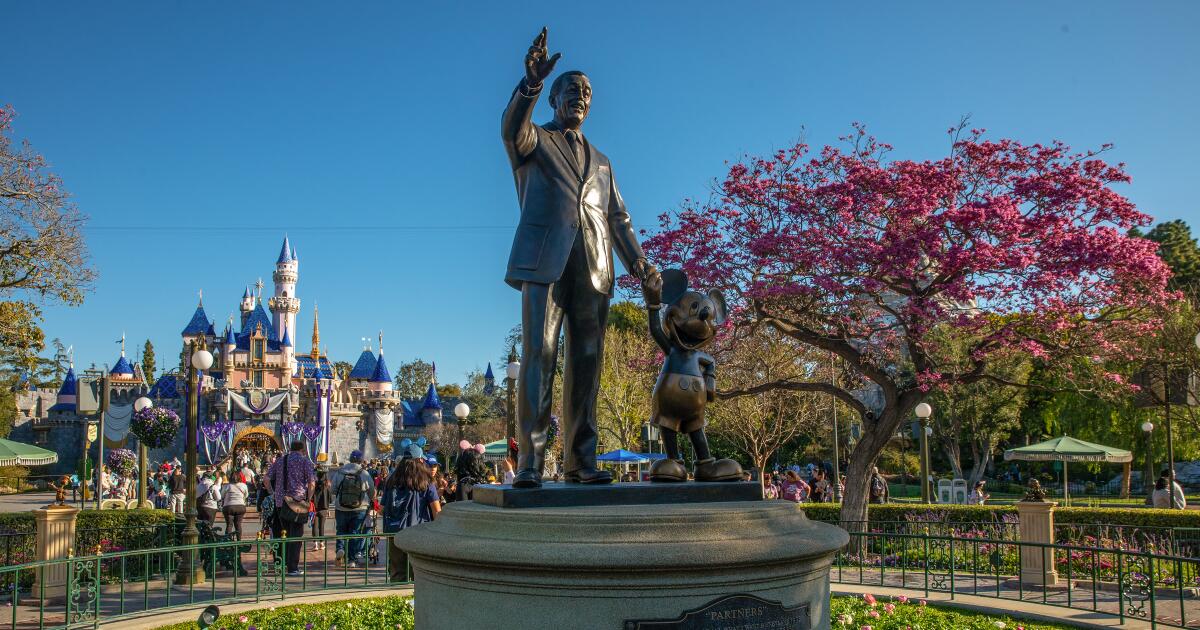
Disneyland to offer $59 evening tickets next month

