Oregon
Oregon Senate rejects bill making big tech pay for local journalism as session end nears


By: Shaanth Nanguneri
A novel proposal that would mandate tech companies to pay local journalism outlets for using their news content failed to gain steam in its first floor vote in the Oregon Senate on Tuesday, effectively killing its chance to pass this year.
Lawmakers on Tuesday voted 15-14 against Senate Bill 686, introduced in January, which aims to regulate tech companies and social media platforms like Google and Meta that aggregate, publish and use news content for their feeds or algorithms to provide information to users. Four Democrats were in opposition.
“Does anybody honestly believe these companies are going to just write the check and keep doing business as usual here?” Sen. Mark Meek, D-Gladstone, asked his colleagues Tuesday before voting against the legislation. “No, they will stop sharing news content in Oregon all together, just like they did in Canada.”
The effort at enacting the nation’s most stringent rules regulating journalism content and reproduction has also met a mounting resistance from tech companies. Meta, for instance, has threatened to remove Oregon news from their platforms altogether if the bill passes, echoing its position in Canada where a similar law was passed in 2023.
The vote against the bill was followed by a motion by Sen. Kayse Jama, D-Portland, to send the bill back to the Senate Committee on Rules, where it was previously amended on June 11 in the face of legal concerns over regulation of private markets and the First Amendment.
But it’s unlikely that the bill will be revived, amended and passed out of committee and both chambers by Sunday, when Oregon’s legislative session ends. And the bill’s author, Sen. Khanh Phạm, D-Portland, told the Capital Chronicle that she will be reintroducing the bill in a future session, though she hasn’t decided when.
The original version of the legislation had three avenues for platforms to satisfy the legislation’s regulations: pay each accessed provider an unspecified amount, enter into an arbitration process, or donate to a university-backed public media board. The new bill preserves those pathways but heightens the protections news outlets have if their content is used without an agreement with an online platform.
Under the legislation, companies like Apple, Google and Meta could pay tens of millions of dollars into a state fund that would support news outlets throughout the state, based on their size and the number of journalists they employ. Firms like Google, Instagram and Facebook could pay into a central fund that is doled out to different newsrooms based on size, paying $104 million annually if they have six billion or more monthly active users worldwide, or $18 million annually if they have fewer than six billion worldwide users.
One-tenth of that money would go to the Oregon Civic Information Consortium, a proposed board under the purview of the University of Oregon that would help train future journalists, offer grants to newsrooms and ensure funding for news deserts such as rural communities. The rest of the funding would go to newsrooms based on the number of employees and journalists they have; 70% of the funds must be spent on journalists and support staff by providers.
“We trust the people who work in this industry and whose vocation depends on freedom of the press to guide us on what they need,” Phạm said on the Senate floor, referencing the more than 50 Oregon newsrooms that have voiced support for the bill. “Now they need a fighting chance in an unfair market.”
The bill was amended in a June committee hearing, however, to address legal concerns about violating the First Amendment and regulating the free market, though lawmakers anticipate the untested measure would face a legal challenge anyway. The new version shifted the focus away from cracking down on social media and tech platforms, aiming instead to empower news outlets to create agreements with platforms for payment or face legal consequences.
Sen. Daniel Bonham, R-The Dalles, warned his colleagues that the bill could unintentionally incentivize platforms to establish agreements with politically-biased media. He was also unsure if the bill would survive under legal scrutiny.
Under the new version of the legislation, online platforms could face lawsuits for damages from newsrooms if the companies accessed their content without a written agreement. The proposal would establish an arbitration process to decide what proportion of ad revenue a platform should dole out to newsrooms. The reworked bill also classifies the access and use of such content through aggregation, publishing and distribution without a formal agreement with an outlet as an unfair trade practice.
Sen. Jeff Golden, D-Ashland, told his colleagues there was no avoiding the uncertainty the bill would pose in the courts. But, he asked, “Can you think of a significant law in the past that tries to solve a significant problem that hasn’t been litigated?”
Aside from Meek, the three other Democrats who voted in opposition to the bill were Sens. Kayse Jama, D-Portland, Floyd Prozanski, D-Eugene and Janeen Sollman, D-Hillsboro. Jama reversed his position in order to be part of the prevailing majority against the bill, allowing him to call for the bill to be reconsidered and sent to committee. The one Republican who had expressed support for the legislation, Sen. Dick Anderson, R-Lincoln City, also voted against the bill.
Note: Oregon Capital Chronicle Editor Julia Shumway is board treasurer of the Greater Oregon Pro Chapter of the Society of Professional Journalists, which supports the bill referenced in this article. She did not participate in the editing of this item.
Correction: Sen. Khanh Phạm, D-Portland, has not decided on a date in which she will reintroduce the legislation. A previous version of this story reported that she would do so next session.


Summer is in full swing, and across the country, the songs of birds and the cheeps of baby chicks are filling the air. While birdwatching season is happening just about everywhere right now, the Pacific Northwest offers something truly special: the chance to see puffins along the Oregon Coast. If you’re wondering when, where and how to see puffins in Oregon, you’re in the right place.
Few wildlife sightings feel as magical as spotting a Tufted Puffin (Fratercula cirrhata) in the wild. These beloved seabirds return to the Oregon Coast each year during their breeding season, drawing birdwatchers, photographers and nature lovers hoping for a glimpse of their bright orange beaks, expressive faces and unmistakable charm. For many visitors, seeing puffins in their natural habitat is a heartwarming coastal experience that captures the spirit of the Pacific Northwest.
Because puffins are seasonal migratory birds that nest in specific coastal areas, timing and location are key. With a bit of planning—and a little luck—you can witness one of Oregon’s most iconic wildlife moments along its rugged coastline. Here are the best places to see puffins on the Oregon Coast.
What Are the Best Places to See Puffins in Oregon?
If you’re wondering where you can you see these cute creatures, there are three spots that are worth going to and are hailed as the best places to see puffins in Oregon.
Haystack Rock, Cannon Beach
Haystack Rock is a popular place where puffins nest in Oregon.Getty Images Big5 Studio
Few wildlife encounters feel as effortless as spotting puffins right from shore, and Haystack Rock at Cannon Beach is one of the rare places where that’s possible.
This towering sea stack isn’t just an Oregon landmark, it’s also a seasonal nesting site for Tufted Puffins, who return here each year to raise their young on the rocky ledges. From the beach, visitors can often catch glimpses of puffins flying to and from the rock or resting along its cliffs, especially during the warmer months when activity peaks.
Because it requires no boat or hike to access, Cannon Beach remains one of the most rewarding and beginner-friendly places to experience puffins in the wild.
Face Rock State Scenic Viewpoint (Bandon)

Image via Getty Images/Moelyn Photos
For a quieter, more immersive coastal experience, Face Rock in Bandon offers a different kind of puffin viewing.
Here, the focus shifts from crowds to coastline where Tufted Puffins and other seabirds nest along offshore rocks just beyond the shoreline. The setting is calmer than Cannon Beach, making it ideal for visitors who want to slow down and scan the horizon for wildlife activity.
Every Saturday and Sunday from now until July 26, Face Rock Wildlife Interpreters will host on-site sessions at Face Rock Wayside from 9 am to 11 am, where guests will get to look out for puffins nesting on Face Rock with the wildlife interpreters’ help. Whether you go puffin-peeping on your own or with a group, be sure to bring binoculars!
Three Arch Rocks National Wildlife Refuge

Image via Getty Images/Bob Stefko
If looking for something a little closer to Portland, Three Arch Rocks is home to the largest breeding colony of Tufted Puffins in Oregon. A trip to Three Arch Rocks National Wildlife Refuge is sure to be a treat for any lovers of the Pacific Northwest’s coastal wildlife.
Not only is it one of the top places in Oregon to spot nesting puffins over the summer, but it is also the only pupping site on the North Oregon coast for the federally-threatened Steller sea lion, one of two sea lion species native to Oregon. Incidentally, the Steller sea lion’s pupping season, which runs from mid-May to mid-July, coincides with the first half of the Tufted Puffin’s nesting season, so right now is the perfect time of year for a visit!
When Do Puffins Arrive on the Oregon Coast?
For a large part of the year, Tufted Puffins live far out at sea across the North Pacific Ocean (in fact, they can be found as far eastward as Japan). However, from right now through August, Tufted Puffins are making their way back to coastal islands along the Oregon coastline to create their nests and raise their young until they are strong enough to join them out at sea. Therefore, if you want to catch a glimpse of them, now’s the perfect time.
What’s the Best Time of Day to See Puffins in Oregon?
These birds don’t follow a predictable shoreline schedule, which is part of what makes spotting them such a rewarding experience. So when’s the best time to see puffins in Oregon? Throughout the day during the breeding season, they move between offshore feeding areas and nesting sites on rocky cliffs and sea stacks. However, early morning and late afternoon often offer the most consistent viewing opportunities, when bird activity around colonies tends to increase and lighting conditions make movement easier to spot from shore.
For visitors hoping to increase their chances, choosing calm, clear days can make distant movement easier to detect against the waves.
What Do Puffins Eat and Why Do They Come to Oregon?
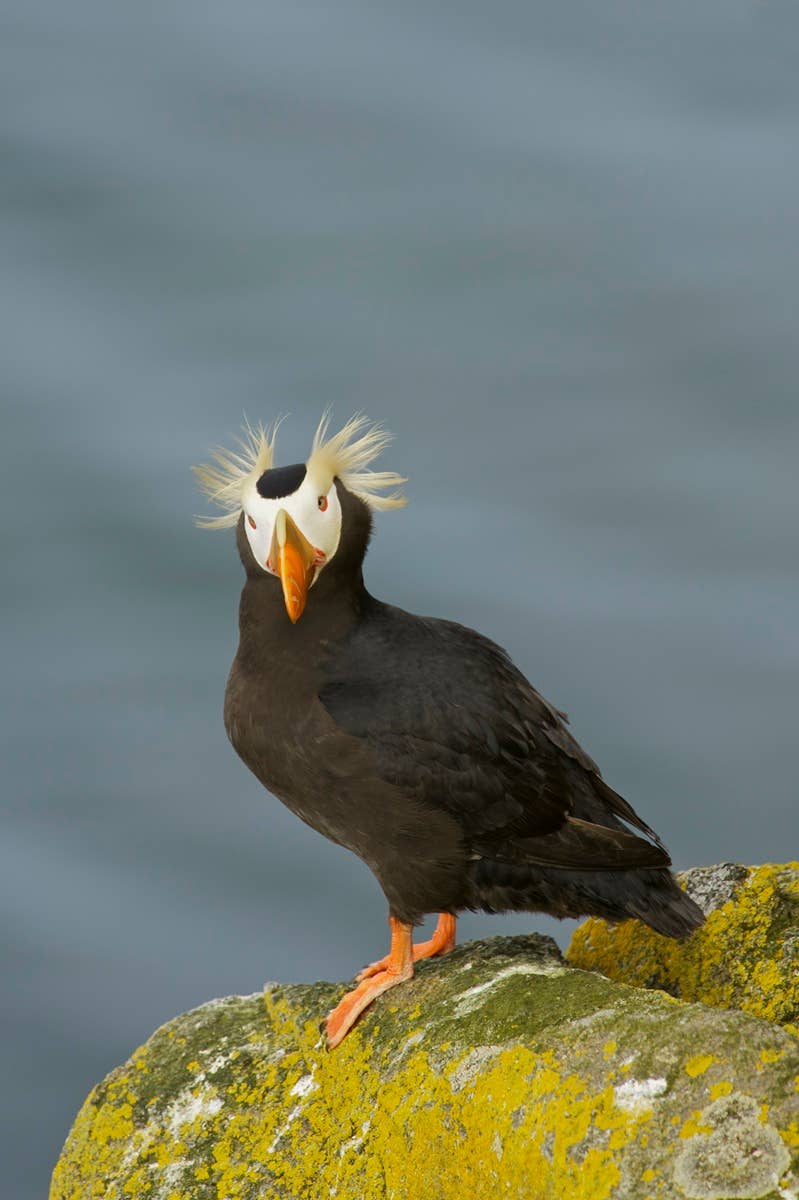
Tufted Puffins return to the Oregon Coast each summer.Getty Images Enrique Aguirre Aves
The presence of puffins along the Oregon Coast is closely tied to the health of the surrounding ocean ecosystem.
Oregon’s offshore waters provide an especially productive feeding environment thanks to cold currents that bring nutrients to the surface, supporting large fish populations. After all, Tufted Puffins rely on small schooling fish such as sand lance, anchovies and herring, which they catch by diving underwater and carry multiple fish back to feed both themselves and their chicks during the nesting season.
Combined with nearby rocky islands that offer protected nesting sites, the region creates an ideal seasonal habitat for breeding puffins and is what brings them back each year. It’s also why Oregon remains one of the most important puffin-viewing regions on the West Coast.
Tips for Spotting Puffins in Oregon
At one point, the Tufted Puffin’s distribution in North America stretched from northern California to British Columbia and the Aleutian Islands of Alaska. However, starting in the 1990s, the North American Tufted Puffin population plummeted in numbers, and now only a few thousand visit the Pacific Northwest every summer, including only a little over 500 puffins in Oregon. If you want the best odds at spotting these rare birds in Oregon, there are a few things you should keep in mind.
Puffins are easiest to spot when you know what to look for—and where to focus your attention. Bring binoculars and scan rocky cliffs and offshore waters, especially during calm mornings or late evenings when the sea is quieter. Watch for quick, low flights over the water or brief pops of movement near the surface as they dive for fish. Patience pays off, since puffins often appear suddenly and disappear just as quickly.
Why Puffin Sightings in Oregon is Special
Puffin sightings along the Oregon Coast are special because they’re both seasonal and fleeting. These seabirds spend most of their lives far offshore, only returning briefly to coastal nesting areas. That short window makes each sighting feel rare, especially when you catch them diving, flying, or gathering near rocky shorelines. Their bright beaks and energetic behavior make even a quick glimpse feel memorable.
Sources:

CURRY COUNTY, Ore. (KPTV) – A Texas man wanted for child sex crimes was arrested in Curry County on Tuesday afternoon.
The Curry County Sheriff’s Office says Kenneth Leatherwood of Bastrop, Texas, was arrested with the help of Oregon State Police and U.S. Marshals just after 12:30 p.m.
Leatherwood, who is accused of sex-related crimes involving a child in Texas, was reportedly found camping in a heavy wooded area near Lucas Lodge in Agness.
Investigators say Leatherwood has been on the run from Curry County law enforcement since June 16 after reports that he had been seen with a stolen car in the Agness area.
Leatherwood was also believed to have stolen weapons with him.
His dog was also found and returned to the suspect’s family in good shape, according to the sheriff’s office.
Copyright 2026 KPTV-KPDX. All rights reserved.

PORTLAND Ore. (KPTV) – Fireworks are on sale in Oregon until July 6, but state and local rules limit where they can be used and what types are allowed.
In Portland, fireworks use and sales are banned year-round.
Fireworks are also banned on beaches and in state and national parks.
Statewide, fireworks that fly into the air, explode, act unpredictably or move more than 12 feet horizontally are illegal. Banned fireworks include sky lanterns, missiles, rockets, Roman candles, firecrackers, cherry bombs and M-80s.
Fountains, sparklers, ground spinners and smoke devices are among the fireworks allowed under state rules.
Officials said people should not call 911 to report illegal fireworks. They said reports should go to the non-emergency line for the area.
First responders said there were 263 fires across Portland during last year’s fireworks season, and 27 were caused by fireworks.
For more details about fireworks regulation in Oregon, click here.
In Washington, fireworks sales legally begin Sunday and run through July 4.
Copyright 2026 KPTV-KPDX. All rights reserved.
-

 Illinois3 minutes ago
Beckman’s new Illinois Polymer Maker Lab commissions first instrument
-

 Indiana5 minutes ago
Body of teen recovered from Lake Michigan after search near Indiana beach
-

 Iowa11 minutes ago
Dima Petrov Dishes On Iowa Offer – Hawk Fanatic
-

 Kansas18 minutes ago
Where to watch Kansas City Royals vs Tampa Bay Rays: TV channel, start time, streaming for June 24
-

 Kentucky20 minutes ago
INTERACTIVE MAP | Find free summer lunches around Kentucky, Indiana
-
 Louisiana26 minutes ago
Q&A: Louisiana U.S. Senate candidates sound off on important issues ahead of primary runoff
-

 Maine32 minutes ago
Governor’s celebrates 67 years with cheap lobster rolls at all 6 Maine locations
-

 Maryland36 minutes ago
Candidates nominated with under 40% of the vote in Maryland and New York primary elections – FairVote

