Oregon
Breakfast, lunch will be free to all students at many more Oregon schools this year


About 70% of Oregon schools will offer free breakfasts and lunches to all students during the upcoming school year, up from around 55% a year ago, the state Department of Education said Monday.
Their ranks now include almost every school in the metro area, including all in Portland Public Schools, the state’s largest district, and the Beaverton School District, its third largest, both of which offered free meals only in higher need schools last year.
Universal school meals are having a national moment, after briefly being on the menu coast-to-coast for all students during the pandemic’s immediate aftermath. The federal government discontinued that effort in October, 2022.
Most recently, Minnesota Gov. Tim Walz, soon to be the Democrats’ formal nominee for vice president, went viral after being inundated with hugs from children when he signed a bill to make school breakfast and lunch free for all in 2023.
The topic isn’t without controversy though. Only eight states, all of them led by Democrats, have passed legislation guaranteeing free school meals regardless of income. Republican governors and legislators have pushed back, arguing that the program wastes money giving free meals to children from families who can afford to buy school food or pack a lunch from home.
Anti-hunger advocates have pointed to studies showing that making meals at school free for all students can reduce the stigma associated with getting them and that feeding all students translates to better behavioral and academic outcomes.
In Oregon, a bill that would have funded free school meals statewide died in the 2023 legislative session. But advocates are planning to renew that request in the 2025 session, said David Wieland, a policy advocate for Partners for a Hunger-Free Oregon. It would cost less this time, Wieland said, because of changes in federal reimbursement policies that helped fuel this year’s expansion in Oregon.
The proposed bill is still taking shape, but advocates envision grants to help districts for whom it is a logistical struggle to serve meals — for example, to purchase more scratch cooking equipment, Wieland said. There are also ongoing conversations about how to ensure that students have time to eat cafeteria meals and meal choices appeal to their palates to cut down on waste, he said.
Last October, the U.S. Department of Agriculture announced that if at least 25% of students in schools and districts were enrolled in government assistance programs like food stamps or Head Start or were homeless, migrants or in foster care, the entire school or district could qualify for free meals and get reimbursed for up to 90% of the cost of providing them. Previously, the threshold had been set at 40%. Oregon lawmakers pitched in an extra $17 million to help schools defray the extra costs.
Another big factor that aided the expansion, said Matt Newell-Ching, a policy manager for the Oregon Food Bank: a federal pilot program that has allowed all Medicaid-eligible Oregon children to be automatically registered for free school lunches, taking the paperwork onus off of their parents.
In schools that aren’t offering universal free school meals this year, a family of four needs to make under $90,000 annually to qualify for their students for free lunches. Every school district sets its own prices for lunch, and costs can vary widely. There are no free meals planned in ???
In addition to Portland and Beaverton, free meals will also be offered in North Clackamas, Tigard-Tualatin and Hillsboro.
“Everyone’s food budgets are high right now, and this helps all families,” Newell-Ching said. “Instead of putting in means tests about who needs it, this is a recognition that food costs are high for everyone.”
— Julia Silverman covers education for The Oregonian/OregonLive. Reach her via email at jsilverman@oregonian.com or find her on X.com at @jrlsilverman.



The man wanted in connection with two Pierce County homicides was shot and killed by police in Seaside, Oregon, Pierce County Sheriff Keith Swank announced on X Wednesday night.
Hayes McCloud, 24, was identified earlier in the day by the Pierce County Sheriff’s Office (PCSO) as a person of interest in two killings — the first in Puyallup around 2:40 a.m. and the second in Tacoma shortly after 3 a.m.
On Wednesday night, authorities referred to him as a suspect.
“The suspect has been contacted by police in Seaside, Oregon,” PCSO said in a Facebook post. “We are no longer looking for the suspect and details of the contact and major incident that transpired in Oregon will be available once the investigation is concluded.”
After that announcement, Swank posted an update on X.
“After he killed the person in Tacoma, he drove away. We didn’t know where he went, but he was picked up by a Flock camera in Lewis County around 4 a.m. So we knew he was headed southbound at that point,” Swank’s post said. “The suspect was shot and killed by police in Seaside, Oregon. No cops were hurt. I’m glad he was stopped before he killed anyone else. Great police work!”
The murder suspect from the homicide on Woodland Avenue also shot and killed a person in Tacoma.
After he killed the person in Tacoma, he drove away. We didn’t know where he went, but he was picked up by a flock camera in Lewis County around 4:00 AM. So we knew he was headed…
— Sheriff Keith Swank (@SaveOurSheriff) July 9, 2026
35-year-old killed in Puyallup home early Wednesday
At 2:40 a.m. Wednesday, deputies responded to the 12500 block of Woodland Avenue E. in Puyallup after receiving reports that a man was found dead in a home. Two homeowners were at the scene when deputies arrived.
“The preliminary investigation indicates there was homicidal violence in a bedroom that eventually led outside the home,” the Pierce County Sheriff’s Office reported. “The 35-year-old male was located inside the home with multiple deadly injuries. We have no suspect in custody at this time.”
Second homicide in Tacoma less than 30 minutes later
Just after 3 a.m., police responded to the 6900 block of E. D Street in Tacoma’s Hillsdale neighborhood after multiple people reported hearing gunfire. When officers arrived, they found a man suffering from apparent gunshot wounds.
Officers began lifesaving measures, but the victim was pronounced dead at the scene.
Contributing: Frank Sumrall, MyNorthwest
Frank Lenzi is the News Director for KIRO Newsradio. Read more of his stories here.


The Oregon Country Fair is right around the corner and got an up-close preview of the annual event with generations of revelers expected to return yet again.
Vendors and construction teams were busy setting the venue up on Wednesday. It opens to the public on Friday, and organizers are expecting a big turnout.
For over fifty years, people have come together to enjoy live music, art, food and community at the event in Veneta.
“It has definitely changed and evolved and it’s definitely still holding true to the magic that has started the fair,” said fair attendee Jill Carter.
Carter has been going to the fair for about forty years, but throughout her time there, there’s always one thing on her mind.
“I’ve had a lifelong dream to do the poster, and I’ve been working on applying for a long time, and I got to do it and I’m so excited!”
Carter says over the years, she’s fine-tuned her design proposal to accurately capture the whimsey of the fair.
“In our day-to-day world, we really don’t get to connect on this kind of level of art and whimsey.”
This curated space of art and whimsey is what keeps generations returning to the fair.
“I was at a meeting the other day and somebody was a third generation Oregon Country fairgoer. Their parents were babies here. They were babies here. Now, they’re on crews that help manage the safety of this community,” says Kate Gillespie, the White Bird Rock Medicine crew coordinator.
Gillespie has been working within medical response at the fair for sixteen years.
Before fair goers even arrive, White Bird Rock Medicine works on setting up for the two hospitals provided on site as well as staffing medical crew – which consists of almost 300 medical professionals and mental health crisis workers.
“We are prepared to deal with first aid things like scrapes, bumps, bruises; injured feet are a big thing that we see – all the way up to things like cardiac events and strokes,” Gillespie explains.
And for the attendees they serve, the event is a yearly tradition that is more than just a fair – it’s a chance to catch up with old friends and make new memories.
“I think it’s really like a reunion for a lot of the people that are out here on this property,” says Gillespie.
The Oregon Country Fair runs Friday through Sunday from 11 a.m. to 7 p.m. at the intersection of Suttle Road and Bus Road in Veneta.
For more information, visit the fair website.

The Oregon attorney general will ask a court to pause Paramount’s PSKY.O $110 billion bid to acquire Warner Bros. WBD.O for 60 days, saying on Tuesday that the company withheld records of its lobbying efforts.
While Paramount has told the state it will not close the deal before July 16, Attorney General Dan Rayfield said he will ask a Multnomah County court to order the company to hand over records and to delay the deal so the state can review them.
“We’re not going to let Paramount Skydance play hide the ball so they can rush through their massive merger,” Rayfield said in a statement. “Oregonians have a real stake in this deal – in our film industry, in our economy, in the choices they’ll have as consumers.”
A Paramount spokesperson said the information Oregon seeks “has nothing to do with whether this transaction complies with Oregon’s antitrust laws and is not a legitimate basis to delay a plainly lawful, pro-competitive transaction.”
The company has provided the state with documents relevant to the merger, the spokesperson added.
Oregon is seeking documents regarding “Project Warrior,” which was Paramount’s internal code name for efforts to obtain regulatory clearance. The state is also asking for records related to the company’s efforts to lobby the Trump administration for support of the merger.
Paramount CEO David Ellison’s father, billionaire Oracle co-founder Larry Ellison, has cultivated ties with President Donald Trump, and the company has hired former Trump officials.
Oregon is also seeking information on whether Paramount had any role in the U.S. Department of Justice’s statement announcing it had cleared the deal.
While Oregon ordinarily “would afford significant weight” to the DOJ’s determination, the state plans to cite a Wall Street Journal report that officials overrode career staff attorneys at the DOJ who were leaning toward a recommendation to challenge the deal, according to documents to be filed in court that Reuters reviewed.
The DOJ issued a lengthy statement last month saying it believed the deal would “increase competition across the media and entertainment ecosystem, with benefits for American consumers and workers.”
The company has said the deal would create a stronger streaming competitor to Netflix NFLX.O and Disney DIS.N, and benefit creatives and consumers.
California, New York and other U.S. states are preparing to sue to block the deal, sources familiar with the matter told Reuters last month. The states have authority to enforce laws against mergers that they believe would unlawfully decrease competition.
Opponents of the deal, including some actors, writers and media workers, have worried that it would hurt jobs.
-
 Science3 minutes ago
‘I’d rather my house burn down than get cancer’: Herbicide use upends California’s fight to save forests
-
 Sports8 minutes ago
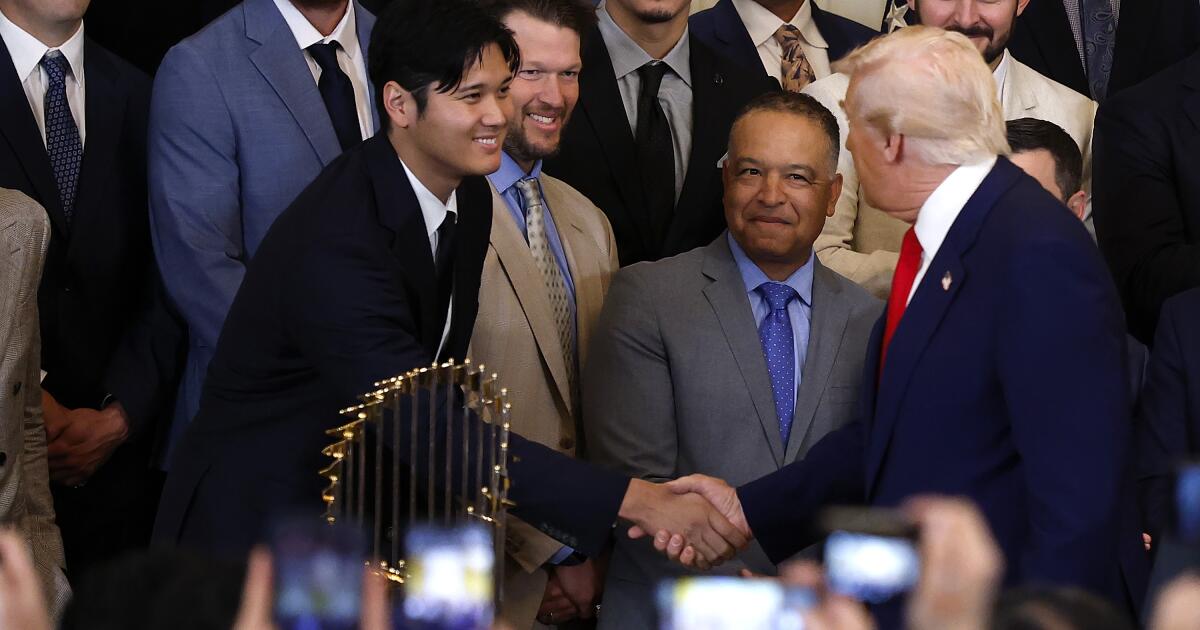
Dodgers scheduled to visit White House in late July to celebrate 2025 World Series win
-

 World18 minutes ago
Former US Olympian pleads not guilty in DC reflecting pool vandalism case
-
 News45 minutes ago
Former Olympian pleads not guilty in reflecting pool vandalism charges
-

 Los Angeles, Ca2 hours ago
Heat advisory, beach hazards in effect as Southern California sizzles
-

 Detroit, MI2 hours ago
Teen on moped hit by car after cruising through stop sign in Detroit
-

 San Francisco, CA3 hours ago
Flight of fancy: San Francisco moves to build private luxury airport terminal
-

 Dallas, TX3 hours ago
Dallas’ digital creator economy is booming. Burnout is too.

