New Mexico
Preventable heat injuries and deaths rising in New Mexico • Source New Mexico


Heat and degraded air quality harming New Mexicans is projected to worsen in the coming years, as climate change fueled by burning and extracting fossil fuels cranks up the planet’s temperature.
State lawmakers heard that message from panels of experts from government and outside groups in an interim Water and Natural Resources Committee meeting Monday held in Albuquerque.
Extreme heat is the deadliest natural disaster, killing more people in the U.S. than flooding and hurricanes combined. Hotter, drier conditions also increase and intensify wildfires. It leads to arid conditions causing dust storms and increases air pollution.
The data shows the Southwestern U.S. is the fastest warming area in the lower 48 states, and New Mexicans are feeling the consequences, with 50 people going to emergency rooms between April and May.
With extreme heat growing more frequent and intense, New Mexico has to transform its approach, said heat public health expert Nathaniel Matthews-Trigg, a co-founder of advocacy group Healthy Climate New Mexico.
“The stark reality is this: every summer, New Mexicans are dying preventable deaths,” Matthews-Trigg told lawmakers. “It’s time we shift our focus from individual actions to collective community efforts.”
Extreme heat is killing more people crossing the border
He said New Mexico’s current model treats extreme heat as a matter of personal responsibility, which ignores both science and experience from people who shoulder the brunt of heat exposure.
And while New Mexico has made more efforts to track data on heath injuries and deaths – which are difficult numbers to pin down – members of state agencies said they still required more funding and staffing.
Requests for money by agencies and policy experts included adding six more staff to collect heat injury and death data for the New Mexico Department of Health.
Mann-Lev said that New Mexico’s application for federal funds for $2.5 million to track public health and environment was rejected because of a lack of staff at state agencies to spend it down.
Shelley Mann-Lev, the Executive Director of Healthy Climate New Mexico said the group has been working to establish a statewide public health and climate program.
Supporters said the program would deal with heat, wildfire smoke, drought, flooding, dust and severe storms.
Mann-Lev also supports establishing a $10 million fund to help towns and cities address climate needs.
“That fund would be dedicated at least 50% to communities with populations of less than 100,000 (people),” Mann-Lev said. The proposal has failed the past three sessions.
Deadly heat
Emergency room visits due to heat stress have nearly doubled since 2010 in New Mexico, said Lauren Reichelt, New Mexico Environment Department’s director at the Environmental Health Division.
When temperatures rise above 90 degrees, so do visits in southern and northwestern NM, many of them outdoor workers, men between 18- and 44-years-old, Reichelt said.
Heat stroke and heat exhaustion in New Mexico emergency rooms rose from 200 visits to over 400 visits. Those are only for those specific conditions, Reichelt said, the real impacts are much larger since heat exacerbates heart and kidney conditions.
“If you wanted the real number, you’d have to add a zero at the end and either double or even quintuple it,” she said about estimates on heat-related injuries.
The New Mexico Environment Department ascribed 900 emergency room visits to heat in 2023. This year, there have already been 600 visits due to heat, Reichelt said.
Matthews-Trigg said most existing interventions on extreme heat are ineffective and a waste of money.
“Telling someone to get somewhere cooler, if they don’t have access to transportation is pointless,” he said. “Setting up cooling centers that are not welcoming, that don’t allow pets or in inaccessible locations will mean the people that need them are unable to go to them.”
Facing the heat head on
Matthews-Trigg offered recommendations based on surveys with state agencies, community groups, local governments and research to better prevent deaths. Those include:
Tailoring messages for elderly, children, outdoor workers
Getting better data; treating heat like a mass-casualty event for first responders
Ensuring governments have support, if a blackout happens during a heatwave
Establish a heat emergency hotline to take pressure off of 911 centers
Offer more water bottles, cooling towels to smaller communities
Give more funding and training to rural and tribal communities
Another recommendation is to offer people help with energy bills, since some research shows people don’t use air conditioning or swamp coolers out of financial hardship.
“People literally cook inside their homes because they can’t pay a few dollars to stay cool. This is an incredible injustice,” Matthews-Trigg said.
Gerilyn Antonio, the tribal liaison for the New Mexico Alliance of Health Councils, requested that the state work to consult with tribes, provide tribal-level data, rather than just county-specific data.
“There’s not a comprehensive picture of how tribal communities in our state are affected,” Antonio said about heat.
She said the legislature needs to increase funding for state agencies and work to improve communications to Pueblos.
Sen. Liz Stefanics (D-Cerillos) said the legislature might consider combining the state agencies with climate bureaus or divisions under one office.
“If we could bring together the entities that are working in this, we might be able to better fund something as a whole, rather than piecemeal,” Stefanics said.
Pollution, wildfire smoke and dust
Extreme heat and drought are worsening New Mexico’s air quality said JoAnna Strother, who directs advocacy for the American Lung Association in the Southwest.
Ozone, also known as smog, worsens in high heat, causing a “sunburn” effect on the lungs and worsening or causing lung diseases.
Particle pollution means very tiny amounts of solids and liquids inhaled into the lungs. The pollution is sometimes due to wildfire, but also just emissions from gasoline, diesel or wood fuels.
“Particle pollution can be very dangerous to breathe, especially at higher concentrations. It can trigger illness, hospitalization, and premature death and can even cause lung cancer,” Strother said.
Just over half of New Mexicans live in a county with at least one failing air grade and 32% of New Mexicans live in counties with three failing grades for air quality, she said.
Las Cruces is the 15th most polluted city for ozone, and Albuquerque the 21st in national rankings. But it isn’t just urban areas affected, Eddy County ranked as the 17th most polluted county for ozone in the U.S.
Particle pollution has also worsened in both Albuquerque and Las Cruces, she said.
Maxine Paul, the former chair of the Albuquerque Air Quality Control Board said the legislature’s passage of a bill to reduce pollution from cars and trucks is still being implemented, but that it will work to reduce pollution.
The New Mexico Environment Department only has seven staff to travel around the state, measure, and collect data on air pollution, said Dana Bahar, the deputy director of the Environmental Protection Division.
‘There’s no future where our landscapes are not flammable’
Wildfires and smoke are inevitable in New Mexico, said Matthew Hurteau, a professor studying fire ecology at the University of New Mexico, but the state can do more to limit smoke exposure.
Climate change’s drying effect has made New Mexico’s forests more flammable, meaning the devastating 2022 fire season is projected to become “fairly normal,” as the atmosphere warms and dries, he said.
His research shows forest management is key to reducing pollution from these fires.
“If we restore frequent fire to these forests, through mechanical thinning, and prescribed burning, we can significantly reduce the amount of emissions that are happening, particularly in large doses,” he said.
Elimination of wildfire isn’t an option.
“There’s no future where our landscapes are not flammable in New Mexico,” Hurteau said. “Anyone who tells you that we can manage smoke impacts by putting out wildfire is delusional.”
He said the state needs to do more to clean people’s air, such as offering air purifiers in rural communities.
In addition to air purifiers, wearing properly fitted N95 masks filters out harmful particles and works to protect peoples’ lungs from wildfire smoke and other pollution, said Strother.
How you can protect your community from wildfire smoke
‘Albatross around our neck’
One top lawmaker expressed frustrations at New Mexico Environment Department Secretary James Kenney, saying the administration and agency is failing to display a sense of urgency.
Senate Pro Tem Mimi Stewart (D-Albuquerque) invoked 18th century poem “The Rime of the Ancient Mariner” saying New Mexico had an inescapable burden in relying on fossil fuels.
“We all have this albatross around our neck, thanking oil and gas for giving us funding, at the same time trying desperately to keep them from destroying the Earth.”
She asked Kenney what is preventing the environment department from being at full staffing, asking if the governor requested the agency to keep its budget flat, if it can’t pay enough for staff, or a combination of issues.
Kenney said he feels Stewart’s sense of urgency, but the environment department lacks an office for 167 of its staff, and said state hiring remains slow.
“We have no shortage of people wanting to work there. We just need quicker processing to get them in the door,” Kenney said.
Stewart said she wants New Mexico to be seen by the rest of the country as a model for addressing climate change, boldly addressing public health and economic impacts.
“You can’t say that about us right now. Little tiny steps,” she said pantomiming footprints with her hands. “Little tiny steps while the Earth is burning.”



Press Release – July 4, 2026
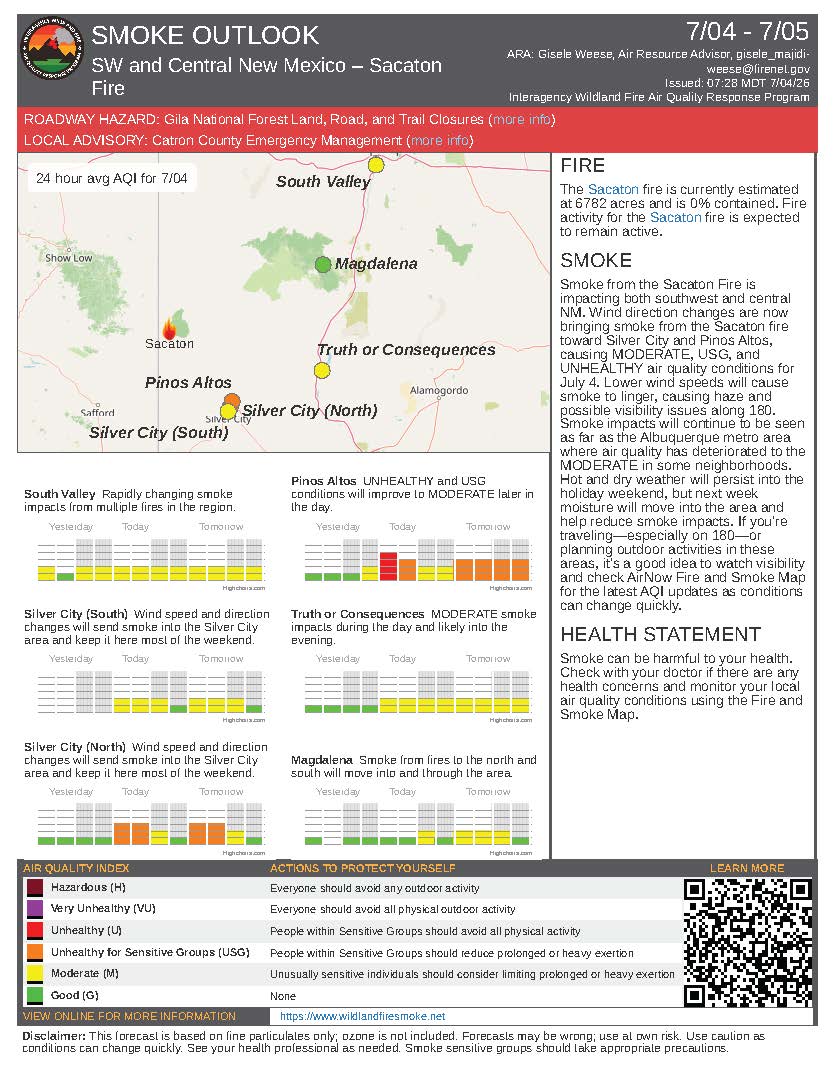
Acres: 6,782
Start Date: June 21, 2026
Location: 15 miles east of Glenwood, NM
Personnel: 148
Containment: 0%
Cause: Lightning
Summary: Yesterday, 114 additional resources arrived on the Sacaton Fire. The fire continued to grow in the headwaters of Willow Creek, flanking through heavy fuel loading and standing dead trees from the 2012 Whitewater Baldy Fire. Fire spread to the north is slowing as it enters the recent Hummingbird and Turkey Feather fire footprints.
Unfortunately, Apache Cabin, a historic Forest Service cabin located in the Gila Wilderness, was lost in the fire. The cabin’s location mid-slope and intense fire behavior did not allow for safe engagement for firefighters. The preservation of life and firefighter safety remain the highest priority.
Today, firefighters will focus on implementing structure protection measures—including the deployment of water pumps and hose lays—around the Willow Creek Subdivision. Crews will also evaluate whether conditions warrant the use of defensive firing operations west of Willow Creek to protect private property.
Weather: Today, highs will be around 80 degrees F. Winds will blow 10 – 15 m.p.h. and gust to 25 m.p.h.
Closures: A forest area closure is in effect. Ensure you have the most current order by checking the forest’s alerts webpage: https://www.fs.usda.gov/r03/gila/alerts. Bursum Road/NM-159 is currently closed east of Mogollon to Willow Creek.
Evacuations: Catron County Sheriff’s Office is implementing the Ready, Set, Go! method. The community of Willow Creek is in a GO! evacuation status due to the proximity of the Sacaton Fire. Residents in GO should leave immediately. For more information evacuation statuses, monitor Catron County Emergency Management on FaceboSacatok and sign up for Catron County emergency notifications at catroncounty.us.
Smoke: Smoke is visible from surrounding communities. Air quality will vary based on fire activity, weather, and wind patterns. Residents should reduce prolonged outdoor activity when smoke is present and check the Air Quality Index before recreating or working outdoors. Sensitive groups should take extra precautions to limit smoke exposure. For real-time smoke conditions, visit fire.airnow.gov.
Fire Restrictions: The Gila National Forest is in Stage 1 Fire Restrictions due to long term severe drought in the Gila region, increased tree mortality across the forest, and forecasted hotter, drier weather conditions. Stage 1 Fire Restrictions limit campfires on forest land to designated recreation sites and campgrounds with constructed metal fire rings. Open burning is also prohibited in the unincorporated area of Catron County and in Catron County Fire District 30.
Public Information Officer: 2026.sacaton@firenet.gov, 575-210-8631
Incident Information:
Facebook: www.facebook.com/GilaNForest
###

EL PASO, Texas (KVIA) — As families across the country gather together to celebrate the 4th of July, one family will reunite for the first time in years in El Paso.
Juan Escobar, an Albuquerque native, will finally be able to celebrate a holiday with his 14-year-old son, Andrew, all thanks to the El Paso Police Department.
Over the last three years, Escobar endured a long-standing search and custody battle over Andrew with his Miriam Felix, Andrew’s mom, which he originally won in 2023.
Not long after that custody victory, Andrew went with Felix for an overnight stay.
He never came home.
Missing posters said Andrew went missing June 25, 2023. He was 11 years old at the time.
Escobar hired a private investigator to uncover Andrew’s whereabouts. Investigation revealed Felix changed her name to Sophie Shelton and changed Andrew’s name to Oliver Shelton. The two reportedly moved to an area near Fort Collins, Colorado.
Suddenly, the case changed from a missing child to an abduction.
Escobar wasn’t able to find Andrew or Felix in Fort Collins.
After years of prayer and searching for answers, Juan received a phone call from El Paso Police last week.
In the call, EPPD said they had Felix in custody and Andrew waiting for him.

Escobar said Andrew told authorities he and his mom traveled to several countries over the three-year period, including Austria, Albania and Turkey.
He reportedly said he went to school online and just finished eighth grade.
However, his father is worried about his mental health.
“Physically, he’s well,” Escobar said. “But he’s just been through so much the last three years emotionally and mentally.”
Escobar told ABC-7 police said Border Patrol identified Andrew as a missing person while he and Felix reportedly crossed into El Paso from Ciudad Juarez, putting both of them into custody.
Escobar told ABC-7 his wife drove him down to El Paso and told him he wasn’t “in the condition to drive.”
He said his first instinct was to hug Andrew, since they used to love wrestling, but was told to give him space instead.
“The reality is that Andrew was an 11-year-old boy that was abducted and was moved across the country, and then moved out of the country and possibly overseas over the last three years,” Escobar said. “He’s a boy right now who has been in flight or fight mode for the last three years.”
Escobar said he’s now investigating how Andrew reportedly traveled around the world without being flagged as a missing person.
He also said he hopes Felix understands the gravity of what she’s done.
“This isn’t just trying to keep a father away from his son. This is breaking local law and breaking international law,” Escobar said. “I’m hopeful she understands what she’s done and she gets the help that she needs.”
Escobar also questioned how Felix afforded international trips.
As Andrew reunites with his father, Escobar has a simple message for parents and families this holiday weekend:
“Do what’s best for your children,” Escobar said. “Because ultimately, they’re what matter the most.”
Escobar said he’s excited to spend the holiday weekend with his son.

-

 Massachusetts5 minutes ago
One dead in Cambridge shooting
-

 Minnesota12 minutes ago
One of two charged in Montevideo, Minnesota, drive-by shooting pleads guilty
-

 Mississippi14 minutes ago
10 Nicest Small Towns In Mississippi
-
 Missouri19 minutes ago
KCFD: 1 adult, 1 child, a dog displaced after a house fire in the 3800 block of Myrtle Avenue
-

 Montana27 minutes ago
The Face Behind Kalispell Montana Hidden Gems – Flathead Beacon
-

 Nebraska29 minutes ago
Nebraska basketball lands commitment from top in-state player
-

 Nevada34 minutes ago
Primm Valley Casino not open after recent ownership change
-
 New Hampshire41 minutes ago
Opinion: America is still a work in progress

