New Mexico
Currier: New Mexico officials on the right track in exploring water reuse


Water is New Mexico’s most precious resource. We must ensure it is conserved and utilized to the greatest extent and encourage innovative technologies that result in safe, responsible water reuse. As directed by the 2019 Produced Water Act, state officials are working diligently to create a framework for water reuse through the Water Quality Control Commission rulemaking.
All viable and safe options to address our declining water availability should be considered, including finding ways to safely use treated produced water. The oil and gas industry is truly one of the few industries capable of attaining “net positive” water balance by saving more fresh water than it uses. Achieving this is a win for all New Mexicans.
In New Mexico, oil and natural gas production uses less than 1 percent of the state’s annual freshwater consumption, while the vast majority of water continues to be consumed by individuals or other water-necessary industries.
Produced water is mostly naturally occurring, highly saline water brought to the surface as part of oil and gas production. Leading universities, like New Mexico State, New Mexico Tech, and Texas Tech, are on the forefront of treated produced water use research. Developments in water recycling technology show that high-quality water can be extracted from produced water for appropriate and regulated reuse. With additional treatment, the water can be cleaner than some natural river ecosystems.
Currently, produced water is injected back into deep subsurface formations as one of the few approved disposal methods. The reinjection of produced water can contribute to seismic events. Coupled with depleting water supplies, it is crucial to find ways to best utilize produced water.
Due to technological advancements, produced water could be used for industrial applications such as municipal landscaping, road construction, and irrigation for non-edible agriculture like cotton. To ensure its safe utilization in approved applications, the use of any produced water will be extensively tested and monitored to guarantee it meets stringent water-quality standards.
Every gallon of treated produced water used for irrigation or industrial uses frees up a gallon of native fresh water.
Concerns that the oil and gas industry introduces Per- and Polyfluoroalkyl Substances – or PFAS – into its produced water are unwarranted. To be clear, the oil and gas industry is not a source of PFAS in produced water. A recent study by the U.S. Geological Survey found PFAS concentrations in the Pecos River near Artesia (upstream of oil and gas fields) averaged 15 nanograms per liter. Water from the Pecos River downstream of oil and gas fields had the same or lower levels. The trace amounts of PFAS found in the surface water are introduced before water reaches the Permian Basin. The study also found PFAS levels in the Pecos River were lower than samples taken from the Rio Grande south of Albuquerque.
We urge state officials to make data- and science-based decisions in the upcoming WQCC rulemaking hearing to ensure proper utilization of all our water resources, preserve our limited supply of fresh water for future generations, and enable economic diversification. To learn more about the rulemaking and treated produced water facts, we urge you to visit NM Environment Department, the WQCC, NMSU, NMT, and TTU sites to learn more the safe usage of produced water and its benefits to New Mexico’s future.
Missi Currier is a Carlsbad native, and President and CEO of the New Mexico Oil and Gas Association.



A wild rat in New Mexico tested positive for the plague after four dogs were diagnosed with the troubling disease earlier this year, according to authorities.
A homeowner discovered the plague-ridden rodent dead on a private property in Santa Fe County and submitted it for testing, according to the New Mexico Health Department.
It is the first confirmed wild animal in Santa Fe County to test positive for the illness caused by Yersinia pestis bacteria in 2026, the health department said.
The case follows four other confirmed plague cases in dogs this year — including three pooches in Santa Fe County and one in Bernalillo County.
“While this is an animal case of plague, it’s important to remember humans can get plague from flea bites or direct contact with infected animals, including rodents, wildlife and even pets,” Dr. Chad Smelser, deputy state epidemiologist for NMDOH, said in a statement.
“Pets can be infected with plague if they eat an infected animal or are bitten by infected fleas,” Smelser said.
Although human cases of the plague are rare, roughly half of all cases in the US each year occur in New Mexico, according to the health department.
The disease can be life-threatening without proper treatment, but if it’s caught early, it can be treated with antibiotics, officials added.
Symptoms in humans include sudden high fever, chills, headache, nausea, and swollen lymph nodes.
Infected pets similarly suffer from fever, low energy, loss of appetite, and swollen lymph nodes, experts added.
The New Mexico Health Department cautioned residents to take several steps to prevent themselves and their contracting the plague — including cleaning up areas near homes such as woodpiles, brush piles, junk and abandoned vehicles, where rodents could live.
Pet food and water should be kept away from where rodents and wildlife can get to them, and people should stay away from sick or dead rodents and rabbits.
Pets should use veterinarian-approved flea control products and be promptly taken to a veterinarian if they are sick.
Last year, a man in Arizona and a domestic cat in Colorado died of the bubonic plague.
A 43-year-old man from Valencia County in New Mexico was also hospitalized with the disease in 2025.
New Mexico
Ex-Barcelona defender takes over as new Mexico boss as Javier Aguirre leaves after England defeat | Goal.com US
.jpg?ssl=1 "Ex-Barcelona defender takes over as new Mexico boss as Javier Aguirre leaves after England defeat | Goal.com US")
The transition comes at a critical moment for Mexico. Marquez’s immediate priority is addressing the tactical shortcomings that proved costly against England. Defensive errors allowed players like Jude Bellingham and Harry Kane to secure the victory.
To fix this, Marquez will rely on his recent coaching experience. During his two-year spell managing Barcelona Atletic, Marquez oversaw 82 matches, recording 40 wins, 21 draws and 21 losses. This period in Spain helped him develop a structured approach to the game, which the federation hopes will translate into a more robust defensive system for the national side.

A few more storms are possible Wednesday in New Mexico. See the latest conditions at KOB.com/Weather.
ALBUQUERQUE, N.M. — The monsoon high has shifted just slightly west and is now centered between Arizona and New Mexico for Wednesday.
We’ll still have a similar setup to the last couple of days. Scattered showers and storms will form off the high terrain between late morning and early afternoon, moving slowly off in a clockwise fashion into nearby highlands and valley areas by mid and late afternoon/early evening before mostly fizzling out after the sun sets.
The mid and upper level moisture draped across the state is slightly below climatological normals for early July. Slightly less moisture will limit rainfall but stronger cells could easily drop a good half-inch or more.
Additional rainfall on the burn scars may lead to flash flooding. Tuesday saw at least 1.5 inches of radar estimated rainfall fall near and on the Hermits Peak/Calf Canyon burn scar.
Storms will produce strong outflow, with gusts likely ranging from 20-40 mph. That may either undercut existing storms or help produce new cells.
Temperatures this afternoon will either be near the same as Tuesday or about one-to-two degrees warmer statewide. Those that get to see the rain first will cool off the fastest.
Higher elevations in the mountains are looking at highs getting into the 70s and 80s. Valleys, low-lying areas and the highlands will heat up into the 90s, with several spots looking at highs near the triple digits this afternoon, such as the lower Rio Grande Valley, and a few southern locales.
Wildfire smoke will also stick around. Most of it will stay lofted into the upper levels of the atmosphere but some light concentrations of it may make it down to the ground and could impact the air quality on a very localized scale for those that do get to see that. Areas around the Sacaton Fire in the Gila’s may see a slightly heavier concentration that could get blown around due to outflow from nearby storms this afternoon.
Meteorologist Amanda Goluszka shares all the details in her full forecast in the video above.
MORE:
-
 Lifestyle2 minutes ago
Meow Wolf taps famed L.A. animation house for its new Los Angeles venue
-
Politics9 minutes ago
Column: Trump decries ‘communism’ while his government takes ownership of companies
-
 Science12 minutes ago
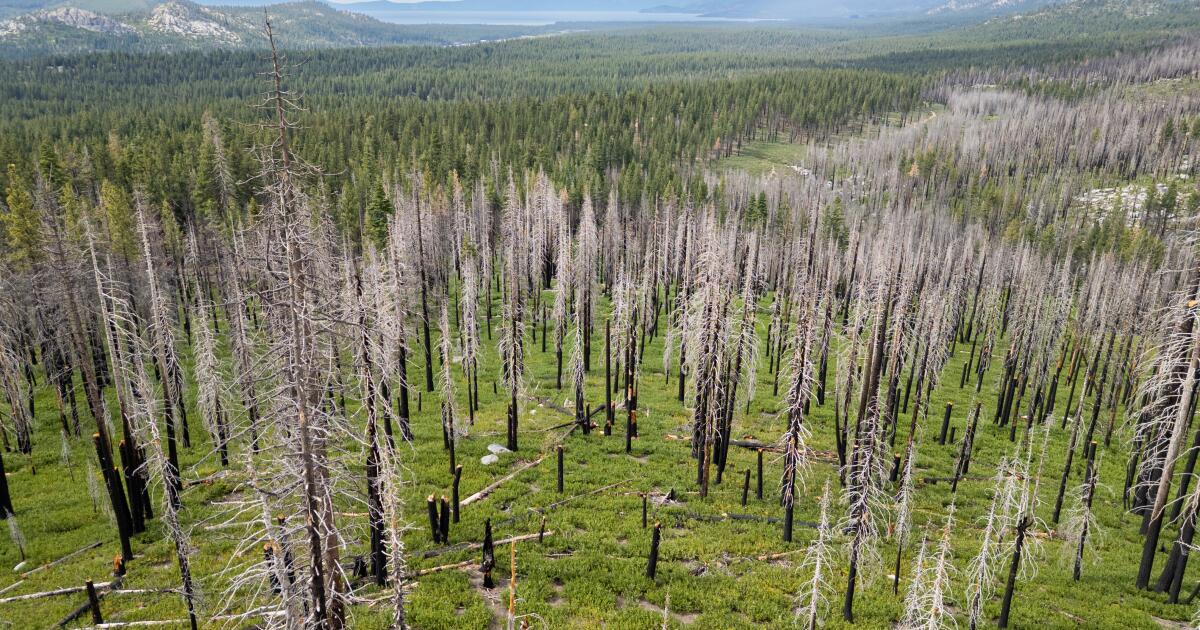
‘I’d rather my house burn down than get cancer’: Herbicide use upends California’s fight to save forests
-
 Sports17 minutes ago
Dodgers scheduled to visit White House in late July to celebrate 2025 World Series win
-

 World27 minutes ago
Former US Olympian pleads not guilty in DC reflecting pool vandalism case
-
 News54 minutes ago
Former Olympian pleads not guilty in reflecting pool vandalism charges
-

 Los Angeles, Ca2 hours ago
Heat advisory, beach hazards in effect as Southern California sizzles
-

 Detroit, MI3 hours ago
Teen on moped hit by car after cruising through stop sign in Detroit


