West
Motorcyclist dies at Death Valley National Park, another hospitalized amid triple-digit heat

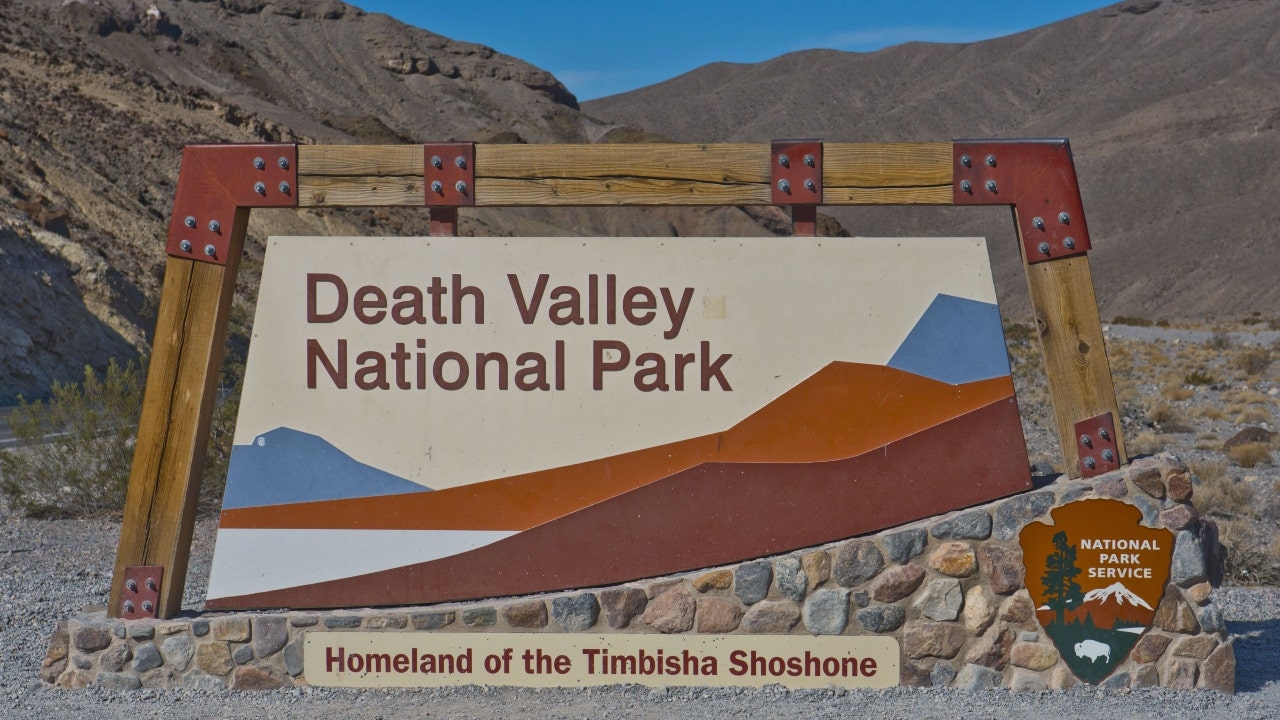
A motorcyclist died Saturday from suspected heat exposure in California’s Death Valley National Park, and another was hospitalized as sweltering temperatures shattered records in the West over the weekend.
Officials did not release any details about the motorcyclist who died. The other motorcyclist was rushed to a Las Vegas hospital for “severe heat illness,” the park said in a statement. No details about their condition were immediately provided.
The two victims were riding through the Badwater Basin area of the park as part of a group of six motorcyclists, the park said. The other four members of the party were treated at the scene.
Temperatures at the park over the weekend hit a high of 128 F.
TEXAS HIKER DIES ON TRAIL AT GRAND CANYON NATIONAL PARK; OFFICIALS WARN OF EXTREME HEAT
Temperatures at California’s Death Valley National Park hit highs of 128 degrees on Saturday and Sunday. (Education Images/Universal Images Group via Getty Images, File)
The scorching temperatures prevented emergency medical helicopters from responding, as the aircraft cannot generally fly safely over 120 F, officials said.
Salt flats at Badwater Basin are pictured in Death Valley National Park. The park is known for its extreme temperatures, vast deserts and unique geological features. (Gabe Ginsberg/SOPA Images/LightRocket via Getty Images, File)
The park was under an “extreme summer heat” alert, which advises visitors to avoid hiking after 10 a.m., drink plenty of water and “travel prepared to survive.”
YELLOWSTONE NATIONAL PARK SHOOTING LEAVES SUSPECT DEAD, OFFICER INJURED
Park Superintendent Mike Reynolds echoed a similar warning in a statement.
“While this is a very exciting time to experience potential world record setting temperatures in Death Valley, we encourage visitors to choose their activities carefully, avoiding prolonged periods of time outside of an air-conditioned vehicle or building when temperatures are this high,” Reynolds said.
As one of the hottest places on Earth, the park boasts dramatic landscapes, including salt flats, sand dunes and rugged mountains. (Gabe Ginsberg/SOPA Images/LightRocket via Getty Images, File)
Officials warned that heat illness and injury are cumulative and can build over the course of a day or days.
CLICK TO GET THE FOX NEWS APP
“Besides not being able to cool down while riding due to high ambient air temperatures, experiencing Death Valley by motorcycle when it is this hot is further challenged by the necessary heavy safety gear worn to reduce injuries during an accident,” the park statement said.
The Associated Press contributed to this report.
Read the full article from Here

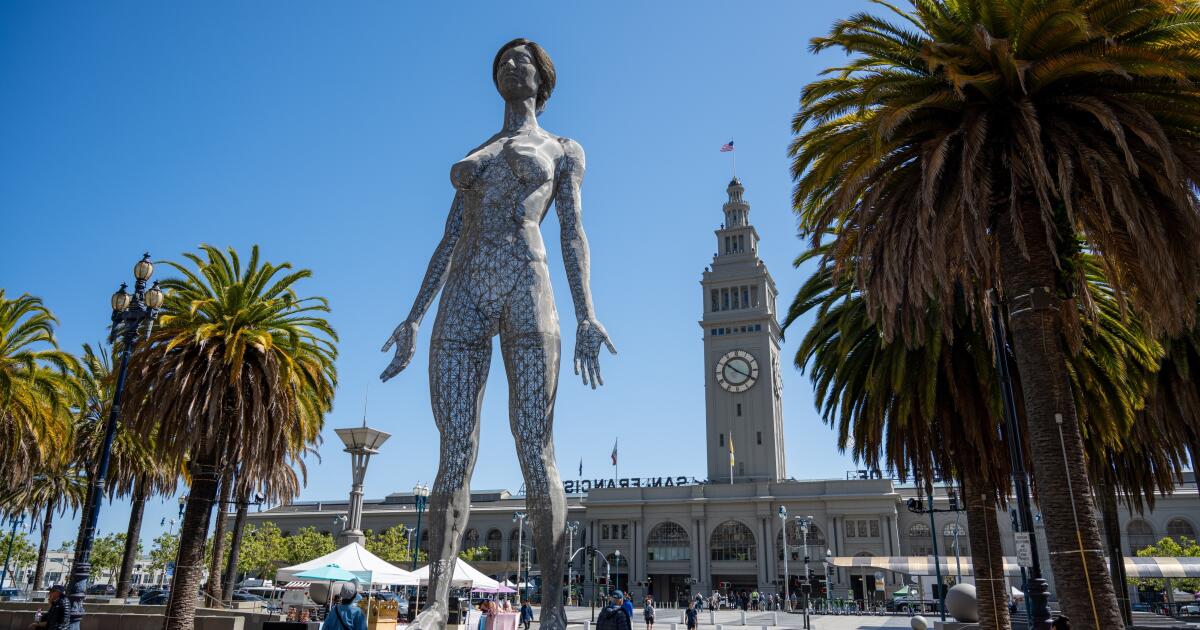
For sale in San Francisco: A 45-foot-tall metal sculpture of a naked woman.
Her name is R-Evolution. Her hair is pulled back and her facial expression is serene. Her mechanized chest expands and contracts, as if she’s breathing. And she tips the scales at 13,000 pounds (not that it’s anyone’s business what a lady weighs).
She will stand in Embarcadero Plaza across from the historic Ferry Building until October. Then she goes on sale. The artist says “she can go anywhere in the world,” but whoever buys or leases her will need a crane and a 60- to 80-foot bucket lift to resurrect her.
Since she was first unveiled as a temporary installation in April 2025, the giant statue, created by artist Marco Cochrane and modeled after California dancer and singer Deja Solis, has spurred debate about whether privately funded works are really public art. It also questions whether R-Evolution is a celebration of femininity in a free-spirited city that has long embraced public nudity or a hypersexualized shock piece from a male artist.
But debate, per the public and private entities who brought her to the plaza, is kind of the point. Art, they say, is supposed to be controversial.
An attempt to revitalize public space
R-Evolution is part of Big Art Loop, a privately funded initiative that aims to bring up to 100 temporarily installed large-scale sculptures — a minimum of 10 feet high or wide preferred — to public spaces along a 34-mile walking and biking trail over the next few years.
R-Evolution in Embarcadero Plaza in April 2025.
(Christopher Reynolds / Los Angeles Times)
Big Art Loop is funded by the Sijbrandij Foundation, a nonprofit established by billionaire Sid Sijbrandij, co-founder of the software company GitLab. It is curated by the art production agency Building 180, in partnership with the city’s Recreation and Parks Department and other public agencies.
“We’re going to continue to lean in to our arts and culture because that is driving our comeback here in San Francisco,” Mayor Daniel Lurie said in a September video promoting the Big Art Loop.
A city news release last year said R-Evolution’s arrival “aligns with San Francisco’s broader efforts to revitalize downtown” by increasing foot traffic to the battered business district, where office vacancy rates soared to record-high rates of more than 30% amid the pandemic-era pivot to remote work.
Controversial lady and Burning Man
Like a few of the Big Art Loop pieces, R-Evolution originally debuted at Burning Man, towering above the sweaty and stoned desert masses in 2015.
Critics of R-Evolution say the statue and other massive pieces along the billionaire-backed Big Art Loop did not get as much community input and were not subject to the same intense scrutiny by the San Francisco Arts Commission as other public artworks.
“I think what a lot of people, myself included, are frustrated by is the fact that these private entities are able to remake the public landscape in their own image,” Max Blue, a San Francisco Examiner art critic, told Gazetteer San Francisco in October, adding: “I don’t like these sculptures. I think a lot of them are just left over from Burning Man.”
Visual artist DJ Meisner told the Gazetteer: “It’s just so clear when you see the art that it’s like, ‘Oh, I’m supposed to be unbelievably wealthy and high looking at this.’ I’m neither of those things, so I’m just annoyed to be looking at it.”
Female representation or inappropriate?
Before R-Evolution was installed, an art vendor with a booth in Embarcadero Plaza wrote in a letter to the Arts Commission, saying she thought the statue, whose bare butt faces the Ferry Building, “might be very inappropriate for children.”
Another vendor wrote: “A naked woman statue designed by a man feels out of step with the times.”
The creator of the piece, Cochrane, said in a statement: “Women’s presence in public art is rare. When they are depicted, it is often through outdated or passive narratives. R-Evolution challenges that. She stands strong, aware, and grounded — calling for a world where all people can walk freely and without fear.”
Love her or hate her, she gets eyeballs
Julie Richter, a spokeswoman for Big Art Loop, told me in an email Thursday that R-Evolution, which had been slated for removal in April, got “very positive” feedback that led to her Arts Commission-approved extended stay through October. That feedback included positive reviews from most tourists, art vendors and nearby local businesses, according to a pitch to extend the statue’s stay by Big Art Loop and Building 180.
Near R-Evolution’s current perch, Vaillancourt Fountain — a colossal, crumbling Brutalist concrete sculpture that was unveiled in Embarcadero Plaza in 1971 and became a skateboarding mecca — was equally reviled and revered. Despite fans’ efforts to save it, the city removed it this spring.
Today’s top stories

The Visalia sign seen from Highway 99.
(Tomas Ovalle / For The Times)
These are California’s most affordable and least affordable cities
What we know about the boat accident near Alcatraz
- A memorial cruise turned tragic when a boat sank near Alcatraz Island, leaving one passenger dead, three missing and 17 rescued.
- The search for the missing was challenged not only by high winds and rough seas, but because the incident took place in a particularly deep channel of the bay dredged for cargo ships.
Scientists fear when the San Andreas fault finally snaps
- Scientists warn the region’s long earthquake drought is building dangerous strain on the San Andreas and San Jacinto faults, raising the odds of a devastating multi-county “Big One” in coming decades.
- With scenarios forecasting violent shaking from downtown L.A. to the Inland Empire, experts say the fault’s growing stress is a stark reminder to strengthen preparedness before nature resets the clock.
What else is going on
Commentary and opinions
This morning’s must-read
Other must-reads
For your downtime

The dining room at Baldi in Beverly Hills.
(Myung J. Chun / Los Angeles Times)
Going out
Staying in
A question for you: As temperatures rise in SoCal, how do you stay cool?
Email us at essentialcalifornia@latimes.com, and your response might appear in the newsletter this week.
And finally … your photo of the day

The trunk of a flooded car is seen in an underground garage along Palm Avenue in West Hollywood after a water main break sent thousands of gallons of water rushing down Sunset Boulevard and the surrounding area on Thursday morning.
(Allen J. Schaben / Los Angeles Times)
Today’s photo is from Times photographer Allen J. Schaben in West Hollywood, after a water main break sent thousands of gallons of water rushing down Sunset Boulevard and the surrounding area on Thursday morning.
Have a great day, from the Essential California team
Hailey Branson-Potts, staff writer
Hugo Martín, assistant editor, fast break desk
Kevinisha Walker, multiplatform editor
Andrew Campa, weekend writer
Karim Doumar, head of newsletters
How can we make this newsletter more useful? Send comments to essentialcalifornia@latimes.com. Check our top stories, topics and the latest articles on latimes.com.

Denver Broncos football is right around the corner.
As the 2026 World Cup nears its July 19 final, sports fans will soon begin turning their attention toward NFL training camps. The Broncos are set to open training camp on July 31 — two weeks from today — with the first of 14 practices open* to fans.
*Due to construction at the team’s facility, capacity at practice will be limited to approximately 1,000 fans, so (free) tickets are required to attend. Those tickets became available on July 1 and were quickly claimed. (Tickets are sometimes returned, though, so fans should check Ticketmaster for potential available tickets.)
Broncos training camp schedule
- Friday, July 31: 10 a.m.
- Saturday, Aug. 1: 10 a.m.
- Monday, Aug. 3: 10 a.m.
- Tuesday, Aug. 4: 10 a.m.
- Wednesday, Aug. 5: 10 a.m.
- Thursday, Aug. 6: 10 a.m.
- Friday, Aug. 7: 10 a.m.
- Saturday, Aug. 8: 10 a.m.
- Monday, Aug. 10: 10 a.m.
- Tuesday, Aug. 11: 10 a.m.
- Wednesday, Aug. 12: 10 a.m.
- Monday, Aug. 17: 10 a.m.
- Tuesday, Aug. 18: 10 a.m.
- Wednesday, Aug. 19: 10 a.m.
Fans should note that Denver’s practice schedule is subject to change due to weather. Be sure to check the team’s Twitter/X page for the latest updates on the practice schedule.
In addition to the open camp practices, the Broncos will play three preseason games in August, including two at home. After that, Denver will open the season against the Kansas City Chiefs on Monday Night Football on Sept. 14.
Social: Follow Broncos Wire on Facebook and Twitter/X! Did you know: These 25 celebrities are Broncos fans.

Letter to the Editor: Apartment Vacancy Rates Paint an Incomplete Picture
By David Malcolm | Voice of San Diego
In last Saturday’s “Politics Report,” Will Huntsberry tackled the thorny issue of apartment vacancy rates (apparently the highest in this century) and the impact on affordability. He also correctly wrote that the city of San Diego needs “strategies beyond build, build, build.”
What’s Really Happening
My company owns and operates apartment rental complexes in San Diego County (San Marcos, Encinitas, La Jolla, El Cajon and South Bay) and in Temecula (Riverside County). Here is what we are seeing.
Base rents are stable … but offers of two months’ free rent are common. That is a de facto 16.7 percent reduction on annualized rents. Reducing base rents is not possible in the face of rent control measures and, even more importantly, bank loan covenants. Thus, concessions like two months’ free rent are not hard to find.
Read more
New study shows promising step forward in improving Parkinson’s treatment
by Nicole Abrams | Times of San Diego
A small molecule was found to increase the benefits and reduce the side effects of the standard drug for Parkinson’s disease, according to a new study from UC San Diego startup called Sinopia Biosciences.
L-dopa or levodopa is the main treatment for Parkinson’s disease, but its benefits wane over time and can cause involuntary movements called dyskinesia. About 90% of patients with Parkinson’s disease develop dyskinesia in 9 or more years of using L-dopa, and 70% develop motor fluctuations in 9 or more years of using the drug, according to the study.
Read More
-

 Finance6 minutes ago
Butterfield Readies CIBC Caribbean Purchase
-

 Fitness12 minutes ago
The bridge variation women over 40 need to build deep core strength – without a single crunch
-

 Movie Reviews24 minutes ago
‘3 Weeks After’ Review: A High-School Field Trip Goes Off the Rails in a Skillful but Sadistic Serbian Shocker
-

 World36 minutes ago
Sitges Film Festival’s Monica Garcia at the Costa Rica Media Market: ‘We’re Waiting for the Next Issa Lopez’
-
News42 minutes ago
How ICE’s Traffic Stops Led to Fatal Confrontations
-

 Science60 minutes ago
The Latest Texas Floods Tested Warning Systems. This Time, They Passed.
-
 Lifestyle1 hour ago
‘I Want You to Be Happy’ takes on modern-day dating
-

 Technology2 hours ago
Apple’s plot to crush OpenAI

