West
Mother of Australian surfers killed in Mexico delivers touching eulogy at San Diego beach

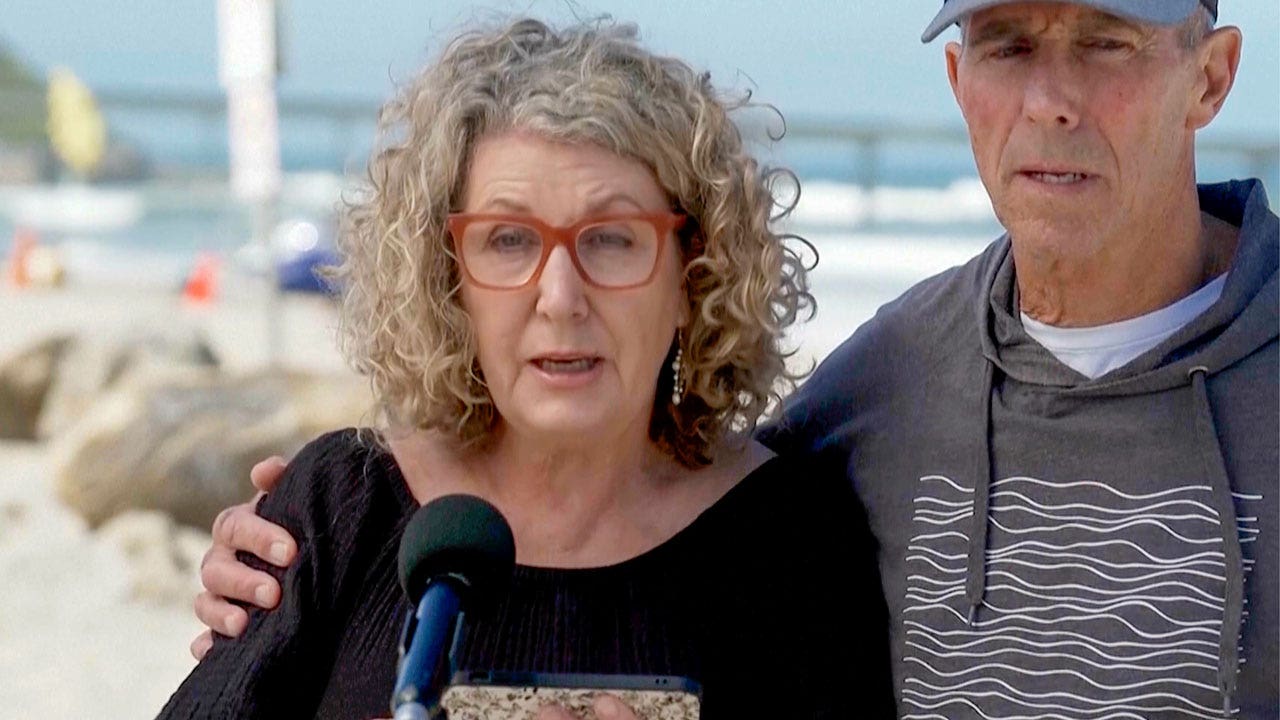
The mother of two Australian surfers killed in Mexico delivered a moving tribute to her sons Tuesday at a beach in San Diego.
“Our hearts are broken and the world has become a darker place for us,” Debra Robinson said, fighting back tears. “They were young men enjoying their passion of surfing together.”
Her sons, Callum and Jake, were allegedly killed by car thieves in Baja California, across the border from San Diego, somewhere around April 28 or 29.
MEXICAN AUTHORITIES REVEAL BIZARRE REASON THEY BELIEVE AUSTRALIANS, AMERICAN WERE MURDERED ON SURFING VACATION
Robinson also mourned the American who was killed with them, Jack Carter Rhoad.
The beachside location where she spoke, across the border from the Baja California city of Tijuana, was no coincidence. She noted that her son Callum “considered the United States his second home.”
Robinson noted that her son Jake loved surfing so much that, as a doctor, he liked to work in hospitals near the beach.
Australian citizen Debra Robinson with her husband Martin address the media on the beach in San Diego on May 7, 2024, following the deaths in Mexico of their two sons during a surfing trip. (Channel 9/POOL via AP)
“Jake’s passion was surfing, and it was no coincidence that many of his hospitals that he worked in were close to surfing beaches,” she said.
Choking back tears, Robinson conveyed a final message that coincided with her sons’ adventurous lifestyles.
“Live bigger, shine brighter, and love harder in their memory,” she said.
Robinson thanked Australian officials and supporters there and in the United States.
While she thanked Mexico’s ambassador to Australia, she notably did not thank the local officials in Baja California who eventually found the bodies of her sons and Carter Rhoad.
Their killers dumped the bodies of the men into a well about 4 miles away from where they had been attacked at a beachside campsite. Investigators were surprised when, underneath the bodies of the three foreigners, a fourth body was found that had been there much longer. It was unclear if the body was related to the current case.
The fact that such killers are not caught or stopped in the overwhelming majority of cases in Mexico has led some Mexicans to protest that authorities only investigate such disappearances when they are high-profile cases involving foreigners.
Robinson said that her sons’ bodies, or their ashes, will eventually be taken back to Australia.
“Now it’s time to bring them home to families and friends,” she said. “And the ocean waits in Australia.”
Prosecutors have identified three people as potential suspects, two of whom were caught with methamphetamines. One of them, a woman, had one of the victims’ cellphones when she was caught. Prosecutors said the two were being held pending drug charges but continue to be suspects in the killings.
A third man was arrested on charges of a crime equivalent to kidnapping, but that was before the bodies were found. It was unclear when or if he might face more charges.
The third man was believed to have directly participated in the killings. In keeping with Mexican law, prosecutors identified him by his first name, Jesús Gerardo, alias “el Kekas,” a slang word that means quesadillas, or cheese-filled tortillas.
He had a criminal record that included drug dealing, vehicle theft and domestic violence, and authorities said they were certain that more people were involved.
Australian Prime Minister Anthony Albanese told a radio station in the Robinsons’ home town of Perth in Western Australia state that every parent felt for the family’s loss.
“I think the whole nation’s heart goes out to the parents of Callum and Jake Robinson. It is every parent’s worst nightmare to lose a son or a daughter. To lose these two brothers is just awful and my deepest sympathies and condolences and I’m sure the whole nation’s with the parents and with the other family and friends of these two fine young Australians,” Albanese told Perth Radio 6PR.
Albanese said he was reminded of when his only child Nathan Albanese traveled last year at the age of 22 to a musical festival in Spain.
“You do worry, but you think as well that’s part of the Australian right of passage, is traveling around with a backpack and meeting people and it’s how you grow as a person as well so you want to encourage them,” Albanese said.
In 2015, two Australian surfers, Adam Coleman and Dean Lucas, were killed in western Sinaloa state, across the Gulf of California — also known as the Sea of Cortez — from the Baja peninsula. Authorities said they were victims of highway bandits. Three suspects were arrested in that case.
Read the full article from Here


SALT LAKE CITY (KUTV) — After weeks of long days on the fire line, firefighters battling Utah’s Iron and Cherry fires received some four-legged support.
Golden Healers, a Utah nonprofit that provides therapy and service dogs, visited the wildfire base camp at the invitation of the incident management team, giving firefighters a chance to step away from the demands of the job, if only for a few minutes.
The certified therapy dogs spent time with crews in dining areas, gathering spaces and rest areas, where firefighters petted the dogs, took photos and talked about the pets waiting for them back home.
MORE | Utah Fires
“Our firefighters face tremendous physical and emotional demands every day,” said Mike Carlson, founder and CEO of Golden Healers. “Sometimes all it takes is a few minutes with a therapy dog to help someone relax, smile and reset before heading back to work. It was an honor to support these incredible men and women.”
The visit came as hundreds of firefighters continue working to contain the Iron and Cherry fires, which have burned tens of thousands of acres in central Utah.
Golden Healers brought several certified therapy dogs, including Golden Retrievers, doodles, poodles and a corgi. Each dog has completed specialized therapy training designed to help them remain calm in busy, high-stress environments.
Volunteers said the response from firefighters was immediate.
Crews who had spent hours battling wildfire conditions gathered around the dogs, laughing, sharing stories and enjoying a brief reminder of home before returning to their assignments.
One of the most memorable moments came when an entire firefighting crew surrounded one therapy dog, taking turns petting it while talking about their own dogs and families.
For a few minutes, conversations shifted away from fire behavior and operational briefings to life beyond the fire camp.
“Watching these firefighters light up the moment a dog walked over reminded us why therapy dogs are so important,” Carlson said. “These are people who dedicate their lives to protecting our communities, often while spending weeks away from their own families. If we can give them even a few minutes of comfort and emotional support, then we’ve accomplished something meaningful.”
Golden Healers hopes to continue visiting wildfire camps and other first responders across Utah. The nonprofit regularly provides therapy dog visits to hospitals, schools, law enforcement agencies, mental health providers and community organizations.
“Our mission has always been to improve lives through the healing power of dogs,” Carlson said. “Whether we’re helping a child with autism, supporting someone struggling with mental health, or bringing comfort to firefighters after a long shift, these dogs have an incredible ability to connect with people exactly when they need it most.”
_____

After DSA candidates roiled traditional Democrats with wins in New York City last week, Tuesday’s primary in a Denver-centered district tested whether the left wing’s appeal could prevail elsewhere.
It turns out the democratic socialists’ reach extends well beyond New York — and it may well grow before the year is out.
Melat Kiros, backed by the national Democratic Socialists of America and Vermont Sen. Bernie Sanders, upset Rep. Diana DeGette, who has held her reliably blue seat for almost 30 years.
“What we’re seeing right now is the response to voters feeling like the party has not actually been fighting for working people,” Kiros told MS NOW last week.
The result is that Kiros, a critic of the Israeli government and high-ranking Democratic leaders, will likely be a member of Congress come next year. That happened even as DeGette cast the race as a warning, with President Donald Trump’s second term continuing to upend governance from the nation’s capital.
“Now is not the time to gamble and send somebody with no experience to Washington,” DeGette said during a recent candidate forum. “We need a strong, bold, hardened leader who will hold Trump accountable.”
The result was one of several Colorado results Tuesday to test incumbents or prominent statewide officials navigating a turbulent moment in Democratic politics — one in which voters have shown an appetite for untested fighters over familiar faces who’ve served in Washington’s halls of power.
The night’s theme wasn’t clear-cut; the three marquee races diverged on everything from ideology to questions of approach and clout. But each pitted an incumbent whose Congressional ties became fodder for a challenger.
In 2020, Democrats’ ability to woo former Gov. John Hickenlooper into the Senate race was seen as a boon for a party trying to unseat incumbent GOP Sen. Cory Gardner, one of the last Republicans left representing a blue state in the Senate. That move came after Hickenlooper’s 2020 presidential primary campaign fizzled. Even so, he faced a somewhat-competitive primary that year, taking 58.7% to his challenger’s 41.3%. Hickenlooper went on to win the seat that November by a little over nine points.

-

 Texas4 minutes ago
Phoenix Merchant Partners and Texas Capital Alternative Asset Management Form Strategic Relationship
-

 Utah6 minutes ago
Therapy dogs offer a welcome break for firefighters battling Utah’s Iron, Cherry fires
-

 Vermont11 minutes ago
She moved from Paris to Vermont and found her ‘dream job’ opening a bakery – The Boston Globe
-

 Virginia19 minutes ago
Reopening date set for Virginia Creeper Trail after months of work
-

 Washington22 minutes ago
Colorado Democrats punish Washington ties in primaries
-

 Wisconsin27 minutes ago
Missing Wisconsin teen Joniah Walker found safe 4 years after disappearing from home
-

 West Virginia34 minutes ago
Transmission line proposals raise ratepayer cost concerns in West Virginia
-

 Wyoming36 minutes ago
Wyoming Department of Health warns of scam callers using official phone number

