Montana
Expanded Great Northwest Challenge set for Montana This Weekend


The Great Northwest Challenge is back in Montana for 2026 with an added feature and a large field of teams in competition.
The tournament will run Friday, June 12 to Sunday, June 14, with the first day being a combine and a major college expo for players to be seen and discuss their college options.
The College Expo is in partnership with GRR Sponsor Next Phase Rugby, the app that helps high school players find their college home, and as well as The Rugger’s Edge college rugby consultancy. The message from both Next Phase and The Rugger’s Edge, as well as the College Expo ,is that while high-level players do need help finding the right college, players of a variety of levels can play competitive rugby after high school, and can even be recruited.
Over two-dozen college rugby programs will be in attendance at the GNC, and will be held at Gallatin High School in Bozeman, Mont. High School players will attend a coaches panel hosted by Next Phase Rugby’s Greg Stelluti and Karen Fong Donghue from The Rugger’s Edge, speaking with coaches about what they want to see from potential recruits.
After that, high school players can meet and speak with college coaches representing both men’s and women’s teams.
Check out Next Phase Rugby’s updated app which makes it easier for you to sign up for, upgrade, and manage your account. A new monthly premium has been launched and the yearly rate for Premium has dropped to $99.
Connect with college rugby teams. Find out how competitive, unified, and fun a rugby team is before you get to the college you want. Find out how you can get recruited as a rugby player, even if you’re not on a high-profile team.
Rugby can help make college more fun, can sometimes help you get into a school, and can even find you some financial assistance. How? Get the Next Phase Rugby app and set up your profile.


One characteristic that distinguishes male grizzly bears from female grizzly bears is a larger head.
With that in mind, check out the grizzly bear featured this week on the Mission Valley Montana Grizz Cam Facebook page. (Photo and video posted below; view Instagram version here.)
The imagery, captured after dusk on July 3, shows a large grizzly bear pausing and sniffing in front of the camera before exiting the frame. Several followers commented on the beauty of the the striking bruin.
“Absolutely MAGNIFICENT!” one person exclaimed.
ALSO: Bison fight on Yellowstone road reveals raw power of iconic beasts
But others remarked about the size and shape of the grizzly bear’s head, and the appearance of thicker fur on its shoulders.
This, along with the gray lighting, lends a surreal quality to the footage. (Click here if video player doesn’t appear below.)
“No doubt that’s a big-headed male griz,” one follower remarked. “It looks like he picked up some scent left at the camera site and moved off!”
“Look at that head! YEOW!” another follower exclaimed. “What an amazing critter.”
The folks behind Mission Valley Montana Grizz Cam use motion-sensor cameras in different locations to capture footage of grizzly bears in Mission Valley, in northwestern Montana.
The Grizz Cam website states: “In 2015 we started seeing a lot of Grizzly Bears on our property so we decided that setting up some trail cameras might lead to some interesting footage and give us insight.
“Several cameras were put in various locations, and we came to realize there were more bears than any of us had anticipated.”
While many Grizz Cam clips look similar, and some feature brilliant daytime colors and audio, this post stands out because of the unique appearance of the bear.
As one follower stated, “That’s a bad boy there.”
Montana
The Record is Clear: The Wilderness Society, Greater Yellowstone Coalition, and Montana Wilderness Association have Consistently Undermined the Roadless Rule

Beartooth Range, Montana. Photo: Jeffrey St. Clair.
The Wilderness Society, the Greater Yellowstone Coalition, and the Montana Wilderness Association, now rebranded “Wild Montana,” all claim they support the Roadless Rule and have been asking people for donations to oppose efforts to repeal it. But a review of the record shows that these “conservation” groups have supported opening 1,585,000 acres or Roadless and Wilderness Study Areas to logging and road building since the roadless rule went into effect in 2001.
Tracy Stone-Manning, now the President of The Wilderness Society, has been widely quoted as supporting the Roadless Rule. But while working as a top environmental advisor for former Montana Senator Jon Tester, she strongly supported his 2009 Forest Jobs and Recreation Act. The Montana Wilderness Association, now doing business as Wild Montana, was also one of the main cheerleaders for Tester’s bill
Although the bill never passed, it would have opened one million acres of roadless lands in the Beaverhead-Deerlodge National Forest in southwest Montana and mandated logging 10,000 acres per year for 10 years in the Beaverhead and Kootenai National Forests. The Kootenai contains the smallest, most threatened grizzly population in the world in the Cabinet-Yaak. Since most grizzly bears are killed within 1/3 of a mile of a road, more logging means more logging roads would be bulldozed into grizzly habitat, resulting in more dead grizzly bears. The measure was so extreme even the Forest Service opposed it.
The groups also strongly supported former Montana Senator Max Baucus’ Rocky Mountain Front Heritage Act, passed as a rider on the 2014 defense spending bill. The measure opened 208,000 acres of roadless lands to logging and road-building and guaranteed grazing in perpetuity with no environmental analysis or public review. The pitiful 67,000 acres of wilderness tack-ons also required the sacrifice of four Wilderness Study Areas in Eastern Montana, opening 29,000 acres to oil and gas exploration and development.
Then came Tester’s 2017 Blackfoot Clearwater Stewardship Act that carved up 50,000 acres of an Inventoried Roadless Areas contiguous to the Scapegoat and Bob Marshall Wilderness Areas. The measure also allowed loggers to decide where to build roads and designated 5,000 acres as a play area for snowmobiles and mountain bikes.
The bill didn’t even make it out of committee, but now these same groups have renamed it “A River Runs Through It Act” — although there is no sponsor and no “act.” In addition to the roadless lands Tester’s bill would have destroyed, it turns over management of 70,000 acres in grizzly, lynx and wolverine habitat in the Ogden Mountain Roadless Area northwest of Lincoln Montana to the timber industry. It also converts 130,000 acres of Inventoried Roadless Areas into play areas for motorized recreation and mountain bikers.
The clearcutting, bulldozing new logging roads, and motorized recreation in roadless areas will send tons of sediment into the Blackfoot River which has been designated critical habitat for bull trout, a threatened species. It should be called “A Clearcut Runs Through It Act.”
Finally, all three groups support the Greater Yellowstone Conservation And Recreation proposal. There is no sponsor and no bill, but the proposal opens much of the Lee Metcalf Wilderness Study Area and other Inventoried Roadless Areas to motorized recreation, logging and road building. While adding only 102,000 acres as wilderness — less than half of the 250,000 acres that qualify for wilderness designation — it also significantly reduces the 155,000 acre Hyalite-Porcupine-Buffalo Horn Wilderness Study Area by 53,000 acres.
Don’t fall for the con. The record is clear: these groups have supported reducing, not protecting Inventoried Roadless Areas in the past and are doing so now.
Please consider helping us get the only bill before Congress that would designate all 23 million acres of roadless in the Northern Rockies designated as wilderness, the Northern Rockies Ecosystem Protection Act. Please also consider donating to Counterpunch to help them continue exposing hypocrites.

BIGFORK, Mont. — Boaters on the Flathead River near Bigfork will face a temporary closure this week as crews continue work on the new Sportsman’s Bridge.
The Montana Department of Transportation and Sletten Construction will continue constructing the new bridge on Montana Highway 82 northwest of Bigfork by placing steel beams over the east side of the Flathead River. The beams will support the deck of the new bridge.
To safely complete the work, the river beneath the bridge will be temporarily closed from 7 a.m. Wednesday, July 8, to 6 p.m. Thursday, July 9.
No boat traffic will be allowed to travel under the bridge during that time.
The following was sent out by Montana Department of Transportation:
The Montana Department of Transportation (MDT) and Sletten Construction will continue constructing the new Sportsman’s Bridge on Montana Highway 82 (MT 82) northwest of Bigfork by placing steel beams over the east side of the Flathead River. These beams will support the deck of the new bridge.
To safely complete this work, the river beneath the bridge will be temporarily closed from 7 a.m. on Wednesday, July 8, to 6 p.m. on Thursday, July 9.
No boat traffic will be allowed to travel under the bridge during this time.
This closure area includes approximately 20 feet upstream and 300 feet downstream of the bridge and applies to all motorized and non-motorized watercraft, including kayaks, canoes, rafts, and paddleboards.
The Sportsman’s Bridge Fishing Access Site will remain open during this time for boaters traveling southbound (downstream) on the river toward Flathead Lake.
No traffic impacts are anticipated for motorists traveling on MT 82 during this work.
-

 Illinois2 minutes ago
Shooting leaves man dead, woman wounded in Mundelein, Illinois, apartment
-

 Indiana9 minutes ago
Indiana’s beloved Ice Cream Social returns to Monument Circle, sweetening support for youth sports
-

 Iowa12 minutes ago
Where is Iowa State football placed in USA TODAY’s Big 12 rankings?
-

 Kansas17 minutes ago
How to buy Argentina quarterfinal World Cup soccer tickets in Kansas City
-

 Kentucky24 minutes ago
Former Kentucky guard Quade Green joins La Familia
-

 Louisiana27 minutes ago
Looking for a luxurious place to stay? These are Louisiana’s 6 best resorts
-

 Maine32 minutes ago
Leslie Marshall urges Democrat Graham Plattner to exit Maine Senate race amid allegations | Fox News Video
-
 Michigan42 minutes ago
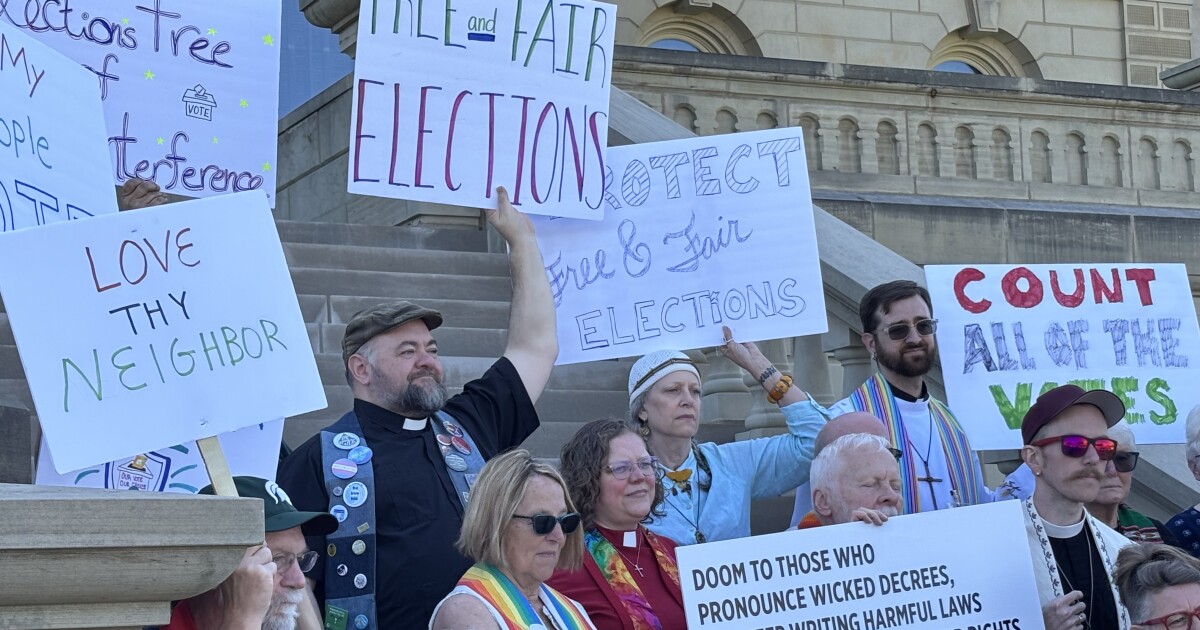
Michigan religious leaders speak against what they say are voter intimidation efforts

