Montana
Citing Wyoming corner-crossing case, hunters sue Montana for public land access – WyoFile


Montana’s lieutenant governor made clear that corner crossing remains trespassing in her state, despite a Wyoming case decided in favor of access to public land.
Lt. Governor Kristen Juras made her remarks Thursday at a legal forum at the Miles City Bucking Horse Sale, where she called the Wyoming corner-crossing case “unique” and said that Montana had a “different precedent” that allows it to criminalize the act.
She defended a Jan. 21 memo to game wardens declaring “corner crossing remains unlawful in Montana.” The memo authorizes them to cite corner-crossing hunters and others under state game and trespass laws.
The day Juras made her remarks, public land advocates sued Montana Fish, Wildlife and Parks, asking a district court to block enforcement of the memo.
The suit by Montana Backcountry Hunters and Anglers and Public Land And Waters Access names the wildlife agency and Director Christy Clark as defendants. The groups cite the Wyoming corner-crossing case in which hunters prevailed. Ruling on that Wyoming case, the 10th Circuit Court of Appeals held that corner crossing is legal in Wyoming, Colorado, Utah, New Mexico, Kansas and Oklahoma.
That should apply to Montana, even though it is not in the 10th Circuit’s jurisdiction, the new lawsuit states.
“The 10th Circuit Court of Appeals just last year held that Defendant [Montana, Fish, Wildlife and Parks] is wrong,” the new lawsuit states.
Corner crossing is the act of stepping from one piece of public land to another where ownership is arranged in a checkerboard pattern. Corner crossers do not set foot on kitty-corner sections of private property but do momentarily pass through the airspace above it.
Whether corner crossing is legal affects public access to 871,000 acres of public land in the Treasure State, public land advocates say. Juras said the “corner-locked” acreage — public land accessible by corner crossing alone — is about half that.
Unconstitutional directive?
The suit against Montana Fish, Wildlife and Parks asserts that the memo authored by Director Clark violates administrative rule-making laws and the state constitution. The complaint goes further, claiming that Clark’s interpretation of Montana’s criminal and hunting laws “is an incorrect statement of Montana law and directly in conflict with federal law governing much of the lands at issue.”
The suit claims that treating corner crossing as a crime damages John Sullivan and Dylan Pipinich, who recreate on public land and have corner-crossed to do so.
“For generations, Montanans have responsibly corner-crossed to hunt, fish, and recreate on public lands without ever being found guilty of trespass,” Backcountry Hunters and Anglers said in a Facebook post. “Our lawsuit challenges that administrative overreach and seeks a durable path forward for law abiding citizens to hunt and access their shared public lands while ensuring private property rights are respected.”
The complaint by the two public access groups states that Clark’s memo “does not cite any Montana statute or court decision establishing that corner crossing is illegal, nor did it address a recent Federal Circuit Court Decision directly addressing the issue.
“[N]ot a single Montana Court decision supports FWP’s position,” the lawsuit states.
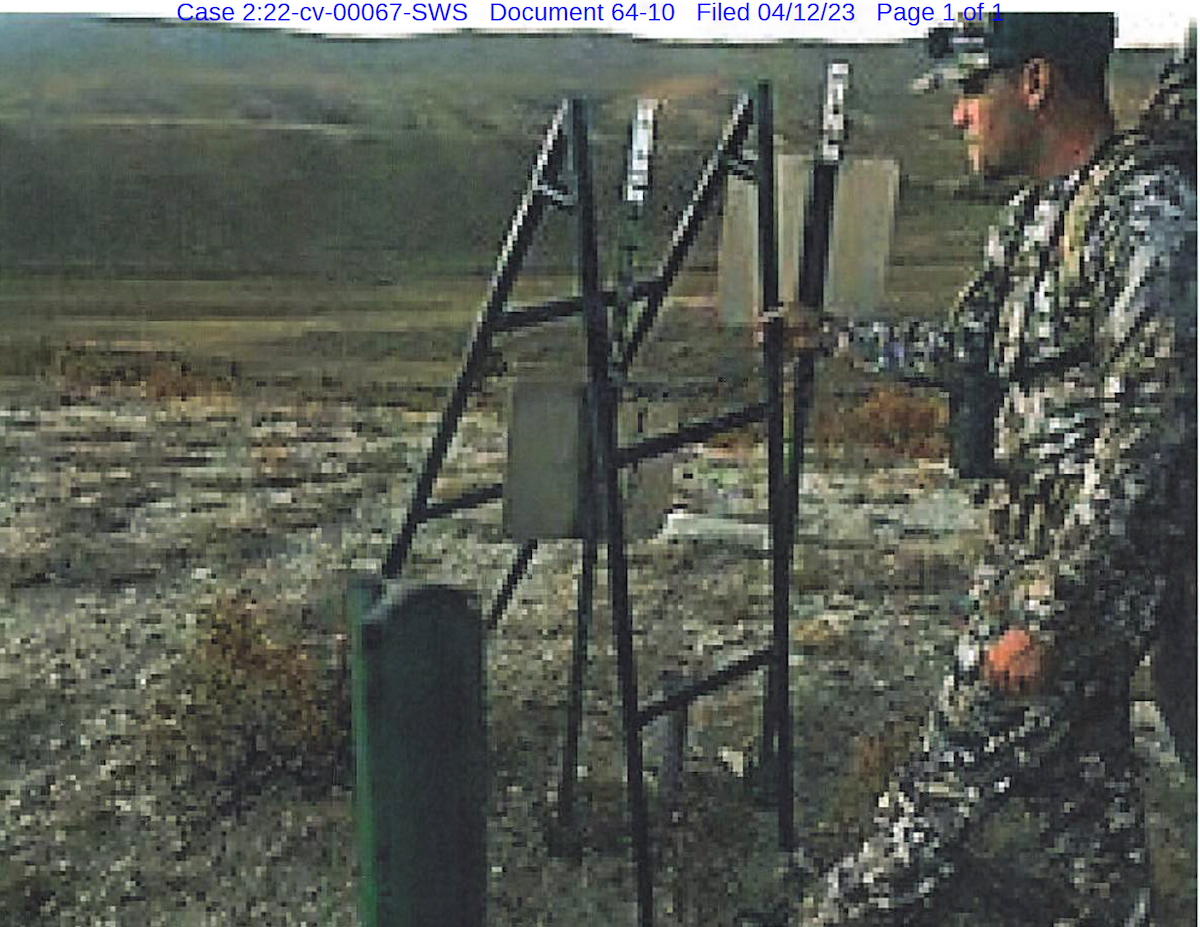
Montana’s trespass and hunting laws “focus on physical contact, occupation of land, and actual interference with property rights owned,” the suit states. The laws “require more than momentary crossing of undefined airspace” before they can be used to charge a person, according to the public-access advocates.
Fish, Wildlife and Parks “is specifically ‘interpreting’ the momentary act of de minimus [sic] airspace crossing as ‘entering private land’ or being ‘on private property’ with no statutory direction from the legislature,” the suit states.
Backcountry Hunters and the Public Land and Waters Access, an organization whose members say access to public lands and waters is fundamental to the identity of Montana, reject the common law ad coleum doctrine that holds that landowners also own from the depths to the heavens. The groups cite a 1946 U.S. Supreme Court decision that says the concept “has no place in the modern world.”
The new lawsuit also states that Fish, Wildlife and Parks has a public trust duty to ensure access. The suit claims that cases involving river access even allow contact with private land and should apply to corner crossing.
Courts have decided that “in order for the public to recreationally use its water resource, some ‘minimal’ contact with the banks and beds of rivers is generally necessary,” the two advocacy groups say. “[P]ublic access to public land at common corners is the same as public access to public water,” the suit states.
Ruling on the Wyoming case, the federal 10th Circuit Court of Appeals held that the 1885 Unlawful Inclosures Act “prevents any landowner from implementing a program that prevented hunters from corner-crossing,” the groups’ suit reads.
“‘It is perfectly proper for [Montana courts] to use criteria developed in federal cases’ when state law is silent or lacking,” the suit states.
Bucking the 10th Circuit
Montana’s Lt. Governor Juras said the 10th Circuit opinion doesn’t apply in Montana’s 9th Circuit, which covers Montana, Washington, Oregon, California, Idaho, Nevada and Arizona.
“We do have different precedent,” she said. “That is why our administration feels strongly.
“We have Montana case law that does allow [prosecution of] trespass into airspace, both at the district court and the Montana Supreme Court level,” she said. “So we truly are under a different legal paradigm than the 10th Circuit.”
“We have Montana case law that does allow [prosecution of] trespass into airspace, both at the district court and the Montana Supreme Court level.”
Kristen Juras
The 10th Circuit limited its ruling to federal public lands that can only be reached by corner crossing, she said.
“So if there is some other road,” Juras said, “even if it’s inconvenient, even if it means you have to hike another two miles, or you have to go over a mountain or across the stream, you need to use whatever available public access is there.”
A lot of corner monuments are affixed to trees, she said, making corner crossing at such points impossible.
“You literally can’t walk across it,” she said of a tree monument. “That takes away all the corner crossings with a marker on the tree.”

Juras also raised the issue of fencing and whether a corner-crosser who touches a fence is trespassing by contacting private property. The Wyoming case appears to discount that theory because the Unlawful Inclosures Act deems that a fence cannot be used to block public access.
Montana landowners build fences “with legitimate, good faith intent to contain your livestock,” Juras said. The intent “is not to lock out people from using the corner.”
In Montana’s 9th Circuit, a landowner’s fence-building intent — whether to contain stock or deter corner crossers — is relevant, she argued. If fences are built to contain livestock, a corner crosser who touches one would be trespassing unless they used a ladder or stile, she argued.
The U.S. Supreme Court rejected an appeal from the Elk Mountain landowner who wanted it to overturn the 10th Circuit’s ruling that favored public access. But that doesn’t mean it endorsed the 10th Circuit’s reasoning, Juras said.
It is possible, depending on how the new Montana case evolves, that the Supreme Court would be more interested in considering corner crossing if the new lawsuit ends in a determination that’s different from the conclusion reached by the 10th Circuit.
Meanwhile, Juras said her concern “is that hunters are going to overly interpret what a corner crossing means, and don’t understand how narrow and what the tests are and how strictly you have to comply with them in order to meet the standards set out by the 10th Circuit.”

The Montana Lottery offers multiple draw games for those aiming to win big.
Here’s a look at July 17, 2026, results for each game:
Winning Mega Millions numbers from July 17 drawing
22-34-45-48-55, Mega Ball: 14
Check Mega Millions payouts and previous drawings here.
Winning Big Sky Bonus numbers from July 17 drawing
20-21-25-27, Bonus: 05
Check Big Sky Bonus payouts and previous drawings here.
Winning Millionaire for Life numbers from July 17 drawing
03-19-38-48-58, Bonus: 01
Check Millionaire for Life payouts and previous drawings here.
Feeling lucky? Explore the latest lottery news & results
When are the Montana Lottery drawings held?
- Powerball: 8:59 p.m. MT on Monday, Wednesday, and Saturday.
- Mega Millions: 9 p.m. MT on Tuesday and Friday.
- Lucky For Life: 8:38 p.m. MT daily.
- Lotto America: 9 p.m. MT on Monday, Wednesday and Saturday.
- Big Sky Bonus: 7:30 p.m. MT daily.
- Powerball Double Play: 8:59 p.m. MT on Monday, Wednesday, and Saturday.
- Montana Cash: 8 p.m. MT on Wednesday and Saturday.
- Millionaire for Life: 9:15 p.m. MT daily.
Missed a draw? Peek at the past week’s winning numbers.
This results page was generated automatically using information from TinBu and a template written and reviewed by a Great Falls Tribune editor. You can send feedback using this form.

Six months before the legislative session is slated to kick off, a group of Republicans in Senate leadership have thrown their support behind a flat income tax proposal for 2027, thrusting one of Republican Gov. Greg Gianforte’s long-term priorities into the spotlight.
A Monday press release cited support for the policy from Senate President Matt Regier; Senate President Pro Tempore Ken Bogner; Senate Majority Leader Tom McGillvray; all the Senate majority whips; and Greg Hertz, R-Polson, who heads the Senate Taxation committee. Regier has requested a bill draft to “lower Montana income tax rates” for the 2027 session.
“The governor is encouraged by the growing support for his call for a flat income tax and looks forward to working with the legislature to deliver on this promise to Montanans,” said Kaitlin Timken, the governor’s director of communications. “In 2027, Governor Gianforte is focused on securing a fair, flat income tax rate to continue Montana’s strong economic momentum and return money back to Montanans who work hard to earn it.”
For the last three legislative sessions, the legislature has slashed income tax rates, moving the top income tax bracket from 6.9% to 5.4% during Gianforte’s tenure. The state has also moved from seven different income tax brackets to two.
Even as members of Senate leadership proclaim their support for the move to a flat income tax ahead of 2027’s session, some have found themselves at odds with more aggressive efforts to slash income taxes before.
During the 2025 session, for instance, the governor’s income tax proposal in Senate Bill 323 was tabled in Hertz’s Senate Taxation Committee. It would have cut the top-bracket tax rate from 5.9% to 4.9%. Hertz told the Montana Free Press at the time the legislation “pulls off too much money, too fast, at the top.” What eventually passed in 2025 in the form of House Bill 337 was a phased decrease of that top-bracket rate from 5.9% to 5.4%, along with raising the maximum threshold for the lower tax bracket, which stands at 4.7%.
Regier cited “momentum” on the issue as the reason Senate leadership has jumped into the fray to back the idea now. He said getting Senate leadership on board included some debate on the issue. But ultimately, there was agreement that the governor’s position was right on flat income tax. Regier pointed to both income tax and property tax cuts as topics of importance to Senate leadership ahead of 2027.
“We’ve had large, large surpluses in the past two sessions,” Regier said in an interview with the Beacon. “I’m looking at another surplus session. We have cut income tax the last two sessions … so it’s, to me, the premise of this — and to a lot of Republicans — is government is not a business. We should only take enough money from the people to operate government, and so we shouldn’t be running surpluses like that.”
During a February discussion with the Mountain States Policy Center, a right-leaning think tank, Gianforte said he hoped to get the state to a 4.7% flat income tax rate. A 2029 biennium report from the Legislative Fiscal Division projects that move would decrease individual income tax collections by an estimated $130 million per year by fiscal year 2029.
In Montana, income tax makes up the lion’s share of the state’s general fund, accounting for 66% of general fund revenues in fiscal year 2025, per a recent historical analysis from the Legislative Fiscal Division. Those dollars fund schools up to the Base Amount for School Equity, state supported public health programs, and salaries and pensions for state employees, among other items. In recent years, the state’s general fund has been flush with cash, in part thanks to higher-than-anticipated income tax collections.
Sen. Dave Fern, D-Whitefish, a seasoned legislator who serves on the Revenue Interim Committee, said several factors have contributed to the state’s revenue growth. In his estimation, those include high in-migration since the COVID days, more wealth in the state with people working remotely and making higher salaries, and more federal dollars going into people’s pockets thanks to pandemic-era policies.
Even so, Fern and most of his fellow Democratic caucus members have long been skeptical of the flat income tax idea. He cautioned that creating and maintaining a tax structure that keeps Montana’s general fund coffers at a sustainable level is important. Fern added he’s an advocate for maintaining the state’s current income tax levels for another two years to gain a better understanding of what Montana’s growth will look like moving forward — particularly as he anticipates changes coming down the pike.
“Beyond two years, do we have the capacity to deal with what we’re doing?” Fern said. “Will that growth rate of revenue, more income, more people moving here — will that continue? And you know, my reaction is, it will be neutered a bit, getting back to a more normal rate of growth.”
He also pointed to the 2029 biennium outlook, which identified provisions of 2025’s One Big Beautiful Bill Act that that could lower the amount of income tax the state collects. And, depending on the recommendations of the School Funding Interim Commission, which Fern sits on, he said the state could be looking at a different way of bankrolling school districts, which he anticipates could have a higher price tag on it than what has been status quo.
“It’s much easier to cut taxes than increase taxes,” Fern said.
For Gov. Gianforte, the same thing Fern identified as a holdup when it comes to a flat income tax rate serves as a go sign.
“The real advantage of a flat tax is once you get there, it’s very hard for future legislatures to raise it, because they’ve got to raise the tax on everybody, right?” the governor said at the Mountain States Policy Center discussion in February. “So, the penalty is higher.”
[email protected]

-

 Maryland42 seconds ago
What Doesn’t Change in Chevy Chase, Maryland
-

 Michigan7 minutes ago
Huntington Bank to close 13 Michigan branches by the end of August — see full list here
-

 Massachusetts13 minutes ago
Massachusetts RMV under fire after illegal immigrant trucker kills state trooper
-

 Minnesota19 minutes ago
Thousands expected to attend Minnesota Yacht Club festival in St. Paul
-

 Mississippi25 minutes ago
Mississippi Lottery Mississippi Match 5, Cash 3 results for July 17, 2026
-
Missouri31 minutes ago
Missouri Lottery Mega Millions, Pick 3 winning numbers for July 17, 2026
-
Montana37 minutes ago
Montana Lottery Mega Millions, Big Sky Bonus results for July 17, 2026
-

 Nebraska43 minutes ago
Nebraska Siege prepare for regular season home finale

