Montana
Broadband access is expanding in Montana, but rural areas still lag behind


In the southeastern Montana town of Belfry, 65-year-old resident Mary Boyer reflects on her relationship with technology.
“I’m a green-ledger girl,” Boyer said. “I can handwrite. I don’t like calculators. I never owned a television, I have a crank Victrola for music.”
Boyer’s home is about an hour south of Billings. The Beartooth and Pryor Mountains flank Belfry, as the Clarks Fork of the Yellowstone River meanders through it.
She said technology has always been slow to come to their town.
“We had a heck of a time getting songs – because we have to do it over the internet – for the karaoke machine,” she said. “And all of a sudden halfway through a song there’s no words or there’s no karaoke whatsoever.”
Boyer knows connectivity goes beyond a karaoke machine.
Before this year, she said their internet service couldn’t meet the community’s needs. Her neighbors rely on it for telehealth appointments, education and commerce.
“I think it’s all about the community and keeping them in touch with the outside world,” she said.
Montana ranks among the lowest in the country when it comes to internet access. And rural places disproportionately lack access to high speed connectivity compared to urban.
Montana ranks among the lowest in the country when it comes to internet access. Broadband Now, an independent research organization, ranked Montana second to last in the nation for internet speeds and affordability. And rural places disproportionately lack access to high speed connectivity compared to urban; this is known as the digital divide.
State officials and telecommunications companies have been trying to change that. Over the last few years, just shy of a billion dollars in federal funding aimed at tackling this issue came into the state. The goal is to use it to close the digital divide for good.
In the southern end of Belfry, Jay Velez stands in front of his restaurant, the Silvertip, admiring the scenery.
“What a view, man!” he said, looking toward the Beartooth Mountains. “It doesn’t suck here.”
His restaurant serves as a local watering hole. It offers the karaoke night coveted by Boyer. And this summer, the Silvertip’s internet got better.
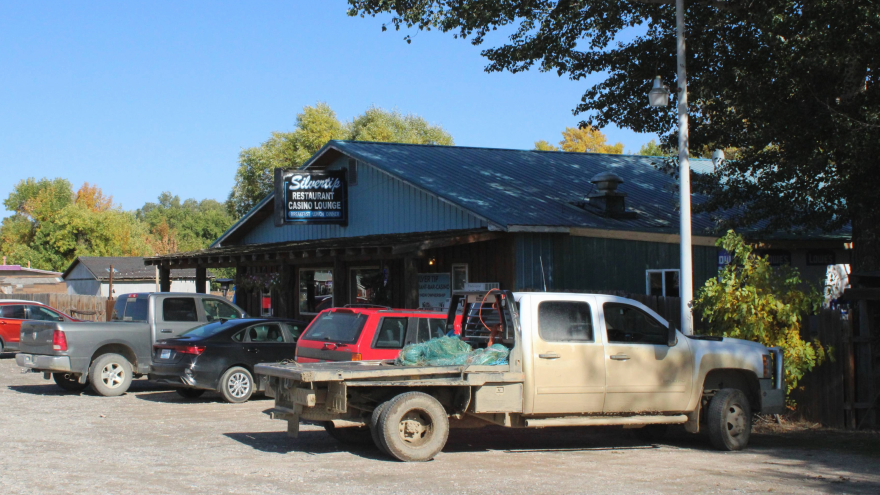
“We just rely on it for our point of sale systems, and so far, it’s been working great,” he said.
His improved internet is due to newly installed fixed fiber optic lines. These are thick cables laid in the ground. They’re considered the “gold standard” for broadband connectivity.
But this technology is expensive to install, and it’s been slow to reach towns like Belfry.
“We’re way behind, in looking at the grander sphere of the problem,” said Misty Ann Giles, the head of the state’s broadband office ConnectMT. “We are farther behind our sister states. Montana does have a lot of challenges when it comes to thinking about internet access.”
Government-led efforts to close the digital divide have been underway for decades. The federal government established the Universal Service Fund in 1996, prescribing that “all Americans” should have access to basic connectivity. The fund subsidizes fiber installation and maintenance in remote areas.
But it wasn’t enough. So, another project emerged in 2018. The U.S. Department of Agriculture’s ReConnect program offers federal funds and loans to expand internet access.
Giles helped stand-up the program as former Chief of Staff at the agency’s Rural Development office.
“A lot of the work we did when we were at USDA when we first came into office was trying to look at the bigger Rubik’s Cube of, why are rural communities lacking some core services when it comes to education, telehealth, things like that in their communities,” Giles said. “And what it all came down to was connectivity.”
This connectivity became even more imperative during the pandemic. Business, community, health care and education all required a stable internet.

According to the Federal Communications Commission, broadband expansion timelines considered reasonable pre-COVID-19 became “unworkable,” and the Commission pushed to get rural communities connected faster. So the federal government launched several new programs.
Since 2019, around $900 million from four federal programs for rural broadband expansion has flowed into the state.
Since 2019, around $900 million from four federal programs for rural broadband expansion has flowed into the state.
The main sources include funds from the ReConnect Program, which go to telecom companies through grants and loans. Those total around $144 million for Montana-focused projects. Then there’s the American Rescue Plan Act, which provided $310 million; The Broadband Equity Access and Development program, which allotted around $308 million; Lastly, there’s the FCC’s Rural Digital Opportunity Fund, which provided Montana $126 million for a 10-year period during its Phase I auction.
And it’s through these programs that Belfry’s internet just got a little better.
Back in southeastern Montana, Nemont Communications Chief Operating Officer Scott Paul drives through the 250-resident town on a sunny October afternoon.
“You probably didn’t see it, but look for an orange capped plastic pole,” he said, pointing out markers of their recent efforts. “Beneath that orange-capped plastic pole, there is gonna be a handhole. And then between those plastic poles, there’s fiber that’s buried underground.”

Nemont just replaced Belfry’s copper wire laid around the 1970s. Paul said copper was great for dial-up internet, but fails at providing the internet speeds we expect today. But installing fiber in Montana is expensive. It can cost up to $300,000 to reach a single home or business, according to Giles.
“If you’re trying to put all of this fiber into an area that’s all rock, then it becomes a lot more expensive because rock’s a lot harder to get through than the dirt,” he said.
For Belfry’s project, Nemont received $10 million ReConnect dollars to build fiber for around 1,000 households in 500 square miles. That’s an area the size of Los Angeles. Paul said they installed 80 miles of fiber just to reach Belfry.
Most companies rely on their customer base to cover the costs of installing internet infrastructure. But in low population states like Montana, that model does not always work. Paul said that’s why these funds are so important.
“It’s allowing us to escalate the speed of doing that,” he said. “We’re doing a little bit more now than we have done in the past, for that reason.”
Dozens of companies like Nemont have leveraged these federal programs to try and reach more residents. Sometimes the costs still exceed what they can afford, and they default.
According to the FCC, Montana’s broadband coverage increased 10 percent between 2023 and 2024. But there’s more work to be done. 70,000 homes and businesses across Montana still need better internet.
Some progress has been made. According to the FCC, Montana’s broadband coverage increased 10 percent between 2023 and 2024. But there’s more work to be done. 70,000 homes and businesses across Montana still need better internet.
And rural residents like Mary Boyer know how necessary it is to be connected.
“If we didn’t have the access to the good communications, we could be in a world of horse pucky,” she said.
State officials hope to bridge the digital divide by the end of the decade.



HELENA — You probably have goals and plans for 2026—the Montana Department of Agriculture does too.
“We’re really focusing on innovative agricultural practices,” Montana Department of Agriculture director Jillien Streit said.
It’s no secret that agriculture—farming and ranching—is not easy. There are long days, planning, monitoring crops and livestock, and other challenges beyond farmers’ and ranchers’ control.
(WATCH: Montana Department of Agriculture focusing on innovation in 2026)
Montana Department of Agriculture focusing on innovation in 2026
“We have very low commodity prices across the board,” Streit said. “We still have very high input prices across the board, and we have really high prices when it comes to our equipment, and so, it’s a really tough year.”
But innovation, including new practices, partnerships and technology use, can help navigate some of those challenges.
“We can’t make more time and we can’t make more land, so we need to start putting together innovative practices that help us maximize what our time and land can do,” Streit said.
Practices range from using technology like autonomous tractors and virtual fencing—allowing rangers to contain and move cattle right from their phones—to regenerative farming and ranching.
“It is bringing cattle back into farming operations to be able to work with cover cropping practices to invigorate the soil for new soil health benefits,” Streit said.
The Montana Department of Agriculture is working to help producers learn, share, and collaborate on new ideas to work in their operations.
The department will share stories of practices that work from farms and ranches across the state. Also, within the next year or so, Streit said the department is hoping to roll out technology to help producers collaborate.
“(It’s) providing a communication platform where people can get together and really help each other out by utilizing each other’s assets,” she said.
While not easy, agriculture is still one of Montana’s largest industries, and Streit said innovating and sharing ideas across the state can keep it going long into the future.
Montana
Frontier Conference women: MSU-Northern, Montana Western pull upsets to advance to semifinal round

BUTTE — MSU-Northern and Montana Western pulled a pair of upsets Saturday at the Butte Civic Center to wrap up the quarterfinal round of the Frontier Conference women’s basketball postseason tournament.
The fifth-seeded Skylights started the day with a red-hot shooting performance to down No. 4 Rocky Mountain College 82-74. Western, the sixth seed, used a third-quarter surge to defeat No. 3 Carroll College 65-56.
MSU-Northern (17-11) and Western (14-13) now advance to Sunday’s semifinal round, where the Skylights will play No. 1 seed Dakota State at noon and the Bulldogs will face No. 2 Montana Tech at 2:30 p.m.
MSU-Northern 82, Rocky Mountain College 74
MSU-Northern sizzled in the first quarter, making seven 3-pointers to take a double-digit lead, and put together a crucial third-quarter run to get past Rocky and advance to the semifinal round.
Becky Melcher splashed four 3s in the first 10 minutes, and Taya Trottier, Canzas HisBadHorse and Shania Moananu added one apiece as the Skylights built a 29-13 lead. Melcher scored 14 first-quarter points and finished with a game-high 30 on 10-of-19 shooting (7 of 15 from 3-point range). She added 11 rebounds, a blocked shot and three steals to her stat line.
Rocky battled back to tie the game at 36-36 in the second quarter on a Brenna Linse basket, but MSUN responded with consecutive triples from Trottier and Melcher and took a 44-38 lead into halftime. The Bears eventually stole the lead back in the third quarter following a 9-0 run capped be an Isabelle Heggem bucket.
But the Skylights again answered — this time with a 13-2 run to take a 60-51 lead. MSUN led 66-59 going to the fourth and wouldn’t trail the rest of the way. The Skylights trailed for less than two total minutes of the game.
As a team, MSUN made 14 of 26 3s in the game. Ciera Agasiva was 3 for 3 from behind the arc, and Trottier was 2 for 3. Trottier had 18 points, eight rebounds and six assists, while Agasiva had 13 points.
Paige Wasson led Rocky (20-9) with 29 points but was 0 for 10 on 3-point attempts. Heggem had a double-double of 21 points and 12 rebounds.
Montana Western 65, Carroll 56
After neither team led by more than five points in the first half, Western broke open a 25-25 tie game by outscoring Carroll 20-9 in the third quarter.
Bailee Sayler scored 10 points in the quarter, including making two 3-pointers, to help the Bulldogs take control. They led 45-34 going to the fourth, and Carroll wouldn’t get closer than six points the rest of the way.
The Fighting Saints were just 18-of-65 shooting (27.7%) for the game.
Sayler scored an efficient 22 points on 7-of-8 shooting. She was 2 for 3 from 3-point range and 6 for 7 at the free throw line. The Missoula native also had nine rebounds.
Isabella Lund added 16 points for the Bulldogs, and Keke Davis had 11 points and 11 rebounds.
Carroll (19-10) was led by Kenzie Allen with 12 points. Willa Albrecht and Meagan Karstetter scored 11 points apiece for the Saints.

Recently, I was asked to talk about what it is like to be a female rancher.
I was flattered to be asked, but I don’t know the answer.
I do know what it is like to be a human rancher and I know that I admire many women who also are ranchers.
In fact, 36 percent of the farmers and ranchers in the U.S. are women and they manage almost half of America’s ag land.
Globally, we produce more than half of all food.
In Montana, we all benefit from amazing female leaders in agriculture.
If you want to know about improving soil health or the rewards of raising sheep, talk to Linda Poole in Malta.
If you want to learn how to organize a grassroots rancher’s organization and effect meaningful change, talk to Maggie Nutter in Sunburst.
Trina Bradley of Dupuyer will look you in the eye and tell you everything you need to know about the impacts of grizzlies on her ranch life.
Colleen Gustafson, on the Two Med, graciously hosts and educates non-ranchers for months at a time without strangling them, all while maintaining every fence, buying every bull and killing every weed on her ranch.
Adele Stenson of Wibaux and Holly Stoltz of Livingston find innovative solutions to ranching challenges and then — even harder — find ways to share these innovations with hard-headed, independent cusses who want to do it our own way.
In fact, I’ve noticed that often women seek novel innovations to deal with a ranching challenge.
If a man happens to be around, she might even run it past him.
It’s rubber band ranching – stretch with an idea, contract to assess it, then stretch again to implement it.
Long ago, my friend Michelle and I promoted the One Good Cow program at the Montana Stockgrowers Association meeting.
We asked cattle producers to donate one cow to ranchers who had lost so many in blizzards and floods that year.
As we stood on stage in a room full of dour, silent men, I remember finding the one person I knew and asking what he thought.
Just as he would bid at a livestock auction, he barely nodded his approval.
We ended up gathering more than 900 cows from across the nation and giving them to 67 producers.
One Good Cow was a good idea.
Now I don’t seek approval for my ideas so sometimes my rubber band doesn’t contract to assess one before I stretch into action.
That’s how I got myself into producing shelf-stable, ready-to-eat meals made with my beef and lamb.
This is a good idea, too.
I hope.
I wonder if it is easier to ranch as a woman in some ways.
Society pressures men to know all of the answers all of the time, but If I mess up, I try to learn from my mistake and move forward.
When Imposter Syndrome hits or we can’t find a solution to an unsolvable problem – the effects of climate change, commodity markets or competing demands from family – secretly faking it until we make it gets lonely.
The downward spiral of loneliness and the pressure to be perfect can lead to suicide.
Male ranchers kill themselves 3.5 times more often than the general public.
Female ranchers kill themselves, too, just a little less often.
I’m fortunate to have good friends who love me even when I’m far from perfect.
We laugh together, they remind me that I have a few good attributes even when I forget, they tolerate my weirdness and celebrate little successes.
They stave off loneliness.
They know all ranchers try our best, we appreciate a little grace, and a warm fire feels good to our cold fingers.
Lisa Schmidt raises grass-fed beef and lamb at the Graham Ranch near Conrad. Lisa can be reached at L.Schmidt@a-land-of-grass-ranch.com.

Two dead after I-495 road rage incident leads to stabbing, Virginia State Police shooting – WTOP News

PHOTOS: Long Beach State Dirtbags vs. Washington State, Baseball

Setting sail on iceboats across a frozen lake in Wisconsin

West Virginia Surrenders Six-Run Lead, Falls in Series Finale to Kennesaw State

Meyer’s Late Score Lifts Wyoming past Air Force – SweetwaterNOW

Florida High School Football Rankings: Top 25 teams – Oct. 21

Cleary's 21 help Le Moyne down Central Connecticut State 69-64 in OT

How old is Bo Nix? What to know about Oregon quarterback ahead of 2024 NFL Draft

99th annual Pony Swim held in Virginia

Indiana Members Credit Union announced as new anchor tenant at Bottleworks District

House Republicans push Johnson to go to war with Senate over SAVE Act

Israel FM says Europe too divided, slams Spanish PM

Satellite images provide view inside Iran at war

Video: What the Texas Primary Battle Means for the Midterms

Dems’ potential 2028 hopefuls come out against US strikes on Iran
-

 World4 days ago
Exclusive: DeepSeek withholds latest AI model from US chipmakers including Nvidia, sources say
-

 Massachusetts4 days ago
Mother and daughter injured in Taunton house explosion
-

 Denver, CO4 days ago
10 acres charred, 5 injured in Thornton grass fire, evacuation orders lifted
-

 Louisiana7 days ago
Wildfire near Gum Swamp Road in Livingston Parish now under control; more than 200 acres burned
-

 Technology1 week ago
YouTube TV billing scam emails are hitting inboxes
-

 Politics1 week ago
OpenAI didn’t contact police despite employees flagging mass shooter’s concerning chatbot interactions: REPORT
-

 Technology1 week ago
Stellantis is in a crisis of its own making
-

 News1 week ago
World reacts as US top court limits Trump’s tariff powers