West
Man convicted for dozens of threats against former Speaker McCarthy over Chinese balloons

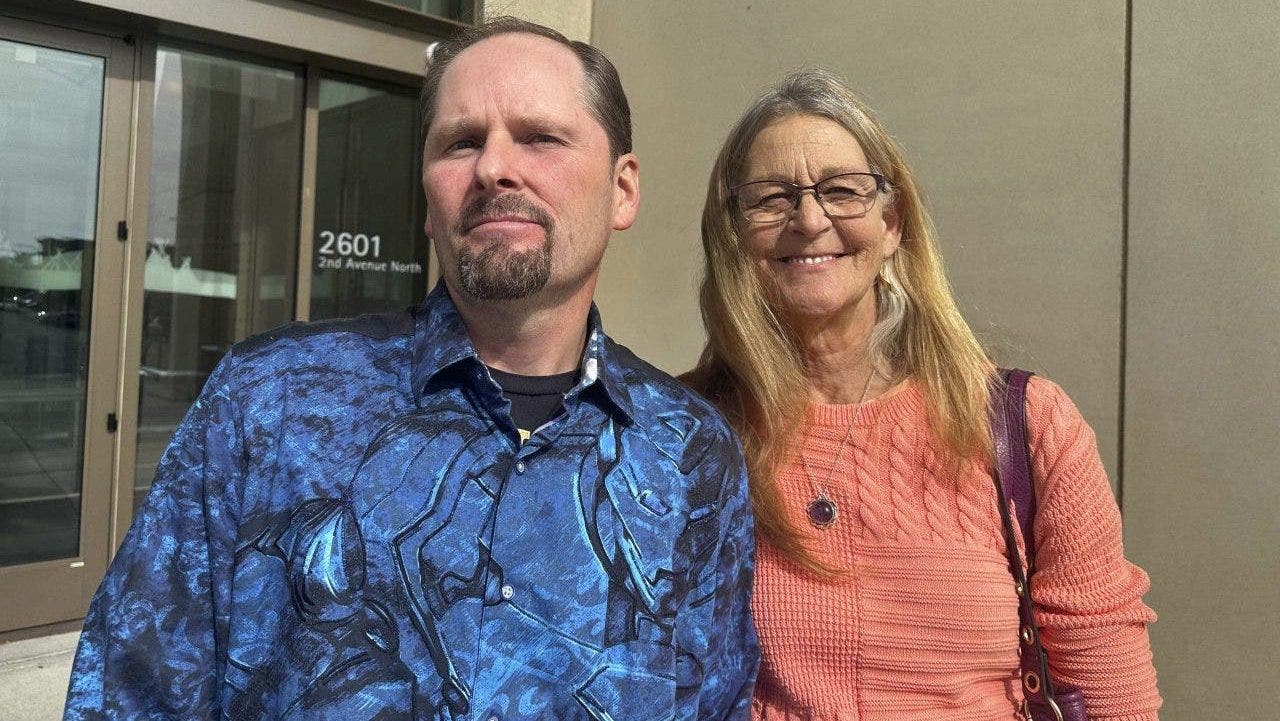
A man from Montana has been convicted after making dozens of threatening phone calls against the Speaker of the House.
Richard Rogers, 45, made over 100 threatening calls to then-Speaker Kevin McCarthy’s office after the U.S. government shot down a Chinese balloon over Montana.
A federal jury on Wednesday found Rogers guilty of threatening to assault McCarthy as well as two counts of harassing telephone calls.
ALASKA MAN ARRESTED FOR THREATS AGAINST 6 SUPREME COURT JUSTICES
Richard Rogers and his wife Laurie are seen outside the James F. Battin Federal Courthouse in Billings, Montana. (AP Photo/Matthew Brown)
Rogers made over 100 calls to McCarthy’s office in the course of just 75 minutes on Feb. 3 of last year, prosecutors said.
He also made over 150 calls to the FBI tip line between 2021 and 2022.
Authorities say that his calls were frequently filled with vulgar and offensive statements, as well as physical threats.
‘SHOOT IT DOWN’: MONTANA GOP DEMAND BIDEN TAKE OUT SUSPECTED CHINESE SPY BALLOON HOVERING OVER US FOR DAYS
“You can’t talk to people that way. It’s common sense,” said Assistant U.S. Attorney Thomas Godfrey. “He’s calling not out of political protest; he’s calling because he gets enjoyment out of it.”
Rogers argued in court that his dozens of calls to McCarthy’s office — inspired by the Chinese balloon but commenting on everything from the FBI to President Biden — were a form of “civil disobedience.”
Speaker Emeritus Kevin McCarthy is shown addressing the audience during an event awarding House Clerk Cheryl L. Johnson with the 2023 Freedom Award. (Aaron Schwartz/NurPhoto via Getty Images)
“They were disrespectful to me, so I was disrespectful to them,” Rogers said of his abusive language used against congressional staff and receptionists.
Rogers is set to be sentenced on Jan. 31.
He faces a maximum penalty of six years in prison and a $250,000 fine for threatening to harm a congressman.
On the harassment conviction, he faces up to two years in prison and a $250,000 fine.
Read the full article from Here

California
California still hasn’t released Newsom’s Baby2Baby diaper contract as lawmakers weigh longer public records delays

California’s delayed release of its Baby2Baby contract is casting a shadow over the state’s new Golden State Diaper program.
Two months after Gov. Gavin Newsom announced a controversial multimillion-dollar state diaper contract with Baby2Baby, a nonprofit with existing ties to the Newsom administration and the First Partner, Californians still have not been allowed to see the contract or competitive bid records behind the deal to manufacture and deliver millions of California co-branded free diapers to new parents.
The delay comes despite repeated requests by CBS California Investigates and despite California law requiring the state to release these records.
ALSO READ: California’s “Diapergate”: Critics got free diaper math wrong, but state won’t release key Baby2Baby records
The Newsom administration waited 24 days to decide whether it would even allow the public to see the records, but continues to delay releasing the Baby2Baby contract and competitive bid records that the governor announced more than two months ago.
At the same time, California lawmakers are advancing legislation that would give state agencies additional time to respond to California Public Records Act requests, further extending how long the public must wait for records like these.
Delayed accountability
CBS California Investigates requested a copy of the Baby2Baby contract on May 12, four days after Governor Newsom announced the partnership during a high-profile press conference.
Given the controversy and misinformation surrounding the announcement, we asked the Newsom administration to forgo the formal California Public Records Act (CPRA) process and provide an expedited copy of the contract and competitive bid records.
Both are expressly identified as public records under California law, which also requires agencies to “promptly notify” requesters whether records are disclosable, allowing a maximum of ten days to let them know the estimated date that they will provide the records.
Instead, the Newsom Administration spent 24 days determining whether or not it would even allow Californians to see these public records, then said it would take another 42 days (if the state meets its latest deadline) to provide a copy of the contract and competitive bid records that the governor publicly announced two months ago.
What is AB 1821?
Even as public interest grows, California lawmakers are advancing a bill that would allow agencies to further delay responses to Public Records Act requests, extending the maximum initial 10-day determination window and 14-day extension window from calendar days to business days.
State law does not limit how long an agency can wait to actually provide the records after they provide that initial response.
ALSO READ: California State Secrets: What public officials don’t want you to know
Assemblymember Blanca Pacheco introduced Assembly Bill 1821, which originally sought to overhaul the transparency law to allow agencies to sue if they deemed a request “malicious” and charge up to $66 an hour to provide public records.
The proposal triggered fierce pushback from a broad coalition including the First Amendment Coalition, ACLU California Action, Common Cause California, the League of Women Voters, and the Howard Jarvis Taxpayers Association.
The Senate Judiciary Committee, led by Senate Judiciary Chair Tom Umberg, stripped the most controversial elements from the legislation before moving it forward.
“People shouldn’t have to tell us why they want that information. People shouldn’t have to pay to get information from public officials,” Umberg told CBS California.
Still, the amended version lengthens the legal window for officials to respond to records requests.
Pacheco maintained the necessity of the changes for burdened departments.
“Agencies across the state are experiencing a sharp increase in requests that are exceptionally broad,” she argued during testimony.
Ginny LaRoe of the First Amendment Coalition contends that essential documents, such as multimillion-dollar state contracts, should be accessible without any formal request at all.
“You should have that document in your hands. You should’ve had it in your hand the day they were talking about it,” LaRoe said.
Rather than forcing Californians to wait weeks for paper-pushing, LaRoe suggests the state should proactively upload finalized agreements online with minor necessary redactions for personal information, ensuring immediate transparency and easing the administrative burden.
Umberg signaled support for a shift toward automated disclosure.
“I think there’s a world where we make them do that,” he said. “It’s up to us to motivate them to do so.”
More than two months after Newsom’s big announcement, CBS California Investigates continues to wait for the state to release the Baby2Baby contract and the underlying bid documents.
After waiting 24 days to confirm the records were, in fact, disclosable, the state said it would need an additional 28 days to provide them. At 5:09 pm on the 28th day – Friday, July 3, a state holiday – CBS California received a presumably automated email informing us the state would need another two weeks to provide the contract the governor announced two months ago.
Until these public records are actually public, questions will continue to mount about how this deal was reached and how competing proposals were scored.
Day 1 | May 12
CBS California Investigates requested a copy of the Baby2Baby contract four days after Governor Newsom announced the partnership during a high-profile Capitol press conference.
The Governor’s Office referred the request to the California Health and Human Services Agency. Because of the intense public interest following the announcement, CBS California Investigates asked Deputy Secretary of External Affairs Sami Gallegos and Assistant Secretary of External Affairs Rodger Butler to forgo the formal California Public Records Act (CPRA) process and simply provide an expedited copy of the highly publicized contract.
Instead, Butler directed us to the Department of Health Care Access and Information (HCAI), the agency handling the procurement. HCAI acknowledged receipt of the request.
Day 7 | May 19
CBS California Investigates followed up with the HCAI, again requesting an expedited copy of the contract because we were on a deadline.
The agency responded that the request was being processed through the California Public Records Act, rather than providing the contract directly.
Day 14 | May 22
Exactly 10 calendar days after the request, the HCAI invoked the CPRA’s “unusual circumstances” provision, extending the deadline another 14 days to determine whether the requested records were disclosable.
The agency wrote that it needed additional time because “two or more components of the agency have substantial subject matter interest” in the request.
Day 28 | June 5
Fourteen days later, the HCAI agreed that the records are public.
The agency determined that the Baby2Baby contract, procurement packet, scope of work, bid scoring sheets and vendor award documents are disclosable public records.
However, instead of releasing them, the HCAI said it would need another three to four weeks to identify and produce the records.
AB 1821 | While we waited
While CBS California Investigates waited for the records, lawmakers advanced AB 1821, legislation that originally proposed sweeping changes to California’s Public Records Act.
After bipartisan criticism and opposition from transparency advocates, many of the bill’s most controversial provisions were removed. However, the amended bill still gives agencies additional time to respond to public records requests.
Day 52 | July 3
Instead of receiving the records, CBS California Investigates received another email at 5:09 p.m. on the final day of the promised three-to-four-week production window.
Rather than releasing the records, the state delayed production another two weeks, pushing the expected release well past the two-month mark.
Day 56 and counting
Fifty-six days after CBS California Investigates requested the Baby2Baby contract, and 60 days after Governor Newsom publicly announced the partnership, Californians still have not been allowed to review:
- The executed contract
- The procurement packet
- The scope of work
- The competitive bid scoring sheets
- The vendor award documents
Translation: The Newsom administration spent 24 days determining whether records already identified as public under California law could be released. It then delayed producing those records for another six weeks. If the state meets its latest deadline, Californians will have waited 66 days from our request and 70 days from the governor’s announcement to see the contract.

State and federal agencies are starting to reopen public lands, state wildlife areas and a segment of the Colorado River that were closed in light of the Snyder Fire in Mesa County.
Stage 2 fire restrictions — banning all open fire or flames, including charcoal grills and wood-burning stoves — remain in effect as extreme fire danger, spurred on by hot and dry conditions, persists across the region.
The Snyder Fire started on Friday, June 26, when several smaller fires burning on the Colorado-Utah border combined. As of July 7, the fire was 98% contained after burning over 30,200 acres and killing three wildland firefighters.
With fire activity decreasing and containment increasing, Colorado Parks and Wildlife and the Bureau of Land Management shared their plans Tuesday to reopen lands impacted by the wildfire.
Parks and Wildlife said in a news release that it, alongside the Bureau of Land Management, had lifted the closure for public access and downstream recreation on the Colorado River, starting at the James M. Robb-Colorado River State Park in Fruita and extending to the Utah state line. It also reopened the boat ramp at the Fruita section of the James M. Robb-Colorado River State Park in Fruita to downstream traffic.
The state agency’s Horsethief State Wildlife Area in Fruita and the Loma Boat Launch State Wildlife Area also reopened.
The BLM said in a news release that all lands within the perimeter of the Snyder Fire burn area remain closed to ensure public and firefighter safety.
“The burned landscape — including vegetation — remains dynamic and unpredictable as it naturally recovers from the fire impacts. This order is effective immediately and will remain in effect until the order is rescinded,” the BLM said.
Both agencies also warned that fire danger remains extremely elevated and Stage 2 fire restrictions are in place.
A map of current federal and state fire restrictions is available on the Rocky Mountain Area Interagency Fire Restriction Dashboard or by visiting DFPC.Colorado.Gov/sections/wildfire-information-center. The Colorado Trails Explorer (or COTREX) app also has wildfire closure alerts.
Under current conditions, Parks and Wildlife advised the following actions to prevent sparking wildfires:
- Use established rings: Where permitted, only build campfires inside permanent metal fire rings in designated campgrounds.
- Clear nearby debris: Remove all dry grass, leaves and pine needles within a 10-foot radius of any flame.
- Drown and stir: Extinguish fires completely with water, stir the ashes, and ensure the debris is cold to the touch.
- Watch campfires constantly: Never leave a fire or portable stove unattended. If you see an unattended fire, call 911.
- Keep vehicles off brush: Avoid parking or idling cars on tall, dry grass where hot exhaust systems can ignite a fire.
- Secure towing equipment: Ensure trailer safety chains do not drag and spark against asphalt. Check them at every stop.
The BLM added that under its Stage 2 restrictions, smoking is prohibited except in an enclosed vehicle or building, a developed recreation site, or while stopped in an area at least three feet in diameter that is barren or cleared of all flammable materials.
Gas-powered stoves or grills with a shut-off valve are still allowed in cleared areas under this stage.
Violating Stage 2 fire restrictions by lighting a campfire is a Class 2 misdemeanor. Violators face an immediate citation, a mandatory court appearance, steep fines and potential jail time. Additionally, you can be held financially liable for all fire suppression costs and property damage if the campfire sparks a wildfire.

HONOLULU (HawaiiNewsNow) – Newly redesigned Hawaii driver’s licenses and state IDs are beginning to arrive in mailboxes statewide.
The Department of Customer Services said more than 50,000 residents who renewed or obtained a license or state ID starting in mid-May began receiving the new cards last Friday.
Officials said the updated cards are made of 100% polycarbonate, with laser-engraved photos and added security features intended to deter tampering, fraud and identity theft.
The department said existing driver’s licenses and state IDs remain valid until their expiration dates and do not need to be replaced.
“There’s no reason for them to request a duplicate unless they would like the new card design,” said Kim Hashiro, director of the Department of Customer Services.
Residents were also reminded that temporary paper licenses are not accepted by the Transportation Security Administration for air travel. Travelers using a temporary credential should bring another acceptable form of identification, such as a passport.
Permanent plastic cards are typically mailed within six to eight weeks after an application is submitted, officials said.
Copyright 2026 Hawaii News Now. All rights reserved.
-

 California11 seconds ago
California still hasn’t released Newsom’s Baby2Baby diaper contract as lawmakers weigh longer public records delays
-

 Colorado3 minutes ago
Colorado River, public lands reopen as Snyder Fire containment increases
-

 Connecticut8 minutes ago
Opinion: A lifeline in CT’s childcare desert
-

 Delaware15 minutes ago
Talk & Film Bring Delaware’s Revolutionary Story to Life at Archives’ First Saturday Program – State of Delaware News
-
 Florida18 minutes ago
Heat alerts expand across Florida as dangerous temperatures return
-

 Georgia23 minutes ago
Trooper injured in chain-reaction crash on Georgia 400
-

 Hawaii30 minutes ago
Redesigned Hawaii IDs begin rolling out statewide
-
 Idaho33 minutes ago
All lanes blocked on I-84 in Payette County due to multiple brush fires, officials say

