West
Jillian Michaels sounds off on why she left California: The 'woke victimology poker' became 'too crazy for me'

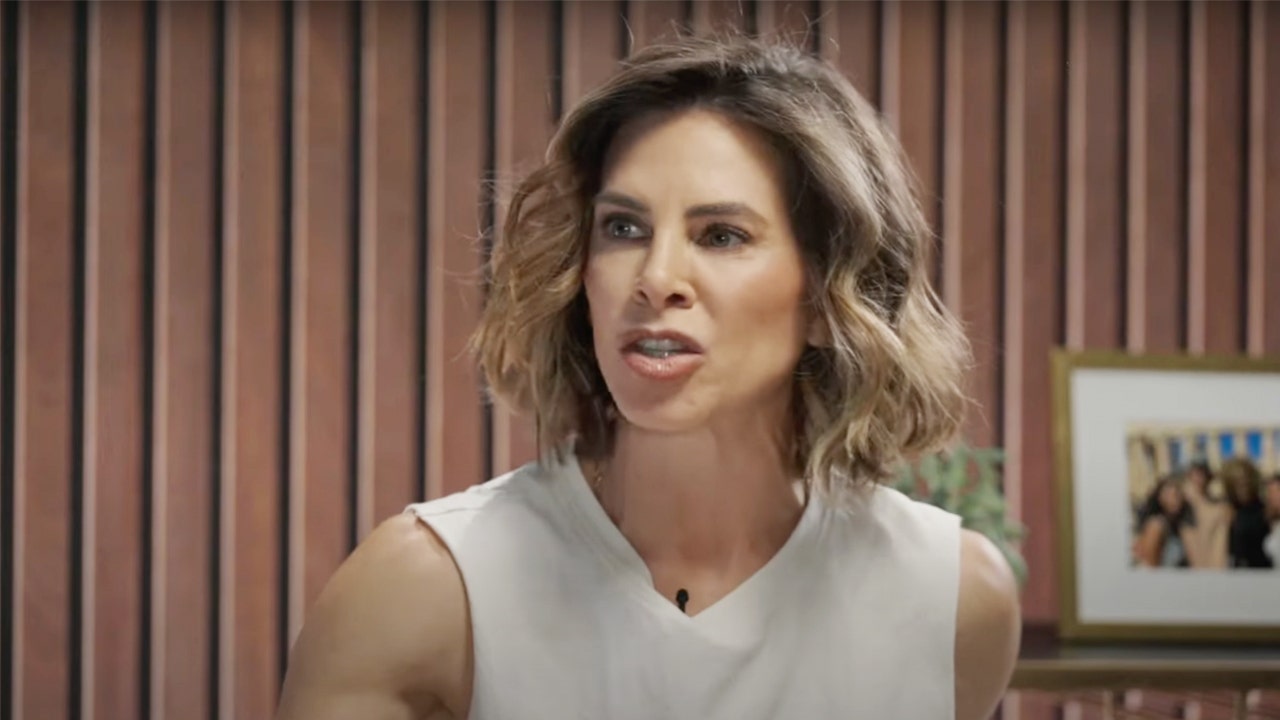
Fitness guru Jillian Michaels went off on how “insane” her home state of California has become in recent years and how “woke victimology poker” drove her away.
“California got too crazy for me,” Michaels said Wednesday on “The Sage Steele Show.”
“I grew up here. I’m a woman. I’m a gay woman. My mom’s a Jew. My dad’s an Arab. I have a Black kid. And believe it or not, my son is half Latin, even though he doesn’t look like it,” Michaels told host Sage Steele. “I hold a million cards in your game of woke victimology poker. And when I leave California, maybe you’ve lost your f—ing mind. Just maybe! Like when you have me running from home, maybe it’s gone way too far.”
JILLIAN MICHAELS SAYS SHE LEFT CALIFORNIA BECAUSE OF NEWSOM’S LEADERSHIP, PRAISES HOW FLORIDA IS ‘LESS CRAZY’
Fitness guru and California native Jillian Michaels rails about the woke policies that drove her away from the Golden State during her appearance on “The Sage Steele Show.” (Screenshot/Club Random Media)
Michaels, who now lives in Miami, insisted she hasn’t changed but “the world around me is shifting and I haven’t moved.”
“Some of these laws that are passing here are absolutely f—ing mind-boggling,” Michaels said. “In relation to crime, protecting our kids, like, we’re decriminalizing everything, which arguably I would probably be okay with but we’re not regulating any of it. So it’s like, okay, you’re gonna decriminalize sex work but only so women can loiter on the streets, not to keep them safe, not to have them pay taxes, not to make them, you know, regularly check for STDs, not to take away the pimps out of the equation. Like if you made that argument to me, I’d be like, ‘well, yes, of course.’”
CALIFORNIA EXODUS CONTINUES AS CONSERVATIVE STATES ATTRACT BLUE-STATE RESIDENTS: REPORT
Michaels slammed California’s far-left policies of not enforcing laws and allowing children to receive so-called “gender affirming” medical care. (Slaven Vlasic/Getty Images)
“I could be liberal! I could go there with you! I grew up this way!” she added.
Michaels continued criticizing California laws.
“Or the fact that a 12-year-old child can be put on off-label cancer drugs to irreparably change their body,” she said. “Again, if my son came to me and said, ‘Mom’ — or my daughter — ‘I think I’m trans.’ I’d say okay, you know, like, you want to dress this way. You want me to call you whatever the heck you want, dress, fine. Explore it. I love you. I’m cool, do you as long as we’re safe, but we’re not changing your body until it’s fully developed. I’m sorry. Conversation’s over. Can’t get a f—ing tattoo!”
“Exactly,” Steele said.
“Are you crazy? It’s insane! Like I just can’t. It’s madness. It’s madness to me. I can go on and on and on. And it’s madness,” Michaels said.
EX-CALIFORNIA FAMILIES SAY MOVE TO RED STATES WAS CAUSED BY LEFTIST POLICIES AND TAXES: ‘TIME FOR US TO LEAVE’
Michaels previously attacked Democratic California Gov. Gavin Newsom while discussing why she moved away from her home state. (AP Photo/Rich Pedroncelli)
Earlier this year, Michaels had a combative exchange with “Club Random” host and loyal California resident Bill Maher after she said living in Florida “feels less crazy.”
She also repeatedly took aim at Democratic California Gov. Gavin Newsom.
“You’re going to decriminalize everything, but regulate nothing. You’re prioritizing the craziest s— I’ve ever seen in my life. C’mon, really?” Michaels said.
“I can’t stand him,” she later added.
Read the full article from Here


HONOLULU (HawaiiNewsNow) – One of Hawaii’s sweetest partnerships is returning with a larger footprint this year.
In celebration of National Pineapple Day and Dole’s 125th anniversary, residents who donate blood on Friday, June 26, will receive a free fresh Dole pineapple while supplies last.
The effort is a collaboration between Dole Food Company and Blood Bank of Hawaii aimed at boosting donations during a time of year when blood supplies traditionally decline.
According to Blood Bank of Hawaii, donations typically drop by about 15% during the summer months, even as hospitals continue to rely on a steady stream of lifesaving blood products every day. Organizers say all blood types are needed, with a particularly urgent demand for O-type blood, platelet donations, and AB plasma.
The campaign also comes during a milestone year for Dole.
The company is celebrating 125 years of pineapple history, commemorating the fruit that helped shape Hawaiʻi’s agricultural identity and introduced generations around the world to the islands’ pineapple legacy.
This year, blood donors will receive not only a pineapple, but commemorative Dole-branded anniversary gifts while supplies last.
National Pineapple Day recognizes a fruit often called the “fruit of kings.” Though pineapples originated in South and Central America, they became deeply intertwined with Hawaiʻi’s history after James Dole established commercial pineapple operations in the islands in the early 1900s. Today, Dole continues operating facilities in Wahiawā while promoting initiatives centered around nutrition and community wellness.
Unlike previous years, organizers are expanding the giveaway to every Blood Bank of Hawaii donor center and mobile drive location participating on Friday.
Donation sites include:
Young Street Donor Center
1907 Young Street, Honolulu
6:30 a.m. to 4:30 p.m.
Waikele Center
94-849 Lumiaina Street, Waipahu
7 a.m. to 3 p.m.
Windward Mall
46-056 Kamehameha Highway, Kāneʻohe
9 a.m. to 3 p.m.
Hyatt Regency Waikiki
2424 Kalākaua Avenue, Honolulu
9 a.m. to 3 p.m.
Pearlridge Center
98-1005 Moanalua Road, ʻAiea
Noon to 6 p.m.
Appointments are strongly encouraged and can be made through Blood Bank of Hawaii’s website or by calling (808) 848-4770.
Copyright 2026 Hawaii News Now. All rights reserved.

July 1 isn’t just the start of a new fiscal year for Idaho public schools. It’s also the effective date for many new education-related laws.
From mandatory moments of silence to restrictions on taxpayer funding for teachers’ unions, the Legislature enacted a slew of new policies affecting public schools during this year’s session.
Here’s what educators, parents and students should know:
School trustees, administrators and teachers
Here are the new laws that will affect school trustees, administrators and teachers:
Union activities. Public schools can no longer use taxpayer resources to accommodate teachers’ unions — including by giving teachers paid time off for union “activities” or by using payroll systems to deduct union dues.
The list of union “activities” in House Bill 516 is long. Among other things, it includes:
- Supporting or opposing candidates for office
- Influencing legislation
- Promoting union membership
- Participating in the “administration business or internal governance” of a teachers’ union
- Preparing, conducting or attending a union event
- Distributing union communications
- Speaking on the union’s behalf
- Engaging in union negotiations
- Filing a grievance on behalf of the union
A school district can’t give teachers paid time off to participate in these activities, unless the union reimburses the district.
HB 516 was based on a report from the Washington-based Freedom Foundation, an anti-union think tank, which alleged that public schools have spent more than $1 million subsidizing teachers’ unions.
The bill also prohibited districts from:
- Deducting union dues through payroll systems.
- Increasing teacher pay to cover union dues.
- Requiring that teachers meet with the union.
- Sharing employees’ contact information with the union.
- Communicating on the union’s behalf.
Civics instruction. Public schools must now ensure that their civics instruction aligns with a law aimed at cultivating the “virtue and knowledge necessary for self-government.”
Senate Bill 1336 codified nearly four pages of requirements for civics instruction. By the time public school students graduate, they must exemplify the virtues of “prudence, justice, fortitude, moderation and patriotism” while understanding the “fundamental principles of the nation’s republican form of government” along with the “history, meaning, significance, and effect of key historical documents.”
Click here to read the list of principles and texts that students must understand.
The bill also required that high school students complete two credits in American history and two credits in American government. These classes must include instruction on the American Revolution and founding along with instruction on the incompatibility of totalitarianism with the principles of American government.
The bill also “encouraged” public schools to display historical portraits of George Washington “in a conspicuous place” in each classroom where civics is taught.
Public charter schools can request an exemption from many of the new requirements. Traditional public schools cannot.
Lastly, the bill pushed back the implementation date for a new civics test that the Idaho Department of Education is writing. The new test will be required in 2027-28, rather than during the upcoming school year.
High-needs funding. Public schools are now eligible to receive up to $100,000 in state funding for “high-needs” special education students.
Senate Bill 1288 set aside $5 million for students who require full-time staff support or specialized equipment. Districts can apply for the state funds to cover students whose individual education program-related costs exceed $30,000 annually.
The state will fully reimburse costs between $30,000 and $80,000. Costs above $80,000 will be reimbursed at 80%, and reimbursement is capped at $100,000. Forty percent of the state funds are reserved for rural schools.
Sexual abuse reporting. School districts are no longer allowed to conduct an internal investigation of abuse in lieu of reporting an incident to law enforcement.
Sen. Tammy Nichols, R-Middleton, proposed the law in response to sexual abuse complaints against Gavin Snow, a former special education assistant in the Boise School District.
Senate Bill 1412, which passed with unanimous support, also requires that school districts ask job applicants for sworn statements disclosing pending or prior investigations, resignations during investigations or disciplinary action stemming from misconduct. An applicant who lies in the disclosure is no longer eligible for the job.
Funding flexibility. Public school districts and charter schools are now eligible for flexibility in how they spend state funds — if they meet performance benchmarks.
To qualify for the “earned autonomy,” districts would have to post high marks on test scores and graduation rates while charters would be graded on academics and financials.
House Bill 883’s sponsors estimated that about 10 districts and 15 charters would qualify.
Parents
Here are the new laws that parents should be aware of:
Social transition reporting. Parents will now have a right to be notified if their child identifies as a different gender at school. Schools could face a six-figure penalty for failing to comply.
House Bill 822 requires that public school officials notify parents within 72 hours if their child requests help with “social transitioning.” This includes when a student asks to go by a different pronoun or use a bathroom or participate on a sports team that doesn’t align with their birth sex.
Sponsored by Rep. Bruce Skaug, R-Nampa, the law gives parents the right to sue a school or healthcare provider for relief and monetary damages if they aren’t notified within the 72-hour window.
The attorney general can also seek a civil penalty up to $100,000.
Rep. Bruce Skaug, R-Nampa
Virtual school policy. Parents of virtual-school students will have new restrictions on money they receive to cover the costs of home learning.
After a state report last year found examples of taxpayer money being misused, lawmakers added limits on “supplemental learning funds.” According to House Bill 624, this money can only be spent on “eligible educational expenses, including:
- Computer hardware, internet access or other devices used to meet a student’s educational needs.
- Textbooks, curricula or other instructional materials, including educational software.
- Fees for standardized tests, advanced placement exams, certificate exams or college admissions exams.
- Therapies, including behavioral, physical, speech-language and audiology therapies, along with other State Board of Education-approved services.
In addition to the rules around supplemental learning funds, HB 624 added reporting requirements for private vendors that contract with virtual schools. Vendors must disclose the costs and services they provide while demonstrating a “clear relationship between the public funds received and the services provided.”
Military preference on charter waitlists. Active-duty military parents could be eligible for preference on charter school waitlists.
Lawmakers passed a bill that allows charter schools to place children from military families third among categories of students given preference on waitlists. It’s up to each charter school whether they implement the change.
Students
Here are the new laws that students should know about:
Moment of silence. Public school students will now have to start each school day with a moment of silence.
They can use the 60 seconds however they want — to reflect, meditate or pray — but they must be silent, and “no other activities shall take place,” according to House Bill 623.
Sponsored by Rep. Bruce Skaug, R-Nampa, the law requires that a moment of silence occur “at or near the beginning of each school day.” It prohibits teachers from instructing students on the “nature of any reflection” they might engage in.
School leaders also must notify parents about the moment of silence and “encourage” them to “provide guidance” to their children on how to use it, according to the law.
Idaho Launch cuts. Less state aid will be available for students going to college after they graduate in 2027.
For the current fiscal year and next fiscal year starting July 1, state lawmakers — with Gov. Brad Little’s approval — cut $10 million from Idaho Launch. The program offers high school graduates $8,000 to spend on an in-state higher education degree or workforce training certificate.
While the award amounts will remain the same, the state now has $65 million in scholarship money to dole out, compared to $75 million in previous years.
IDLA cuts. Fewer students are eligible to take discounted courses through the state’s online learning platform, the Idaho Digital Learning Alliance (IDLA).
House Bill 940 cut funding for IDLA’s elementary program, limiting the platform to students in grades 6-12. The bill also cut driver’s education, and eliminated state funding for students attending all-virtual schools and non-public schools — although private- and home-schoolers can pay IDLA’s full course fee and seek reimbursement through the Parental Choice Tax Credit.
HB 940 also set new fees for courses that are eligible for state funding. Courses that satisfy a graduation requirement are $40, while courses that don’t meet a graduation requirement are $100.
Copyright 2026 KMVT. All rights reserved.

We cover lots of hard news here at The Drive. Y’know, the stuff that keeps you updated on the automotive industry and enthusiast scene. Other times, we don’t. Other times, we write silly car-related stuff because it’s fun. This is one of those times. A giant banana recently got pulled over in Montana, and as the Cowboy State Daily put it, it wasn’t its first time.
According to the Montana State Police, the giant banana car and its driver, Steve Braithwaite, were pulled over near Billings because part of the license plate was blocked. He did not receive a ticket. Also, the plate reads “SPLIT.”
“We’ve stopped speeders, distracted drivers, and even a few unusual vehicles… but this one definitely stands out.
The Big Banana Car was stopped cruising near Billings today. While it may be apPEALing, traffic laws still apply to fruit. 😎 🍌
Safe travels, Montana,” said the Montana State Police’s Facebook page.
According to the report, Braithwaite has been pulled over hundreds of times over the decade he’s been driving his banana car across the country. In fact, he believes that during the first few years he had the thing, he was one of the most frequently pulled-over men in America.
“Driving around in a banana and having all these people, all these smiles and waves, affects me. It actually does something fantastic,” he told the outlet.
He even claims to have been pulled over once for “peeling out,” which was, of course, a joke.
Another report claims that Braithwaite began working on the fiberglass banana in 2008 and finished it in 2011. It’s based on a 1993 Ford F-150 and is a bout 23 feet from tip to tip.
Keep on keepin’ on, Steve.
Got a tip? Email us at tips@thedrive.com
-

 Florida6 minutes ago
As Brightline train deaths hit 200+, company rolling out safety plan
-

 Georgia9 minutes ago
Army sergeant gets life sentence for shootings that wounded 5 at Georgia base
-

 Hawaii14 minutes ago
Dole celebrates 125 years by giving free pineapples to blood donors across Oahu
-

 Idaho21 minutes ago
New Idaho education laws: What students, parents and educators should know
-

 Illinois24 minutes ago
Ex-Illinois teacher awaiting deportation linked to Tren de Aragua mass shooting in Chicago: DHS
-

 Indiana29 minutes ago
Madam Walker Legacy Fest brings back Indiana Avenue’s Black history
-

 Iowa36 minutes ago
State officials continue to recommend no swimming at one Iowa lake
-
Kansas39 minutes ago
Kansas City police bring in extra help for World Cup events


