Connect with us

West

FBI searching for missing Montana teen who vanished from home weeks ago

Published

on

FBI searching for missing Montana teen who vanished from home weeks ago

The FBI has joined a search for a missing Montana teen who vanished from her home two weeks ago, vowing not to rest until answers are found about the teen’s disappearance.

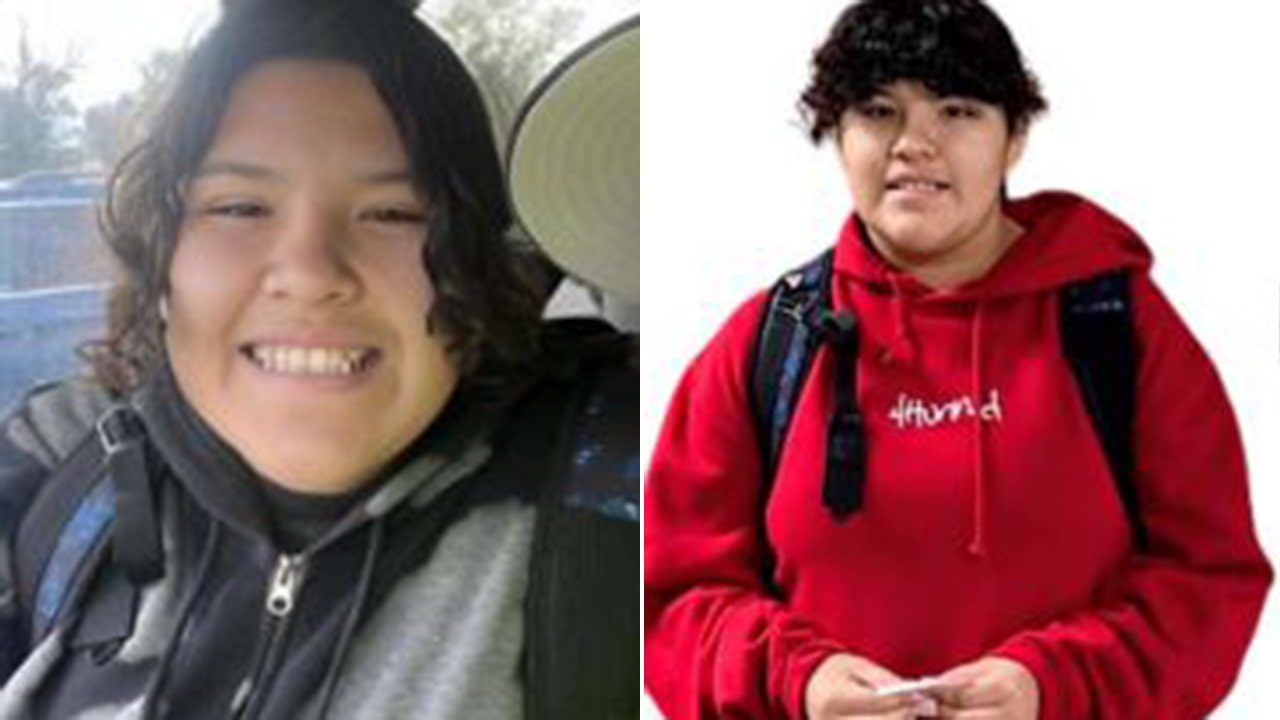
Sa’Wade Birdinground, a 13-year-old member of the Crow Tribe, has not had any known contact with family or friends since she disappeared on Oct. 6, the FBI said Saturday in a news release.

“The FBI is working closely with local law enforcement to find Sa’Wade Birdinground,” said Rhys Williams, acting special agent in charge of the FBI’s Salt Lake City Division. “We are asking for the public’s assistance in locating her, and we won’t stop until we have answers.”

Sa’Wade was last seen at her home in Garryowen on the night of Oct. 6, the Big Horn County Sheriff’s Office said in a news release on Oct. 7. She was last seen wearing a black hoodie with mushrooms on it, an anime t-shirt, basketball trunks and purple slip-on shoes. She is known to wear an elk tooth necklace and is believed to be carrying a black and purple Adidas backpack.

MISSING VIRGINIA ANTIQUE SHOP OWNER’S FAMILY BELIEVES HE WAS MURDERED AFTER MONTHS WITHOUT ANSWERS

Advertisement

Sa’Wade Birdinground is a 13-year-old member of the Crow Tribe. (FBI)

The teen is described as “a quiet, kind and artistic child who likes to laugh,” and is well liked among her teachers and peers, the FBI said.

Sa’Wade went missing from her home in Garryowen, Montana, on Oct. 6, authorities said. (FBI)

“She has never run away from home or been in any serious trouble,” the FBI news release said. “Her disappearance from home is totally out of character for her, and her family is very concerned about her.”

The Montana Department of Justice issued a Missing Endangered Persons Advisory due to concerns about Sa’Wade’s safety.

Advertisement

MISSING TEXAS REAL ESTATE AGENT’S HUSBAND KEPT IN JAIL WITH HIGH BOND AS FAMILY RIPS HIS LACK OF COOPERATION

The FBI said that based on the investigation thus far and the amount of time the teen has been missing, they are taking the case “very seriously and chasing down every lead.”

Big Horn County Sheriff Jeramie Middlestead said authorities are doing everything they can to bring Sa’Wade home safely and called on the public for help.

“The community’s help is crucial at this time, and we urge anyone with information to come forward immediately,” said Middlestead. “Sa’Wade’s family is deeply worried, and any information, no matter how small, can make a difference.”

CLICK TO GET THE FOX NEWS APP

Advertisement

The FBI asked anyone with information about Sa’Wade to contact 406-665-9798, adding that “any details, no matter how small, could assist in bringing her home safely.”

Read the full article from Here

Continue Reading
Click to comment

Leave a Reply

Your email address will not be published. Required fields are marked *

This site uses Akismet to reduce spam. Learn how your comment data is processed.

Alaska

Southwest Airlines Begins First-Ever Alaska Service at Anchorage

Published

on

Southwest Airlines  Begins First-Ever Alaska Service at Anchorage


ANCHORAGE — Southwest Airlines (WN) has launched its first-ever service to Alaska, beginning seasonal flights to Ted Stevens Anchorage International Airport (ANC) from Denver International Airport (DEN) and Harry Reid International Airport (LAS).

The carrier scheduled Anchorage service to begin on May 15, 2026, with once-daily flights through the summer from both Denver and Las Vegas. Southwest’s booking site now markets Anchorage flights, with fares and connecting itineraries visible from multiple U.S. cities.

Southwest adds its 43rd state

Anchorage becomes Southwest’s 122nd airport and brings Alaska into the carrier’s domestic network as its 43rd U.S. state. The airline had announced the move in October 2025, describing Anchorage as one of several new 2026 destinations added as part of a broader network expansion.

The launch follows Southwest’s recent additions of St. Thomas, U.S. Virgin Islands; Knoxville, Tennessee; Sint Maarten; and Santa Rosa/Sonoma County, California. Anchorage is the most geographically distinct of those additions, extending Southwest’s map into a market where air travel is unusually central to state connectivity.

Advertisement

Why anchorage matters

For Alaska, Southwest’s arrival adds another large U.S. carrier at ANC and increases competition on two important Lower 48 corridors. Alaska transportation officials framed the service as a boost for passenger choice, tourism, business travel, and broader state connectivity.

The Denver and Las Vegas launch points are also strategic. Denver gives Southwest a strong inland connecting point to much of its domestic network, while Las Vegas adds another high-volume leisure gateway. Together, the routes allow Southwest to test Alaska demand without immediately entering more crowded West Coast-to-Anchorage markets.

Part of a larger southwest reset

The Anchorage launch comes as Southwest continues to reshape both its network and onboard product. The airline has been rolling out assigned and premium seating, free Wi-Fi for Rapid Rewards members, and in-seat power on Boeing 737-8 aircraft as part of its redesigned cabin strategy.

That context matters. Anchorage is not just a novelty dot on the map; it is part of Southwest’s wider attempt to broaden vacation demand, strengthen connecting relevance, and enter markets that historically sat outside its traditional network profile.

Impacts

For travelers, the immediate impact is simple: Anchorage now has new seasonal nonstop options from Denver and Las Vegas, backed by Southwest’s large connecting network. For ANC, the service adds another national carrier during the peak summer travel window.

Advertisement

For Southwest, Alaska is a symbolic and strategic expansion. The carrier is moving beyond its old domestic playbook, adding more geographically ambitious destinations while modernizing the product around assigned seating, premium options, and loyalty benefits. The real test will be whether Anchorage performs strongly enough to return beyond the initial summer season.


Source link

Continue Reading

Arizona

Road to the WCWS: Arizona can’t defend the long ball, Duke wins Durham Regional

Published

on

Road to the WCWS: Arizona can’t defend the long ball, Duke wins Durham Regional


The Arizona Wildcats needed to win one game on Sunday to advance to regionals. They couldn’t do it.

Next time someone says that balls fly out of Hillenbrand because of the “desert air,” point to the home runs in more humid, low-lying areas around the country. Like Durham, NC, where one Duke home run after another put a nail in the Wildcats’ season on Sunday by scores of 8-6 and 9-4.

Duke hit four home runs in the early game. The Blue Devils returned to hit four more in the late game. Durham is at 404 feet above sea level and was supposed to have humidity between 45 and 70 percent on Sunday. So much for the lazy broadcasters’ take of “altitude and dry air.”

There are three parts of a game. Both Duke and Arizona have had their difficulties with pitching. Both are very good offensively. So, defense can make the difference. Both teams made crucial errors in the opener, but Arizona’s turned out to be the deciding one. The officials also made some interesting calls that ended up having huge impacts in the game.

Advertisement

A critical obstruction call was not made in the bottom of the first that would have put runners on the corners with one out. Arizona chose not to challenge, and the inning ended with Duke leading 1-0.

The lack of the challenge evened out an earlier missed call when Sereniti Trice was out of the box but it went unseen. While out of the box isn’t open to challenge, obstruction is. Regardless, missed calls affected both teams in the opening inning and it wasn’t the last time.

A bigger missed obstruction call came in the second. Duke threw the ball away as Regan Shockey got to first, and she took off for second. In the interim, a run scored for the Wildcats.

Centerfielder D’Auna Jennings came in to cover second base, but completely blocked it. As Shockey tried to slide in, Jennings’ knee hit her shoulder. Jennings also lost the ball. Yet, Shockey was called out on the play.

Arizona’s baserunner on third took off when the ball came loose and crossed home plate. A score of 3-1 went up on the ESPN score bug. That’s when the challenges started.

Advertisement

Duke challenged that Shockey was out at first. That was obviously a futile challenge even when looking at the TV replay. The safe call was upheld.

Arizona challenged obstruction at second base. That call of out was overturned and obstruction called. Not only did Jennings slow Shockey down, but she literally left the Arizona centerfielder clutching her shoulder in pain due to contact. It was an easy call.

After that, Duke challenged again. This time, they said Arizona’s second run shouldn’t have scored because it didn’t cross home until after the second base umpire signaled Shockey out. The officials sent the baserunner back to third and took an Arizona run off the board. A 3-1 game became 2-1 in Arizona’s favor.

Arizona likely caught a break that got that run in the third, though. Tayler Biehl was hit on the finger by a pitch, but it looked like it happened when she was swinging. It was called a foul ball. Arizona challenged the foul ball ruling and it was overturned. Biehl took first on a HBP to put two on with no one out.

Biehl came around to score, putting Arizona up 4-3 after three innings.

Advertisement

The obstruction and contact with Shockey in the second had a bigger impact than one play or a couple of runs. Arizona’s centerfielder stayed in the game at the time, but she was obviously in pain. Her next at-bat was taken by Emma Kavanagh, who drew a leadoff walk in the fourth. Shockey then went in to run.

The fourth was the start of the defensive drama. Kavanagh’s walk was followed by a hit-by-pitch that put Trice on base.

Arizona slugger Sydney Stewart continued to press. She has struggled this postseason, chasing pitches that are obviously out of her “plan” and not taking walks as consistently when the pitcher doesn’t throw what she’s looking for. Her foul-out and Biehl’s strikeout left Shockey and Trice standing on first and second.

It looked even more dire when Grace Jenkins popped up onto the infield. What should have been a routine catch for Duke shortstop Jessica Oakland simply went off the end of her glove. While the ACC Network commentators kept talking about the sun, it was the exact location Biehl had been playing without sunglasses or a visor. It looked like Oakland simply let the moment get to her.

It was a big moment. Two runs scored and Jenkins motored into second base. Arizona tied the game at six runs apiece, but that’s all the Wildcats could get. They didn’t score again.

Advertisement

Biehl is an amazing shortstop who gets to balls that many others would not. She’s a former Pac-12 Defensive Player of the Year. She’s also prone to trying to make the spectacular play and having it go awry. That tendency hurt Arizona in the top of the sixth.

Freshman righthander Rylie Holder walked the first batter in the sixth, but she followed that with two quick outs. The third out proved elusive.

A double put runners on the corners with two outs. Aminah Vega then singled up the middle. Biehl stopped the ball just behind second base and tried to throw to first. It was obvious that the ball was never going to catch Vega. It not only wasn’t there in time, but it went sailing into foul territory. A second run scored, giving Duke an 8-6 lead.

Arizona made nothing out of its final six outs, although Shockey showed the Wildcat faithful some hope by reaching on a bunt single in her final at-bat. How much her shoulder is hindering her could be important in the next game.

Arizona used all three of its pitchers.

Advertisement

Errors at critical times were big in the late game, too. Duke scored its first run after a throwing error by Sniffen allowed Duke leadoff hitter Jennings to take an extra base to start the game. She moved to third on a fielder’s choice that had Sniffen fail to get a tag down at third. That wasn’t an official error, but it was one of the “miscues” that are just as damaging.

From there, a run scored on a sacrifice fly. Adams got out of it with only one run despite another error by her defense in the inning.

Once again, Arizona showed that blaming the desert environment for giving up home runs is an easy explanation for broadcasters and perhaps those who want to sell the line to pitchers when going up against Arizona on the recruiting trail.

Duke put up its second run off a solo shot to lead off the second inning. Two different Blue Devils had two-run shots in the fourth.

The four runs in the bottom of the fourth were especially difficult for the Wildcats. They had just cut Duke’s lead to one on RBI singles by Emma Kavanagh and Shockey.

Advertisement

Even worse, the first home run knocked Shockey from the game. That outcome was so close to happening in the first game when Jennings’ obstruction led to a collision at second base. This time, there was no way for Shockey to come back from it.

The Big 12 co-Defensive Player of the Year showed that it’s not just about skill but about heart. She did everything she could for her team, running towards the wall, timing her jump perfectly, and getting the ball in her glove. It looked like a tremendous out.

Then, Shockey collided with the outfield wall. First, it was her shoulder, then it was her face.

Shockey dropped the ball and fell to the ground with her face forward. The trainers and coaching staff huddled around her for an extended period, then walked with her back to the dugout. Shockey was holding her nose as if it was bleeding or broken.

The second two-run homer really put the Wildcats’ back against the wall. Duke was up 7-2 with only three more offensive innings to go for Arizona. That also meant three more offensive innings for the Blue Devils, and neither Arizona’s pitching nor its defense had been up to that task.

Advertisement

The loss of Shockey made a big impact on everything Arizona does. She was 2-for-3 with an RBI in both games on top of being the center of the outfield defense.

Arizona had to move Kiki Escobar to left field and move Addison Duke to center. Escobar started at first base, so Kez Lucas took over there. That also made Lucas the leadoff hitter in Arizona’s lineup.

The Wildcats cut the Duke lead to three runs in the fifth. The sixth would have presented a prime opportunity to cut further into that lead. Shockey should have been leading off the inning. Instead, the freshman first baseman who has been scuffling at the plate was in her place. Lucas got into a 2-1 count then swung at two pitches out of the zone.

Both Trice and Stewart went down without much trouble, as well. The 1-2-3 inning was the last thing Arizona needed.

Jenae Berry had her usual outings in both games. She threw a strong inning or so, but then the opposing offense caught up to her. The same was the case for Holder earlier in the contest.

Advertisement

Adams started the game and was brought back in during the bottom of the sixth to finish her career on the field. She surrendered the final Duke home run of the day.

The Arizona offense went down quietly, going 1-2-3 in the top of the seventh.

The game ends Arizona’s season at 37-18. With Biehl, Stewart, Jenkins, Adams, Escobar, and reserve Camilla Zepeda all completing their eligibility, next year will be another round of new faces trying to break through. With the portal opening soon, the Arizona faithful will also have to wait and see whether money, playing time, and more attention in bigger leagues lure away some of those they’ve come to love.


Source link

Advertisement
Continue Reading

California

Duck Hunting in an Unlikely Destination: California Sea Ducks – Gun Dog

Published

on

Duck Hunting in an Unlikely Destination: California Sea Ducks – Gun Dog


City lights of bustling San Francisco shown dimly along the shore, while the headlights of cars making their morning commute streaked quickly along one of the towering bridges of the Bay. We floated below the cement city, rocking gently with the waves of the sea and sitting silently as the world woke up around us. As the sun rose with the people from its sleeping slumber, our group of hunters waited for our boat Captain, Melynda Dodds, to say the magic words: “Scoters on the horizon, get ready.”

A scoter drake is known for the black and white patches on its head, and its bright orange bill. (Photo courtesy of Kali Parmley)

San Fran Scoters

When hunters think of sea duck hunting, images of the snowy, blistering winter conditions of remote Alaska or coastal Maine come to mind. And while it’s true these destinations see their fair share of sea ducks migrating through, so do warmer climates.

California is more than just movie stars and Los Angeles. It’s a state that is steeped in hunting heritage but often overlooked because of its Hollywood fame. The Pacific Flyway stretches some 4,000 miles north to south and encompasses The Golden State and the Pacific Ocean. The state is a waterfowl hunting destination as it sees thousands of birds migrate through including not only divers like goldeneyes and blue bills, but puddle ducks and sea ducks.

Instead of ice and snow, hunters are given a unique hunt in warm climates as surf scoters make their way south along the Pacific coast from their far north breeding grounds in Alaska and Canada.

Advertisement

The surf scoter is a unique species of sea duck. The drakes are often referred to as “Old skunkhead” because of the unique black and white patches that line its head, while a bright orange and white bill is florescent against its black plumage.

Although they may sometimes fly inland to lakes during migration, their primary range is wide open seas. Like all sea ducks, scoters do not respond well to calling. They are, however, excellent decoy and flagging birds. They fly fast and low along the water, making hunting and connecting on this fowl a test in skill as you battle shooting on rolling ocean seas.

Unlike most hunting, where you find yourself far off the beaten path, a healthy population of surf scoters passes through the San Francisco Bay area, making for a unique urban hunt. Sprawling cities with tall tech buildings and refineries line the skyline and sit as your backdrop, while cargo ships sail by your small, in comparison, hunting vessel. While you swing on fast flying scoters, city life is thriving just a few miles away on the shore.

A black lab retrieves a scoter through the ocean water.
Black Lab, Nova, helps retrieve scoters when conditions are right and the current isn’t too dangerous. (Photo courtesy of Kali Parmley)

Hunting Scoters with California Guide Service

It was 5 a.m. and in the middle of December as my friends and I pulled into the boat ramp in the San Francisco Bay. We expected to see a line to launch duck boats during prime hunting season. Instead, it was empty except for a lone Toyota Tundra hauling a 25-foot Bankes Titan boat and two women moving with purpose around the vessel.

With skilled precision from many mornings of this same routine, Melynda Dodds, owner of California Guide Service, and her deckhand Maddie Day, prepared the open water boat for launch as we stepped out to greet them.

Advertisement

One wouldn’t know Melynda was an adult-onset hunter. Her depth of knowledge regarding how to shoot California sea ducks and skills as a boat Captain gave off the conviction that she had been hunting these open waters since an early age. Instead, Melynda began her love for the outdoors as a young woman growing up in Texas, a far cry from the busy San Francisco area.

“I grew up in a hunting family, but I was never invited to hunt, they didn’t think I would be interested,” explained Melynda. “It wasn’t until I was 30 that I would shoot my first deer and hog. I was told I couldn’t do it…you don’t tell a Texas girl that.”

After taking her first big game animals, Melynda was hooked on hunting and would make it her career soon after. Relocating with her family to the Bay area, she experienced the thrill of hunting ducks along the Pacific Flyway and never looked back.

“I was at a crossroads after my kids were both in school,” said Melynda. “I could either go back to the corporate world or dive into guiding for fishing and hunting, two things that I was actually passionate about. So, I dove right in.”

Starting from the bottom, Melynda began by working as a deckhand on charter fishing boats to gain experience before applying for her Captain’s license. Once licensed, she set out to learn how to drive as many boats as possible, skippering seven different boats—from 50-foot Deltas, to Six-Pack boats, to 56-foot Westports. While mastering her Captain’s license, Melynda’s knowledge for hunting ducks in the Bay went from novice to expert, and California Guide Service was born.

Advertisement
Surf scoters land among decoys on the open ocean.
Scoter drakes with heir black and white plumage can be picked out of the flock when compared to the brown hens. (Photo courtesy of Kali Parmley)

Sea Duck Hunting in California

With the boat ready for launch thanks to our skilled guides, I watched as Melynda backed the 25-foot duck boat down the ramp with ease, her years of hard work and experience showing itself.

We were ready for our California sea duck adventure. With gear loaded, and Melynda’s black Lab, Nova, in her place next to deckhand Maddie, Captain Melynda Dodds steered us through the harbor, the city lights twinkling in the distance.

Having embarked on blistering boat rides for sea ducks in years past, it was satisfying not to have to hunker down for warmth on the short ride before Melynda slowed the throttle. Working as a proficient team, our Captain maneuvered the boat while Maddie prepared and launched multiple strings of scoter decoys.

Soon after legal shooting light, flocks of scoters began flying. Unlike puddle ducks or divers that provide high in the sky shooting, sea ducks fly low and fast along the water, making it very difficult to connect on birds. If we were lucky, we could spot flocks of sea ducks off in the distance so we could prepare ourselves for shooting if we saw the birds turn towards our decoys. Other times, the ducks would zip into the decoys without notice, their black bodies blending in with the dark of the water.

Your positioning in the boat tested your skills as a shotgunner. At times, you were lucky, and the scoters would cup their wings for landing straight on in your shooting lane, while other times, you were dealing with hard crossing shots. Because they fly low on the water, it’s easy to determine whether your shots are behind or ahead thanks to your shot string making a visual splash.

My friends and I marveled at the scoters who humbled us for a time before we had our lead times tuned in. Soon, we were enjoying the cool California morning, picking our shots carefully on drakes while Captain Melynda and Maddie laughed with us at our epic hits and misses.

Advertisement

Nova sat patiently, waiting on us to get our sea legs so she could work. The drakes were easy to pick out of the flocks, the white paint on their heads serving as a makeshift target that was easily distinguishable from the all brown plumage of the scoter hens. Soon, Melynda gave Nova what she wanted, releasing her to dive into the dark seas to retrieve our quarry.

Two women who are hunting and fishing guides stand with the ocean as a backdrop.
The women of California Guide Service (left to right): Maddie Day and Captain Melynda Dodds. (Photo courtesy of Kali Parmley)

An All Women Guiding service

Melynda and Maddie worked as a smooth operating team during our two days hunting the San Francisco Bay. In fact, Melynda prides herself on being a Women Owned Small Business with a crew of only females for both her fishing charters and hunts.

“It’s important for me to provide opportunities to women and young girls,” said Melynda. “In this industry, ladies are generally guided by men—few are full female outfits. I want to show women that they really can hunt all on their own. I feel having a team comprised of all women helps to build confidence and expand possibilities for other ladies.”

Melynda and her crew had our respect long before the hunt began, but after days on the water together, that respect only grew. Her passion for hunting California burned bright, making this urban sea duck hunt one for the record books.

A box of B&P Dual Steel shotguns hells with black ducks behind it.
B&P Dual Steel has a Green Core wad that is completely biodegradable. (Photo courtesy of Kali Parmley)

Gear For Hunting Surf Scoters

Sea ducks are tough fowl. Their plumage is made to withstand the harshest ocean conditions, making it hard for shot to penetrate. Additionally, close ranging shots on these fast flyers are rare—most of the time they’re zipping past the end of your decoy lines, typically 30 to 40 yards at the minimum.

Benelli Ethos A.I.

Scoters proved a fantastic opportunity to put an Ethos with the new Benelli Advanced Impact (A.I.) barrel technology to the test.

The new A.I. barrel is packed with enhanced features, making it one of the most advanced shotgun barrels of all time. The interior contours as it makes its way down the barrel, making an hourglass shape that is extremely long and tapered. This creates pressure in the barrel that not only increases velocity and energy at impact, but keeps shot strings compact and uniform. At 30 yards, velocity is 21 percent higher than a standard barrel, giving the Ethos 50 percent more penetration on target.

Advertisement

benelliusa.com

B&P Dual Steel

To bring down tough ocean scoters, a reliable steel shot load was needed. The B&P Dual Steel Magnum shot is made with two layers of pellets: steel and plated steel. This combination helps maintain consistent shot patterns, even at distance. The loads are also made with B&P’s Green Core wad, which is not only completely bio-degradable, but also made to withstand varying inclement weather and temperatures like those found when hunting sea ducks.

baschieri-pellagriusa.com

Advertisement


Source link

Continue Reading
Advertisement

Trending