Denver, CO
Yes, Denver has a fashion style, but it’s changing fast. Here’s what we’re wearing now.


When singer, dancer and designer N3PTUNE leaves the house, he doesn’t sacrifice looks for comfort.
“Oh no, I’m feeling good,” he said when asked if he was overheated on a recent, sunny weekday. “The vest is the only heavy thing, and it not that heavy.”
It was 90-plus degrees on the concrete patio of The Bardo Coffee House on South Broadway, and only a table umbrella provided shade. Denver-based N3PTUNE, meanwhile, was resplendent from head to toe. A pair of Afro puffs on the top of his head broke through a close-fitting, platinum wig that hid his eyes. Over a sheer, black, body-hugging undergarment and pants, he wore a petite, construction-yellow vest of faux fur. His highest-heeled shoes added an extra chunky base.
“My great grandmother was a seamstress, so fashion is my bread and butter,” he said as he pounded his chest with pride. “You can put somebody in some nice-(arse) clothes, but you can’t teach everybody style.”
In Denver, comfort tends to be the style. To the extent that our look is different from other cities, Mile High City residents dress in outdoorsy, informal clothing, leaning on athleisure wear and Western accents such as hats and boots. Earth tones abound.
Literally and figuratively, Denver sits somewhere between the Patagonia-loving high country and the modest, functional wear on the plains. But when you zoom out, designers say, it’s more of a kaleidoscope than a crisp image. Economic background, culture and taste play a factor, as well as one’s age group. Most Boomers aren’t wearing graphic T-shirts, short pants, sports bras or Doc Martens, nor would many of them care that ’90s looks are back for younger people.
It’s even harder to generalize in the wake of a pandemic that practically forced us into sweatpants and shorts, but that prompted bolder looks when we were returned to public life. The fuse between trends sparking and trends exploding nationally is also shorter-burn than usual, too, thanks to social media.
Still, Denver’s population growth and increasing urban density has added a creeping, artsy sophistication to our style that reeks of bigger cities. Between runway shows, museum exhibits, and fashion incubators, there are a lot of exciting advances most of us haven’t seen. At least not yet. Here’s what to watch.
Fashion can be trashy, and sustainable
Drag queens, pop stars and TikTok videos have helped nudge the trash-fashion trend toward the mainstream, with shows such as Meow Wolf Denver’s “Absolute Rubbish” showcasing the latest designs. It’s a reaction in many ways to the proliferation of factory-sourced, fast-fashion clothing that clogs discount chains and quickly ends up in donation bins (or landfills), designers said.

“The fashion industry worldwide is such an enormous polluter,” said Kate Major, Meow Wolf’s costume designer who curated the 20 artists, mostly local, in the shows. “Here in Denver, we’re a very green city to begin with, so a lot of designers are looking at how to make couture-level designs sustainable, accessible, and affordable.”
Sustainable fashion prioritizes all-natural materials alongside looks, playing into both consumer psychology (feeling good about your purchase) and environmental stewardship.
“What’s surprising to me is that coutre designers, with the high-end and upscale pieces, are sometimes upcycling fabrics and materials,” said Nikki Strickler, a runway producer for Denver Fashion Week (DFW) and a former, Los Angeles-based model. “We have a whole night dedicated to that this season, and it’s really moved to the forefront.”
Fashion is radical, and narrative
“The bodies hold the stories the designer is trying to tell,” said Dominique Christina, who co-curated Sept. 13’s “Lawless: A Fall Fashion Experience” at the MCA Holiday Theater, along with DNA Picasso.

“Lawless” looked at fashion as identity, both personal and political. Participating designer Faatma Be One is an Iranian American multidisciplinary artist who, as a resident alien and immigrant, is both invisible in the broader culture and also quickly categorized by it as a second-class citizen, Christina said.
“She has elected to generate art from (the labels) as a kind of resistance to being labeled at all,” Christina said. “Faatma (explored) the idea that, as it turns out, invisibility really is a super power.”
Local designers/labels Allegra, Chance of Uniq Jeans, Menez to Society, and Faatma also exhibited at the show, although it was hard to pick just four, said co-curator DNA Picasso.
The day after the Holiday Theater event, the Buell Theatre also welcomed the African Creators Festival, featuring music and fashion designs from top African designers. The showcasing of formerly marginalized groups in Denver and broader U.S. fashion is a step forward, designers said.
Fashion is bold

Denver Fashion Week’s fall showcase returns Nov. 9-17, with themed shows including Streetwear & Sneakers, Maximalism and Society. You can probably guess what some of those look like, but the Maximalism show is a grab-bag that honors the rise of hyperpop (a maximalist-music genre), psychedelic overtones, and a disregard for the bland, held-back looks of casual fashion.
Of course, if you’re dressing in traditional business attire or a work uniform, you likely aren’t focused on subverting your environment, even with the best of fits. But that changes in social situations, in bars, restaurants, parties, and concerts. People can look one way at the gym, and another at a street festival, but neither defines their overall style.
That leaves a lot of room for experimentation.
“Some of these local designers are doing very avant-garde styles with hints of camp,” DFW’s Strickler said. “Anyone can understand what minimalism is, so this is the opposite — taking mixed, matching patterns or overdoing it with accessories, or big and bold shapes and colors and silhouettes. It’s doing the most, with the most, and it overlaps a lot with streetwear.”
Fashion is individual, and it doesn’t have to be fancy
Fashion is not the sole province of runway shows and Instagram celebrities. Really, it’s anything you wear and the way you wear it, whether practical, aesthetic or some combination of the two.
“I end up doing my own thing,” said N3PTUNE, who’s gotten as nearly much acclaim for his sexy, confrontational looks as his music — think netting, giant shoulder pads, color-coordinated hair and accessories, and the occasional gas mask. “Give me some damn white sneakers, jeans and an orange shirt and I’ll turn it into streetwear.”

The highs and lows of fashion culture can be dizzying but entertaining. Denver Art Museum hosted the largest Dior collection outside of France in the 74-year history of the fashion house, DNA Picasso said, and major fashion conglomerate, VF Corp, recently relocated its headquarters to Denver, 303 Magazine reported.
“Fashion in Colorado has deep roots, natively, but this is also due to residents who were transplants and brought their fashion sense with them, contributing to the larger Colorado fashion gumbo pot,” DNA Picasso said. “Similarly to New York, fashion is used here as a great self-expression outlet.”
“It’s about dressing for a city where you can experience all four seasons in a day, while still incorporating pops of color and eco-friendly elements,” said designer and producer Brandi McMichael, whose Fashion Denver is preparing celebrating 20 years of showcasing and advocating for local designers. “Our designers reflect a wide range of aesthetics, from streetwear to high-end couture, all with a local flair. There’s something for every style in Denver, making it a vibrant and diverse fashion hub right in our backyard.”
That includes diverse styles from Black, Latino and Indigenous designers. Fashion Denver’s “Color of Fashion” runway shows, Sept. 26-29 at various venues, showcase African textiles and other nontraditional U.S. materials, but also luxury designs that further buck the dressed-down looks so common here.
“Veteran designers are creating sophisticated daywear, evening wear, and couture pieces, while new designers are bringing a fresh perspective, particularly in street style,” McMichael said.
Subscribe to our weekly newsletter, In The Know, to get entertainment news sent straight to your inbox.



Denver, CO
Victor Marx wins GOP primary for Colorado governor, defeating veteran lawmaker after unorthodox campaign

Victor Marx, a first-time candidate and nonprofit leader with a controversial personal history that’s drawn intense scrutiny, has edged out his more establishment opponent and will be Colorado Republicans’ gubernatorial nominee in November.
The Associated Press called the race for Marx late Thursday afternoon, nearly nine days after polls closed. He led the runner-up, state Sen. Barb Kirkmeyer, 39.9% to 39.4%, with 99% of ballots counted, according to the AP.
Marx had taken his first narrow lead over Kirkmeyer the day after the June 30 primary, and though the race remained close, he never lost the advantage. While outstanding deficient and overseas ballots helped delay a final call on the race, those votes only served to expand Marx’s margin. He led by 2,524 votes at 5:30 p.m. Thursday, out of about 522,000 ballots cast.
State Rep. Scott Bottoms was a distant third, with 20.8% of the vote.
A veteran lawmaker and former Weld County commissioner, Kirkmeyer had jumped to an early advantage on the strength of early ballot returns. But as votes returned on Election Day began to filter in, her lead thinned and collapsed. Within 48 hours of polls closing, and with few ballots left to count in Kirkmeyer’s Front Range strongholds, her path to retake the lead had all but vanished.
Marx will next face Democratic Attorney General Phil Weiser in November. No Republican has been elected to the governor’s office in more than 20 years. Four months out, Weiser appears to be heavily favored to continue Democrats’ electoral dominance.
In an email to supporters after the race was called, Marx said he was humbled to be the nominee and that the victory was “the starting line.”
“My team and I have put together this special message that I want every Coloradan to hear — Republicans, independents, unaffiliated voters, and Democrats who are open to a better way,” he said. “Because what we’re building now is bigger than a primary victory.”
In a video, he appealed to Coloradans who are frustrated with the status quo and don’t think things can change — citing his victory as proof they can.
“Now Phil Weiser, he’s a smart fella — but he represents the current system, because he is part of it,” Marx said. “And that current system has made Colorado more expensive, less safe and harder for regular families to trust government.”
In a separate statement, Kirkmeyer said she was proud of the race that she had run and the “clear vision” she had laid out for the Republican Party here.
“While we came up short in what appears to be the closest Republican gubernatorial primary in Colorado history, I’m grateful for every voter who placed their trust in us,” she wrote.
Echoing the pledge she’d made before Election Day, she pointedly did not endorse Marx. She said only that she hoped voters “choose the path that is best for Colorado” in November.
Kirkmeyer also threw a final jab at Marx, who declined in late May to tell 9News how many people he’d killed as an adult.
Kirkmeyer wrote that, “for the record, I still haven’t killed anyone.”
First-time candidate shrugged off questions
Marx’s primary win is a remarkable result for the embattled Colorado GOP and for Marx, a former Marine, martial arts instructor and nonprofit leader whose extensive and much-scrutinized personal history had drawn national headlines. It’s also attracted sharp criticism from other Republicans.
In his video, Marx appealed to Republican primary voters, saying there was room in his campaign for those who supported his opponents.
Marx had entered the fray last fall with no political profile and no experience as a political candidate. But by the time voters began receiving ballots last month, he’d ridden an atypical — if thoroughly modern — campaign to fundraising dominance and front-runner status.
Kirkmeyer’s support largely flowed from northern Front Range counties, nudging her ahead initially. But Marx picked up bigger margins among Election Day voters — meaning those more conservative voters skeptical of mail-in balloting.
He also won ruby-red El Paso County while racking up smaller wins in rural counties and grabbing enough in the Front Range to edge Kirkmeyer.
Map: Where did the votes come from in the Colorado primary races for governor?
In a pitch reminiscent of President Donald Trump, the arch-dealmaker, Marx has cast himself as a solutions-focused negotiator disinterested in partisan squabbles. In 2003, he founded All Things Possible Ministries, a Christian nonprofit that has provided stuffed animals and trauma support to people. It has also done work in conflict areas in Syria and Iraq, where Marx primarily worked away from the front lines as a funder and facilitator.
By 2024, the nonprofit’s annual revenue had surpassed $7.5 million, and Marx has said the group — from which he has resigned — now primarily works to help law enforcement.
Despite his outsider status, Marx was considered the likely winner in the weeks before Election Day. His narrow victory, then, came as something of a surprise, and, on election night, he speculated that Bottoms — a conservative pastor from Colorado Springs — had pulled votes from him. In El Paso County, Bottoms earned more than 20,000 votes, or 24% of the county’s Republican total.
Though Marx out-raised and out-spent both Kirkmeyer and Bottoms, it was Kirkmeyer who had been perceived as the expected nominee when she entered the race last year. Marx had never run for office before, and the stories he’s told about his life — that he’d killed a man at age 7, been involved in “high-risk humanitarian” operations across the globe and could free people from demonic possession — drew intense scrutiny and national punchlines.
But he repeatedly shrugged off questions about his background and said he stood by all that he had said and written.
Through his personality-heavy, direct-to-voter campaign, he encouraged Colorado Republicans to shrug it off, too. He spent heavily on direct mailers, which provided a boost to both his fundraising and name recognition.
Marx eschewed policy discussions and skipped nearly every debate. When he did participate in one, he spent part of the event leaning on the lectern, with his dog at his feet. Rather than deliver a closing statement, he prayed.

Campaigning his own way
Though he leaned into his outsider status, the aw-shucks appeal belied a careful campaign shaped by Marx’s emergence from a political environment forged by Trump: He skipped one debate after a moderator pressed him about his background, and he held a rally instead; his campaign later highlighted how many more people attended the rally than the debate.
His media operation was led by a former Turning Points USA staffer, and his campaign touted its social media posts’ views at Marx’s watch party last week. He was comfortable as a podcast guest, regularly released videos of himself and repeatedly assured voters that he was no politician.
Though Marx had little backing — or trust — from institutional Republican forces, the PAC that supported his campaign was established by a former senior official from Gov. Bill Owens’ administration. Marx also was endorsed by U.S. Rep. Lauren Boebert, the most nationally visible Colorado Republican.
His approach proved to be enough for Colorado Republicans to back him. But his next task will be far harder.
In November, he will face a surging Weiser, who last week dismantled U.S. Sen. Michael Bennet on his way to the Democratic nomination. Weiser proved an adept fundraiser and campaigner with statewide appeal, and he will look to lead a restless Democratic base that elected progressive candidates up and down the ballot.
In a statement Thursday, Weiser said Marx’s “views and style are far out of step with Coloradans, and his nomination for governor is a threat to our state’s values and our future.”
Republicans’ last statewide win was in a University of Colorado at-large regent’s race in 2016. The state GOP has had four elected party chairs since the last Republican gubernatorial bid in 2022, which ended with a culture war-focused Heidi Ganahl — who had won that at-large regent seat — losing by nearly 20 percentage points to Gov. Jared Polis.
Simultaneously, Marx may also have to contend with an independent candidacy from Greg Lopez, a former Republican congressman and gubernatorial candidate who is gathering signatures to make the fall ballot.
Stay up-to-date with Colorado Politics by signing up for our weekly newsletter, The Spot.

If you use Santa Fe Drive as a part of your daily commute, you will notice full closures this weekend on a popular section, from Florida Avenue to Evans Avenue, for the installation of a pedestrian bridge.
Once the 370-foot pedestrian bridge is completed, it will connect the east and west portions of Denver’s Overland neighborhood. This bridge will be used by pedestrians and bicyclists.
The Denver Department of Transportation and Infrastructure says this closure is needed to keep the traveling public safe. Large cranes will be used to set the two spans in place. Each one weighs about 215,000 pounds and is 180 feet long.
Once the bridge is completed in 2027, it will create a safer connection for pedestrians and bicyclists. It will link neighborhoods to trails, transit, parks, and local businesses without requiring residents to cross heavy traffic.
“Our neighborhood is quartered by transportation routes, so having a safe pedestrian bridge that can take people from one side to the other is an amazing development that neighbors have been asking for for years,” Jenn Greiving, President, Overland Park Neighborhood Association, said.
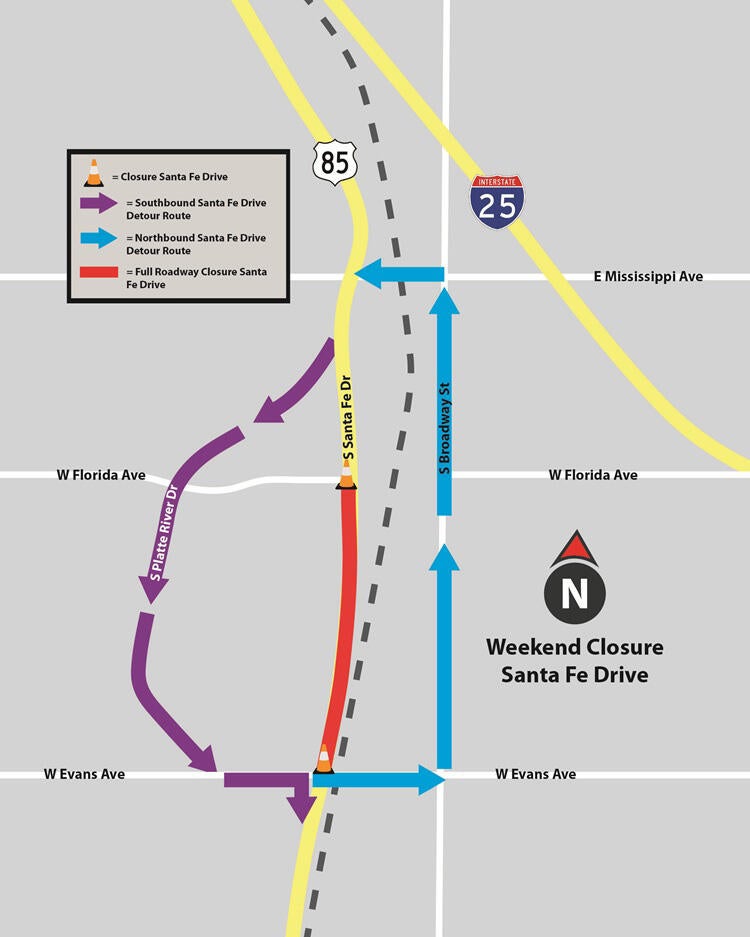
The Santa Fe Drive closure will begin at midnight on Saturday, July 11, and end on Monday, July 13, at 5 a.m. There will be detours in place. This includes:
- Southbound Santa Fe Drive Detour: Traffic will be routed to Platte River Drive to reenter southbound Santa Fe Drive at the West Evans Avenue on-ramp.
- Northbound Santa Fe Drive Detour: Access to northbound Santa Fe Drive will be at Mississippi Avenue via South Broadway Street.
- On-Ramp Closure: The West Evans Avenue on-ramp to northbound Santa Fe Drive will close at noon on Friday, July 10, to prepare for the full weekend closure and will remain closed until 5 a.m. on Monday, July 13. Traffic will be detoured to South Broadway Street to re-enter northbound Santa Fe Drive via Mississippi Avenue.
- Off-Ramp Closure: The southbound Santa Fe Drive off-ramp to West Evans Avenue will close for the full weekend period and remain closed until Friday, Sept. 11, while crews build new sidewalks and perform other concrete work at the southwest corner of the project. Detours will be posted to West Florida Avenue, West Dartmouth Avenue or West Hampden Avenue to bypass the ramp closure
During this closure, DOTI will reopen the underpass on Iowa Avenue. This is a new ADA accessible pathway that will be available between Santa Fe Drive and Acoma Street.

DENVER (KDVR) — Two officers, one now formerly of the Denver Police Department, face multiple charges relating to separate incidents in the past two months.
According to a release, now-former Denver Police Officer Gabriel Lucero was issued a citation for third-degree assault, official misconduct and false reporting, while Officer Javon Leach was cited for reckless driving and eluding.
The incident involving Lucero reportedly occurred on May 22 just before 1 a.m. in the 500 block of 16th Street. According to a release, Lucero was involved in an assault at a business, as he allegedly assaulted a person and walked away as others continued to assault the victim.
Security guards and an off-duty officer escorted him and the group out; however, Lucero reportedly identified himself as a Denver police officer and attempted to re-enter by using his police badge.
Lucero reportedly provided a false name without any other information, and further investigation verified Lucero as the person involved. Lucero was hired in 2025 and, due to his current probationary status, was fired as of Wednesday.
The incident involving Leach occurred around 1:41 a.m. on June 21, when Leach was reportedly pulling out of a parking lot on Larimer Street, attempting to drive against traffic.
Leach reportedly refused commands to stop as he left the area. Officials said he was found just seven minutes later, traveling at high speeds northbound on Park Avenue West.
He reportedly fled a traffic stop and continued to drive away, and officials deemed Leach to be the suspect following an investigation. He was placed in an off-line assignment while the case progresses, as they are considered misdemeanors.
“The Denver Police Department’s administrative review of Leach’s incident will begin once the criminal case is adjudicated, and that process includes the Denver Department of Safety and the Office of the Independent Monitor, a civilian oversight agency,” the release said.
-

 Michigan4 minutes ago
How two Michigan stamping plants power Stellantis turnaround plan
-

 Massachusetts11 minutes ago
3 hospitalized after vehicle crashes into Danvers business
-

 Minnesota14 minutes ago
Minnesota voter registration review finds county record errors
-

 Mississippi19 minutes ago
Mississippi Highway Patrol deployed to Goodman after viral gun video, leaders explain goals
-
Missouri26 minutes ago
Missouri Lottery Pick 3, Pick 4 winning numbers for July 9, 2026
-
Montana29 minutes ago
Montana Lottery Big Sky Bonus, Millionaire for Life results for July 9, 2026
-

 Nebraska34 minutes ago
HealthierU offers small group training for staff
-
 Nevada41 minutes ago
Nevada bystanders pull crash victim from burning motorhome on I-15 near Mesquite

