Denver, CO
Worries mount over fate of Denver’s Grande Dame, the Brown Palace Hotel: “It is in a free fall now”


For decades, nothing epitomized the highest tier of hospitality in Denver more than The Brown Palace Hotel & Spa.
It served as the landing spot for U.S. presidents and celebrities when they came into town, and a gathering place for local movers and shakers cutting deals over power lunches at Ellyngton’s, cocktails at the Ship Tavern or cigars at Churchill Bar.
Generations of Coloradans celebrated proms, weddings and honeymoons there, enjoyed holiday dinners together at its restaurants or sipped tea under the soaring atrium with their aunts, moms and grandmas. Like clockwork every January, the hotel hosted auctions for the top steers selected at the National Western Stock Show.
In a city best known for beer, the Brown Palace represented champagne.
Former employees, however, are worried that the iconic property is on a downward spiral under its current owner, Crescent Real Estate LLC and management company, HEI Hotels & Resorts.
“The hotel is dying a tragic, slow death. It is already well along in that process. It would be like walking into grandma’s house and seeing her with bruises and skinny and no food in the fridge,” said Adrian Kley, a former bellman and concierge who left the hotel in March.
A basement chimney fire knocked the hotel’s boilers, a known problem area, out of commission in November 2022. A lack of heat and hot water closed the place during the busy Thanksgiving week. Maintenance crews switched to city steam, but the boilers still haven’t been replaced, resulting in complaints about low water pressure, fluctuating water temperatures and in some cases no hot water.
Not long after the boilers went down, a pipe on the sixth floor burst flooding a dozen rooms, a second-floor meeting room and Ellyngton’s, the hotel’s largest restaurant, said Jordan Saunders, the hotel’s former food and beverage manager.
The restaurant was temporarily relocated to the second floor, and more than a year passed before the original space was repaired, remodeled and reopened. Long-time patrons complained about the outcome, saying it converted a location known for its rich color palette and warmth into something more akin to a hospital cafeteria — cold, white and sterile, Saunders said.
A damaged front door required customized repairs and allowed cold winter air to infiltrate the lobby for weeks. Another broken pipe flooded the ballroom, which is in a nearby sister tower that operates as a Holiday Inn.
Missteps have continued into this year. Discounted room rates of below $100 a night were designed to boost occupancy, but also resulted in a rise in drunken and disruptive guests, Kley said.
To cut costs, HEI made moves in March that resulted in the departure of several longtime bellmen and valets who greeted guests and contributed to the hotel’s high service levels.
Management also reduced security staff shifts, said Melanie Burrow, former director of operations at The Brown Palace. More people experiencing homelessness entering the hotel and fentanyl contamination showed up in lobby bathrooms, she said.
Hotel management announced the Palace Arms, which had been operating for 74 years, would close on May 4, only to reverse course after a public outcry and brought back a limited weekend schedule. Employees who worked at the restaurant faced whiplash.
“It was heartbreaking to see how badly the building and the people were treated by the current management company and ownership,” Burrow said. “The hotel has been declining for a number of years, but it is in a free fall now.”
A storied history, an uncertain future
Henry Cordes Brown, an Ohio businessman and builder, opened the hotel in 1892 at a then-princely sum of $2 million, the equivalent of $69 million today.
It occupies a triangle at the intersections of Broadway, Tremont and 17th streets, and its red sandstone exterior and Italian Renaissance design set it apart from nearby high rises.

As other hotels in the area and other buildings fell one by one, The Brown, at 321 17th St., remained standing.
By Denver standards, The Brown is old. Yet deterioration is a constant battle in old buildings and can be held at bay, former employees said, provided owners are committed to reserving money and making the required upgrades.
Viewing a historic icon as a short-term financial investment has put the hotel on a path of alienating a loyal customer base, and disrupted the hotel’s winning formula, said Jack Johnson, formerly the chef concierge at the hotel.
By diminishing the guest experience and not adequately investing in the building, and by lacking a long-term vision, Crescent will undercut the value of its investment, creating a lose-lose proposition for everyone, he warned.
When Crescent purchased the Brown Palace Hotel in June 2018, it pledged it would usher in a “new era of luxury and refinement for the iconic property,” according to the press release at the time.
“Crescent plans comprehensive investments that will enhance the property’s 241 exquisite guest rooms and Top of the Brown suites,” the company said.
Founded by John Goff, the company has set aside about $65 million to upgrade two hotels it owns in Dallas’s Uptown neighborhood — the Ritz-Carlton Dallas and the Hotel Crescent Court, according to The Real Deal.
That indicates that Crescent understands the importance of upgrading the older hotels it owns. And Jana Smith, the general manager of The Brown Palace, disputes criticisms that Crescent and HEI have not invested adequately in The Brown Palace or in its staffing.
“Crescent has made improvements since the purchase of the hotel, including renovating premium apartment-like guest rooms, offering an elevated experience on our top floors for our discerning travelers,” Smith said.
The hotel, part of Mariott’s Autograph collection since 2012, has turned a meeting room into a club lounge, renovated Ellyngton’s restaurant, refreshed the Palace Arms and done infrastructure work on the major mechanical systems, Smith said.
And plans are in the works for an upgrade of the Atrium Lobby, one of the hotel’s most distinctive features.
Former employees counter that the hotel’s previous owner had already made plans for the suite upgrades that Crescent followed through on. The Ellyngton’s renovation occurred because of the flooding from a broken pipe after plumbing, HVAC and other critical systems were neglected.
Crescent Real Estate is no stranger to Colorado, but its primary focus here and elsewhere has been on office buildings — including the Riverpoint, Riverview and Platte Fifteen office buildings in Denver. The Brown wasn’t its first hotel, but it represented a level of luxury it and HEI weren’t accustomed to, Johnson said.
Things came to a head in March, former employees said, when HEI tried to squeeze out money for repairs by reducing overhead. Among the cost-cutting moves was handing over valet and door services, which helped set the property apart and had been handled by employees with decades of experience, to an outside provider.
Although workers were offered positions at the other firm, the benefits were less and switching would require going for a month without health insurance coverage, a nonstarter for older workers, Kley said.
Smith disputes claims that The Brown has drastically cut its staffing level. In 2019, The Brown had 273 employees and today it has 254 positions, both filled and available. That lower headcount reflects the hit the hotel, like so many others, suffered during the pandemic, when travel ground to a halt.
“This is relatively minor given the market impact since 2020 and our goal is to get back to 273 plus,” she said.
Falling stars a bad omen
“The first day after (Crescent Real Estate) took over, they wheel us into a meeting room and say: ‘You no longer work for a hospitality company, you now work for a real estate company.’ My heart sank. A lot of us thought but how bad could it get?” Johnson said.
The answer wasn’t long in coming. The Forbes Travel Guide stripped The Brown Palace of its coveted four-star rating in 2020, a designation it had held since 1958, when it became the first Colorado hotel to receive it from Mobil, which originated the rankings, Johnson said.
“The Brown Palace is a (AAA) four-diamond hotel, and after the pandemic, we did not pursue a rating with Forbes since our TripAdvisor and Google ratings are both 4.5 stars which are ratings given by our guests; we believe this feedback is the most critical to our success,” Smith said.
TripAdvisor reviewers do give the hotel an average rating of 4.5, and numerous glowing reviews praise the hotel’s courteous employees, its beautiful design and rich history and the overall experience of staying there.
Where TripAdvisor ranks the hotel overall based on those reviews tells a different story. The Brown comes in 52nd out of 162 hotels in the metro area. Among luxury hotels, a much smaller category that it once dominated, it ranks ninth behind the likes of Halcyon, Four Seasons, the Crawford Hotel and Le Meridien.
U.S. News & World Report ranks the Brown Palace as 12th best hotel in Denver, 26th best in Colorado and 633rd best in the U.S.

Helen H. Richardson, The Denver Post
A nearby skyscraper is reflected in the window of the famous Brown Palace hotel in downtown Denver on July 25, 2017 in Denver, Colorado. (Photo by Helen H. Richardson/The Denver Post)
Critical reviews are spread among the more complimentary ones on TripAdvisor. A sampling of some more recent and scathing comments:
• “I’ve stayed at other hotels for a fraction of the price with a million times better experience. For a ‘luxury’ hotel that costs several hundred dollars a night, a warm shower in a clean bathroom with edible room service food should be the bare minimum and the Brown Palace simply didn’t deliver.” — Vivian P., a guest from Plano, Texas.
• “This grand old hotel has fallen into disrepair. We’ve stayed at The Brown Palace for decades when visiting Denver, it’s lost its charm. The lobby is of course spectacular but it stops there. The room was awful. Chipped furniture, glass surfaces smeared, woodwork chipped and marked up, horrible bed, no water in the room, the air conditioning was abysmal, lukewarm at best. Very, very sad to see this beautiful old (lady) no longer treated with care and respect. It’s a real shame.” — yoginiok from Tulsa, OK
President Dwight Eisenhower made the Brown Palace his western campaign headquarters. The Beatles stayed there when they played their first concert in Colorado. It was among the locations where global leaders gathered for the G-8 Summit in 1997. And the Denver Broncos football team — that came together in the hotel’s lobby.
Have no doubts, Johnson said, The Brown Palace is no longer Denver’s top hotel.
“That star designation is a big thing on the luxury level. It is your identity to quality,” he said. “If you don’t care about it, you won’t get it. They didn’t care enough to try and meet the standards.”
Tough times in a tough neighborhood
Hospitality industry analysts looking in from the outside offer a slightly different take than front-line employees, saying that historic hotels and restaurants in downtown areas were among the hardest hit by the chaos the pandemic unleashed in 2020.
Business travel evaporated for months, cutting into a key revenue source for downtown properties. Remote work resulted in fewer office workers in the area and smaller crowds showing up for lunch or staying for drinks after work, said John Imbergamo, president of The Imbergamo Group and a long-time marketing consultant to restaurants.
The George Floyd protests in the summer of 2020 created a perception that downtown wasn’t safe, especially among older adults more likely to visit The Brown. The seemingly never-ending redevelopment of the 16th Street Mall has tested the staying power of numerous businesses in the area. It will be an improvement, but for now, it has made downtown a harder place to navigate.
Gravity in the downtown area has also shifted west to LoDo, the Central Platte Valley and RiverNorth. The Brown, once at the center of the action, increasingly finds itself at the periphery.
A loss of identity also appears to be at play. Johnson said the luxury hotel niche is a demanding space, but one that The Brown excelled at for years. By moving the hotel away from luxury toward more of a full-service model, the competition has expanded from about a half dozen serious rivals to more than 100. Standing out will be harder.
“In this type of hotel with such a deep-seated connection to the community and frequent guests, they will need to bring it back to prior service levels,” said Allison Ahrens, president of Hospitality Revenue Solutions in Denver.
There are examples of how that can be done. Although smaller and a year older than The Brown Palace, the Oxford Hotel near Union Station has invested consistently in upgrades and the guest experience, allowing it to remain a popular destination.
Its art-deco Cruise Room Bar, which opened on the day Prohibition ended in 1933, has crossed generational boundaries to become a destination in its own right.
The Crawford Hotel, carved from the marrow of the upper floors of Union Station, which is older than both the Oxford and Brown, now surpasses The Brown Palace on TripAdvisor rankings.
Ed Blair, area general manager for the Sage Hospitality Group, shows off one of the loft rooms inside the Crawford Hotel at Union Station in Denver on July 8, 2024. (Photo by Helen H. Richardson/The Denver Post)Despite being only a decade old, the Crawford underwent an $11 million upgrade earlier this year funded by the Union Station Alliance.
Being up there in age and being located downtown isn’t synonymous with failure, Imbergamo said. A lot of boutique hotels with popular restaurants have sprung up in recent years, proving that a market exists for a retro vibe.

A describable vibe was in short supply on a stay at The Brown Palace in late July. One person manned the main door, another the concierge desk and a third worked the front desk, where there was no line to check-in in the evening. No cookies or snacks were offered, only water in a plastic bottle.
Cocktails and music in the atrium lobby were advertised but not provided.
If security was present, they were as invisible as the “friendly” ghosts that supposedly haunt the hotel.
The room was clean but showing its age. Fixtures were worn aside from a newer LG television. Hot water took about two minutes to show up, but it did show up and the pressure was adequate. Unlike what another guest complained about while riding the elevator, which worked fine, the toilet didn’t back up.
“It doesn’t matter how much investment comes back into that property, the damage from the neglect is incalculable,” Kley lamented. “HEI steps over dollars to pick up dimes. They don’t want the money that comes with providing service.”
Kley said he heard from numerous regulars in his three years there who had finally suffered enough disappointment that they weren’t coming back.
“I saw the final straw for people who had a relationship with that building since they were children,” he said. When the bellmen and valets they respected were put in a tough spot, he and Johnson decided they had reached a final straw and resigned.
Employees kept hoping that Crescent would realize it had overpaid and wouldn’t obtain the return it had wished for. They hoped it would throw in the towel and sell before too much damage was done, Johnson said. They kept giving their best effort to preserve the hotel’s reputation.
If a hotel has “good bones” it can be rescued from poor management and underinvestment, said John Keeling, executive vice president at Valencia Hotels, which specializes in acquiring and refurbishing higher-end historic and luxury properties.
The Brown Palace still has people everywhere who love what she represents, Johnson said.
His hope is that one day the historic hotel will again be the toast of Denver.
Get more business news by signing up for our Economy Now newsletter.
Originally Published:



Denver, CO
Victor Marx wins GOP primary for Colorado governor, defeating veteran lawmaker after unorthodox campaign

Victor Marx, a first-time candidate and nonprofit leader with a controversial personal history that’s drawn intense scrutiny, has edged out his more establishment opponent and will be Colorado Republicans’ gubernatorial nominee in November.
The Associated Press called the race for Marx late Thursday afternoon, nearly nine days after polls closed. He led the runner-up, state Sen. Barb Kirkmeyer, 39.9% to 39.4%, with 99% of ballots counted, according to the AP.
Marx had taken his first narrow lead over Kirkmeyer the day after the June 30 primary, and though the race remained close, he never lost the advantage. While outstanding deficient and overseas ballots helped delay a final call on the race, those votes only served to expand Marx’s margin. He led by 2,524 votes at 5:30 p.m. Thursday, out of about 522,000 ballots cast.
State Rep. Scott Bottoms was a distant third, with 20.8% of the vote.
A veteran lawmaker and former Weld County commissioner, Kirkmeyer had jumped to an early advantage on the strength of early ballot returns. But as votes returned on Election Day began to filter in, her lead thinned and collapsed. Within 48 hours of polls closing, and with few ballots left to count in Kirkmeyer’s Front Range strongholds, her path to retake the lead had all but vanished.
Marx will next face Democratic Attorney General Phil Weiser in November. No Republican has been elected to the governor’s office in more than 20 years. Four months out, Weiser appears to be heavily favored to continue Democrats’ electoral dominance.
In an email to supporters after the race was called, Marx said he was humbled to be the nominee and that the victory was “the starting line.”
“My team and I have put together this special message that I want every Coloradan to hear — Republicans, independents, unaffiliated voters, and Democrats who are open to a better way,” he said. “Because what we’re building now is bigger than a primary victory.”
In a video, he appealed to Coloradans who are frustrated with the status quo and don’t think things can change — citing his victory as proof they can.
“Now Phil Weiser, he’s a smart fella — but he represents the current system, because he is part of it,” Marx said. “And that current system has made Colorado more expensive, less safe and harder for regular families to trust government.”
In a separate statement, Kirkmeyer said she was proud of the race that she had run and the “clear vision” she had laid out for the Republican Party here.
“While we came up short in what appears to be the closest Republican gubernatorial primary in Colorado history, I’m grateful for every voter who placed their trust in us,” she wrote.
Echoing the pledge she’d made before Election Day, she pointedly did not endorse Marx. She said only that she hoped voters “choose the path that is best for Colorado” in November.
Kirkmeyer also threw a final jab at Marx, who declined in late May to tell 9News how many people he’d killed as an adult.
Kirkmeyer wrote that, “for the record, I still haven’t killed anyone.”
First-time candidate shrugged off questions
Marx’s primary win is a remarkable result for the embattled Colorado GOP and for Marx, a former Marine, martial arts instructor and nonprofit leader whose extensive and much-scrutinized personal history had drawn national headlines. It’s also attracted sharp criticism from other Republicans.
In his video, Marx appealed to Republican primary voters, saying there was room in his campaign for those who supported his opponents.
Marx had entered the fray last fall with no political profile and no experience as a political candidate. But by the time voters began receiving ballots last month, he’d ridden an atypical — if thoroughly modern — campaign to fundraising dominance and front-runner status.
Kirkmeyer’s support largely flowed from northern Front Range counties, nudging her ahead initially. But Marx picked up bigger margins among Election Day voters — meaning those more conservative voters skeptical of mail-in balloting.
He also won ruby-red El Paso County while racking up smaller wins in rural counties and grabbing enough in the Front Range to edge Kirkmeyer.
Map: Where did the votes come from in the Colorado primary races for governor?
In a pitch reminiscent of President Donald Trump, the arch-dealmaker, Marx has cast himself as a solutions-focused negotiator disinterested in partisan squabbles. In 2003, he founded All Things Possible Ministries, a Christian nonprofit that has provided stuffed animals and trauma support to people. It has also done work in conflict areas in Syria and Iraq, where Marx primarily worked away from the front lines as a funder and facilitator.
By 2024, the nonprofit’s annual revenue had surpassed $7.5 million, and Marx has said the group — from which he has resigned — now primarily works to help law enforcement.
Despite his outsider status, Marx was considered the likely winner in the weeks before Election Day. His narrow victory, then, came as something of a surprise, and, on election night, he speculated that Bottoms — a conservative pastor from Colorado Springs — had pulled votes from him. In El Paso County, Bottoms earned more than 20,000 votes, or 24% of the county’s Republican total.
Though Marx out-raised and out-spent both Kirkmeyer and Bottoms, it was Kirkmeyer who had been perceived as the expected nominee when she entered the race last year. Marx had never run for office before, and the stories he’s told about his life — that he’d killed a man at age 7, been involved in “high-risk humanitarian” operations across the globe and could free people from demonic possession — drew intense scrutiny and national punchlines.
But he repeatedly shrugged off questions about his background and said he stood by all that he had said and written.
Through his personality-heavy, direct-to-voter campaign, he encouraged Colorado Republicans to shrug it off, too. He spent heavily on direct mailers, which provided a boost to both his fundraising and name recognition.
Marx eschewed policy discussions and skipped nearly every debate. When he did participate in one, he spent part of the event leaning on the lectern, with his dog at his feet. Rather than deliver a closing statement, he prayed.

Campaigning his own way
Though he leaned into his outsider status, the aw-shucks appeal belied a careful campaign shaped by Marx’s emergence from a political environment forged by Trump: He skipped one debate after a moderator pressed him about his background, and he held a rally instead; his campaign later highlighted how many more people attended the rally than the debate.
His media operation was led by a former Turning Points USA staffer, and his campaign touted its social media posts’ views at Marx’s watch party last week. He was comfortable as a podcast guest, regularly released videos of himself and repeatedly assured voters that he was no politician.
Though Marx had little backing — or trust — from institutional Republican forces, the PAC that supported his campaign was established by a former senior official from Gov. Bill Owens’ administration. Marx also was endorsed by U.S. Rep. Lauren Boebert, the most nationally visible Colorado Republican.
His approach proved to be enough for Colorado Republicans to back him. But his next task will be far harder.
In November, he will face a surging Weiser, who last week dismantled U.S. Sen. Michael Bennet on his way to the Democratic nomination. Weiser proved an adept fundraiser and campaigner with statewide appeal, and he will look to lead a restless Democratic base that elected progressive candidates up and down the ballot.
In a statement Thursday, Weiser said Marx’s “views and style are far out of step with Coloradans, and his nomination for governor is a threat to our state’s values and our future.”
Republicans’ last statewide win was in a University of Colorado at-large regent’s race in 2016. The state GOP has had four elected party chairs since the last Republican gubernatorial bid in 2022, which ended with a culture war-focused Heidi Ganahl — who had won that at-large regent seat — losing by nearly 20 percentage points to Gov. Jared Polis.
Simultaneously, Marx may also have to contend with an independent candidacy from Greg Lopez, a former Republican congressman and gubernatorial candidate who is gathering signatures to make the fall ballot.
Stay up-to-date with Colorado Politics by signing up for our weekly newsletter, The Spot.

If you use Santa Fe Drive as a part of your daily commute, you will notice full closures this weekend on a popular section, from Florida Avenue to Evans Avenue, for the installation of a pedestrian bridge.
Once the 370-foot pedestrian bridge is completed, it will connect the east and west portions of Denver’s Overland neighborhood. This bridge will be used by pedestrians and bicyclists.
The Denver Department of Transportation and Infrastructure says this closure is needed to keep the traveling public safe. Large cranes will be used to set the two spans in place. Each one weighs about 215,000 pounds and is 180 feet long.
Once the bridge is completed in 2027, it will create a safer connection for pedestrians and bicyclists. It will link neighborhoods to trails, transit, parks, and local businesses without requiring residents to cross heavy traffic.
“Our neighborhood is quartered by transportation routes, so having a safe pedestrian bridge that can take people from one side to the other is an amazing development that neighbors have been asking for for years,” Jenn Greiving, President, Overland Park Neighborhood Association, said.
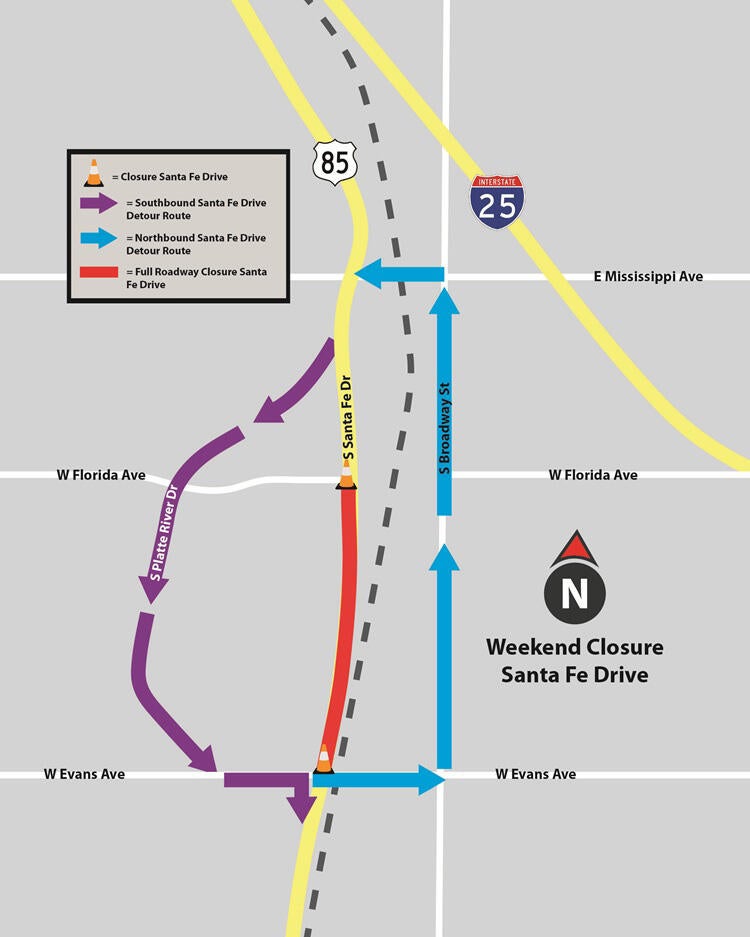
The Santa Fe Drive closure will begin at midnight on Saturday, July 11, and end on Monday, July 13, at 5 a.m. There will be detours in place. This includes:
- Southbound Santa Fe Drive Detour: Traffic will be routed to Platte River Drive to reenter southbound Santa Fe Drive at the West Evans Avenue on-ramp.
- Northbound Santa Fe Drive Detour: Access to northbound Santa Fe Drive will be at Mississippi Avenue via South Broadway Street.
- On-Ramp Closure: The West Evans Avenue on-ramp to northbound Santa Fe Drive will close at noon on Friday, July 10, to prepare for the full weekend closure and will remain closed until 5 a.m. on Monday, July 13. Traffic will be detoured to South Broadway Street to re-enter northbound Santa Fe Drive via Mississippi Avenue.
- Off-Ramp Closure: The southbound Santa Fe Drive off-ramp to West Evans Avenue will close for the full weekend period and remain closed until Friday, Sept. 11, while crews build new sidewalks and perform other concrete work at the southwest corner of the project. Detours will be posted to West Florida Avenue, West Dartmouth Avenue or West Hampden Avenue to bypass the ramp closure
During this closure, DOTI will reopen the underpass on Iowa Avenue. This is a new ADA accessible pathway that will be available between Santa Fe Drive and Acoma Street.

DENVER (KDVR) — Two officers, one now formerly of the Denver Police Department, face multiple charges relating to separate incidents in the past two months.
According to a release, now-former Denver Police Officer Gabriel Lucero was issued a citation for third-degree assault, official misconduct and false reporting, while Officer Javon Leach was cited for reckless driving and eluding.
The incident involving Lucero reportedly occurred on May 22 just before 1 a.m. in the 500 block of 16th Street. According to a release, Lucero was involved in an assault at a business, as he allegedly assaulted a person and walked away as others continued to assault the victim.
Security guards and an off-duty officer escorted him and the group out; however, Lucero reportedly identified himself as a Denver police officer and attempted to re-enter by using his police badge.
Lucero reportedly provided a false name without any other information, and further investigation verified Lucero as the person involved. Lucero was hired in 2025 and, due to his current probationary status, was fired as of Wednesday.
The incident involving Leach occurred around 1:41 a.m. on June 21, when Leach was reportedly pulling out of a parking lot on Larimer Street, attempting to drive against traffic.
Leach reportedly refused commands to stop as he left the area. Officials said he was found just seven minutes later, traveling at high speeds northbound on Park Avenue West.
He reportedly fled a traffic stop and continued to drive away, and officials deemed Leach to be the suspect following an investigation. He was placed in an off-line assignment while the case progresses, as they are considered misdemeanors.
“The Denver Police Department’s administrative review of Leach’s incident will begin once the criminal case is adjudicated, and that process includes the Denver Department of Safety and the Office of the Independent Monitor, a civilian oversight agency,” the release said.
-

 Connecticut4 minutes ago
Marian Katz Obituary
-

 Delaware7 minutes ago
DE health officials ‘on pins and needles’ after measles cases in PA
-

 Florida12 minutes ago
Florida man accused of driving drunk, causing head-on crash and seriously injuring 2
-

 Georgia19 minutes ago
Georgia cops’ alleged misuse of Flock license plate tracking data fuels privacy concerns
-

 Hawaii22 minutes ago
3 candidates to be considered for District 18 seat
-
 Idaho27 minutes ago
“We won’t insure you”: Robie Creek homeowners struggle to get home insurance due to wildfire risks
-

 Illinois34 minutes ago
After recent Illinois lightning strikes, officials share safety tips
-

 Indiana37 minutes ago
Kelsey Mitchell winner completes Fever comeback against Mercury, without Caitlin Clark

