Denver, CO
Real estate commissions, unassailable for decades, could crumble after landmark settlement


The National Association of Realtors announced Friday that it had reached a legal settlement that upends the traditional model of sellers paying for the buyer’s agent in a home purchase. The agreement has the potential to save home sellers billions of dollars every year, but could also complicate purchases for buyers.
The NAR, the largest trade group representing residential real estate agents, agreed to pay $418 million over four years to settle claims that the group and its members engaged in uncompetitive practices that forced sellers to compensate agents who brought buyers to the closing table.
“There are valid positions on both sides, and this is the way the game has been played,” said Mark Lee Levine, a professor at the Burns School of Real Estate and Construction Management at the University of Denver who has tracked the issue closely.
Starting in July, the game will be played differently. Buyers can no longer count on sellers paying the agents representing them, Levine said. On a $600,000 home, that could shift around $15,000 to $18,000 in typical commission costs back to the buyer.
Commissions on a home sale are, in theory, completely negotiable, but they typically run in the 5% to 6% range. How commissions get split can vary, but sellers almost always pay the buyer’s agent via what is known as a cooperative compensation model or co-op.
What a seller was willing to pay was communicated on the multiple-listing service or MLS controlled by local Realtor associations. If the compensation was too low or non-existent, buyer agents would pass on showing a home, plaintiffs in a case known as Sitzer-Burnett argued.
Listing the buyer agent compensation is now prohibited as part of the settlement. States must require buyers and their agents to enter into written agreements detailing compensation and what services are provided for it, something Colorado already requires.
Buyers still have the right to push for a lower commission, as was the case before. But if they know they are footing the bill, they may be much more motivated to do so.
“For far too long, home sellers have faced a system recognized by many as blatantly unfair. Individual sellers often feel powerless to negotiate a better deal for themselves given the risk that offering lower commissions will cause brokers to steer buyers to other properties,” Robert Braun, a partner in Cohen Milstein’s Antitrust practice, and one of the attorneys that led the case against NAR said in a statement.
Technology has lowered or eliminated commissions across wide parts of the economy, from stock brokerages to travel agencies. But they largely remained unassailable in real estate until a jury ruled against the industry last year. A series of settlements have followed that ruling.
Friday’s settlement resolves claims against NAR and its more than 1 million members, and against regional and local Realtor associations, including the Colorado Association of Realtors and the Denver Metro Association of Realtors. The settlement also shields brokerages run by a NAR member that did $2 billion or less in transactions in 2022 in the case, sparing them the cost of extensive litigation.
“We are pleased we have a solid path forward. We know how to move forward now. We are looking forward to going back and selling,” said Libby Levinson-Katz, head of DMAR’s Market Trends Committee.
Although the heavy weight of litigation in the Sitzer case has been lifted, what comes next is uncertain.
Will sellers and buyers, aided by cost-saving technology, push to lower some of the highest real estate transaction costs in the developed world? Will the real estate brokerage industry, already struggling from higher interest rates, suffer another steep drop in revenues, forcing tens of thousands of agents out of the field? Will buyers get a break via lower home prices to cover their added costs, or will sellers pocket the savings, leaving buyers in the lurch?
“NAR has worked hard for years to resolve this litigation in a manner that benefits our members and American consumers. It has always been our goal to preserve consumer choice and protect our members to the greatest extent possible. This settlement achieves both of those goals,” said Nykia Wright, NAR’s interim CEO in a release.
One by one large brokerage firms have settled in the case, the most recent being Keller Williams, which reached a $70 million agreement in February. HomeServices of America, whose brands include Berkshire Hathaway HomeServices and Kentwood Real Estate, remains a holdout.
Listing agents and buyer agents can still communicate directly about commissions and sellers can still pick up those costs. Sellers might do that if they think it will generate more interest in their listings or set them apart. But not every seller will agree, and a buyer may be set on owning that house.
That is where things get more complicated. The agreement a buyer has signed with the agent will then leave the bill for services rendered on the buyer’s table. Buyers, already stretched to come up with down payments and escrow costs, not to mention elevated home prices, may lack the funds, killing a deal. Or their agents might agree to take a smaller cut.
“We shouldn’t have been fighting over the commissions. We should have been fighting to serve our customers better,” said Bret Weinstein, founder of Guide Realty in Glendale.
Weinstein said becoming a real estate agent comes with a low bar of entry. Most who get in do a minimal number of transactions, if any, in a given year. And horror tales abound of unaware consumers in the hands of unskilled agents.
“It will shake up the industry,” he said of the changes coming. “One day there will be an exodus of people leaving.”
Buyer agents who remain will pursue different models, he predicted. One camp will offer high-level service from skilled negotiators who can justify their costs. That is one reason top-performing agents aren’t fearful of what comes next, he said.
At the other end will be agents offering a lower level of services in return for discounted commissions. Expect more technology firms to emerge that will try to automate the buying process or lower costs in other ways.
Levine offers another scenario, one where consumers continue to do the legwork in researching neighborhoods and finding a place through online resources. They negotiate terms or hire someone to do that. Then a real estate lawyer is brought in to handle the contract and closing. The costs would be lower and the approach might appeal to repeat buyers.
“As of July that co-op is going away. There is no guarantee that a buyer’s agent will get paid,” Weinstein said.
It will be a brave new word for consumers and the real estate industry alike.



If you use Santa Fe Drive as a part of your daily commute, you will notice full closures this weekend on a popular section, from Florida Avenue to Evans Avenue, for the installation of a pedestrian bridge.
Once the 370-foot pedestrian bridge is completed, it will connect the east and west portions of Denver’s Overland neighborhood. This bridge will be used by pedestrians and bicyclists.
The Denver Department of Transportation and Infrastructure says this closure is needed to keep the traveling public safe. Large cranes will be used to set the two spans in place. Each one weighs about 215,000 pounds and is 180 feet long.
Once the bridge is completed in 2027, it will create a safer connection for pedestrians and bicyclists. It will link neighborhoods to trails, transit, parks, and local businesses without requiring residents to cross heavy traffic.
“Our neighborhood is quartered by transportation routes, so having a safe pedestrian bridge that can take people from one side to the other is an amazing development that neighbors have been asking for for years,” Jenn Greiving, President, Overland Park Neighborhood Association, said.
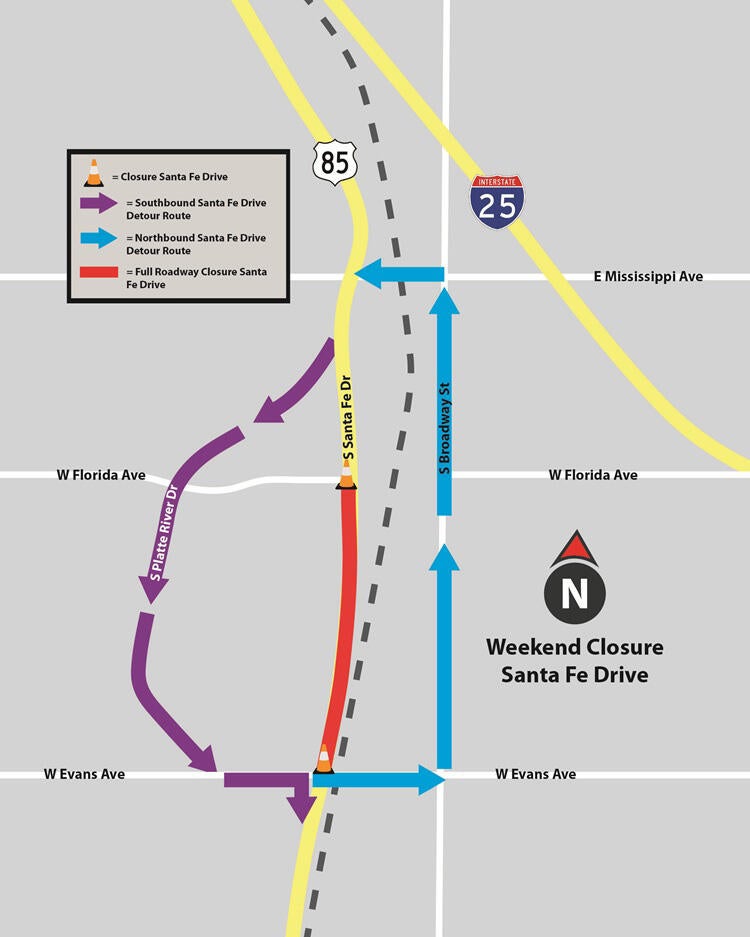
The Santa Fe Drive closure will begin at midnight on Saturday, July 11, and end on Monday, July 13, at 5 a.m. There will be detours in place. This includes:
- Southbound Santa Fe Drive Detour: Traffic will be routed to Platte River Drive to reenter southbound Santa Fe Drive at the West Evans Avenue on-ramp.
- Northbound Santa Fe Drive Detour: Access to northbound Santa Fe Drive will be at Mississippi Avenue via South Broadway Street.
- On-Ramp Closure: The West Evans Avenue on-ramp to northbound Santa Fe Drive will close at noon on Friday, July 10, to prepare for the full weekend closure and will remain closed until 5 a.m. on Monday, July 13. Traffic will be detoured to South Broadway Street to re-enter northbound Santa Fe Drive via Mississippi Avenue.
- Off-Ramp Closure: The southbound Santa Fe Drive off-ramp to West Evans Avenue will close for the full weekend period and remain closed until Friday, Sept. 11, while crews build new sidewalks and perform other concrete work at the southwest corner of the project. Detours will be posted to West Florida Avenue, West Dartmouth Avenue or West Hampden Avenue to bypass the ramp closure
During this closure, DOTI will reopen the underpass on Iowa Avenue. This is a new ADA accessible pathway that will be available between Santa Fe Drive and Acoma Street.

DENVER (KDVR) — Two officers, one now formerly of the Denver Police Department, face multiple charges relating to separate incidents in the past two months.
According to a release, now-former Denver Police Officer Gabriel Lucero was issued a citation for third-degree assault, official misconduct and false reporting, while Officer Javon Leach was cited for reckless driving and eluding.
The incident involving Lucero reportedly occurred on May 22 just before 1 a.m. in the 500 block of 16th Street. According to a release, Lucero was involved in an assault at a business, as he allegedly assaulted a person and walked away as others continued to assault the victim.
Security guards and an off-duty officer escorted him and the group out; however, Lucero reportedly identified himself as a Denver police officer and attempted to re-enter by using his police badge.
Lucero reportedly provided a false name without any other information, and further investigation verified Lucero as the person involved. Lucero was hired in 2025 and, due to his current probationary status, was fired as of Wednesday.
The incident involving Leach occurred around 1:41 a.m. on June 21, when Leach was reportedly pulling out of a parking lot on Larimer Street, attempting to drive against traffic.
Leach reportedly refused commands to stop as he left the area. Officials said he was found just seven minutes later, traveling at high speeds northbound on Park Avenue West.
He reportedly fled a traffic stop and continued to drive away, and officials deemed Leach to be the suspect following an investigation. He was placed in an off-line assignment while the case progresses, as they are considered misdemeanors.
“The Denver Police Department’s administrative review of Leach’s incident will begin once the criminal case is adjudicated, and that process includes the Denver Department of Safety and the Office of the Independent Monitor, a civilian oversight agency,” the release said.

Denver Nuggets standout forward Peyton Watson could find himself on another team before you know it.
With the Nuggets reportedly open to a sign-and-trade of Watson, could Denver really lose a core piece to their rotation?
It’s hard to imagine many teams being able to shoulder the financial weight of a Watson contract at this point because of the aprons and such, but he’s absolutely an asset to any contending team.
We’ve gone through and identified a few teams that make sense for Watson in the fall… including the one he’s already on at the moment. Hey, he might stay home, you never know!
The Clippers have been linked to Watson as a possible destination; he could help them immensely.
The Pistons have also been linked to Watson, which would help them a lot to contend for an NBA title.
Look, HYPOTHETICALLY, the Nets could move around some cap space with some player trades and such and get a deal done. They are one of the only teams in the NBA right now not in the negative with cap space.
The Grizzlies are the team with the least amount of negative cap space right now, per Spotrac. If they really wanted to pull off a Watson sign-and-trade… it would be hypothetically possible from a money standpoint.
Denver Nuggts
Look, it’s very possible Watson just stays in Denver on a brand-new deal. Who knows at this point?
-

 Detroit, MI8 minutes ago
Teen on moped hit by car after cruising through stop sign in Detroit
-

 San Francisco, CA16 minutes ago
Flight of fancy: San Francisco moves to build private luxury airport terminal
-

 Dallas, TX23 minutes ago
Dallas’ digital creator economy is booming. Burnout is too.
-
Miami, FL30 minutes ago
I went to 2 famous Miami restaurants, a flashy steakhouse and a Cuban hot spot. Here’s how they compared.
-

 Boston, MA33 minutes ago
Pedestrian struck and killed in Roxbury – Boston News, Weather, Sports | WHDH 7News
-

 Denver, CO38 minutes ago
Santa Fe Drive in Denver closed this weekend for pedestrian bridge construction
-

 Seattle, WA45 minutes ago
Police video shows West Seattle Bridge copper wire theft suspect’s arrest
-

 San Diego, CA48 minutes ago
Opinion: More apartments eased rents. Townhomes could aid buyers.


