Denver, CO
Colorado lawmakers end session with camaraderie, finalizing property tax reform — though not all is resolved


Unlike last year, the end of the Colorado legislative session Wednesday came with no fireworks — no protest walkouts, no intracaucus tensions boiling over into public, no last-minute implosions of keystone policy bills.
The final day of lawmakers’ nearly four-month session instead was dominated by noticeably brighter spirits as the General Assembly put the finishing touches on a slew of legislation that had dominated the final weeks. Notable bills touched on tax credits, property tax reform, gun restrictions and major land use changes that will shape the state for years and, supporters hope, decades to come.
Contentious housing bills that died or were vetoed last year were brought back, in varying forms, and passed. Lawmakers and the governor struck grand bargains to defuse ballot measures. And Democrats have settled into a now-familiar — if not consistently united — seat at the head of the legislative table.
Some of the last proposals to cross the finish line on the final day — which ended with the Senate’s adjournment just before 8 p.m., before dark — included an income tax credit for Colorado families with household incomes under $90,000, to cover up to two years of tuition and fees at in-state public universities, colleges and technical schools; a bipartisan bill to remake the public school finance system; a series of tax reforms that include a tax credit of up to $3,200 for dependent children, scaling down as family income increases, as children age and if state revenue growth slows down; and an income tax reduction of $450 million this year.
When the legislature convened in January, it was with a palpable sense of dread. Lawmakers, lobbyists and observers feared the session would reflect the angst and tension that marred last year’s regular and special meetings of the General Assembly.
Instead, the session unfolded largely as a casual observer would’ve expected.
Where tensions did rise, they did so mostly within standard — though at times still pointed — etiquette under the Gold Dome, even if public exchanges between lawmakers outside the building’s marble halls sometimes descended into personal attacks.
Sen. Dylan Roberts, speaking Wednesday about a compromise on a bill penalizing gun owners who don’t secure handguns left in vehicles, lamented “disrespectful” comments made in the House about an amendment from his chamber. But the Frisco Democrat ended on a simple request to “disagree better.”
Flare-ups still emerged. The House’s Democratic leadership implemented new protocols to limit what they considered offensive speech on the floor. Some House Republicans repeatedly castigated their Democratic colleagues on social media as supporting pedophiles and criminals, based on votes opposing various GOP-backed bills.
Those comments contributed to a tense meeting between Democratic lawmakers and their leadership last week, with legislators demanding that leaders do more to address attacks online.
But by the last day of the session on Wednesday, most of the session-defining measures had already been resolved — with largely perfunctory agreements and votes remaining.
The Senate and House had already hammered out differences on a bill supported by Gov. Jared Polis that, once signed, will promote denser development along transit corridors. They avoided the last-day drama of last year, when an omnibus land use bill died at the 11th hour because of irreconcilable differences between the chambers, both led by large Democratic majorities.
A proposal to ban the sale and transfer of certain high-powered, semiautomatic firearms — which had hung heavy over the final weeks amid Democratic division over how much to embrace the policy — was tabled peacefully on the penultimate day. Backers pledged to continue that fight in future years.
Meanwhile, a slew of other gun bills, some intended to improve enforcement of existing laws, passed against strong Republican opposition, but without extraordinary incidents.
Most of Wednesday was dominated by tributes to departing members, a steak cook-off in the House and the Capitol’s version of spring cleaning. A Colorado Politics reporter played the harp on the House floor. Lawmakers showed parody videos on the projector screens on the House’s walls.
Perhaps the highest point of drama wasn’t focused inside the Capitol at all.
A bipartisan bill to reshape state property tax policy was subject to months of wrangling before being introduced the Monday before the session’s end — this week. Shortly after the bill was unveiled, lawmakers were taken by surprise when a prominent business group, Colorado Concern, announced its opposition and refused to pull back from its support for two tax-related ballot initiatives that Republicans and Democrats alike warn would devastate the state budget if voters approve them this fall.
Sponsors of the proposal, Senate Bill 233, said they had been trying to find a middle ground with Colorado Concern, in exchange for the group dropping its support for the ballot initiatives. The bill, now heading to Polis for his signature, would make adjustments in property tax calculations to save homeowners potentially a few hundred dollars compared to projected increases under current law, while also reducing tax rates for commercial properties. But the ballot measures are aimed at more drastic changes.
By mid-afternoon Wednesday, sponsors said those negotiations had broken down. It also didn’t escape notice that representatives of Colorado Concern had not shown up to testify publicly on the measure.

“I will note there are some organizations conspicuously absent today who did not choose to come to testify and share their opinion about the bill — and what they would like to see or not see changed,” said Rep. Emily Sirota, a Denver Democrat, as a public hearing on the bill wrapped up Tuesday. “That, to me, is pretty disappointing, because that is how the work is done. It is done in the light of day, in front of everyone.”
Senate President Steve Fenberg, a Boulder Democrat, said to reporters Tuesday morning, about Colorado Concern: “To me, they are not taking actions that would increase their relevance in this building.”
The ballot measures, one of which has been approved for the ballot already, still threaten to complicate state lawmakers’ work in coming months.
But as the session wound down on its final day, geniality underscored the often-contentious atmosphere inside the building. The House had finished with the bulk of its work, and, as the Senate entered its seventh hour of tributes for departing members, a pack of restless representatives wandered over with handwritten signs to send their colleagues a final message:
Get back to work.
Sen. Rachel Zenzinger, herself a term-limited Democrat, and Sen. Barbara Kirkmeyer, a Republican, waved them off so that the goodbyes could continue at their own pace.
Stay up-to-date with Colorado Politics by signing up for our weekly newsletter, The Spot.



DENVER — Denver Mayor Mike Johnston is launching a $100 million plan to boost the local economy and support 10,000 jobs over the next three years.
Johnston announced the four-part program Thursday morning, flanked by business leaders while praising downtown businesses like brunch eatery Snooze.
▶️ WATCH: Denver7’s Alex Dowd reports on the plan
Denver mayor promises to create 10K jobs in next 3 years
Snooze Co-Founder Adam Schlegel said his business benefited from a similar program when U.S. Sen. John Hickenlooper was mayor in the early 2000s.
“The city really was the one that stepped up,” Schlegel said. “We wouldn’t have started if it wouldn’t have been for the economic development office. We ended up getting an incentive from the city to open up, particularly in this space [downtown]. It was a fiscal incentive to do it, in addition to coaching.”
Both of those are offered in the new four-part Denver Jobs Agenda. With funding from the Denver Downtown Development Authority and the Office of Economic Development and Opportunity, Johnston aims to develop start-ups in the city, grow existing businesses and draw in new companies while working to advance the Denver-area workforce across industries.
At the end of the last fiscal quarter, Denver’s unemployment rate hovered around 3.6% — under the national rate of 4.2% — according to U.S. Bureau of Labor Statistics, while office vacancy sits just under 40%, according to commercial real estate broker CBRE.
Johnston and other speakers made multiple references to more jobs bringing more people downtown.
“Denver has so many things going for it, so it will come back,” Schlegel said. “It’s not coming back as fast as I want, or as much as anyone will, but will it have a long-term future? 100%. It’s things like this, though, that I think give us a lot of hope that it can happen sooner than waiting it out.”
▶️ Watch the full press conference
Press conference: Denver mayor announces Denver Jobs Agenda
Chris Berthiaume, the city’s director of workforce industry initiatives, says the three workforce development centers across Denver serve around 20,000 people each year. He’s confident this new initiative will help more of those visitors find employment.
“We want to focus on things like aerospace, cybersecurity, green construction,” Berthiaume said. “This new initiative really just tightens the focus on sectors that we know are growing. Colorado is home to a huge aerospace culture. Quantum technology is emerging and coming. Green workforce are jobs that we know drive around Denver. Construction is everywhere. We need to make sure we have a skilled workforce that’s ready to take on those jobs.”
While also finding employers to hire them and stay within the community for the long haul.
“I think the reason businesses work — certainly restaurants work — is that you are integral to the community specifically where you are,” Schlegel said. “There are so many people in our community that really believe in Denver and want to see what it can be, and so it will get there.”
It’s well on the way. Denver’s Economic Development Corporation says they’re working with 52 active prospects that could bring more than 12,000 jobs to the area.
Coloradans making a difference | Denver7 featured videos
Denver7 is committed to making a difference in our community by standing up for what’s right, listening, lending a helping hand and following through on promises. See that work in action, in the videos above.
Denver, CO
Victor Marx wins GOP primary for Colorado governor, defeating veteran lawmaker after unorthodox campaign

Victor Marx, a first-time candidate and nonprofit leader with a controversial personal history that’s drawn intense scrutiny, has edged out his more establishment opponent and will be Colorado Republicans’ gubernatorial nominee in November.
The Associated Press called the race for Marx late Thursday afternoon, nearly nine days after polls closed. He led the runner-up, state Sen. Barb Kirkmeyer, 39.9% to 39.4%, with 99% of ballots counted, according to the AP.
Marx had taken his first narrow lead over Kirkmeyer the day after the June 30 primary, and though the race remained close, he never lost the advantage. While outstanding deficient and overseas ballots helped delay a final call on the race, those votes only served to expand Marx’s margin. He led by 2,524 votes at 5:30 p.m. Thursday, out of about 522,000 ballots cast.
State Rep. Scott Bottoms was a distant third, with 20.8% of the vote.
A veteran lawmaker and former Weld County commissioner, Kirkmeyer had jumped to an early advantage on the strength of early ballot returns. But as votes returned on Election Day began to filter in, her lead thinned and collapsed. Within 48 hours of polls closing, and with few ballots left to count in Kirkmeyer’s Front Range strongholds, her path to retake the lead had all but vanished.
Marx will next face Democratic Attorney General Phil Weiser in November. No Republican has been elected to the governor’s office in more than 20 years. Four months out, Weiser appears to be heavily favored to continue Democrats’ electoral dominance.
In an email to supporters after the race was called, Marx said he was humbled to be the nominee and that the victory was “the starting line.”
“My team and I have put together this special message that I want every Coloradan to hear — Republicans, independents, unaffiliated voters, and Democrats who are open to a better way,” he said. “Because what we’re building now is bigger than a primary victory.”
In a video, he appealed to Coloradans who are frustrated with the status quo and don’t think things can change — citing his victory as proof they can.
“Now Phil Weiser, he’s a smart fella — but he represents the current system, because he is part of it,” Marx said. “And that current system has made Colorado more expensive, less safe and harder for regular families to trust government.”
In a separate statement, Kirkmeyer said she was proud of the race that she had run and the “clear vision” she had laid out for the Republican Party here.
“While we came up short in what appears to be the closest Republican gubernatorial primary in Colorado history, I’m grateful for every voter who placed their trust in us,” she wrote.
Echoing the pledge she’d made before Election Day, she pointedly did not endorse Marx. She said only that she hoped voters “choose the path that is best for Colorado” in November.
Kirkmeyer also threw a final jab at Marx, who declined in late May to tell 9News how many people he’d killed as an adult.
Kirkmeyer wrote that, “for the record, I still haven’t killed anyone.”
First-time candidate shrugged off questions
Marx’s primary win is a remarkable result for the embattled Colorado GOP and for Marx, a former Marine, martial arts instructor and nonprofit leader whose extensive and much-scrutinized personal history had drawn national headlines. It’s also attracted sharp criticism from other Republicans.
In his video, Marx appealed to Republican primary voters, saying there was room in his campaign for those who supported his opponents.
Marx had entered the fray last fall with no political profile and no experience as a political candidate. But by the time voters began receiving ballots last month, he’d ridden an atypical — if thoroughly modern — campaign to fundraising dominance and front-runner status.
Kirkmeyer’s support largely flowed from northern Front Range counties, nudging her ahead initially. But Marx picked up bigger margins among Election Day voters — meaning those more conservative voters skeptical of mail-in balloting.
He also won ruby-red El Paso County while racking up smaller wins in rural counties and grabbing enough in the Front Range to edge Kirkmeyer.
Map: Where did the votes come from in the Colorado primary races for governor?
In a pitch reminiscent of President Donald Trump, the arch-dealmaker, Marx has cast himself as a solutions-focused negotiator disinterested in partisan squabbles. In 2003, he founded All Things Possible Ministries, a Christian nonprofit that has provided stuffed animals and trauma support to people. It has also done work in conflict areas in Syria and Iraq, where Marx primarily worked away from the front lines as a funder and facilitator.
By 2024, the nonprofit’s annual revenue had surpassed $7.5 million, and Marx has said the group — from which he has resigned — now primarily works to help law enforcement.
Despite his outsider status, Marx was considered the likely winner in the weeks before Election Day. His narrow victory, then, came as something of a surprise, and, on election night, he speculated that Bottoms — a conservative pastor from Colorado Springs — had pulled votes from him. In El Paso County, Bottoms earned more than 20,000 votes, or 24% of the county’s Republican total.
Though Marx out-raised and out-spent both Kirkmeyer and Bottoms, it was Kirkmeyer who had been perceived as the expected nominee when she entered the race last year. Marx had never run for office before, and the stories he’s told about his life — that he’d killed a man at age 7, been involved in “high-risk humanitarian” operations across the globe and could free people from demonic possession — drew intense scrutiny and national punchlines.
But he repeatedly shrugged off questions about his background and said he stood by all that he had said and written.
Through his personality-heavy, direct-to-voter campaign, he encouraged Colorado Republicans to shrug it off, too. He spent heavily on direct mailers, which provided a boost to both his fundraising and name recognition.
Marx eschewed policy discussions and skipped nearly every debate. When he did participate in one, he spent part of the event leaning on the lectern, with his dog at his feet. Rather than deliver a closing statement, he prayed.

Campaigning his own way
Though he leaned into his outsider status, the aw-shucks appeal belied a careful campaign shaped by Marx’s emergence from a political environment forged by Trump: He skipped one debate after a moderator pressed him about his background, and he held a rally instead; his campaign later highlighted how many more people attended the rally than the debate.
His media operation was led by a former Turning Points USA staffer, and his campaign touted its social media posts’ views at Marx’s watch party last week. He was comfortable as a podcast guest, regularly released videos of himself and repeatedly assured voters that he was no politician.
Though Marx had little backing — or trust — from institutional Republican forces, the PAC that supported his campaign was established by a former senior official from Gov. Bill Owens’ administration. Marx also was endorsed by U.S. Rep. Lauren Boebert, the most nationally visible Colorado Republican.
His approach proved to be enough for Colorado Republicans to back him. But his next task will be far harder.
In November, he will face a surging Weiser, who last week dismantled U.S. Sen. Michael Bennet on his way to the Democratic nomination. Weiser proved an adept fundraiser and campaigner with statewide appeal, and he will look to lead a restless Democratic base that elected progressive candidates up and down the ballot.
In a statement Thursday, Weiser said Marx’s “views and style are far out of step with Coloradans, and his nomination for governor is a threat to our state’s values and our future.”
Republicans’ last statewide win was in a University of Colorado at-large regent’s race in 2016. The state GOP has had four elected party chairs since the last Republican gubernatorial bid in 2022, which ended with a culture war-focused Heidi Ganahl — who had won that at-large regent seat — losing by nearly 20 percentage points to Gov. Jared Polis.
Simultaneously, Marx may also have to contend with an independent candidacy from Greg Lopez, a former Republican congressman and gubernatorial candidate who is gathering signatures to make the fall ballot.
Stay up-to-date with Colorado Politics by signing up for our weekly newsletter, The Spot.

If you use Santa Fe Drive as a part of your daily commute, you will notice full closures this weekend on a popular section, from Florida Avenue to Evans Avenue, for the installation of a pedestrian bridge.
Once the 370-foot pedestrian bridge is completed, it will connect the east and west portions of Denver’s Overland neighborhood. This bridge will be used by pedestrians and bicyclists.
The Denver Department of Transportation and Infrastructure says this closure is needed to keep the traveling public safe. Large cranes will be used to set the two spans in place. Each one weighs about 215,000 pounds and is 180 feet long.
Once the bridge is completed in 2027, it will create a safer connection for pedestrians and bicyclists. It will link neighborhoods to trails, transit, parks, and local businesses without requiring residents to cross heavy traffic.
“Our neighborhood is quartered by transportation routes, so having a safe pedestrian bridge that can take people from one side to the other is an amazing development that neighbors have been asking for for years,” Jenn Greiving, President, Overland Park Neighborhood Association, said.
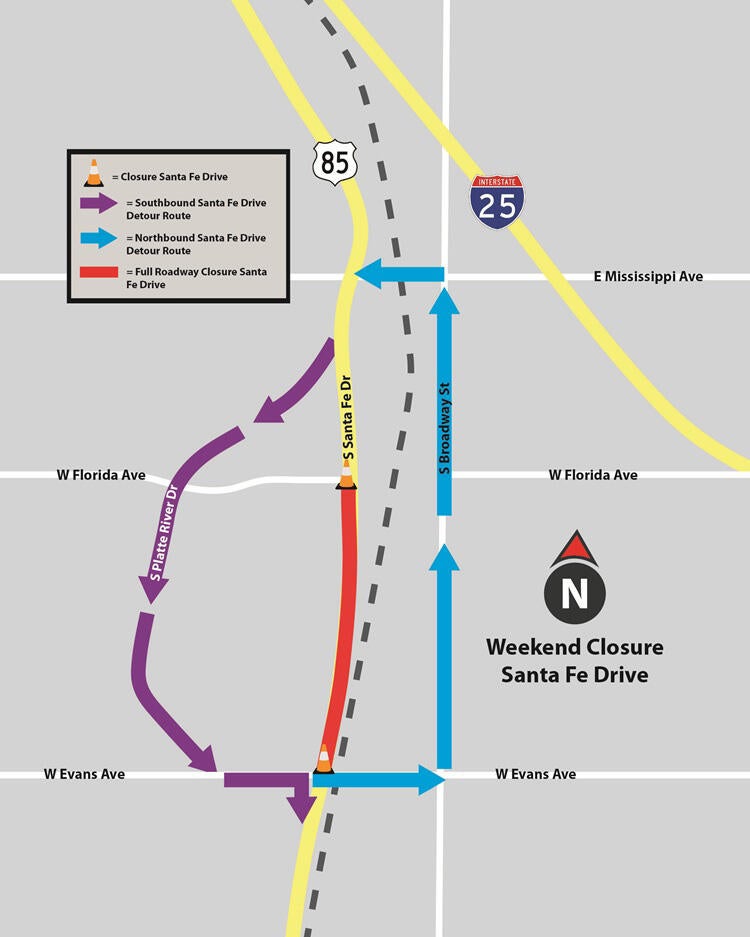
The Santa Fe Drive closure will begin at midnight on Saturday, July 11, and end on Monday, July 13, at 5 a.m. There will be detours in place. This includes:
- Southbound Santa Fe Drive Detour: Traffic will be routed to Platte River Drive to reenter southbound Santa Fe Drive at the West Evans Avenue on-ramp.
- Northbound Santa Fe Drive Detour: Access to northbound Santa Fe Drive will be at Mississippi Avenue via South Broadway Street.
- On-Ramp Closure: The West Evans Avenue on-ramp to northbound Santa Fe Drive will close at noon on Friday, July 10, to prepare for the full weekend closure and will remain closed until 5 a.m. on Monday, July 13. Traffic will be detoured to South Broadway Street to re-enter northbound Santa Fe Drive via Mississippi Avenue.
- Off-Ramp Closure: The southbound Santa Fe Drive off-ramp to West Evans Avenue will close for the full weekend period and remain closed until Friday, Sept. 11, while crews build new sidewalks and perform other concrete work at the southwest corner of the project. Detours will be posted to West Florida Avenue, West Dartmouth Avenue or West Hampden Avenue to bypass the ramp closure
During this closure, DOTI will reopen the underpass on Iowa Avenue. This is a new ADA accessible pathway that will be available between Santa Fe Drive and Acoma Street.
-
Politics4 minutes ago
Black mold and $1 wages: Settlement forces immigrant detention centers to protect workers
-
 Science7 minutes ago
Trump administration seeks to limit federal funding that doesn’t ‘advance’ presidential policies
-
 Sports12 minutes ago
Commentary: ‘I don’t want any handouts.’ Amid the Angels’ drought, a starry homecoming for Mike Trout
-

 World22 minutes ago
Does more World Cup history beckon for Norway? England stand in their way
-
 News49 minutes ago
Waymo called the cops on teen riders, raising privacy concerns
-

 Los Angeles, Ca2 hours ago
O.C. police prep for beach, theme park ‘takeovers’ promoted on social media
-

 Detroit, MI3 hours ago
Detroit city leaders to DHS: Stop ICE pursuits which endanger the community
-

 San Francisco, CA3 hours ago
SF Supervisor Jackie Fielder hosts listening session after medical leave


