West
Concerned parents of trans kids compared to 'hate groups' by Colorado Dem: Wouldn't 'ask the KKK' for opinion


A Colorado Democrat likened parent groups to “the KKK” during an hours-long committee hearing for a controversial bill that could see parents accused of “coercive control” in custody fights for using a trans child’s “deadname.”
“I really am curious about how much stakeholdering went on both sides of the issue, and not just one side,” Republican state Rep. Jarvis Caldwell said during the hearing, which began Monday night and ran into early Tuesday. “I’m curious with if the businesses in the community were included in these and if parent groups that are not part of the LGBT community if they were involved.”
Later during the House Judiciary hearing, Democrat state Rep. Yara Zokaie said the committee that night had “heard a lot about stakeholding and who was left out of stakeholding” and that “this process is important for us to understand the implications of the bills that we are passing.”
“But a well-stakeholdered bill does not need to be discussed with hate groups,” Zokaie said. “And we don’t ask someone passing civil rights legislation to go ask the KKK their opinion,” she added as several in the committee room applauded.
HAWLEY OFFICIALLY A YES ON DR OZ AFTER SECURING COMMITMENTS ON TRANSGENDER, ABORTION ISSUES
Colorado state Democrat Rep. Yara Zokaie says a controversial bill “does not need to be discussed with hate groups.” (Getty Images)
The bill in question, HB25-1312, An Act Concerning Legal Protections for Transgender Individuals, requires courts to consider “deadnaming, misgendering, or threatening to publish material related to an individual’s gender-affirming health-care services as types of coercive control” when making child custody decisions. It passed in a 7-4 vote out of the committee, clearing the first major hurdle to becoming law. It now goes to the Assembly for a second reading.
If the bill passes, it would make Colorado the first state to pass such legislation.
In California, similar legislation was passed in 2023 requiring courts to consider a parent’s affirmation of a child’s chosen gender identity in custody battles. However, liberal Gov. Gavin Newsom vetoed the bill.
The Colorado bill, which would create the Kelly Loving Act, named after a transgender man who was killed in the 2022 Colorado nightclub shooting by a nonbinary gunman, also prohibits Colorado courts from enforcing laws from other states that remove children from parents who allow transgender treatments for minors.
TRANS INMATE IN PRISON FOR KILLING BABY MUST GET GENDER SURGERY AT ‘EARLIEST OPPORTUNITY’: JUDGE
The Colorado State Capitol (Michael Ciaglo/Getty Images)
If a child in school wants to go by a different name other than their legal one, the bill says educators must be “inclusive of all reasons that a student might adopt a chosen name.”
“If the individual provides a chosen name that is different from the individual’s legal name, the chosen name must be used on all subsequent forms administered by the public entity,” the bill text summary says.
After the hearing, Caldwell told Fox News Digital in a statement that Zokaie’s reference to certain stakeholders was “deeply concerning” and “reckless.”
“Particularly when it involves labeling parents – the people who care the most about the future of their children – as hate groups,” he said. “Parents who stand up for their children’s education and rights should be respected, not vilified.”
SCOTUS RULINGS THIS TERM COULD STRENGTHEN RELIGIOUS RIGHTS PROTECTIONS, EXPERT SAYS
Parents could face negative legal repercussions in custody battles for “misgendering” trans children under the proposed legislation. (MediaNews Group/Boston Herald via Getty Images)
Zokaie also said during the hearing, “There was a lot of discussion of folks losing their children, and I just want us to note that these are parameters for a judge to consider.”
“The word ‘consider’ is used repeatedly. There are no mandates in this bill,” she said.
Fox News Digital reached out to Zokaie for comment but did not receive a response by publication deadline.
Read the full article from Here


SALT LAKE CITY — The Environmental Protection Agency awarded Utah and Salt Lake County a total of $3.5 million in grants to assess potentially polluted properties for eventual cleanup and redevelopment.
The agency announced a $2 million grant to Utah’s Department of Environmental Quality and $1.5 million to Salt Lake County to conduct environmental assessments and inventory brownfield sites for cleanup. Brownfields are sites that may be difficult to redevelop or expand because of “the presence or potential presence of a hazardous substance, pollutant or contaminant,” according to the agency.
“These brownfields grants will help Utah communities clean up contaminated sites and unlock opportunities for redevelopment and investment,” EPA Regional Administrator Cyrus Western said in a news release announcing the grants earlier this week. “By transforming underused properties into community assets, EPA is helping create healthier neighborhoods and stronger local economies.”
The two grants awarded to Utah and Salt Lake County are among more than $248 million awarded to nearly 200 communities nationwide for brownfield assessment and cleanup. Utah’s Department of Environmental Quality plans to focus the resources on several areas in Ogden, Heber City and Fillmore, among others, according to Bill Rees, who leads Utah’s brownfield cleanup program.
“What we do is work to secure the funding and then begin to reach out to our communities across the state, say, ‘Listen, there’s opportunity to do some assessment work in your community if you’re interested,’ and then work with our rural partners, work with our urban partners to see if there are sites that will fit that bill,” he told KSL.
The state has received similar grants in the past, and Rees said the money can help local governments determine what to do with ailing properties such as old schools, hospitals or private property that have gone to waste.
“Is there asbestos in it, or is there hazardous material in it? Or could there be something that’s impacting the soil or the groundwater, and a policymaker needs to make a decision?” asked Rees. “Knowledge allows you to make good decisions.”
The $1.5 million awarded to Salt Lake County is the largest brownfields assessment grant the county has ever received, according to a county press release.
“This grant is a real win for our communities,” said Mayor Jenny Wilson. “This funding will let us do vital environmental work on a larger scale and in more neighborhoods. It reflects exactly the kind of partnership between local and federal government that gets results for residents.”
The county grant funds will be used to help create cleanup plans in three areas, including a vehicle storage yard in Salt Lake City’s Ballpark Neighborhood, a 4.26-acre vacant lot in Millcreek and a small commercial building in Magna that was damaged during an earthquake in March 2020, according to the EPA.
Contributing: Don Brinkherhoff
The Key Takeaways for this article were generated with the assistance of large language models and reviewed by our editorial team. The article, itself, is solely human-written.

WashingtonCaps.com is the official Web site of the Washington Capitals. Washington Capitals and WashingtonCaps.com, WashingtonCapitals.com are trademarks of Lincoln Hockey. NHL, the NHL Shield, the word mark and image of the Stanley Cup and NHL Conference logos are registered trademarks of the National Hockey League. All NHL logos and marks and NHL team logos and marks as well as all other proprietary materials depicted herein are the property of the NHL and the respective NHL teams and may not be reproduced without the prior written consent of NHL Enterprises, L.P. Copyright © 1999-2020 Lincoln Hockey and the National Hockey League. All Rights Reserved. NHL, the NHL Shield and the word mark NHL Winter Classic are registered trademarks and the NHL Winter Classic logo is a trademark of the National Hockey League. NHL and NHL team marks are the property of the NHL and its teams. © NHL 2026. All Rights Reserved.
Wyoming
At 6,000-year-old crossing, Gov. Gordon OKs Wyoming’s first-ever designated pronghorn migration route – WyoFile

SUBLETTE COUNTY—Gov. Mark Gordon heralded Wyoming’s first-ever designation to protect a pronghorn migration corridor — a more than 2 million-acre web of habitat — at Trapper’s Point, which he called a “wonderful passageway.”
“How incredibly valuable it is that you are standing here today,” Gordon told the crowd, “to witness this remarkable moment.”
Gordon commemorated the moment with his feet planted on the narrow bulge of high country that splits the Green and New Fork rivers. Thousands of years ago, the site was a well-used hunting ground for Native Americans — it’s the earliest known killing and processing site for pronghorn in North America. Now it boasts a wildlife overpass.
No pronghorn were to be seen during the especially windy Friday afternoon gathering, which attracted 75 attendees from nearby Pinedale and other western Wyoming communities.
Now Trapper’s Point is officially classified as a “bottleneck” for the Sublette Pronghorn Herd — one of 13 such bottlenecks. That classification is supposed to prevent any surface-disturbing activity, with the intent that pronghorn can keep passing through Trapper’s Point for generations to come.

Protecting the ability of the fleet-footed, tawny-and-white ungulates to migrate is a “key factor” in sustaining their population, Wyoming Game and Fish Director Angi Bruce said.
“This becomes even more important in severe winters or extreme droughts,” Bruce said. “Pronghorn are long overdue for recognition.”
Pronghorn in Sublette, Teton, Sweetwater and Lincoln counties travel a long road — some migrate more than 200 miles to escape harsh winters, trekking south into the lower Green River Basin, a semi-arid sweep of sagebrush steppe between Pinedale and Rock Springs. Then in the spring, they retrace those paths, returning to summer ranges, lush with verdant vegetation, even going as far as Grand Teton National Park.
There was also a long road of bureaucracy to get to this point.
Nearly three decades of effort preceded the formal designation of the migration routes used by the Sublette Pronghorn Herd, which is the farthest-traveling and among the largest pronghorn herds in the West.
Jackson Hole biologists long knew that the valley’s pronghorn left in the winter. But details were hazy on where they went and how they got there until around the turn of the century. Using data from tracking collars, biologists like Joel Berger, Steve Cain, Hall Sawyer and Doug Brimeyer helped delineate the route.

In 2008, a Bridger-Teton National Forest plan amendment established a portion of the path as the nation’s first designated wildlife migration corridor.
Popularized by its branding as the “Path of the Pronghorn,” the route has received press in national publications like High Country News and the New York Times.
But the southern reaches of the migration through the energy-rich Green River Basin have faced major political opposition since the early 2000s. Wyoming first attempted to protect those travel corridors in 2019, under a policy administered by the Wyoming Game and Fish Department. That effort was halted after a coalition of industry trade groups and counties protested.
Then, in early 2020, Gordon revamped the migration policy with an executive order. Still, the Sublette Pronghorn Herd proposal gathered dust, even as development threatened the route.
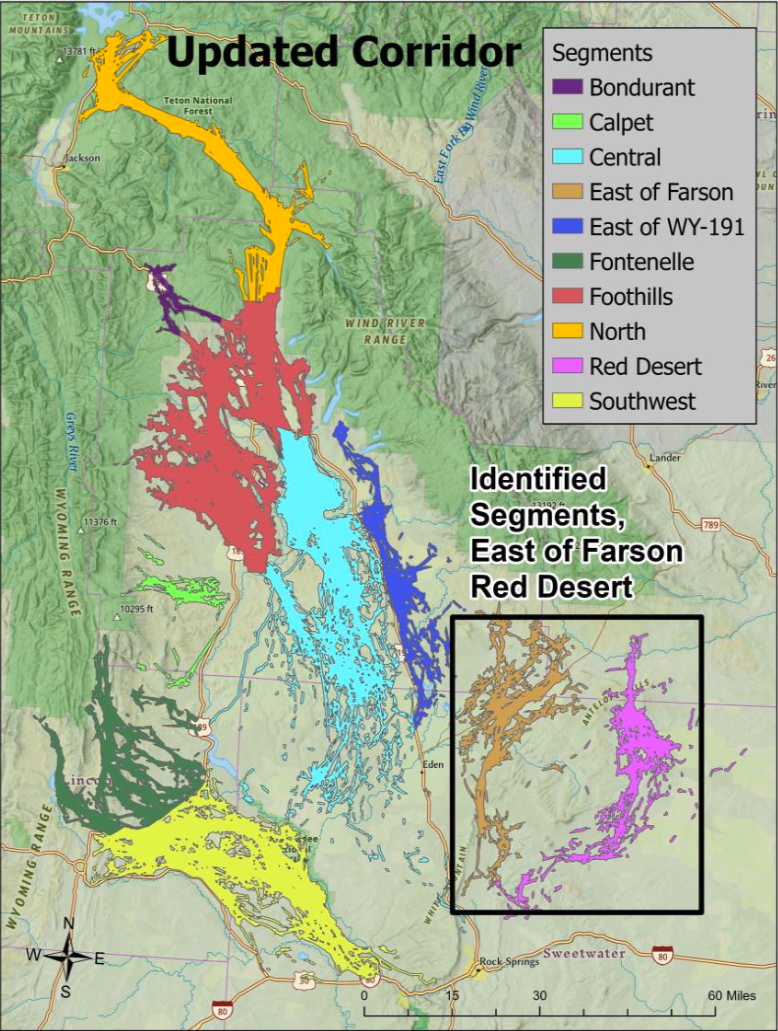
Game and Fish revived efforts to protect the migration in late 2023 and early 2024. Biologists pulled together one of North America’s most comprehensive migration datasets, benefiting from approximately two decades of GPS collar information collected from more than 400 pronghorn.
Some controversy followed the process until near the end. There was a debate about whether to designate the migration’s two easternmost segments, in the Red Desert and east of Farson. The Game and Fish Department proposed excluding the routes, but was overridden by its commission. Then Gordon upended that decision, excluding the two segments.
Vetting the migration corridor through a Gordon-appointed working group was the second-to-last step in the designation process.
“Today’s designation demonstrates that voluntary, locally driven conservation works,” said Robb Slaughter, who chaired the group, during the commemoration at Trapper’s Point.
Time will tell if that’s the case. Wyoming’s migration policy is, by design, permissive of development. Private land is exempt from protections, and designation is not an assurance that new stressors won’t be added to the landscape.

“Today is not the end of the process,” Slaughter said. “It’s the beginning of the next chapter. Continued monitoring, adaptive management, research, and cooperation will ensure these recommendations remain effective as conditions change.”
But Friday was the end of the migration designation process. The governor’s informal OK — no signature was needed — was the last step, said Sara DiRienzo, the governor’s deputy policy advisor.
Wildlife advocates celebrated the moment.
“This is historical,” Bruce said. It’s the first effort to protect the full length of a pronghorn migration corridor in the nation, she said.
-

 Pennsylvania7 minutes ago
Federal government sues Pennsylvania, others over SNAP data
-

 Rhode Island10 minutes ago
Target 12: State of RI’s fire hoses
-

 South-Carolina15 minutes ago
Mississippi State baseball lands Will Craddock, South Carolina transfer infielder
-

 South Dakota22 minutes ago
South Dakota Republicans reject censuring John Thune over stalled SAVE America Act
-

 Tennessee25 minutes ago
Flood watch in effect for Middle Tennessee: 2-3″ of rain expected Saturday
-

 Texas30 minutes ago
Texas state school board approves mandated reading list including Bible passages
-

 Utah37 minutes ago
Utah, Salt Lake County awarded grants for community cleanup
-

 Vermont40 minutes ago
West Rutland man dies in hit-and-run, police seek vehicle

