Colorado
“The Wild Robot” finds inspiration in director’s Colorado childhood


The idea behind “The Wild Robot” sounds like a paradox: An artificially intelligent machine transforms itself into an emotional creature after exposure to the wilderness.
Those emotions are not a malfunction, but rather a result of natural evolution for our android protagonist, Roz. In author Peter Brown’s hit book, and now the DreamWorks movie it’s based on, it’s also a matter of survival.
“When I first talked with (author Brown), he immediately mentioned something that had a huge impact on the movie,” said writer and director Chris Sanders, a Colorado Springs native and veteran of Disney and DreamWorks Animation features such as “Lilo & Stitch,” “The Croods” and “How to Train Your Dragon.” “It’s the idea that kindness can be a survival skill, and sometimes you have to change your programming and become more multidimensional to survive.”
The animated sci-fi tale, which hits the big screen on Sept. 27, is another stab at Oscar gold for DreamWorks, as well as the final film being produced in-house at the studio known for “Shrek.” Its last movie, the 2022 feature “Puss in Boots: The Last Wish,” was an uncommonly thoughtful sequel/spin-off that netted its creators a Best Animated Feature nomination.
“The Wild Robot” looks likely to nab another, with its jaw-droppingly beautiful visuals, richly constructed world, and themes and action that avoid the zany, slapstick-laden formula of most talking-animal stories.
“Programming is a theme in any robot movie, but this was a substantially different tone,” said Sanders, who graduated from Arvada High School before going on to the California Institute of the Arts. “Roz sees the animals as having individual programming, which is just her way of looking at things. She puts their behavior in terms she can understand.”
Indeed, the robot’s accidental crash-landing on a lush, deserted island kicks off a series of events that blur the organic and artificial. Voiced by Oscar winner Lupita Nyong’o, Roz is a service robot designed to meet the needs of humans. And yet there are no humans to fulfill her purpose, so she turns her attention to decoding the animal kingdom, from an insecure beaver and a grumpy bear to an orphaned gosling (Brightbill, voiced by Kit Connor) that she’s more or less forced to parent after accidentally killing his parents in her crash-landing.
The menagerie is driven by a skilled voice cast that includes Pedro Pascal (as Fink the fox), Catherine O’Hara (Pinktail the possum), Bill Nighy (Longneck the goose), Mark Hamill (Thorn the grizzly bear), Stephanie Hsu (bad robot Vontra) and Ving Rhames (Thunderbolt the falcon).
Sanders and his team offer clever sequences that inject realism into the otherwise fantastical scenes, cross-wiring the best parts of Pixar and Disney movies such as “WALL-E” with “Zootopia.” In one montage, Roz translates the chirps, barks and growls of the animals into a language that she (and we) can speak and understand — something like a Universal Translator in Star Trek. Most movies wouldn’t even bother explaining how they can communicate.
Writer-director Sanders, who grew up hiking and picnicking with his family along the Front Range — “every weekend, if the weather was good enough,” he said — saw opportunity in the blank spaces of the book. Author and illustrator Brown’s source material was first published in 2016 and ascended to No. 1 on the New York Times bestseller list while spawning its own middle-grade series.

“When I got into the book and the journey of the story, I realized these were really fresh characters I could attach myself to,” he said. “I got inside them immediately and understood their relationships are more subtle and intricate and felt more real than they would in a fairytale. I’ve worked on those before, and am proud of those projects. But as fanciful as the (‘The Wild Robot’s’) plot is, this felt like it was really happening because the relationships are believable.”
The movie contrasts the robot’s programming — and the idea that it can evolve past it — with evolutionary instinct and self-preservation. Without giving anything away, hard lessons lead to revelations about working together and the merits of personal sacrifice for the greater good.
Above all, there’s an artful, refreshing wisdom to “The Wild Robot” that’s missing from most movies, kids’ or otherwise. Sanders’ Colorado past showed him nature’s big-screen beauty, as well as the different ways one must adapt to the outdoors, and he certainly internalized that before moving to Hollywood, he said.
“Whether we were on a trail or having lunch, I always got altitude sickness,” Sanders remembered with a laugh, naming Devil’s Head, the Flatirons and the Royal Arch among his favorite spots. “I was super duper prone to that, whereas my brother never got sick. I never really connected that (to the book); it was just part of being a kid.”
Studying animals up close, however, was not part of being a kid, Sanders said. That could be why he’s so attracted to depicting them as an adult.
“We never had pets (growing up),” he said. “That’s why I drew them.”
Subscribe to our weekly newsletter, In The Know, to get entertainment news sent straight to your inbox.



As a result of a snow drought and a heat wave that have both set records, some Colorado residents face the earliest restrictions on their water use ever imposed.
Denver Water announced Wednesday that it is seeking a 20% cut in water use, asking people to turn off automatic watering systems until mid-May and restricting the watering of trees and shrubs to twice a week.
“The situation is quite serious,” said Todd Hartman, a spokesperson for the utility. “We’re in such a dire situation that we could be coming back to the public in two or three months and saying you’re limited to one day a week.”
It is the earliest in the year that Denver Water has ever issued a restriction, Hartman said.
Colorado’s snowpack peaked at extremely low levels on March 12 — nearly a month earlier than usual — then cratered during the recent heat wave that cooked nearly every state in the West.
“We already had the lowest snowpack we’ve seen since at least 1981, and now, with the heat wave conditions, we’ve already lost about 40% of the statewide snowpack” since the March 12 peak, said Peter Goble, Colorado’s assistant state climatologist. “Conditions are looking more like late April or early May.”
The water restrictions are a harbinger of what’s to come in many Western states as officials try to manage widespread drought concerns. Nearly every snow basin in the Mountain West had one of its warmest winters on record and is well behind normal when it comes to water supply, according to the U.S. drought monitor. The dwindling snowpack is likely to raise the risk of severe wildfires, hamper electricity generation at hydropower dams and force water restrictions for farmers.
Hartman said nearly every community east of the Rockies, along Colorado’s front range, is in much the same boat as Denver.
City Council members in Aurora are considering similar water restrictions; reservoirs there stand at about 58%, according to the city’s website. In the town of Erie, officials declared a water shortage emergency on March 20 after they observed a massive spike in consumption.
Gabi Rae, a spokesperson for the town, said Erie was perilously close to having taps run dry because so many residents had started watering their lawns early amid the unseasonable heat.
“We were a day away from running out of water. That’s why it was such an emergency,” she said.
Erie officials demanded that residents stop using irrigation systems altogether.
Goble said this month’s heat wave has set records in every corner of Colorado, sometimes by double digits.
“I can’t remember seeing a single heat wave that broke this many records, and seeing it across such a large portion of the country is certainly eye-popping,” he said, adding: “I’m located in Fort Collins, and we got up to 91 last Saturday. The previous record for March was 81, so we smashed that record. And it wasn’t just one day, either.”
Denver Water, which serves about 1.5 million residents in the city and its surrounding suburbs, gets about half of its water from the Upper Colorado River Basin and the South Platte River Basin. The latter’s snowpack was at about 42% of normal Tuesday, the utility reported. The Upper Colorado River Watershed was at 55%.
Systemwide, Denver Water’s reservoirs are about 80% full, which is only about 5 percentage points lower than in a typical year.
“That sounds pretty good,” Hartman said. “Except that what we’re not going to be able to rely on is that rush of water that will bring those reservoirs back up, because the snowpack is so low.”
In other words, the snowpack — a natural water reservoir — is mostly tapped already and won’t replenish reservoirs later this spring and into summer, when runoff usually peaks.
In Erie, city workers plan to aggressively police water use until sometime next week using smart meters that monitor residential usage. Rae said the city is also sending utility workers to patrol neighborhoods and look for sprinklers that are turned on.
“People have been kind of annoyed with how aggressive we were, and I don’t necessarily think they understand the ramifications if we weren’t,” Rae said. “It is an actual serious emergency situation. We were so close to reaching empty, there would literally be no water coming out of the taps — hospitals, schools, fire hydrants, your home would have no water.”
Although the limits on outdoor watering will be lifted soon, Rae expects more restrictions later this spring and summer.
Colorado
Suddenly hazy skies in Denver prompt some residents concerned about wildfire smoke to call 911

Some people who live in the Denver metro area on Thursday afternoon were making calls to 911 after skies became noticeably hazy and winds kicked up. It was due to smoke from wildfires in Nebraska moving into Colorado. A cold front also was moving through the Front Range, and there is dust in the air.
The poor air conditions led to reduced visibility downtown after 3 p.m. Several of CBS Colorado’s City Cams showed dust or smoke in the air.
Temperatures were expected to drop by as much as 20 to 30 degrees with the cold front.
The suddenly dusty skies prompted at least one fire agency to put out a plea to residents to please only call 911 “if you see flames.” That warning was put out by South Metro Fire Rescue, which shared a photo on X of an office building with haze visible outside.
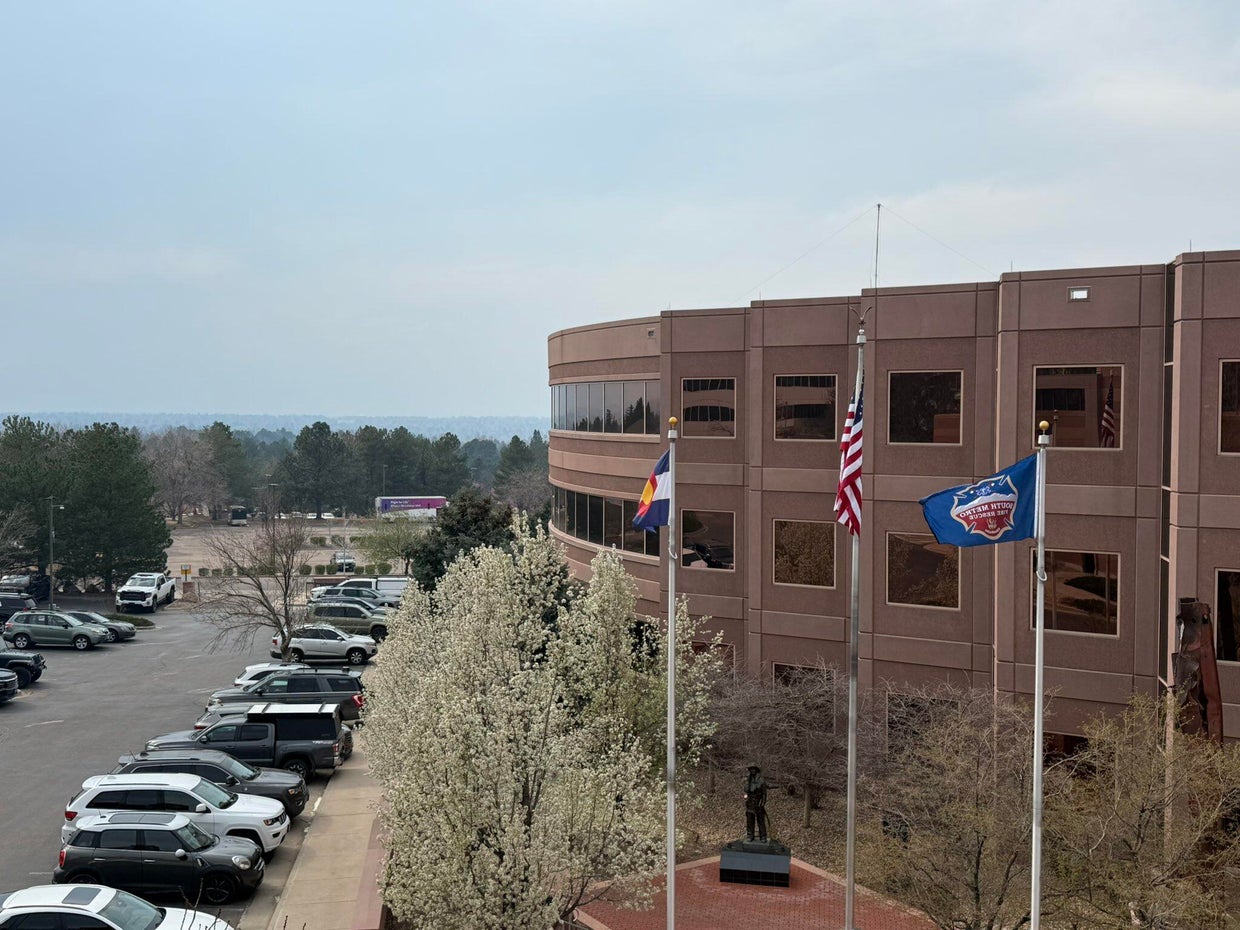
South Metro Fire Rescue said in their post that the smoke is from Colorado’s neighbor to the east. They called it a “significant haze” in the air.
Earlier this month, the Morrill Fire and the Cottonwood Fire burned a significant amount of Nebraska grassland and ranchland. They have mostly been contained by firefighters. Nebraska Gov. Jim Pillen said those two fires combined with several others have burned approximately 800,000 acres of land. On Thursday, Pillen announced that he is signing several executive actions intended to ease the burden caused by the fires.
There were no wildfires burning in the Denver metro area on Thursday afternoon.

ARAPAHOE COUNTY, Colo. (KKTV) – A homicide suspect based out of Colorado, wanted in a fentanyl-related death, is back in the state after being captured in Colombia.
The Arapahoe County Sheriff’s Office (ACSO) said 33-year-old Max Arsenault had been on the run since January 17.
Deputies said this stemmed from an incident in May 2023, where deputies responded to a call for a man named Nicholas Dorotik, who was found unresponsive.
ACSO said the cause of death was a mixed drug overdose involving meth and fentanyl, having about three times the lethal amount of fentanyl in his system.
One year later, Arsenault was arrested. He was scheduled for trial in January 2026 when deputies said he fled the country while on bond three days before the trial was set to start.
He was caught in Medellin, Colombia, on March 4, following a two-month international investigation. He has since been extradited back to Denver, where he is facing charges and awaiting trial.
Copyright 2026 KKTV. All rights reserved.

The White House has an app now, and Trump wants you to report people to ICE on it

The race against time to destroy Iran’s illicit nuclear weapons program heats up amid fresh strikes

WATCH: Senate hearing goes silent after Angel Father confronts top Dem over daughter’s death

Another state bans ‘gas station heroin’ as officials warn of deadly risks

Tiger Woods involved in rollover crash in Florida less than 2 weeks before Masters: reports

Florida High School Football Rankings: Top 25 teams – Oct. 21

How old is Bo Nix? What to know about Oregon quarterback ahead of 2024 NFL Draft

Cleary's 21 help Le Moyne down Central Connecticut State 69-64 in OT

99th annual Pony Swim held in Virginia

Indiana Members Credit Union announced as new anchor tenant at Bottleworks District
WATCH: Senate hearing goes silent after Angel Father confronts top Dem over daughter’s death

US diplomat Marco Rubio denounces settler violence, tolls in Hormuz strait

Iran-linked hackers have breached FBI Director Kash Patel’s personal emails | CNN Politics

Live: CPAC 2026 Day 2

Video: Will ICE Change Under Its New Leader?
-

 Detroit, MI1 week ago
Drummer Brian Pastoria, longtime Detroit music advocate, dies at 68
-

 Movie Reviews1 week ago
‘Youth’ Twitter review: Ken Karunaas impresses audiences; Suraj Venjaramoodu adds charm; music wins praise | – The Times of India
-

 Sports6 days ago
IOC addresses execution of 19-year-old Iranian wrestler Saleh Mohammadi
-

 New Mexico5 days ago
Clovis shooting leaves one dead, four injured
-
 Business1 week ago
Disney’s new CEO says his focus is on storytelling and creativity
-

 Technology5 days ago
YouTube job scam text: How to spot it fast
-

 Tennessee4 days ago
Tennessee Police Investigating Alleged Assault Involving ‘Reacher’ Star Alan Ritchson
-

 Texas1 week ago
How to buy Houston vs. Texas A&M 2026 March Madness tickets