Colorado
Supreme Court set to hear Trump challenge to Colorado ballot ban that cited 'insurrection'


U.S. President Donald Trump looks on he as meets with Colorado Governor Jared Polis and North Dakota Governor Doug Burgum in the Cabinet Room of the White House on May 13, 2020 in Washington, DC.
Doug Mills-Pool | Getty Images
The Supreme Court is set Thursday morning to hear oral arguments on an effort by former President Donald Trump to reverse a ruling by Colorado’s top court barring him from that state’s 2024 Republican presidential primary ballot.
The arguments, which are expected to last several hours, come as Trump has a commanding lead in the national GOP primary race, with a long-shot bid from former South Carolina Gov. Nikki Haley appearing to be the only potential stumbling block to him securing the party’s nomination this summer.
The Colorado Supreme Court in December ruled that Trump is disqualified from holding the office of president because he “engaged in insurrection” by inciting the 2021 Capitol riot as part of his effort to reverse his loss to President Joe Biden in the 2020 election.
That bombshell 4-3 ruling was based on Section Three of the 14th Amendment to the U.S. Constitution, which states “no person” can serve as an officer of the United States who, having previously taken an oath of federal office, “engaged in insurrection or rebellion” against the U.S.
Six Republican and unaffiliated voters in Colorado had filed the lawsuit that led to the state Supreme Court ruling.
Trump’s lawyers in a brief filed with the U.S. Supreme Court last month argued that the Colorado court decision was “based on a dubious interpretation” of Section Three, while noting that similar efforts to bar Trump from presidential ballots are underway in more than 30 states.
The U.S. Supreme Court “should put a swift and decisive end to these ballot-disqualification efforts, which threaten to disenfranchise tens of millions of Americans and which promise to unleash chaos and bedlam if other state courts and state officials follow Colorado’s lead and exclude the likely Republican presidential nominee from their ballots,” Trump’s lawyers wrote.
Those lawyers said that Trump “is not even subject” to Section Three because a president is “not an ‘officer of the United States’ under the Constitution.”
The attorneys also argue that even if Trump were subject to the provision, he did not engage in any conduct that qualifies as an insurrection.
Sean Grimsley, one of the lawyers representing the plaintiffs in the case that led to Trump’s disqualification, during a call with reporters Wednesday said that Trump’s claim that he was not an officer of the United States as president has become his lead argument in the case.
Grimsley predicted that claim will be closely scrutinized by the Supreme Court justices during oral arguments.
“I think the justices will be very interested in that question, if only because President or former President Trump has made that the lead argument in this case,” Grimsley said.
He and another lawyer for the plaintiffs dismissed that argument.
They said it was obvious that a president is an officer of the United States and that it requires “linguistic acrobatics” to argue otherwise.
Mario Nicolais, one of the plaintiffs’ lawyers, acknowledged that to win the case the attorneys on his side “have to win every argument” they are making to disqualify Trump.
“We think we will,” Nicolais said.
“We think we win so many of those arguments on multiple different levels, and that’s why we feel very strongly that we will win this case,” he said.
The plaintiffs’ key arguments are that Trump engaged in insurrection against the Constitution, and Section Three applies to insurrectionist presidents, that state courts can adjudicate Section Three under state ballot access laws, and that states can exclude presidential candidates from ballots if they are deemed constitutionally ineligible.
The plaintiffs also argue that Congress does not have to first deem a candidate ineligible under Section Three.
“Donald Trump is disqualified today,” Nicolais said. “He was disqualified on January 6, 2021 when he engaged in that, he disqualified himself under our Constitution.”
Three of the nine Supreme Court justices who will hear his appeal Thursday were appointed by Trump — Neil Gorsuch, Brett Kavanaugh, and Amy Coney Barrett. Three other justices who were appointed by Republican presidents with Trump’s appointees comprise a conservative supermajority on the Supreme Court.
Despite that bloc, Trump has failed to get the Supreme Court to take his side in a number of past cases, including in his efforts to challenge the voting processes and results during the 2020 presidential election.



DENVER — Five of the seven law enforcement officers in a rural Colorado county, including the sheriff, have been indicted in an investigation into allegations of misconduct, prosecutors said Friday.
A grand jury indicted Costilla County Sheriff Danny Sanchez and former Deputy Keith Schultz on charges of allegedly mishandling human remains discovered in October 2024, according to court documents. A man who found the remains and reported them to the sheriff’s office said Sanchez and Schultz took only the skull and left the other remains behind, including teeth, court documents state.
Two months passed before Schultz wrote a report, saying he left bones in a bag on his desk and went on another call, the documents state. A coroner’s official said he received the skull in an unlabeled paper bag from the sheriff’s office, the documents state.
Separately, Undersheriff Cruz Soto, Sgt. Caleb Sanchez — the sheriff’s son — and Deputy Roland Riley are charged in connection with the use of a Taser against a man who was suffering a mental health crisis in February and tried to leave when they insisted he go to the hospital, according to the documents. The man said he was “roughed up” by deputies and was left with broken ribs, according to the indictments.
Soto was charged with failing to intervene and third-degree assault, according to court documents. Caleb Sanchez and Riley were charged with second- and third-degree assault.
In announcing the indictments, 12th District Attorney Anne Kelly said she’s committed to investigating and prosecuting crimes no matter the offender.
“I cannot and will not ignore violations of the trust that a community should have in their police. No citizen of the San Luis Valley should have any doubts about the integrity of their police force,” Kelly said at a news conference Friday evening.
A person who answered the phone Friday at the sheriff’s office said it had no immediate comment but planned to post a statement online. Phone numbers listed for Danny Sanchez, Soto and Riley did not work. Caleb Sanchez did not have a listed number. An unidentified person who answered a number for Schultz referred The Associated Press to an attorney, Peter Comar. The AP left a message Friday for Comar seeking comment.
__

As a result of a snow drought and a heat wave that have both set records, some Colorado residents face the earliest restrictions on their water use ever imposed.
Denver Water announced Wednesday that it is seeking a 20% cut in water use, asking people to turn off automatic watering systems until mid-May and restricting the watering of trees and shrubs to twice a week.
“The situation is quite serious,” said Todd Hartman, a spokesperson for the utility. “We’re in such a dire situation that we could be coming back to the public in two or three months and saying you’re limited to one day a week.”
It is the earliest in the year that Denver Water has ever issued a restriction, Hartman said.
Colorado’s snowpack peaked at extremely low levels on March 12 — nearly a month earlier than usual — then cratered during the recent heat wave that cooked nearly every state in the West.
“We already had the lowest snowpack we’ve seen since at least 1981, and now, with the heat wave conditions, we’ve already lost about 40% of the statewide snowpack” since the March 12 peak, said Peter Goble, Colorado’s assistant state climatologist. “Conditions are looking more like late April or early May.”
The water restrictions are a harbinger of what’s to come in many Western states as officials try to manage widespread drought concerns. Nearly every snow basin in the Mountain West had one of its warmest winters on record and is well behind normal when it comes to water supply, according to the U.S. drought monitor. The dwindling snowpack is likely to raise the risk of severe wildfires, hamper electricity generation at hydropower dams and force water restrictions for farmers.
Hartman said nearly every community east of the Rockies, along Colorado’s front range, is in much the same boat as Denver.
City Council members in Aurora are considering similar water restrictions; reservoirs there stand at about 58%, according to the city’s website. In the town of Erie, officials declared a water shortage emergency on March 20 after they observed a massive spike in consumption.
Gabi Rae, a spokesperson for the town, said Erie was perilously close to having taps run dry because so many residents had started watering their lawns early amid the unseasonable heat.
“We were a day away from running out of water. That’s why it was such an emergency,” she said.
Erie officials demanded that residents stop using irrigation systems altogether.
Goble said this month’s heat wave has set records in every corner of Colorado, sometimes by double digits.
“I can’t remember seeing a single heat wave that broke this many records, and seeing it across such a large portion of the country is certainly eye-popping,” he said, adding: “I’m located in Fort Collins, and we got up to 91 last Saturday. The previous record for March was 81, so we smashed that record. And it wasn’t just one day, either.”
Denver Water, which serves about 1.5 million residents in the city and its surrounding suburbs, gets about half of its water from the Upper Colorado River Basin and the South Platte River Basin. The latter’s snowpack was at about 42% of normal Tuesday, the utility reported. The Upper Colorado River Watershed was at 55%.
Systemwide, Denver Water’s reservoirs are about 80% full, which is only about 5 percentage points lower than in a typical year.
“That sounds pretty good,” Hartman said. “Except that what we’re not going to be able to rely on is that rush of water that will bring those reservoirs back up, because the snowpack is so low.”
In other words, the snowpack — a natural water reservoir — is mostly tapped already and won’t replenish reservoirs later this spring and into summer, when runoff usually peaks.
In Erie, city workers plan to aggressively police water use until sometime next week using smart meters that monitor residential usage. Rae said the city is also sending utility workers to patrol neighborhoods and look for sprinklers that are turned on.
“People have been kind of annoyed with how aggressive we were, and I don’t necessarily think they understand the ramifications if we weren’t,” Rae said. “It is an actual serious emergency situation. We were so close to reaching empty, there would literally be no water coming out of the taps — hospitals, schools, fire hydrants, your home would have no water.”
Although the limits on outdoor watering will be lifted soon, Rae expects more restrictions later this spring and summer.
Colorado
Suddenly hazy skies in Denver prompt some residents concerned about wildfire smoke to call 911

Some people who live in the Denver metro area on Thursday afternoon were making calls to 911 after skies became noticeably hazy and winds kicked up. It was due to smoke from wildfires in Nebraska moving into Colorado. A cold front also was moving through the Front Range, and there is dust in the air.
The poor air conditions led to reduced visibility downtown after 3 p.m. Several of CBS Colorado’s City Cams showed dust or smoke in the air.
Temperatures were expected to drop by as much as 20 to 30 degrees with the cold front.
The suddenly dusty skies prompted at least one fire agency to put out a plea to residents to please only call 911 “if you see flames.” That warning was put out by South Metro Fire Rescue, which shared a photo on X of an office building with haze visible outside.
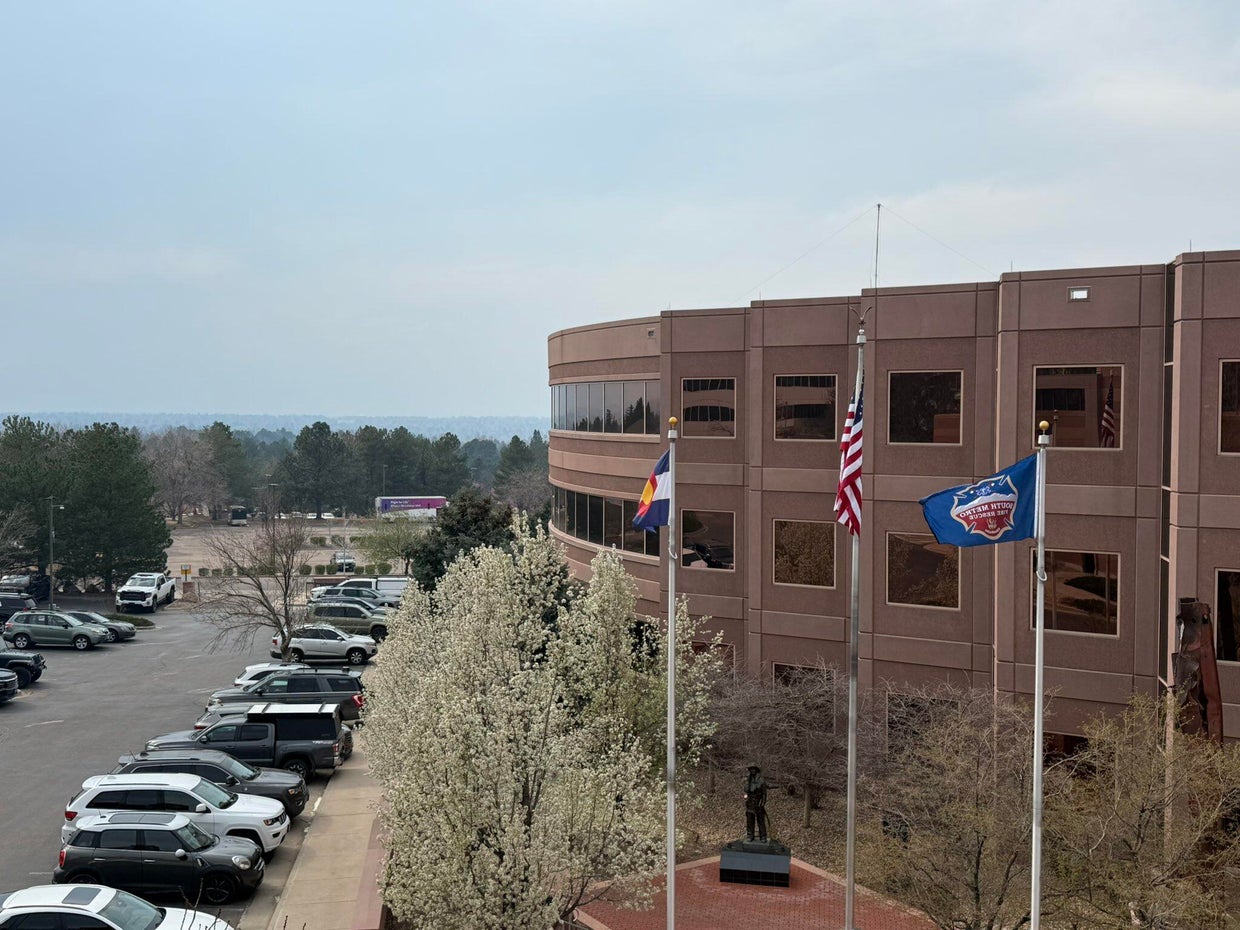
South Metro Fire Rescue said in their post that the smoke is from Colorado’s neighbor to the east. They called it a “significant haze” in the air.
Earlier this month, the Morrill Fire and the Cottonwood Fire burned a significant amount of Nebraska grassland and ranchland. They have mostly been contained by firefighters. Nebraska Gov. Jim Pillen said those two fires combined with several others have burned approximately 800,000 acres of land. On Thursday, Pillen announced that he is signing several executive actions intended to ease the burden caused by the fires.
There were no wildfires burning in the Denver metro area on Thursday afternoon.

Preview: Spirit Prepares for First Match Against Denver Summit FC, Another Record Crowd

Report: Seattle Seahawks hiring ex-UW Huskies coach

Tom Krasovic: Catarina Macario signing shows brighter days ahead for Wave

Travelers see shorter lines at Milwaukee Mitchell despite the ongoing partial government shutdown

Minnesotans mobilize for third and potentially biggest No Kings Day

Florida High School Football Rankings: Top 25 teams – Oct. 21

How old is Bo Nix? What to know about Oregon quarterback ahead of 2024 NFL Draft

Cleary's 21 help Le Moyne down Central Connecticut State 69-64 in OT

99th annual Pony Swim held in Virginia

Indiana Members Credit Union announced as new anchor tenant at Bottleworks District

WATCH: Senate hearing goes silent after Angel Father confronts top Dem over daughter’s death

US diplomat Marco Rubio denounces settler violence, tolls in Hormuz strait

Iran-linked hackers have breached FBI Director Kash Patel’s personal emails | CNN Politics

Live: CPAC 2026 Day 2

Video: Will ICE Change Under Its New Leader?
-

 Detroit, MI1 week ago
Drummer Brian Pastoria, longtime Detroit music advocate, dies at 68
-

 Movie Reviews1 week ago
‘Youth’ Twitter review: Ken Karunaas impresses audiences; Suraj Venjaramoodu adds charm; music wins praise | – The Times of India
-

 Sports6 days ago
IOC addresses execution of 19-year-old Iranian wrestler Saleh Mohammadi
-

 New Mexico5 days ago
Clovis shooting leaves one dead, four injured
-
 Business1 week ago
Disney’s new CEO says his focus is on storytelling and creativity
-

 Technology5 days ago
YouTube job scam text: How to spot it fast
-

 Tennessee4 days ago
Tennessee Police Investigating Alleged Assault Involving ‘Reacher’ Star Alan Ritchson
-

 Texas1 week ago
How to buy Houston vs. Texas A&M 2026 March Madness tickets