Colorado
High Winds Mean High Fire Danger In Colorado Springs


COLORADO SPRINGS, CO — The Colorado Springs Fire Department says it is critical for residents of Colorado Springs to know if they live in the Wild Land Urban Interface, and the fire dangers there. It’s different parts of town that have a higher risk of fire because of their proximity
to certain types of vegetation. You can check out the map to see where you lie.
Monday, 5/6/24 we saw a fire started on the southwest side of Colorado Springs- that was in fact inside the Wild Land Urban Interface. The fire department says the fire was caused by a downed power line due to the high winds. Steve Oswald, the Battalion Chief at CSFD says down power lines come with a lot of danger, including fires… “some of the dangers you need to be aware of besides just the wind, is it’s taking out a lot of power, we still have a lot of poles that are in precarious spots that could still break in the wind… You need to be aware of any above-ground power lines”
Earlier this spring, Governor Jared Polis and the state forest service announced 31 wildfire mitigation grants across the state. The grants assist communities and groups in reducing wildfire risk in their areas. Almost all of Colorado is under some type of threat, including El Paso County. The worst is to the west, and up into Teller County, which is almost completely high-intensity.
Oswald tells me the temperatures is also a factor to fire danger “As we move into the summertime, as we have been growing more and more fuels, grasses are starting to grow, anytime we get into wind events like this and we get arcing or sparking, you need to be careful with fire starting because of those events”
____
News Tips
What should KOAA5 cover? Is there a story, topic, or issue we should revisit? Have a story you believe should make the light of day? Let our newsroom know with the contact form below.
____
Watch KOAA News5 on your time, anytime with our free streaming app available for your Roku, FireTV, AppleTV and Android TV. Just search KOAA News5, download and start watching.



A 51-year-old Castle Rock resident was recently found guilty on 15 counts of fraud by jurors in Denver federal court.
According to a court document, Rico Tomas Garcia received $2.4 million from two businesses at the outset of the COVID pandemic. He spent the money to purchase a vehicle and three properties without delivering any of the promised product.
Garcia agreed in April 2020 to provide nine million 16-ounce bottles of hand sanitizer to a Virginia-based distributor of personal protective equipment (PPE) and safety work gear, according to the grand jury indictment in his case. A second company financed the deal for the distributor.
If reached in full, the deal would have paid Garcia $37.8 million. But Garcia reportedly moved the first $2.4 million paid to him into accounts held by three corporations operated by he and his girlfriend.
A month after making the deal, none of the product was delivered and the finance company halted payments and demanded a refund. Instead, Garcia, according to the indictment, falsified documents about his arrangements with a Chinese manufacturer of the hand sanitizer.
The contract was terminated in June of that year.
Garcia allegedly bought homes in Topanga Canyon, California and Sedalia, Colorado, plus an undisclosed Nevada property, with the ill-gotten proceeds. Federal prosecutors also allege Garcia moved over a million dollars of the remaining money into offshore accounts in the Caribbean.
A federal grand jury indicted Garcia in April 2024. He was taken into custody eight months later. The jury reached its verdict March 9 after a week-long trial, finding him guilty of nine counts of wire fraud and six counts of money laundering.
Meanwhile, the distributor and its finance company are still trying to resolve their finances through a civil lawsuit filed the year the deal went south.
Garcia is scheduled to be sentenced Sept. 8.

Mike Dudley can usually pick up on someone’s anxiety about dealing with Colorado’s funeral home industry the first time they sit down to talk.
It starts with pointed questions as he meets with families in the conference room at Rundus Funeral Home & Crematory in Broomfield, where Dudley is the general manager and funeral director. How is their loved one’s body going to be handled? Who will be caring for them? When, where and how will they be cremated or put in a casket?
Sometimes it comes out of the blue, like when a man called Dudley three years after Rundus cremated his loved one because he couldn’t stop thinking about whether or not he actually had the correct cremains.
“His mind just got wondering and he needed reassurance,” Dudley said. “Like, ‘How do I know this is in fact my person in the urn?’”
Whether it’s pointed questions from prospective clients or phone calls years after the fact, recent scandals in the state’s funeral industry have shaken Coloradans’ trust in the professionals who care for their deceased loved ones, funeral directors and industry experts told The Denver Post.
While Colorado lawmakers have made significant strides in adding state regulations to prevent future scandals, rehabilitating the funeral industry’s reputation is a more complicated task.
“The trust that’s been broken here, it’s going to take a long while for us to restore it,” said Matt Whaley, president of the Colorado Funeral Directors Association.
The effect of Colorado’s notoriously lax funeral home regulations burst into public view in 2018, when an FBI raid on Sunset Mesa Funeral Directors in Montrose found that mother-daughter team Megan Hess and Shirley Koch stole and sold hundreds of bodies around the world to turn a profit.
Hess is now serving a 20-year prison sentence and Koch is serving a 15-year sentence.
Coloradans are still seeing the fallout of more recent scandals, like the active investigation into Davis Mortuary owner (and former Pueblo County coroner) Brian Cotter, who operated the mortuary where state inspectors found 24 decomposing bodies in a hidden room in August.
Dudley is often at a loss for words when he thinks about the scandals, like what happened at the Return to Nature funeral home in Penrose, where owners Jon and Carie Hallford allowed 191 bodies, stacked on top of each other, to decompose for over four years while giving families fake cremains.
The Hallfords both face decades-long prison sentences after pleading guilty in their state criminal cases.
“Even when we’re transferring (the deceased) from a cot to a dressing table, we’re making sure their head doesn’t bang. We’re treating them as if they’re still alive, with care and respect. That you could let those people languish for years… how could you do that?” Dudley said. “How could you sit in front of a family and hand them an urn knowing full well it’s Quikrete?”
So when the man called him out of the blue asking about his loved one’s cremains, Dudley explained that every person who is cremated gets a metal disk with a unique set of numbers that stays with them through the whole process and is zip-tied to the bag of cremains that are returned to families.
“I said, ‘Tell me that number. Don’t tell me the name of your person. I’ll go back to our cremation log and tell you the name associated with the number,’” Dudley said. “I came back, said I have that number associated with this person, and he just said, ‘Oh, thank God.’”
Scandals had statewide, local ripple effects
Cases of industry workers mishandling bodies in Montrose, Penrose, Denver and Pueblo have had a far-reaching effect on Colorado’s funeral home industry, said Kim Bridges, who owns the parent company that oversees three metro Denver funeral homes, including Rundus.
“When these things started happening, it was awful for the industry,” she said. “It makes everyone look at the industry with skepticism and that’s a shame because you need to be able to trust the people you entrust your loved one to.”
Bridges Funeral Services, which Bridges owns with her husband, also oversees funeral and mortuary facilities in New Mexico, Tennessee and Florida.
The uptick in funeral directors and staff encountering families who are anxious about cremating or burying their loved ones is not limited to Rundus, said Whaley, who has worked in the funeral home industry for 38 years and is now market director at Dignity Memorial.
More people are also asking to witness cremations to make sure they know exactly what is happening to their loved one, he said.
When Dudley encounters people with questions or doubts about the funeral and cremation process, he tries to be as transparent as possible, answering their questions with as much detail as they want and offering tours of the facility.
For most, the offer is enough to calm their fears, Dudley said. But about a third of those want to see everything, from the plain-but-clean room lined with cabinets and counters where the deceased are prepared for services, to the massive, gray crematory that looks similar to a metal shipping container.
Whaley, Dudley and Bridges all shared the same sentiment: Families asking more questions about the funeral process is a good thing and should be welcomed.
“If someone doesn’t want to give a consumer all the information they’re asking for, shame on them,” Bridges said. “The consumer should go somewhere else and ask for a tour of the place.”
That kind of simple and up-front communication is the right way to rebuild trust with the community after a crisis, said Andy Boian, founder and CEO of the Colorado- and California-based public relations firm Dovetail Solutions.
Boian and other public relations experts who spoke to The Denver Post commented on the scandals hypothetically, as neither have worked directly with funeral homes on this issue.
Good communication includes walking people through the process, making sure they understand what’s happening and circling back regularly, he said.
“At the end of the day, that would ratify and settle a lot of people’s concerns,” Boian said.
That transparency now extends into Colorado’s industry regulations after state legislators, motivated by recent scandals, passed new laws to prevent the same kind of situation from happening at funeral homes or mortuaries ever again.
Passed in 2024, the three new laws require funeral directors and other industry professionals to obtain licenses; for state regulators to perform routine inspections at facilities; and for businesses to obtain consent and share more information about body donation.
Colorado officials say the new regulations are already making a difference — for example, bodies discovered in a hidden room at Davis Mortuary in Pueblo were found by state inspectors during their first-ever visit to the facility — though that impact isn’t necessarily felt by the people doing the work every day.

Bridges jokes that her staff are more nervous about a drop-by visit from her than from state inspectors.
“We welcome all oversight because we conduct ourselves in such a way that it’s not an issue,” she said. “If you have to run around and get things right before someone comes in, you’re doing something wrong.”
That ethos, Boian said, also represents another avenue for funeral homes to redeem themselves in the eyes of the community.
“There’s also an opportunity here as well, and that is to be the best and most proficient at your craft,” he said.
Overcoming scandal, moving forward
Crisis management experts told The Denver Post that while the public is usually willing to forgive and forget scandals if those involved do a good job communicating, the fraught nature of dealing with death makes this more complicated.
“It’s really tricky when it’s something sensitive like this,” said Kara Schmiemann, senior director of crisis communications at Red Banyan, a national crisis PR firm with offices in Denver. “When it has to do with our loved ones, these are the most difficult industries when they face a crisis because there’s a lot of emotion packed in there.”

And while the scandals at a handful of Colorado funeral homes may have sown skepticism among the general public, they had the opposite effect on Arapahoe Community College student Luke Olson.
Olson, who studies in the mortuary science program, was pursuing a mechanical engineering degree before he switched career paths. He said he was drawn to the hospitality of the field and the family connection — his grandfather was a mortician for a tiny town of 90 people.
“Going into the practice is emboldening to me and a new generation of death care practitioners who want to uphold the law and repair the damage that’s been done to Colorado’s reputation in the past,” Olson said.
Contrary to the stereotype about funeral home owners trying to profit off of the bereaved, people who get into the profession are not doing it for the money, Olson said, describing the wages as “very middle class.” (Funeral directors earn $51,607 per year on average, according to the National Funeral Directors Association.)
“You are going into it with the anticipation of serving your community and serving families,” he said.
Olson’s perspective is common among people studying mortuary science, said Faith Haug, mortuary science program chair at Arapahoe Community College.
“One of the things I appreciate with where the younger generation of funeral directors want to go is that it’s more family-centered, where things are not just spirited away to a back room and nobody knows what goes on,” Haug said.
And if there is a sliver of good to be found in the horrors carried out at a handful of Colorado funeral homes, it’s the chance that people will also want to be more involved in the death process for their loved ones as a result, Haug said.
“We have taken families out of the process in many ways, and all these things coming to light show that they deserve more transparency and more involvement if that’s what they want,” she said.
Get more Colorado news by signing up for our daily Your Morning Dozen email newsletter.
Colorado
Statues from northern Colorado foundry find new home at Smithsonian National Museum of Natural History

Two statues from a foundry in Northern Colorado have completed a tour across the country that lasted over a week and are now installed in front of the Smithsonian National Museum of Natural History.
The bronze bison were created by paleoartist Gary Staab at the Art Casting Foundry in Loveland and made their first stop on their road trip at the Denver Museum of Nature and Science on March 11. Staab, a paleoartist for over 30 years, says he created the massive statues over 14 months.
“The American Bison is a fascinating project because it has an incredible story, and it’s a story that is part of America’s history. To be included in it is a really humbling experience,” Staab said in a video announcing the bronze bison road trip.
Bison, America’s national mammal and the largest mammal in Colorado, once lived nearly statewide, Colorado Parks and Wildlife says. The Fort Garland Museum & Cultural Center says the animals have played an integral role in the state’s history and ecology and served as a staple food source for people living in the region as far back as the Paleo-Indian period. They’re seen as spiritually and culturally vital to many Native American Tribes of the Western Great Plains, they added.
Plains bison were nearly driven to extinction in the late 1800s, but collaboration among conservationists, organizations, and Native American communities has helped protect and conserve the species. The U.S. Fish and Wildlife Service says the species is no longer threatened with extinction, and estimates there are currently around 445,500 Plains Bison in conservation and commercial herds.

CPW said bull bison can grow to approximately six feet tall, 10 feet long, and can weigh over a ton.
Staab says each of his bison statues weighs 2,500 pounds, and the tallest of the pair stands at nine and a half feet tall.
After a presentation by NMNH Director Kirk Johnson and postdoctoral fellow Sarah Johnson, representatives of the Sicangu and Oglala Lakota saw the statues off on their journey. Chief Calvin Standing Bear spoke a prayer over the bronze bison. Chasing Hawk Standing Bear also sang a buffalo prayer song, and Jeff Iron Cloud burned sage next to the statues.
The bronzes made stops at the University of Nebraska, the University of Iowa and the Field Museum in Chicago on their long journey to Washington, D.C.
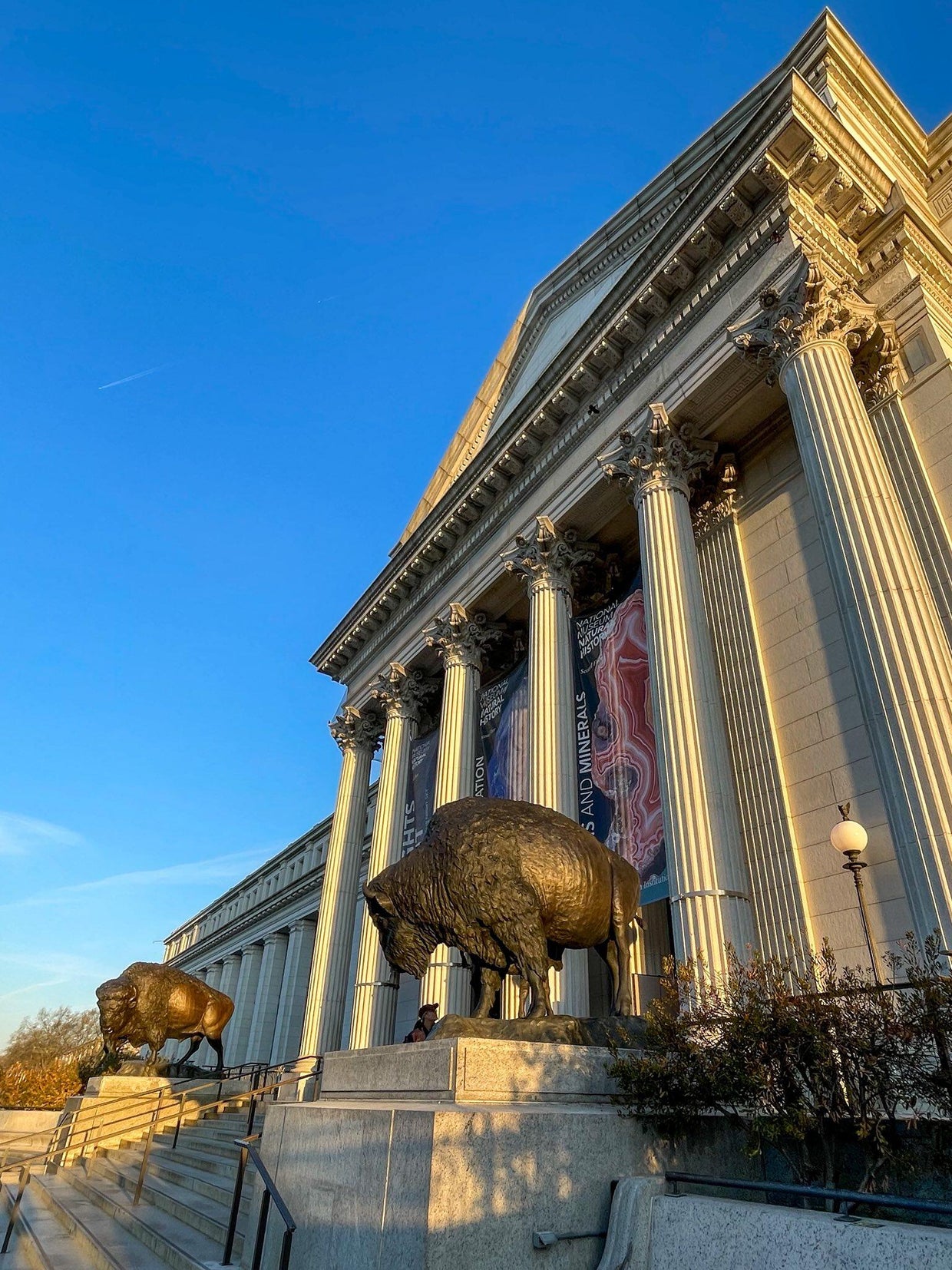
They finished the nearly 1,800-mile trip on March 19 and were installed in their permanent home in front of the museum that night. Now they stand on either side of the stairs leading to the museum’s National Mall entrance to greet visitors.
An exhibit at the museum detailing the bison’s resilience titled “Bison: Standing Strong” is scheduled to open on May 7. The “Imagining Bison Display Cases,” which will explore artistic and scientific depictions of Bison through books, maps, and other materials, is set to open on May 21.

Maine Maple Sunday Weekend draws visitors to 100-plus sugarhouses statewide

What’s on Maryland lawmakers’ deadline day to-do list

Sweet 16 crossroads for Nimari Burnett journey to Michigan basketball

Big ballot mistakes: Mass. rent control, tax cut proposals would backfire – The Boston Globe

NCAA women’s tournament takeaways, Day 3: Minnesota drains buzzer-beater as LSU, Texas dominate again

Florida High School Football Rankings: Top 25 teams – Oct. 21

How old is Bo Nix? What to know about Oregon quarterback ahead of 2024 NFL Draft

Cleary's 21 help Le Moyne down Central Connecticut State 69-64 in OT

99th annual Pony Swim held in Virginia

Indiana Members Credit Union announced as new anchor tenant at Bottleworks District

Video: Plane Collides With Vehicle at LaGuardia Airport

As cattle herds shrink and beef prices rise, investors back AI cow collars

French elections: Paris stays left as far right makes mixed gains

ICE officers set to deploy to airports as delays mount, border czar Homan confirms

Video: ICE Agents Will Be Deployed to U.S. Airports, White House Confirms
-

 Detroit, MI4 days ago
Drummer Brian Pastoria, longtime Detroit music advocate, dies at 68
-

 Oklahoma1 week ago
Family rallies around Oklahoma father after head-on crash
-

 Georgia1 week ago
How ICE plans for a detention warehouse pushed a Georgia town to fight back | CNN Politics
-
 Science1 week ago
Federal EPA moves to roll back recent limits on ethylene oxide, a carcinogen
-

 Alaska1 week ago
Police looking for man considered ‘armed and dangerous’
-

 Movie Reviews4 days ago
‘Youth’ Twitter review: Ken Karunaas impresses audiences; Suraj Venjaramoodu adds charm; music wins praise | – The Times of India
-

 World1 week ago
Thousands march worldwide in solidarity with Palestine, Iran on al-Quds Day
-

 World1 week ago
Jamal Rayyan, the first face of Al Jazeera, dies at 73