Colorado
Glendale rejects Colorado Boulevard Bus Rapid Transit plan; CDOT data shows some commute times could double


Glendale city leaders are forcefully opposing Colorado’s proposed Bus Rapid Transit project on Colorado Boulevard, warning the plan could dramatically worsen traffic for drivers while delivering only modest transit gains.
Last week, Glendale City Council voted unanimously in favor of a resolution recommending “no build” for the Colorado Department of Transportation’s proposed Bus Rapid Transit, or BRT, project along a seven-mile stretch of Colorado Boulevard.
“Hell no,” Glendale City Manager Chuck Line said in an interview with CBS Colorado.
“The juice is not worth the squeeze, not by a little, but by a long shot,” Line said.
The resolution cites concerns about increased congestion and what Glendale leaders described as negative impacts that outweigh the project’s forecasted increases in bus ridership and reductions in transit travel times.
And some of CDOT’s own projections appear to support at least part of Glendale’s concerns.
According to agency data reviewed by CBS Colorado, one proposed configuration featuring center- and side-running bus lanes would double southbound commute times for drivers traveling the full 7-mile corridor — from about 25 minutes to roughly 50 minutes.
Another option using side-running lanes would increase travel times by about 40%, according to CDOT projections.
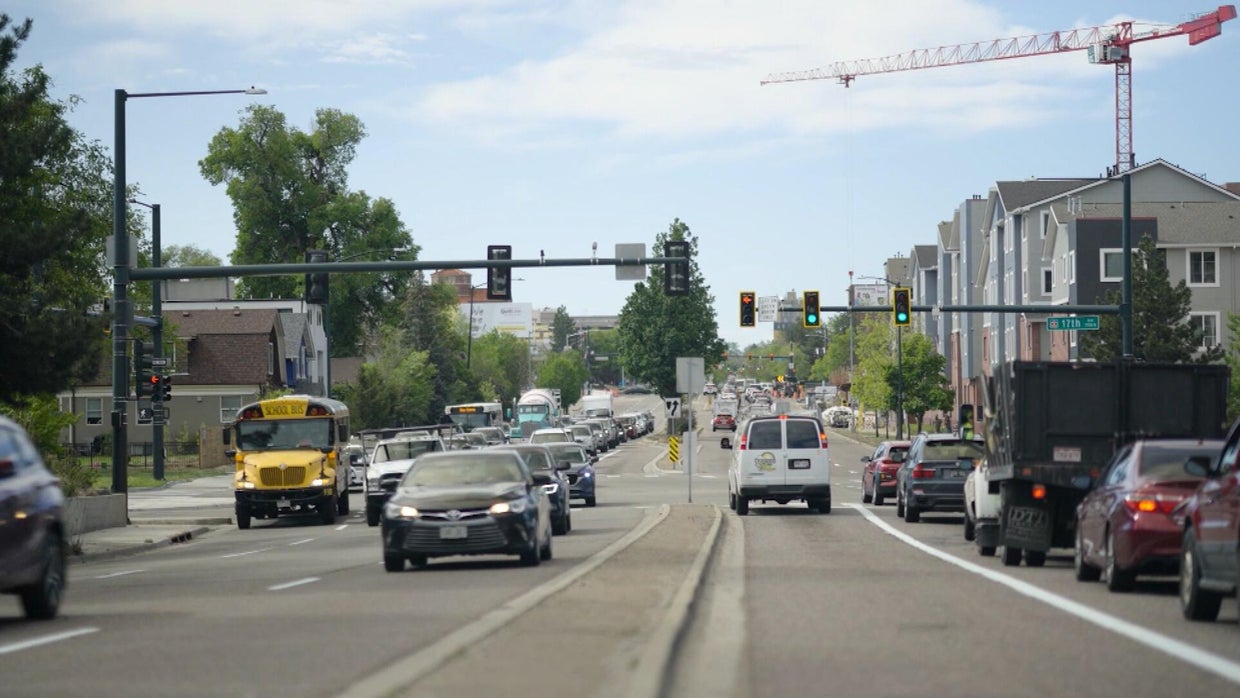
Drivers traveling shorter distances would likely experience smaller delays.
CDOT spokesperson Tamara Rollison suggested for people not wanting to spend more time stuck in Colorado Boulevard traffic, “Busses could be a viable option to take instead of your vehicle.”
“The plans they are offering,” said Line, “are so extreme and have such a big impact on millions of residents of this area that I don’t think they should be considering any of these three plans and should go back to the drawing board.”
CDOT is studying the BRT project as a way to improve transit service and safety along Colorado Boulevard between 40th Avenue and Hampden Avenue. About 1 mile of the corridor runs through Glendale.
The agency is considering several alternatives, including side-running bus lanes, center-running bus lanes, and mixed-flow traffic. No final decision has been made, and the project does not yet have a finalized cost estimate. CDOT hopes the eventual design will reduce crashes, improve traffic flow, and speed up bus service.
“A critical goal of this project is to improve safety as Colorado Boulevard is on the High Injury Network and has one of the highest crash rates and road-related fatalities in the region,” said Rollison.

CDOT data shows all of the proposed options would increase bus speeds along the corridor by roughly 20% to 30%.
Part of that improvement would come from simply reducing the number of bus stops. There are currently about 50 stops along the 7-mile corridor. Under the proposed BRT plans, that number would be cut to approximately 20.
State data also shows roughly 2,800 people currently ride buses along the Colorado Boulevard corridor each day. CDOT forecasts that number could rise to about 6,000 daily riders under a BRT system.
But Line argues the tradeoff could create ripple effects far beyond Colorado Boulevard itself.
He said prioritizing north-south traffic flow would likely require longer green lights on Colorado Boulevard, leading to longer red lights — and backups — on east-west streets.
“If that convenience is disrupted,” said Line, “it could have a significant impact on our business community.”
Glendale is not alone in its concerns. The Hilltop Neighborhood Association recently met with CDOT representatives to discuss the proposed changes.
“The success of this project should not be measured only by bus ridership,” said association president Courtney Mamuscia. “It should also be measured by whether nearby neighborhoods remain safe, livable, and protected from cut-through traffic.”
Residents worry that reducing lanes on Colorado Boulevard could divert more traffic onto neighborhood streets.
“Most residents,” said Mamuscia, “are skeptical of the current direction.”
She said many Hilltop residents share Glendale’s concerns that increasing bus ridership may not justify disruptions for tens of thousands of daily drivers.
CDOT has scheduled an open house on the Colorado Boulevard BRT project for Wednesday, May 13, from 5 p.m. to 7 p.m. at the Clayton Early Learning Center, 3801 M.L.K. Jr. Blvd. in Denver. People who are interested but can’t attend can take an online survey on a special section of CDOT’s website.
“We are still in the planning process, figuring out what is the best solution for Colorado Boulevard,” said Rollison, “and we haven’t gotten there yet.”


There are lots of cities and towns in the Denver area that are hosting professional fireworks shows on the Fourth of July this year.
Here are the shows taking place on July 4 in the Denver metro area:
Arvada
The City of Arvada’s annual fireworks display is scheduled to take place at Stenger Soccer Complex.
Date: Saturday, July 4
Time: 9:15 p.m.
Location: Stenger Soccer Complex
Admission: Free
Link: More Info
Aurora
The “4th of July Spectacular” takes place at the Aurora Municipal Center, located at 15151 E. Alameda Parkway.
Date: Saturday, July 4
Time: 9:30 p.m.
Location: Aurora Municipal Center
Admission: Free
Link: More Info
Brighton
Brighton’s Fourth of July festival takes place in Carmichael Park at 650 East Southern Street. Fireworks will be set off after the band Thumpin’ performs.
Date: Saturday, July 4
Time: After concert
Location: Carmichael Park
Admission: Free
Link: More Info
Broomfield
Broomfield’s Great American Picnic takes place at Broomfield County Commons Park, which is located at 13200 Sheridan Boulevard.
Date: Saturday, July 4
Time: 9:15
Location: Broomfield County Commons Park
Admission: Free
Link: More Info
Castle Rock
The Town of Castle Rock is planning to launch their Independence Day fireworks display from Miller’s Landing. The town is hosting a Independence Day Celebration at Festival Park, and the fireworks can be viewed from there, or several other locations in town.
Date: Saturday, July 4
Time: 9:30 p.m.
Location: Former Acme Brick facility
Admission: Free
Link: More Info
Commerce City
Fireworks will be set off outside Dick’s Sporting Goods Park as part of Commerce City’s 4thFEST celebration. They will be launched after the third of three rugby matches in the stadium.
Date: Saturday, July 4
Time: At the conclusion of the World Rugby Nations Cup
Location: Outside DICK’s Sporting Goods Park
Admission: 4thFEST is free, paid tickets required to see the rugby games
Link: More Info
Denver – Colorado Rockies games
Fans attending the July 4 Colorado Rockies home game at Coors Field will be treated to fireworks at the conclusion of the baseball game. There will also be fireworks for the game the night before — July 3.
Date: July 3 & 4 (against the San Francisco Giants)
Time: The fireworks are usually launched 20 to 30 minutes after the final out.
Location: Coors Field
Admission: Tickets required
Link: More Info
Englewood
In addition to all of its residents, the city of Englewood invites residents of Littleton, Sheridan, Arapahoe County and the South Suburban Parks & Recreation to their Independence Day Celebration.
Date: Saturday, July 4
Time: 9:15 p.m.
Location: Cornerstone Park and Belleview Park
Admission: Free
Link: More Info
Lone Tree
Lone Tree’s city fireworks display will be launched from Prairie Sky Park, and they’ll be viewable from many different locations in the city.
Date: Saturday, July 4
Time: 9:30 p.m.
Location: Prairie Sky Park
Admission: Free
Link: More Info
Longmont
You can watch a fireworks show in Longmont at 9:30 p.m. There will also be a drone show right before then.
Date: Saturday, July 4
Time: 9:30 p.m.
Location: Fireworks can be viewed “from many vantage points across the city.”
Admission: Free
Link: More Info
Louisville
The city of Louisville launches their annual fireworks show from Coal Creek Golf Course.
Date: Saturday, July 4
Time: 9:30 p.m.
Location: Coal Creek Golf Course
Admission: Free
Link: More Info
Northglenn
Fireworks are part of the July 4th Festival in Northglenn at E.B. Rains Jr. Memorial Park.
Date: Saturday, July 4
Time: 9:15 p.m.
Location: E.B. Rains Jr. Memorial Park
Admission: Free
Link: More Info
Parker
Fireworks on July Fourth will be visible from many parts of the town of Parker.
Date: Saturday, July 4
Time: 9:30 p.m.
Location: Fireworks launch northeast of Salisbury Park, although town officials encourage watching the fireworks from other areas, too
Admission: Free
Link: More Info
Thornton
Thornton’s fireworks display is called “Red, White & BOOM!” Fantabulous Fireworks.
Date: Saturday, July 4
Time: 9:30 p.m.
Location: Carpenter Park Fields
Admission: Free
Link:
More Info
Westminster
Date: Saturday, July 4
Location: Westminster City Park
Admission: Free
Link: More Info
There are other fireworks displays taking place in the Denver area on days other than July 4, including Lafayette (June 27), Glendale (June 2), Erie (July 3) and Littleton (July 3).

DENVER – The Colorado Avalanche Hockey Club announced today the team has signed defenseman Brett Kulak to a five-year contract extension through the 2030-31 season.
Kulak, 32, was originally acquired by the Avalanche in a trade with Pittsburgh on Feb. 24, 2026 and tallied three points (0g/3a) in 27 regular-season showings for Colorado over 19:08 of average time on ice per game. His 2025-26 regular season consisted of playing for the Edmonton Oilers and Penguins in addition to the Avalanche where he totaled 12 points (1g/11a) in 83 contests. Kulak was the only NHLer to skate in 83 games last season. Additionally, he dressed in his 600th career NHL contest on Nov. 15 at Carolina and notched his 100th career assist on Dec. 30 vs. Carolina.
The 6-foot-1, 192-pound defenseman was in the lineup for all 13 Stanley Cup Playoff games for the Avalanche in 2026 and chipped in five points (1g/4a) and logged 20:38 of time on ice per game. The goal was his first with the Burgundy and Blue, regular season or postseason, and it came as the overtime-winner in Game 5 of the Second Round (May 13) to send the Avalanche to the Western Conference Final. It was the third time a defenseman scored a series clinching overtime goal in Avalanche/Nordiques history and the first since Sandis Ozolinsh (Game 6 of the 1996 Conference Semifinal) did it 30 years to the date prior to Kulak’s. Additionally, Kulak’s marker was the 10th time an Avalanche/Nordiques skater sent the team to the next round with an overtime tally and the first instance since Artturi Lehkonen in Game 4 of the 2022 Western Conference Final (June 6, 2022).
A native of Edmonton, Alberta, Kulak has registered 137 points (29g/108a) in 663 career regular-season games with Colorado, Pittsburgh, Edmonton, the Montreal Canadiens and Calgary Flames from 2014-26. The last 370 of those games have come consecutively and he enters 2026-27 with the ninth-longest active “Iron Man” streak in the NHL. The left-shot defenseman has also added 29 points (4g/25a) over 111 career Stanley Cup Playoff contests and has been a member of three teams that have made it to the Stanley Cup Final (2023-24 and 2024-25 Oilers, 2020-21 Canadiens). Kulak’s 111 playoff games lead all NHL defensemen since making his postseason debut in 2020 and are second among all skaters in that span behind only Corey Perry (126).
Originally drafted by the Flames in the fourth round (105th overall) in the 2012 NHL Draft, Kulak appeared in 136 AHL games over parts of the 2012-19 campaigns (13g/41a). He was also a member of the then-ECHL Colorado Eagles for part of 2014-15. Prior to turning pro, Kulak played for the Western Hockey League’s Vancouver Giants from 2010-14 and amassed 128 points (35g/93a) in 216 regular-season contests.

COLORADO SPRINGS, Colo. (KKTV) – The Colorado Springs Police Department (CSPD) is searching for a missing child.
CSPD said 11-year-old Emilio Gerardo was last seen Thursday around 8:06 p.m. near North Carefree Circle and Peterson Road.
Gerardo is described as a 4-foot-8 and 65-pound Hispanic male with brown hair and brown eyes.
Police said he was last seen in a black shirt, black pants and black Converse shoes. They said he may have a VR headset with him.
Police said he could be in the area of Sand Creek High School or Remington Park.
If you see Gerardo or know where he may be, contact the Colorado Springs Police Department at 719-444-7000.
Copyright 2026 KKTV. All rights reserved.
-

 North Dakota5 minutes ago
Column: A possible bear season in North Dakota?
-

 Ohio8 minutes ago
Oregon Misses Out On Four-Star Offensive Lineman to Ryan Day, Ohio State
-

 Oklahoma13 minutes ago
Flooded roads prompt travel warnings across Northeast Oklahoma
-

 Oregon20 minutes ago
Public asked to help find missing 2-year-old Armani Andrews in Portland
-

 Pennsylvania23 minutes ago
Trump admin rule puts reproductive health care for 160K Pa. patients at risk, lawsuit says
-

 Rhode Island28 minutes ago
When will RI see promised Time-Varying Rates on electric bills? | Opinion
-

 South-Carolina35 minutes ago
Myrtle Beach is a hotspot for sharks and the potential to be bit
-

 South Dakota38 minutes ago
Work, housing and staffing: How South Dakota’s corrections chief aims to keep inmates from returning

