Colorado
Dangerous fire situation looming for parts of Colorado’s Front Range, as another day of strong winds lies ahead


Dangerous weather conditions in Colorado are expected to team up for a surge in the Front Range fire danger. For most of the day Friday conditions will be favorable for rapid fire spread. Avoid outdoor burning and any activity that may produce a spark. Friday will be a First Alert Weather Day.
The triple threat of hurricane force winds, record heat and single digit relative humidity will all be in force from 10 a.m. to midnight on Friday. That is when a red flag warning for high fire danger is issued.
For the first time in Colorado, the National Weather Service office in Boulder has issued an extra warning know as “A Particularly Dangerous Situation” for northwest Jefferson and western Boulder counties for possible wind gusts of 85 to 105 mph.
The worst areas will be from Highway 93 up into the higher foothills. That, combined with single digit relative humidity, will make conditions worse that what the state experienced on Wednesday.
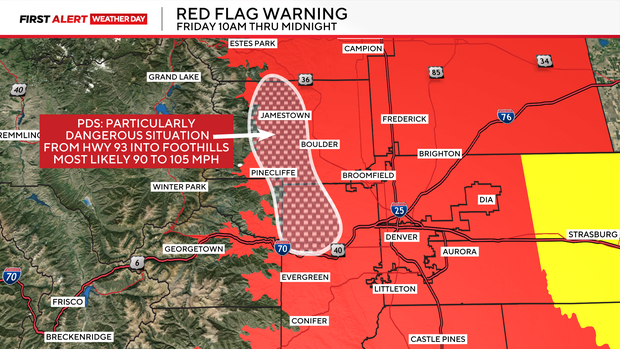
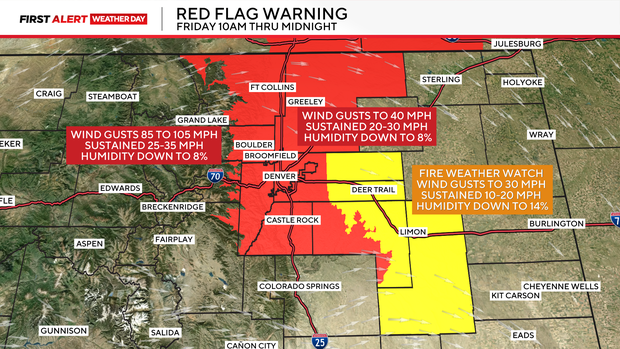
For the northern Front Range, the strongest winds will be west of I-25 into the foothills. Along and east of the I-25 corridor including the Denver metro area, winds may gust up to 40 mph with humidity levels as low as 8%. For that reason, the entire Denver metro area is in the warning area.
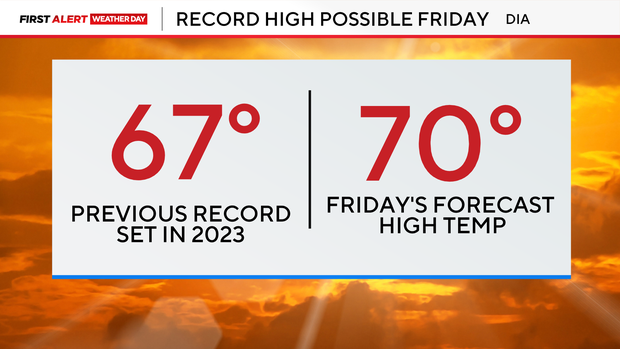
The strong winds will be warming downslope winds for eastern Colorado with highs on Friday shooting up into the 60s and 70s. Denver may have a new record high of 70 degrees. The old record is 67 degrees last set in 2023.
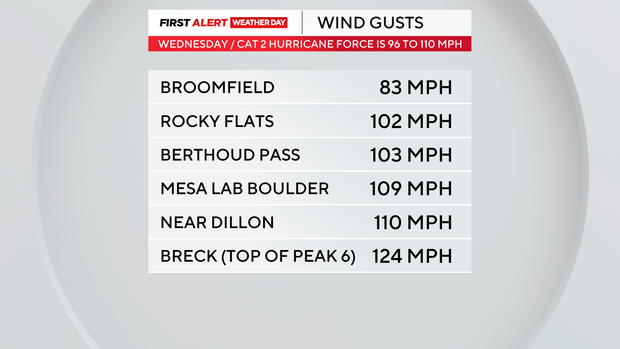
Top wind gusts may likely be stronger than Wednesday. Those gusts were hurricane force in some areas of the foothills and mountains with gusty winds comparable to those of a category 2 or 3 hurricane.


State and federal agencies are starting to reopen public lands, state wildlife areas and a segment of the Colorado River that were closed in light of the Snyder Fire in Mesa County.
Stage 2 fire restrictions — banning all open fire or flames, including charcoal grills and wood-burning stoves — remain in effect as extreme fire danger, spurred on by hot and dry conditions, persists across the region.
The Snyder Fire started on Friday, June 26, when several smaller fires burning on the Colorado-Utah border combined. As of July 7, the fire was 98% contained after burning over 30,200 acres and killing three wildland firefighters.
With fire activity decreasing and containment increasing, Colorado Parks and Wildlife and the Bureau of Land Management shared their plans Tuesday to reopen lands impacted by the wildfire.
Parks and Wildlife said in a news release that it, alongside the Bureau of Land Management, had lifted the closure for public access and downstream recreation on the Colorado River, starting at the James M. Robb-Colorado River State Park in Fruita and extending to the Utah state line. It also reopened the boat ramp at the Fruita section of the James M. Robb-Colorado River State Park in Fruita to downstream traffic.
The state agency’s Horsethief State Wildlife Area in Fruita and the Loma Boat Launch State Wildlife Area also reopened.
The BLM said in a news release that all lands within the perimeter of the Snyder Fire burn area remain closed to ensure public and firefighter safety.
“The burned landscape — including vegetation — remains dynamic and unpredictable as it naturally recovers from the fire impacts. This order is effective immediately and will remain in effect until the order is rescinded,” the BLM said.
Both agencies also warned that fire danger remains extremely elevated and Stage 2 fire restrictions are in place.
A map of current federal and state fire restrictions is available on the Rocky Mountain Area Interagency Fire Restriction Dashboard or by visiting DFPC.Colorado.Gov/sections/wildfire-information-center. The Colorado Trails Explorer (or COTREX) app also has wildfire closure alerts.
Under current conditions, Parks and Wildlife advised the following actions to prevent sparking wildfires:
- Use established rings: Where permitted, only build campfires inside permanent metal fire rings in designated campgrounds.
- Clear nearby debris: Remove all dry grass, leaves and pine needles within a 10-foot radius of any flame.
- Drown and stir: Extinguish fires completely with water, stir the ashes, and ensure the debris is cold to the touch.
- Watch campfires constantly: Never leave a fire or portable stove unattended. If you see an unattended fire, call 911.
- Keep vehicles off brush: Avoid parking or idling cars on tall, dry grass where hot exhaust systems can ignite a fire.
- Secure towing equipment: Ensure trailer safety chains do not drag and spark against asphalt. Check them at every stop.
The BLM added that under its Stage 2 restrictions, smoking is prohibited except in an enclosed vehicle or building, a developed recreation site, or while stopped in an area at least three feet in diameter that is barren or cleared of all flammable materials.
Gas-powered stoves or grills with a shut-off valve are still allowed in cleared areas under this stage.
Violating Stage 2 fire restrictions by lighting a campfire is a Class 2 misdemeanor. Violators face an immediate citation, a mandatory court appearance, steep fines and potential jail time. Additionally, you can be held financially liable for all fire suppression costs and property damage if the campfire sparks a wildfire.

A weekend ascent of one of Colorado’s most storied peaks turned fatal Sunday. Rocky Mountain National Park officials say a climber died on Kiener’s Route on the upper east face of Longs Peak, the 14,259-foot summit west of Estes Park, per KMGH. Search and rescue teams were alerted early Sunday afternoon; a Teton County helicopter assisted in the recovery, which wrapped up Monday morning.
Authorities have not released the climber’s identity or explained what went wrong, and the investigation is ongoing. More than 70 people have died climbing Longs Peak, the park’s tallest mountain, since the park was founded more than a century ago, per the Coloradoan. Indeed, the very first ascent via Kiener’s Route in 1925 proved fatal, per USA Today. The route—temporarily closed but since reopened—is considered the least technical way up Longs’ steep east face, requiring “intermediate alpine climbing skills” and a day or two of climbing, the outlet reports.

With wildfires burning across many Western states, wildland firefighters gathered Sunday to pay tribute to three of their own who died after they were trapped by flames a week ago.
Emily Barker, Nick Hutcherson and Sydney Watson were remembered as courageous public servants who left a lasting impact on the communities where they worked.
“They showed up to make order out of chaos day after day with purpose, dedication and heart,” U.S. Wildland Fire Service Chief Brian Fennessy said during a memorial service in Grand Junction, Colorado, near where the firefighters died while battling flames on the Colorado-Utah border.
While that fire is now almost entirely contained, nearly 40 large fires are still going strong across the West. Most of the current fires are scattered around Colorado, Utah and New Mexico while there are wildfires in eight other states — from Alaska to Arizona.
Over the holiday weekend, more evacuations in Colorado were ordered across four counties where the Aspen Acres fire had burned about 136 square miles (352 square kilometers) south of Colorado Springs.
The fire had damaged or destroyed more than 200 structures as of Sunday, authorities said. National Guard soldiers were sent in Friday to help with staffing checkpoints on roads near the fire zone.
Months of dry weather and a record lack of snow this past winter in some places along with erratic winds have been fueling the fires.
The three firefighters killed on June 27 in western Colorado were members of a Helitack crew that sometimes drops into remote areas by helicopters.
Barker, Hutcherson and Watson and two others who sustained burn injuries were overcome by flames from fast-moving fires in Mesa County. They had deployed emergency protective shelters, which are considered a “last resort” for firefighters when there is no other way out.
Fennessy, the Wildland Fire Service chief, said Sunday that “the weight of this tragedy is felt way beyond our wildland fire community.”
Photos of the firefighters were set up on the stage at the memorial service alongside flowers and flags.
They worked jobs that require courage, selflessness, strength and heart, said Sarah Fisher, the U.S. Forest Service’s deputy chief for fire and aviation management.
“The work demands long days, heavy burdens and quiet acts of bravery,” she said. “We will remember them, we will honor their legacy and we will carry their light forward.”
Emily Barker
Barker, 38, had so much spirit, and the people around her always strived to be a better person by her presence, said Sarah Brubeck Schnurbusch, a friend and former roommate.
Barker was from Clinton Township, Michigan, and liked hiking, skiing, dirt biking and playing hockey. She loved firefighting.
“I’ve never seen someone so excited to go to work,” Brubeck Schnurbusch said. She added that her friend helped pave the way for many women in the industry.
Barker was a trailblazer, first working as a teacher “shaping young lives,” Fennessy said.
“She didn’t just live in wild places, she helped to shape them, care for them and make them better,” he said.
Nick Hutcherson
Hutcherson, 27, served in the U.S. Navy and had plans to become a physical therapy doctor, according to the Kaibab National Forest in northern Arizona where he was assigned. He was also an active member of the Northern Arizona Deaf and American Sign Language community.
Hutcherson, who was from Glendale, Arizona, “embodied the spirit of public service” Fennessy said.
He was a dedicated practitioner of Muay Thai martial arts who trained in Flagstaff.
His favorite saying was “easy day,” Fennessy said, “because Nick had an uncommon ability to face hard things with optimism, humility and a smile.”
Sydney Watson
Watson, 27, was from Warrior, Alabama, and a graduate of the University of Tennessee Southern, where she was a pitcher on the softball team, the university said.
In 2023, she participated in a program in North Carolina organized by the Women-in-Fire Prescribed Fire Training Exchanges, the group said. In her application, she said she wanted to see more women on the fire line and to learn from other women in the field, the university said.
“From the time she was very young, she knew she wanted to be a firefighter someday,” Fennessy said.
“I have no doubt she inspired many young women to become a firefighter,” he said.
-
 Lifestyle15 minutes ago
Can you say no to a friend’s wedding? : It’s Been a Minute
-

 Technology23 minutes ago
The robotaxi law that could ban Tesla
-

 World30 minutes ago
US urges donors to abandon UNRWA funding as UN defends agency’s mission
-

 Politics33 minutes ago
EXCLUSIVE: FBI adds alleged COVID fraudster accused of taking $5M from kids’ meal program to Most Wanted list
-

 Health38 minutes ago
One walking habit could signal a healthier brain after 80, scientists say
-

 Sports45 minutes ago
New Jersey pro wrestling promotion bringing the fight to the beach
-

 Technology48 minutes ago
Are airline miles still worth it?
-
 Business53 minutes ago
Walmart’s EV chargers are coming to California with discounts for members

