West
Colorado drug bust uncovers cartel-connected illegal aliens, approximately 130k fentanyl pills
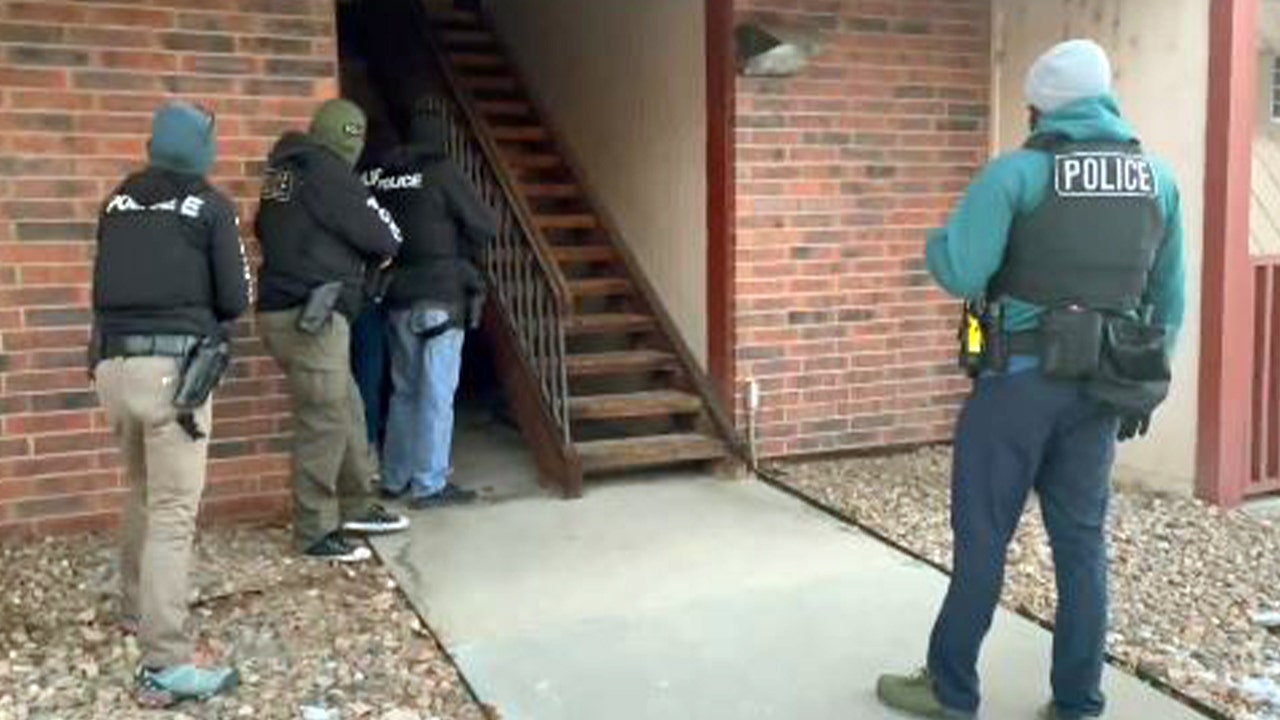
A drug bust near Denver, Colorado, on Monday resulted in the arrest of two cartel-connected illegal aliens and the seizure of various drugs, including a very large stash of fentanyl pills.
In a joint operation, the Drug Enforcement Agency’s Rocky Mountain Field Division (RMFD) and the Rocky Mountain High Intensity Drug Trafficking Area task force executed a search warrant at an apartment complex in the Denver area on Monday morning.
Videos posted on the RMFD’s X account showed law enforcement officers approaching and then breaching the door to a first-level apartment.
TRUMP ADMIN TOUTS PURGING ‘WORST’ ILLEGAL IMMIGRANT CRIMINALS FROM US STREETS: ‘WORKING TIRELESSLY’
Two illegal aliens tied to the Mexican Sinaloa and Jalisco cartels were arrested and approximately 130,000 fentanyl pills, heroin, cocaine and meth were seized during a drug bust in the Denver, Colorado, area. (DEA Rocky Mountain Division/X)
The agency said the raid uncovered two illegal aliens connected to the Sinaloa and Jalisco Mexican cartels, approximately 130,000 fentanyl pills and some cocaine, meth and heroin.
The two men, who were not identified by name, were arrested.
The DEA Rocky Mountain Division and the Rocky Mountain High Intensity Drug Trafficking Area seized approximately 130,000 fentanyl pills during a drug bust in the Denver, Colorado, area. (DEA Rocky Mountain Division/X)
“Message to the bad guys: the next door we kick in just may be yours,” RMFD captioned one of its videos from the bust.
This operation comes one day after the DEA took dozens of illegal aliens into custody after raiding a makeshift nightclub in the Denver area associated with the violent Venezuelan gang Tren de Aragua.
DEA agents seen with handcuffed illegal immigrants outside a makeshift nightclub, where alleged Tren de Aragua gang affiliates were apprehended. (DEA Rocky Mountain Field Division) (DEA Rocky Mountain Field Division)
DEA BUSTS DRUG TRAFFICKERS IN MAKESHIFT NIGHTCLUB, TAKES 50 ILLEGAL ALIENS INTO CUSTODY
Since President Donald Trump took office last week, U.S. Immigration and Customs Enforcement raids have detained thousands of illegal aliens nationwide.
On Monday alone, ICE said 1,179 people were arrested, and 853 immigration detainers were lodged.
The Trump administration is pushing ICE to increase the number of arrests per day from a few hundred to between at least 1,200 to 1,500 people, according to a previous report by Fox News Digital.
Read the full article from Here

Alaska
Man with same name as Alaska Sen. Dan Sullivan can appear on GOP primary ballot, state’s Supreme Court rules
The battle of the Dan Sullivans is on.
The Alaska Supreme Court ruled Monday that a man with the same name as Republican Sen. Dan Sullivan can challenge the sitting lawmaker in the state’s GOP Senate primary in August. The high court upheld a ruling from a lower court judge that cleared the way for Daniel J. Sullivan to appear on the primary ballot, reversing a decision by state officials earlier this month that he was ineligible because he was allegedly trying to confuse voters.
The state Supreme Court directed Alaska’s Division of Elections to decide how Daniel J. Sullivan should be listed on the ballot “within the confines of existing Alaska ballot design law.”
The conflict is taking place in one of the country’s most closely watched Senate elections. The sitting Sen. Sullivan is running for a third term, but former Democratic Rep. Mary Peltola is vying to challenge him, setting up what could be an unusually competitive race in a deep-red state that hasn’t elected a Democrat to the Senate in almost 20 years.
The senator has called his same-name competitor a “sham candidate” and accused him of trying to trick voters and help Democrats flip the seat. Daniel J. Sullivan — a retired teacher and former U.S. Forest Service employee from Petersburg, Alaska — has denied those allegations and insisted he is both qualified and genuinely interested in running for Senate.
About two weeks ago, the Alaska Division of Elections determined that the challenger Sullivan could not appear on the ballot, arguing his paperwork “was not filed in order to declare an actual good-faith candidacy, but was instead filed with a purpose to confuse or mislead.”
In a letter to the candidate, Director Carol Beecher pointed to the fact that Daniel J. Sullivan had initially requested to appear on the ballot as “Dan Sullivan,” the same name format as the senator. She also wrote that he hadn’t previously been affiliated with the state Republican Party, had a website design that “appears to be deliberate[ly]” similar to the senator’s campaign site and had worked with a political consultant with links to Democratic candidates.
Daniel J. Sullivan asked a state court to reverse the decision. On Friday, Judge Thomas Matthews ruled in his favor, finding the non-senator Sullivan met the requirements to run for U.S. Senate and the state didn’t have the authority to exclude him based on “good faith.”
“The court does not minimize the Division’s concern that voters should not be misled,” the judge wrote. But he added that “Alaska election law gives the Division tools to address that concern,” including regulating how candidates appear on the ballot.
With ballots set to be printed this week, the issue was appealed to the Alaska Supreme Court on an expedited basis, with both sides filing court papers over the weekend.
The state Division of Elections asked the high court to overturn Matthews’ ruling, arguing it would “leave Alaska constitutionally required to permit bad-faith ballot access.” The agency said it reached its conclusion about Daniel J. Sullivan after it received a complaint from the National Republican Senatorial Committee “credibly alleging” he was seeking to “cause voter confusion” and made a “bewildering” request to appear on the ballot with the senator’s middle initial.
If Daniel J. Sullivan is permitted to remain on the ballot, the state asked the Alaska Supreme Court to allow it to print his full name and list his party affiliation as “nonpartisan” to “ensure voters are not forced to guess between two nearly identical names.”
The Alaska Republican Party and several GOP-led states filed amicus briefs siding with Alaska.
Daniel J. Sullivan’s lawyers, meanwhile, argued the state “lacked any basis in Alaska law to exclude Mr. Sullivan from the ballot” and didn’t have the power to look into his “private motivations.” They wrote that state law doesn’t give officials the power to keep qualified candidates off the ballot due to potential confusion.
“[All] that Mr. Sullivan asks here is to be listed on the ballot, and the Division is obviously empowered to do so in a non-confusing manner,” his lawyers wrote.
Following oral arguments, the high court sided with Daniel J. Sullivan in a two-page order late Monday, and said it would issue a fuller opinion at a later date.
Jeffrey Robinson, an attorney for Daniel J. Sullivan, told CBS News his legal team is “grateful” for the Alaska Supreme Court’s decision to “affirm Judge Matthews’ well-reasoned, thorough order vacating the Division’s unlawful decision to exclude Mr. Sullivan as a candidate.”
“We expect that the Division will act in full compliance with existing Alaska ballot design law in its preparation of the ballots,” Robinson said in an email.
The senator’s campaign spokesperson, Nate Adams, said: “We’re disappointed in the court’s decision because as the sham candidate Dan J. Sullivan’s lawyers made clear in their legal arguments, the only reason he is running is to deceive voters and manipulate Alaska’s election system.”
“However, we are encouraged by the fact that the Director of the Division of Elections will be able to use her expertise to differentiate between the Petersburg fraud and the incumbent — Senator Dan Sullivan — to the benefit of Alaska voters,” Adams said.
Arizona
Arizona Medicaid work requirements are 6 months away. What to know
What to know about coming Arizona Medicaid work requirements
Stephanie Innes interviews Meaghan Kramer at the Arizona state Capitol about the coming Arizona Medicaid work requirements.
Not a day goes by without staff at the Valle del Sol health clinic in Phoenix strategizing about the looming date of Jan. 1, 2027, and what it will mean for their low income patients’ health coverage.
“We will absolutely see a spike in uninsured people. My biggest concern is that people who are eligible will be cut because of the administrative burden,” said Mike Renaud, the CEO of Via del Sol, a federally qualified community health center that sees roughly 15,000 patients per year, half of whom are covered by Medicaid, which in Arizona is called the Arizona Health Care Cost Containment System or AHCCCS, pronounced “access.”
“Medicaid is the largest health insurance program for low income people in the United States. It is the largest payor of mental health services in the U.S.”
Jan. 1, 2027 — six months away — is the deadline for Medicaid programs in 43 states across the country, including Arizona, to implement major policy changes that include work requirements and twice-yearly renewals (up from once yearly) for certain enrollees.
In Arizona, the new rules will mark the largest operational change in the history of the AHCCCS program, said Meaghan Kramer, health policy adviser to Gov. Katie Hobbs.
“This is the fastest they’ve ever had to do something that is operationally complex. And this is the most operationally complex thing they’ve ever had to do,” Kramer said. “We’re straining existing systems that are already old and overburdened on the IT side. And we will need much, much more work on the eligibility side than we have now.”
The changes are a result of HR1, the budget reconciliation bill also known as the One Big Beautiful Bill Act, which President Donald Trump signed into law on July 4, 2025.
The law significantly changes both eligibility and financing of Medicaid, which is a government health insurance program primarily for low-income people that has been in place since 1965. Arizona has had a Medicaid program since 1982.
Having only 18 months to prepare for HR1 is an extremely heavy technological lift for states, including Arizona. Arizona’s aggressive implementation of HR1 changes to SNAP, the Supplemental Nutrition Assistance Program once known as food stamps, resulted in the highest rate of loss of SNAP recipients in the country, with about 450,000 dropping from the program from February 2025 to mid-2026.
Recipients and would-be recipients have told The Arizona Republic SNAP benefits are harder to get than ever, with long hold times on the phone and at satellite offices, a dysfunctional website and fewer DES employees to help them.
The new state budget that was recently signed includes a little more than $10 million that will go to technology and to employees who will be handling the increased workload, Kramer said.
Hopefully state officials have learned from the experience with SNAP and “don’t make the same mistake again,” said Will Humble, executive director of the Arizona Public Health Association.
“The computer system needs to improve and the staff needs to be trained,” Humble said. “I’m convinced the majority of people who lose coverage will lose it because of administrative reasons.”
Further complicating the implementation is that the Centers for Medicare & Medicaid Services recently released a 387-page interim final rule with strict new guidelines about Medicaid work requirements. The new guidelines, for example, do not automatically exempt people with cancer and end-stage renal disease, among other conditions, from the work requirements.
“It is written in a way that makes it clear this is going to be a much more challenging task than any state anticipated,” Kramer said of the guidelines. “States are really struggling with what this new guidance means…The new guidance is going to be much more burdensome on the member, the applicant and the Medicaid agency long-term.”
Twenty-four attorneys general, including Arizona Attorney General Kris Mayes, and two governors on June 30 sued the federal government over the document, arguing that it illegally narrows congressional protections of medically frail people enrolled in the program.
AHCCCS as of June 1 provided health insurance to approximately 1.8 million Arizonans, which works out to one in four state residents. About one in four of those AHCCCS enrollees or 400,000 and 500,000 people, are expected to be part of the adult expansion population affected by the work requirements and twice-annual renewals.
At Valle del Sol, Renaud said clinicians and other staff are already educating patients and clearing up misinformation.
“We want to make sure they understand this is not a Medicaid cut. It is increased barriers to maintaining coverage.”
Here are seven things to know about the coming changes to Medicaid in Arizona:
Outreach to AHCCCS enrollees begins in September
AHCCCS will be providing communications to impacted enrollees by Sept. 1. Most enrollees probably don’t know whether they are part of the affected adult expansion population and that’s part of the outreach. People covered by AHCCCS can expect to see communications via mail, text and email.
“The goal will be to make sure we are providing reliable information to everybody to reassure folks that they should continue to fill out paperwork when they are prompted by their health plan or by AHCCCS,” Kramer said.
For now, there is nothing Arizonans need to do, AHCCCS officials say, except to keep their contact information current on Health-e-Arizona Plus; respond if AHCCCS or your health plan reaches out to you; and watch for official updates from AHCCCS, not third parties.
The changes won’t hit all affected enrollees at once
Annual AHCCCS renewals (also known as redeterminations) happen on a rolling basis, and that’s how the twice-annual renewals and work requirements will be handled, too, Kramer said.
“If they were redetermined last Jan. 1 they will get redetermined again the next Jan. 1. And then beginning that year they are getting redetermined every six months,” she said.
The work requirements allow for volunteer work and school
Enrollees who are part of the adult expansion population will need to prove they are working at least 80 hours per month or doing another qualifying activity, like job training or education, to avoid losing coverage.
It’s unclear how enrollees prove they are working, volunteering
State officials are able to verify through pay stubs that some people are already meeting the work requirements, but not for everyone. And at some point “self-attestation” − simply saying you are volunteering or in school − won’t be enough.
“What we know is the rules are more aggressive beginning in year two (2028) and there will be some allowance for self-attestations in the first year,” Kramer said.
“But after the first year, beginning Jan. 1, 2028, self-attestations are only permitted once in a continuous eligibility cycle. So that would place an enormous burden on AHCCCS and DES (the Arizona Department of Economic Security), which plays a large role in Medicaid eligibility determinations.”
Kids, seniors and Native populations won’t be affected
Several categories of Arizona’s Medicaid expansion populations will be exempt from the work requirements, such as but not limited to, pregnant and postpartum women, people who are disabled or medically frail, parents and caretakers of children under 14, caregivers of someone with a disability, American Indians and Alaska Natives, and those already meeting similar requirements under SNAP.
Kramer said that state officials are working to determine on their end who is exempt from the requirements in order to lessen the burden on enrollees.
Arizona will be offering short-term hardship exceptions to the work requirements for people who have recently been hospitalized, who need to travel outside of their community for medical care, who live in a county with high unemployment rates, or who live in a community where a national emergency or disaster has recently been declared, Cordoba, the AHCCCS spokesperson, wrote in an email.
Technology could be a problem in Arizona
AHCCCS relies primarily on two major systems to administer eligibility and benefits and both are old.
PMMIS, the agency’s core Medicaid administration system, was originally implemented in 1991 and is currently undergoing modernization, with the updated platform scheduled to go live in October 2027, Cordoba wrote. HEAplus, Arizona’s eligibility system, was implemented in 2013.
“While both systems have undergone significant upgrades and enhancements over time to support changing federal and state requirements, the PMMIS modernization project will not be complete before the federal requirements in H.R. 1 take effect,” Cordoba wrote.
Health entities are trying to prevent AHCCCS coverage losses
Hospitals, community health centers and health plans already connect people to benefits, including AHCCCS. One of the key goals of those entities statewide is to ensure enrollment specialists are all trained on how to interact with the technology that’s going to be used to implement HR1, Kramer said.
All those entities have an interest in keeping people insured. Without health insurance, people tend to wait until their health problems reach a critical point before seeking care, which can cause personal medical debt, bad debt for hospitals, and increased health costs across the board.
The Health System Alliance of Arizona, which includes major Arizona health systems such as Banner Health and HonorHealth is “extremely concerned about eligible individuals losing Medicaid coverage due to the increased renewals and work requirements passed in HR1,” Brittney Kauffmann, alliance CEO wrote in an email.
“Our systems are assessing all options to ensure Medicaid members are aware of these changes.”
Reach health-care reporter Stephanie Innes at stephanie.innes@usatodayco.com or follow her on X: @stephanieinnes or on Bluesky: @stephanieinnes.bsky.social.
California
What you should know about the $351.7 billion state budget Newsom just signed
SACRAMENTO — Gov. Gavin Newsom on Monday signed his final state budget as governor, a $351.7-billion spending plan that seeks to uplift the poorest Californians through a tax system reliant on the stock market gains of the wealthy.
In a video message, Newsom extolled free school meals, universal transitional kindergarten, 130,000 subsidized childcare slots and other accomplishments in his tenure at the state Capitol, a period in state history marked by a dramatic expansion of state government and over $100 billion in increased spending.
“Over the past eight years, we built great things for the people of California — some of the boldest actions any government in this country has taken in a generation,” Newsom said. “And we did this without breaking the bank. We did this by design.”
The agreement ends weeks of lobbying by outside interests and negotiations among lawmakers and the governor at the state Capitol about how to handle a surge of income tax collected on stock market gains related to artificial intelligence.
Economists have warned that the revenue bump is potentially temporary and analysts say the growth in state spending could leave California in a challenging position if the economy declines.
Assemblymember David Tangipa (R-Fresno) agreed with Democrats that the budget is “compassionate.”
“My fear is that it’s not too much of a competent budget, and the budget continues a pattern that Californians know all too well: Spend now, justify it later, and hope somebody else pays the bill,” he said during a floor debate Monday.
Here’s what you need to know about the spending plan, which takes effect July 1.
Who decides the state budget?
The simplest answer is: Democrats. California voters have elected Democrats to represent 30 of the 40 seats in the Senate and 60 seats of the 80 seats in the Assembly. The budget was passed through a majority vote in each house of the Legislature and signed by Gov. Gavin Newsom, also a Democrat.
A more complex answer is that the budget is a product of dozens of legislative hearings, millions of dollars spent on lobbying by outside interests, talks among lawmakers and the governor and ultimately subject to the same political dynamics that rule the Democratic party.
Senate President Pro Tem Monique Limón (D-Goleta) and Assembly Speaker Robert Rivas (D-Hollister), in consultation with the chairs of the budget committees, represent their Democratic caucuses and reach a final agreement on the details of the spending plan with Newsom. In reality, staff members for the three parties handle most, if not all, of the back of forth negotiations to get there.
Union leaders seeking better pay, working conditions, benefits for workers and opportunities to expand their ranks are often brought in to consult or hammer out thorny deals as business groups try to fight off more regulations, taxes and costs, and support policies that increase their financial performance.
Democrats are spending more than ever before. How is that possible?
The Legislative Analyst’s Office, the nonpartisan fiscal advisor for lawmakers, recently examined the increase in state spending since 2019-20, Newsom’s first full year in office.
Between the budget approved that year and the spending proposal Newsom unveiled in January, spending from the state’s main operating fund had grown by over $100 billion, or 70%. That was largely by a 60% increase in revenue during that time. California typically operates with a spending deficit because Democrats spend more money than the state brings in.
The LAO found that the increase in spending stemmed from the growing cost of sustaining programs and services that were already in place when Newsom took office. About 30% of the remaining spending growth was categorized as new, either by newly created programs or the expansion of existing services.
Among the report’s conclusions: California could not afford the programs that predated Newsom and the ones he and the Legislature adopted.
To balance the budget over the last few years, Newsom and lawmakers have dipped into the state’s reserves at a time when California is experiencing strong revenue growth, which the LAO has cautioned against. Democrats have also increased taxes on businesses, paid for programs out of other funds and suspended reserve deposits among other solutions.
This year, the state budget places $6.4 billion in higher than expected revenue into a temporary holding account to knock down a deficit and balance the budget through 2027-28.
Democrats are pursuing a change to the state constitution on the November ballot that would allow them to set aside more money in years of good revenue growth to prevent cuts in future downturns.
Where is the money going?
Education and Medi-Cal are the two largest costs for the state.
Medi-Cal is the state’s version of subsidized health insurance for low-income Californians and provides medical, dental and vision care for an estimated 14.5 million people, or about one-third of the state population.
The federal government pays for more than half of the cost of the program. California is expected to spend about $50 billion from the general fund next year out of a total estimated at more than $220 billion in costs shared between the state and federal government, according to the LAO. State taxes and fees on providers also help fund Medi-Cal.
Overall, Medi-Cal costs more than any other state program and takes up about 40% of total spending, including federal funds the state receives, according to the LAO.
Spending on Medi-Cal has more than doubled over the last 10 years, which the LAO attributes to an increase in costs per enrollee, more enrollees and a greater share of seniors seeking care, among other factors.
Under Newsom, California has expanded Medi-Cal, including offering coverage to include all immigrants regardless of their immigration status, which the governor said has dropped the state’s uninsured rate down to 5.9%
The cost of Medi-Cal has grown beyond what Democrats expected and resulted in Newsom suggesting spending cuts.
The final budget agreement rejects a call by Newsom to lower the asset limit to $2,000 now and instead lowers it to $21,000 in 2027-28 to be eligible for Medi-Cal. The Legislature also delayed the governor’s proposal to reduce dental coverage and shift asylum seekers and other immigrants to restricted scope Medi-Cal, according to Jason Sisney, the lead budget advisor for the Assembly who posts about the budget on Substack.
The budget includes Newsom’s proposal to shift enrollees with unsatisfactory immigration status, a term that includes undocumented immigrants and others, from managed care to fee-for-service to save costs.
Under Proposition 98, approved by voters in 1988, California has a minimum funding guarantee for schools and community colleges and dedicates roughly 40% of general fund revenue to education.
Sisney said the budget increases the Local Control Funding Formula by $2.2 billion and provides historic general fund per pupil spending of $21,148. Support for special education also grew by $1.8 billion.
The California Community Schools Partnership Program received a $1-billion boost and Democrats directed $2.8 million in additional funding to the program that provides free meals for school children.
The budget also establishes 22,770 new slots for free or reduced childcare, which Newsom had proposed decreasing.
-
Washington, D.C3 minutes agoD.C.’s July 4th fireworks will have “TSA-style” security, won’t start until 11 p.m.
-
Augusta, GA5 minutes ago16-year-old wanted in aggravated assault case in Augusta
-
Cleveland, OH13 minutes ago
Earth and Essence IV Spa Launches Free GLP-1 Weight Loss Consultation in Cleveland
-
Austin, TX20 minutes agoAustin Police search for suspects in 7-Eleven robbery
-
Alabama23 minutes agoAlabama under first heat advisory of the season as officials urge residents to take precautions
-
Alaska28 minutes agoMan with same name as Alaska Sen. Dan Sullivan can appear on GOP primary ballot, state’s Supreme Court rules
-
Arizona35 minutes agoArizona Medicaid work requirements are 6 months away. What to know
-
Arkansas38 minutes ago
Arkansas Lottery Powerball, Cash 3 winning numbers for June 29, 2026