West
California’s politicians didn’t start the fires. They made them worse

NEWYou can now listen to Fox News articles!
Seeing homes in Malibu and the Pacific Palisades burn to the ground while fire hydrants ran dry is bad enough, but knowing the water shortage resulted from bad bureaucratic decisions makes the horrifying sights even worse.
Water is everywhere in California. The Golden State borders the Pacific Ocean, which contains countless gallons that could be desalinated to fill reservoirs and feed fire hydrants.
But California’s bureaucracy discourages desalination plants that would guarantee additional water, and no reservoirs were built with the $2.7 billion authorized in 2014.
LOS ANGELES WILDFIRES: CALIFORNIA FIREBUG ARREST CAUGHT ON VIDEO AS POLICE WARN OF ARSONISTS
Environmentalists prefer blaming climate change for wildfires, just like the ancient Greeks blaming their gods when things went wrong. It’s passing the buck rather than looking in the mirror.
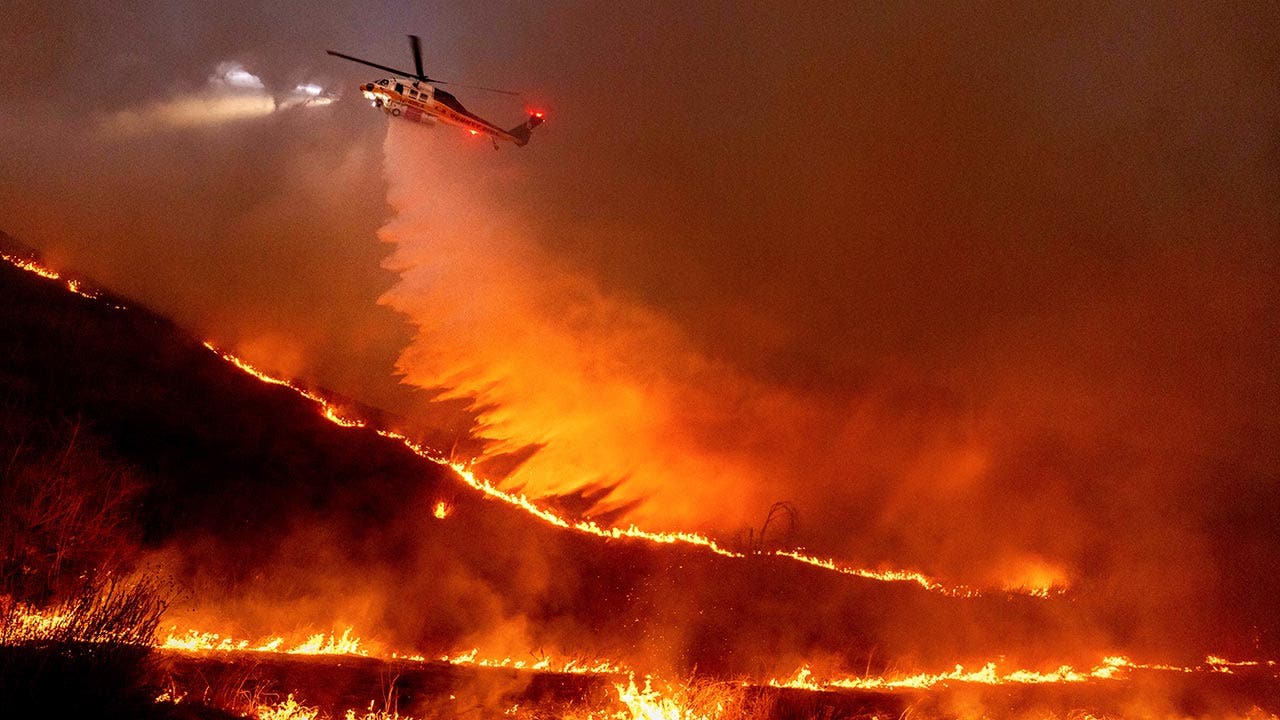
Water is dropped by helicopter on the Kenneth Fire in the West Hills section of Los Angeles, Thursday, Jan. 9, 2025. (Ethan Swope/AP)
Acres of fires burned on federal lands from 1916 to the mid-1940s, when CO2 emissions were lower, were as high as levels in the first decade of the 2000s.
In California, politicians promoted an agenda to get rid of water, energy and minerals, which increased human suffering. The question is how they retain power without people voting them out of office.
This is particularly true when considering the tragedy of the fire, which could have been prevented by water.
State agencies that must approve desalination projects include the State Water Resources Control Board, the California Coastal Commission, the California State Lands Commission, the California Department of Fish and Wildlife, Monterey Bay National Marine Sanctuary, the National Marine Fisheries Service’s West Coast Region and the six coastal regional water quality control boards. This system is designed to slow progress.
Plus, approval depends on tribal consultation, environmental justice, consideration of marine life and energy efficiency, among other factors.
California has awarded $120 million for desalination projects, compared to $1.4 billion on charging stations and $500 million for electric school buses. The California Air Resources Board has the power to fast-track clean air regulations.
Surely, if California can afford billions of dollars on electric vehicles, the state can afford to fill its reservoirs with water — especially since the wildfires are doing more harm to the air than gasoline-powered vehicles?
Countries with lower GDP than California have no trouble building desalination plants. Such plants produce over 7 million cubic meters per day in the United Arab Emirates, about 40% of the country’s drinking water. Kuwait and Oman use desalination for about 90% of their drinking water, and Saudi Arabia’s share of desalinated water is 70%.
More burned-out cars from the Eaton fire at a Brake Masters in Altadena. (Fox News Digital / Ashley Carnahan)
Bahrain has recently completed its second desalination plant, with new reverse osmosis energy-efficient technology from Veolia Water Technologies, headquartered in France. The plant produces 227,000 cubic meters a day and began operations after 22 months.
The problem is that California’s government has created water scarcity, just as it created energy scarcity and critical mineral scarcity.
CLICK HERE FOR MORE FOX NEWS OPINION
California requires 60% of its energy to be created from renewables by 2030, so it has an energy scarcity with high prices. The legislature unanimously passed the Seabed Mining Prevention Act in 2022, which prevents extracting critical offshore minerals, leaving America at the mercy of China.
The environmentalist agenda, which focuses on scarcity rather than abundance, gives power to governments to distribute those limited resources. In times of scarcity, people become dependent on government rather than depending on their own actions.
Water is everywhere in California. The Golden State borders the Pacific Ocean, which contains countless gallons that could be desalinated to fill reservoirs and feed fire hydrants.
One of the two houses on his street that survived the 2018 Wolsey Fire in Malibu was owned by Robert Kerbeck, author of “Malibu Burning: The Real Story Behind L.A.’s Most Devastating Wildfire,” who learned in advance how to spray his home with fire retardant and who cut back brush that could feed the flames.
As Kerbeck recently wrote, “We need more water to fight fires, more reservoirs to store the water, and more firefighters with the right kind of equipment to battle these massive wind-driven blazes.”
California’s policies are often based on a myth inside an enigma, to paraphrase Churchill about the Soviet Union. Californians who promoted the agenda of energy, water, and mineral scarcity for the sake of the environment should think again. Nature should not be worshiped at such cost to people.
CLICK HERE TO READ MORE BY DIANA FURCHTGOTT-ROTH
Read the full article from Here



A Northern California brewery has become the latest victim of declining alcohol consumption after it announced the closure of its taproom in a trendy San Francisco neighborhood.
“We’re sharing that our San Francisco Tasting Room will close Today, Monday, June 29,” a message on Ballast Point Brewing’s Instagram page read about the closure of its location in Mission Bay.
“We’re grateful to everyone who visited, shared a beer, celebrated milestones, and made this location part of the local craft beer community over the years.”
“Thank you for your support and for the memories we’ve made together,” it added.
Started in San Diego’s Home Brew Mart in 1992, the craft beer company has been a favorite of IPA lovers for decades, according to their website.
Known for fan-favorite brews like Fathom, Sculpin and Longfin IPA — the San Diego beer maker rocketed from local favorite to craft brewing giant after opening a flagship brewery and restaurant in the city’s Little Italy neighborhood in 2013.
By 2015, Ballast Point had become one of the country’s top craft breweries by sales volume — and landed a staggering $1 billion buyout from Constellation Brands.
But the brewery’s fortunes quickly went flat.
Just five years later, Constellation unloaded Ballast Point to Chicago-based brewer Kings & Convicts in a deal reportedly worth less than $100 million, according to Food & Wine.
Even as ownership changed hands, Ballast Point continued expanding its footprint, opening restaurants and tasting rooms across California between 2013 and 2023 — including its San Francisco location, which debuted in 2023, the San Francisco Chronicle reported.
Three years later the company announced to fans it was leaving, with no explanation as to why. It also pointed out people could still visit their tasting rooms in “Little Italy, Anaheim, and Long Beach” and find their beers at their favorite “local bars, restaurants, and grocery stores.”
“To everyone who supported our San Francisco Tasting Room over the years, thank you,” the message added.
“Your enthusiasm and loyalty have meant the world to us, and we look forward to raising a glass with you again soon.”
Other craft beer companies and wine makers have experienced similar situations amid declining sales of liquor, beer and wine over the past few years.
Earlier this year, major winemaker Gallo announced the closure of a large production facility and the elimination of nearly 100 jobs across the wine growing region of Napa and Sonoma counties.
The company said there would be staff cuts at Louis M. Martini Winery and the Orin Swift Tasting Room in St. Helena, as well as J Vineyards and Frei Ranch in Healdsburg.
In January, Constellation Brands notified more than 200 people at the Mission Bell Winery in Madera that they would be out of work. And Jean-Charles Boisset Collection closed two Napa Valley tasting rooms.
Last year, two big Northern California brewing company’s — San Francisco’s Fort Point Beer Co and Sonoma County-based HenHouse brewing — merged in order to keep operating.
The number of American adults who say they consume alcohol has fallen to 54%, according to an August 2025 Gallup poll.

Fire crews gained some containment on one of five wildfires burning across Colorado on Tuesday, while others forced more people to evacuate their homes. The fires charred roughly 148 square miles and destroyed at least 100 buildings.
The Snyder, Gold Mountain, Ferris, Willow and Aspen Acres fires have consumed 94,189 acres as of Tuesday evening.
While fire officials said crews made good progress, firefighters are also facing terrain that’s often extremely steep or inaccessible as well as high temperatures, low humidity and gusty winds.
Aspen Acres fire in Custer and Pueblo counties
Driven by 100 mph winds, the Aspen Acres fire has consumed 28,362 acres — roughly 44 square miles — since it sparked Monday, destroyed at least 100 structures and forced evacuations, according to the Pueblo County Sheriff’s Office.
Damage assessment teams are still working on getting to the structures destroyed by the wildfire and will contact property owners directly whenever possible, Pueblo County Sheriff David Lucero said during an update Tuesday afternoon.
Fire activity picked up Tuesday night, leading Pueblo County officials to issue new evacuation orders for people living in the North Creek area, including Central Road to the Custer County Line.
“DO NOT WAIT. PLEASE EVACUATE NOW,” the Pueblo County Sheriff’s Office said in a post on X.
Mandatory evacuations in the Beulah, Rye, San Isabel Lake, Aspen Acres, Lazy Acres and Bishops Castle areas and surrounding roads are still in place.
Snyder fire in Mesa County and Utah
Colorado’s largest wildfire saw a small amount of growth overnight Monday and into Tuesday as firefighters worked on building lines along eastern and southern edges to prevent more spread.
The Snyder fire, which killed three firefighters and injured two others Saturday, scorched 30,209 acres, or 47 square miles, with 10% containment as of Tuesday evening.
The wildfire’s footprint grew about 200 acres between Monday night and Tuesday afternoon, mostly by smoldering and creeping along the eastern edge, Operations Section Chief Nick Ostrom said in an update posted on social media.
Lighter winds have helped firefighters in the past few days, Ostrom said, but National Weather Service forecasters on Tuesday issued a red flag warning for critical fire weather conditions that are expected until at least Thursday.
Colorado Parks and Wildlife officials on Tuesday closed the boat ramp to the Colorado River in the James M Robb State Park for firefighter safety.
Gold Mountain fire near Ouray
A complex incident management team took over the Gold Mountain fire near Ouray on Monday night as the wildfire continued to burn across “very steep, inaccessible country.”
Fire officials mapped the wildfire at 12,376 acres, or almost 20 square miles, as of Tuesday night, up from 7,103 acres on Monday.
Ouray County officials ordered more mandatory evacuations on Tuesday afternoon, including Lower Cow Creek east of county roads 12 and 12A to the Owl Creek U.S. Forest Service Boundary. Previous mandatory evacuation orders for other areas of Ouray County are still in place, sheriff’s officials said, and part of U.S. 550 is closed.
Ferris fire in San Juan National Forest, near Dolores
The lightning-sparked Ferris fire continued burning on 21,495 acres, or 33 square miles, with no containment northwest of Dolores, but firefighters managed to stop it from spreading into a nearby subdivision despite strong winds and low humidity.
Mandatory evacuations are still in place for people living north and east of the wildfires, including the Glade Ranch subdivision, according to the Dolores County Office of Emergency Management.
Firefighters are focused on protecting homes and the historic Benchmark Lookout, operations section chief Pat Seekins said in an update.
Federal and state wildlife officials have closed public access to lands near the fire for safety, including the Bradfield Bridge Campground, Lone Dome State Wildlife Area and surrounding roads.
Willow fire near Leadville
People living near Turquoise Lake west of Leadville remained under mandatory evacuation on Tuesday as crews continued fighting the Willow fire.
The wildfire is burning on 2,011, or 3 square miles, with no containment in the San Isabel National Forest near the Leadville National Fish Hatchery.
Firefighters are focused on building lines to stop the fire from moving west, toward homes near the Halfmoon Diversion Dam, and east toward Leadville, Operations Chief William Dudley said Tuesday night.
Campgrounds around Turquoise Lake, the Colorado Trail and Hagerman Pass into Pitkin County are also under evacuation orders, Lake County officials said.
The cause of the fire is under investigation.
Get more Colorado news by signing up for our Mile High Roundup email newsletter.
-

 Wisconsin29 seconds ago
Missing Wisconsin teen Joniah Walker found safe 4 years after disappearing from home
-

 West Virginia7 minutes ago
Transmission line proposals raise ratepayer cost concerns in West Virginia
-

 Wyoming10 minutes ago
Wyoming Department of Health warns of scam callers using official phone number
-

 Crypto15 minutes ago
Bank of Thailand Backs 1:1 Baht Stablecoin While Tightening Cross-Border Payment Rules
-

 Finance22 minutes ago
Google Cloud Pursues Financial Markets in FactSet Alliance | PYMNTS.com
-

 Fitness25 minutes ago
Boutique Fitness Is Redefining How Americans Work Out. Which Drop-In Classes Are Worth Booking?
-

 Movie Reviews37 minutes ago
‘Supergirl’ Movie Review
-

 World45 minutes ago
Map: 6.0-Magnitude Earthquake Shakes Off Mexico’s Coast

