


- Tariffs impact businesses in Rye Canyon differently
- Supreme Court may rule on Trump’s emergency tariffs soon
- Some businesses adapt, others struggle with tariff costs
California
What the death of local news actually means

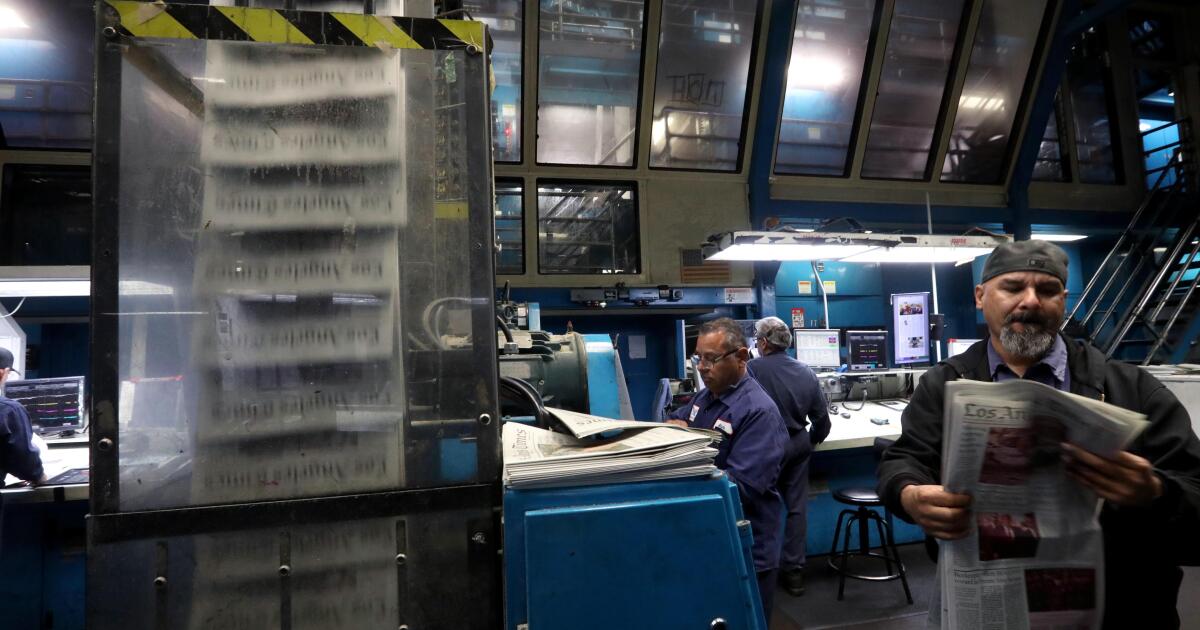
Good morning. It’s Wednesday, July 24. I’m Gustavo Arellano, a metro columnist, which means I’m allowed to have opinions like:
Newspapers are cool.
But before I begin my rant, here’s what you need to know to start your day.
Whither the news industry in California?
Since I was a teen, I’ve lapped up newspapers.
I used to steal the sports section from the rolled-up newspapers on the driveways of homes on the way to Sycamore Junior High in Anaheim. When I realized there was more to life than just the Angels and Dodgers, I’d jump a fence every Sunday morning to buy copies of the Orange County Register and L.A. Times from news boxes in my neighboring apartment complex. Once I got a job my senior year of high school, I subscribed to those two papers along with the New York Times.
I went into journalism straight out of college despite earning a film studies degree — I’ve never regretted it. But as the years went on, I ended my print subscriptions because I could read for free on the internet most of what I used to pay for.
An empty news rack that used to sell the Spanish-language newspaper Excélsior still remains along Bristol Street in a small shopping area in Santa Ana.
(Genaro Molina / Los Angeles Times)
It’s people like me who launched the proverbial Little Boy that destroyed too many journalism outlets to count.
But the Fat Man remains companies like Craigslist, Google and Facebook, which eradicated the traditional business model of news organizations — advertising. This one-two punch has led to mass layoffs, shutdowns and a society where misinformation reigns.
Two bills currently in the California Legislature, Assembly Bill 886 and Senate Bill 1327, seek to confront this digital dystopia.
The former would require social media giants such as Facebook and search engines like Google to pay news outlets for using their content; the latter would use the revenue gathered from a proposed tax on user data gathered by Big Tech to gift news groups a tax credit for every full-time journalist they employ. The California News Publisher Assn., of which The Times is a member, supports AB 886, arguing it could give the state’s dying news industry — and local news — a lifeline.
(Tech companies vehemently oppose the bills, arguing it’s unfair to target them when the news industry hasn’t kept up with modernity and readers have more options to get their news than ever before.)
These bills aren’t merely a desperate money grab by the lamestream press, folks.
A limping media ecosystem affects society in many ways — few of them good.
Times reporters investigated the decline of local news and what it actually means. Here’s what we found:
- More big businesses control the narrative. The largest news source in Richmond, Calif., is owned by the Bay Area town’s largest business: Chevron. That means in a city where pollution concerns are real from the company’s refinery, its digital rag doesn’t say a damn thing, Jessica Garrison reported.
- News that serves disenfranchised communities is ignored. Santa Ana is one of the most-Latino big cities in the United States. Twenty years ago, dozens of local semanarios (weekly papers) and all sorts of sports, entertainment and lifestyle magazines covered the goings-on of the city. Today, just two publications focused on entertainment fluff remain. I looked at how important issues affecting residents now get ignored.
- Tech companies are intent on winning. Australia and Canada passed bills similar to what California legislators have proposed. Some money went to publishers, but tech bros created chaos by blocking news from their platforms, national correspondent Jenny Jarvie reported.
- AI is only making things worse. AI chatbots might openly lift local journalists’ work and either pass it off as their own or mischaracterize it. “The average consumer that just wants to go check [out a restaurant], they’re probably not going to read [our article] anymore,” L.A. Taco editor Javier Cabral told Wendy Lee on AI’s effects on his scrappy indie site.
- Even news nonprofits — long seen as a foolproof solution — are having a rough time of it: The Long Beach Post had eclipsed the 127-year-old Press-Telegram in readership and gravitas but now finds itself in tatters after nearly three-quarters of its reporters resigned over editorial and business disputes with management. Those defectors now have their own publication, the Long Beach Watchdog, James Rainey reported.
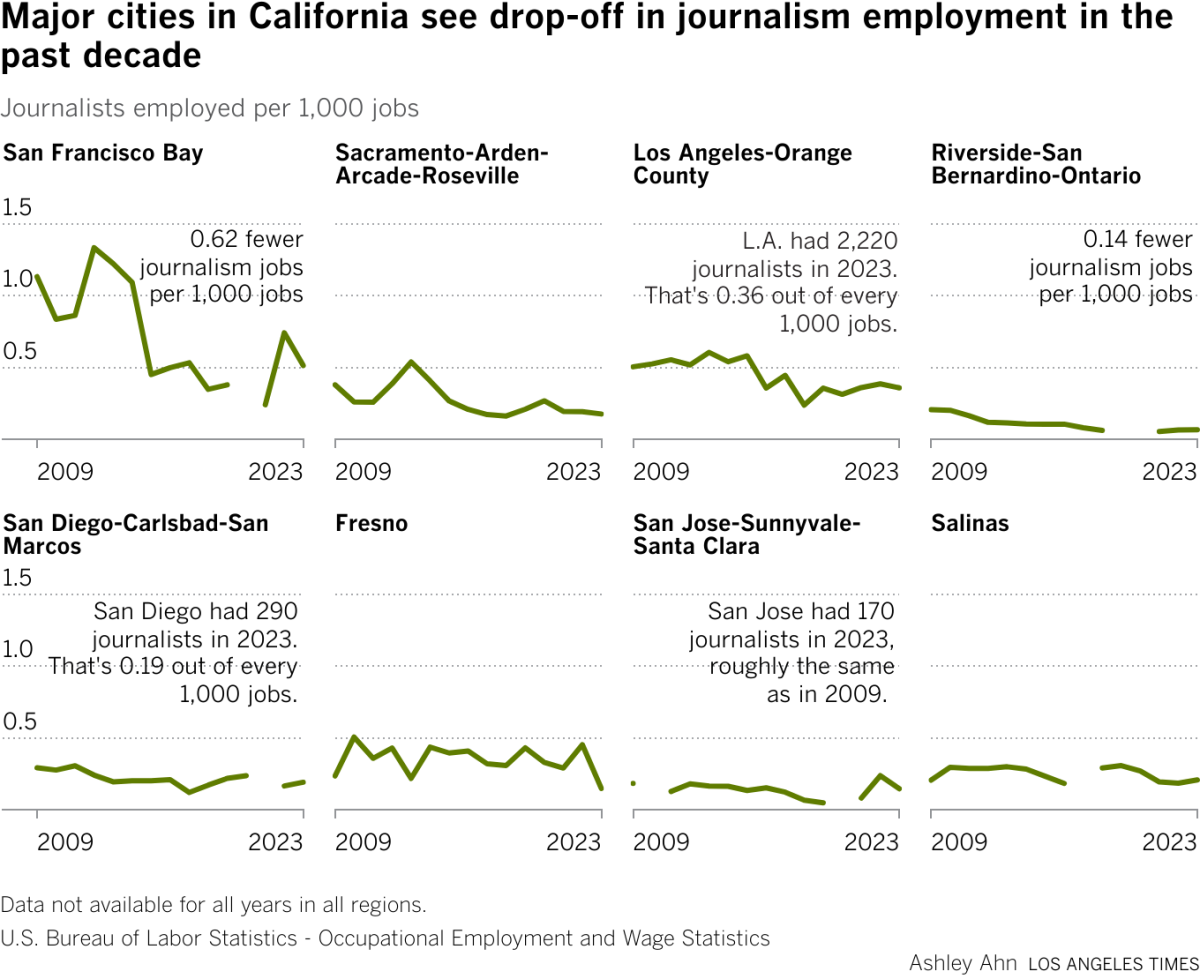
- There are fewer reporters to hold power accountable. The people paid to objectively find out what people in power are trying to hide from you … we’re losing jobs like the Halos are losing fans, Ashley Ahn showed.
I thank you, gentle reader, for reading this newsletter, offer you a virtual high-five if you subscribe to Essential California, and gift you a digital gold star if you are a Times subscriber. And if you read this without paying us? We pardon you — and ask you to subscribe. Hey, $1 for four months is a deal anyone can afford, amirite?
Today’s top stories

Vice President Kamala Harris campaigns at West Allis Central High School in West Allis, Wis.
(Kayla Wolf / Associated Press)
Kamala Harris hits the trail
Coronavirus in California
How clean is your weed?
Fentanyl
- The family of 3-year-old twins who died of a suspected fentanyl overdose is in shock. Relatives said they had no idea the boys’ mother used the opioid.
- Their mother has been charged with murder.
- Just last week, another toddler died of a fentanyl overdose. DCFS had trusted his mom’s friend to keep him safe
More big stories
Get unlimited access to the Los Angeles Times. Subscribe here.
Today’s great reads

A plate of tacos is displayed at the Industrial Downtown Night Market.
(Dania Maxwell / Los Angeles Times)
How L.A. reached peak taco. To understand how Los Angeles became the world’s most taco-diverse city, let’s start with the taco truck.
Other great reads
How can we make this newsletter more useful? Send comments to essentialcalifornia@latimes.com.
For your downtime

Tacos at Bandito Taqueria.
(Andrea D’Agosto / For The Times)
Going out
Staying in
And finally … from our archives
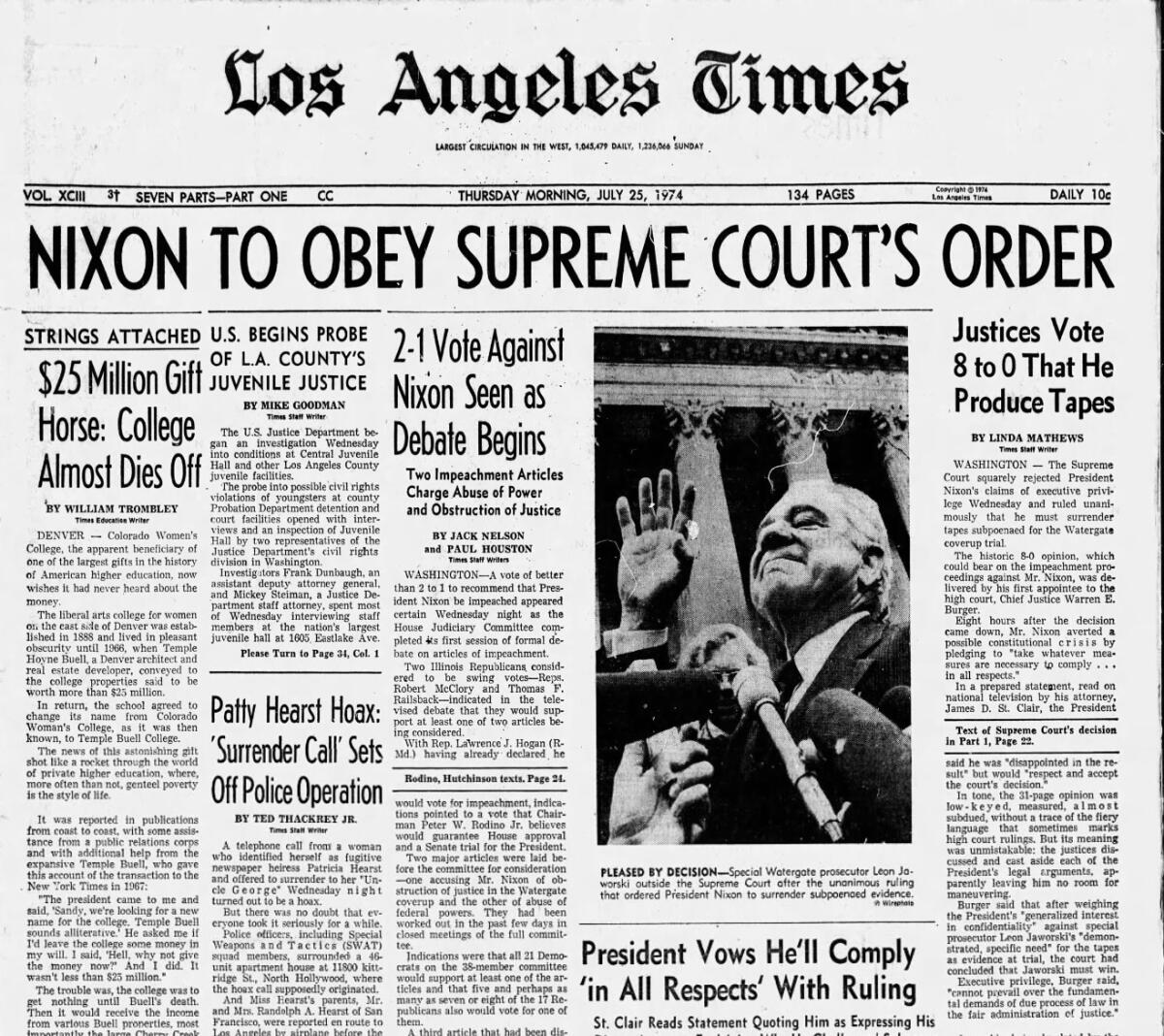
On this day in history, the Supreme Court voted 8 to 0 that President Nixon had to turn over transcripts of the Watergate tapes to Special Counsel Leon Jaworski.
Have a great day, from the Essential California team.
Ryan Fonseca, reporter
Defne Karabatur, fellow
Andrew Campa, Sunday reporter
Kevinisha Walker, multiplatform editor and Saturday reporter
Christian Orozco, assistant editor
Stephanie Chavez, deputy metro editor
Karim Doumar, head of newsletters
Check our top stories, topics and the latest articles on latimes.com.


California Gov. Gavin Newsom unveiled a record-high $350 billion state budget Friday that makes “historic” investments in areas like education — but kicks the can on paying down federal debt, foisting costs onto struggling employers.
Newsom’s budget incorporates a $43 billion windfall tied to the stock market that he touted in his State of the State speech Thursday, bringing his office’s estimated deficit down to $3 billion — the state’s fourth deficit in a row. The budget plows billions into maintaining education, health care, and other programs but ignores a $20 billion federal loan for Covid unemployment payments — a situation one legislator called “alarming.”
Ignoring the loan means small businesses are on the hook for the state’s debt, said state Sen. Roger Niello of Fair Oaks.
“We already have the highest unemployment in the nation and we’re putting this additional burden on our employers. It makes absolutely no sense,” Niello said.
The budget includes $662.2 million in mandatory interest payments, but there is no money going towards the principal.
Since July, the total balance has ballooned to $21.3 billion, and private employers in California pick up the tab under federal rules. Employers pay an $42 extra per employee this year and growing, per KCRA
Every state expect California has paid off the Covid-era loans.
“That is an alarming thing because [Newsom is] basically saying that businesses and employment are not a priority to him and that’s troubling,” Niello added.
At 5.5%, California’s unemployment rate was the highest in the country as of November.
Newsom’s $350 billion budget proposal is about $30 billion higher than this year’s budget, thanks largely to federal healthcare cuts that forced costs onto the state and mandatory set-asides in areas like education.
At a budget briefing Friday, Newsom’s finance director Joe Stephenshaw highlighted record spending on education— amounting to a record $27,418 per K-12 student, $5.3 billion for the University of California system, $15.4 billion to community colleges, and $1 billion to needy schools — along with $500 million towards local homelessness prevention, $195 million in new public safety spending, $3 billion for the state’s rainy day fund and $4 billion for school reserve funds.
The budget includes some cuts to climate-related spending and housing and homelessness, per Calmatters. And it does not include any direct funding for Prop. 36, the anti-crime measure supported by nearly 70% of voters in 2024 — a move Republicans blasted.
But even with Newsom’s unexpected windfall, analysts expect deficits to grow to as high as $35 billion in the coming years as expenditures outpace even optimistic revenue projections.
Newsom and the state Legislative Analyst create separate budget projections, and the governor’s has historically been far rosier on the revenue side. The legislative analyst projected a $18 billion deficit in the coming fiscal year, while the governor calculated $3 billion.
Under Newsom, the state’s general fund spending has increased by 77% partly owing to new programs spun up when the state was flush with cash, according to Republican legislators.
Newsom’s $350 billion budget — the last before he leaves office next year — does little to confront ballooning expenses, dumping the problem on the future governor and Legislature, according to Senate Minority Leader Brian Jones.
“This is more of the same from a lame-duck governor content on leaving the rest of us to pick up the financial pieces when he leaves office,” Jones said in a statement.
Democrats in the legislature were more measured in their responses.
“During these times of uncertainty, we must craft a responsible budget that prioritizes the safety and fiscal stability of California families,” said State Senate Leader Monique Limón in a statement.
Newsom and legislators will refine the budget in the coming months towards a final proposal in May.
One major unknown is how California will handle a loss of about $1.4 billion in funding due toTrump administration changes to low-income health care and food programs.
Last year, Newsom was force to scale back a controversial plan to provide Medicaid coverage for illegal immigrants after costs spiked, forcing California was forced to borrow $3.4 billion, Politico reported.
Newsom’s budget didn’t fully explain what would happen to immigrant health care under federal cuts, and Stephenshaw struggled to answer detailed questions from reporters — saying Newsom’s office was still awaiting guidance from the feds.
“As we work through the May revision, this is something we’ll be well aware of and we’ll make those decision at that time,” he said.

VALENCIA, California, Jan 9 (Reuters) – America’s trade wars forced Robert Luna to hike prices on the rustic wooden Mexican furniture he sells from a crowded warehouse here, while down the street, Eddie Cole scrambled to design new products to make up for lost sales on his Chinese-made motorcycle accessories.
Farther down the block, Luis Ruiz curbed plans to add two imported molding machines to his small plastics factory.
Sign up here.
“I voted for him,” said Ruiz, CEO of Valencia Plastics, referring to President Donald Trump. “But I didn’t vote for this.”
All three businesses are nestled in the epitome of a globalized American economy: A lushly landscaped California business park called Rye Canyon. Tariffs are a hot topic here – but experiences vary as much as the businesses that fill the 3.1 million square feet of offices, warehouses, and factories.
Tenants include a company that provides specially equipped cars to film crews for movies and commercials, a dance school, and a company that sells Chinese-made LED lights. There’s even a Walmart Supercenter. Some have lost business while others have flourished under the tariff regime.
Rye Canyon is roughly an hour-and-a-half drive from the sprawling Ports of Los Angeles and Long Beach. And until now, it was a prime locale for globally connected businesses like these. But these days, sitting on the frontlines of global trade is precarious.
The average effective tariff rate on imports to the U.S. now stands at almost 17%–up from 2.5% before Trump took office and the highest level since 1935. Few countries have been spared from the onslaught, such as Cuba, but mainly because existing barriers make meaningful trade with them unlikely.
White House spokesman Kush Desai said President Trump was leveling the playing field for large and small businesses by addressing unfair trading practices through tariffs and reducing cumbersome regulations.
‘WE HAD TO GET CREATIVE’ TO OFFSET TRUMP’S TARIFFS
Rye Canyon’s tenants may receive some clarity soon. The U.S. Supreme Court could rule as early as Friday on the constitutionality of President Trump’s emergency tariffs. The U.S. has so far taken in nearly $150 billion under the International Emergency Economic Powers Act. If struck down, the administration may be forced to refund all or part of that to importers.
For some, the impact of tariffs was painful – but mercifully short. Harlan Kirschner, who imports about 30% of the beauty products he distributes to salons and retailers from an office here, said prices spiked during the first months of the Trump administration’s push to levy the taxes.
“It’s now baked into the cake,” he said. “The price increases went through when the tariffs were being done.” No one talks about those price increases any more, he said.
For Ruiz, the plastics manufacturer, the impact of tariffs is more drawn out. Valencia makes large-mouth containers for protein powders sold at health food stores across the U.S. and Canada. Before Trump’s trade war, Ruiz planned to add two machines costing over half a million dollars to allow him to churn out more containers and new sizes.
But the machines are made in China and tariffs suddenly made them unaffordable. He’s spent the last few months negotiating with the Chinese machine maker—settling on a plan that offsets the added tariff cost by substituting smaller machines and a discount based on his willingness to let the Chinese producer use his factory as an occasional showcase for their products.
“We had to get creative,” he said. “We can’t wait for (Trump) to leave. I’m not going to let the guy decide how we’re going to grow.”
‘I’M MAD AT HIM NOW’
To be sure, there are winners in these trade battles. Ruiz’s former next-door neighbor, Greg Waugh, said tariffs are helping his small padlock factory. He was already planning to move before the trade war erupted, as Rye Canyon wanted his space for the expansion of another larger tenant, a backlot repair shop for Universal Studios. But he’s now glad he moved into a much larger space about two miles away outside the park, because as his competitors announced price increases on imported locks, he’s started getting more inquiries from U.S. buyers looking to buy domestic.
“I think tariffs give us a cushion we need to finally grow and compete,” said Waugh, president and CEO of Pacific Lock.
For Cole, a former pro motorcycle racer turned entrepreneur, there have only been downsides to the new taxes.
He started his motorcycle accessories company in his garage in 1976 and built a factory in the area in the early 1980s. He later sold that business and – as many industries shifted to cheaper production from Asia – reestablished himself later as an importer of motorcycle gear with Chinese business partners, with an office and warehouse in Rye Canyon.
“Ninety-five percent of our products come from China,” he said. Cole estimates he’s paid “hundreds of thousands” in tariffs so far. He declined to disclose his sales.
Cole said he voted for Trump three times in a row, “but I’m mad at him now.”
Cole even wrote to the White House, asking for more consideration of how tariffs disrupt small businesses. He included a photo of a motorcycle stand the company had made for Eric Trump’s family, which has an interest in motorcycles.
“I said, ‘Look Donald, I’m sure there’s a lot of reasons you think tariffs are good for America,” but as a small business owner he doesn’t have the ability to suddenly shift production around the world to contain costs like big corporations. He’s created new products, such as branded tents, to make up for some of the business he’s lost in his traditional lines as prices spiked.
He pulls out his phone to show the response he got back from the White House, via email. “It’s a form letter,” he said, noting that it talks about how the taxes make sense.
Meanwhile, Robert Luna isn’t waiting to see if tariffs will go away or be refunded. His company, DeMejico, started by his Mexican immigrant parents, makes traditional-style furniture including hefty dining tables that sell for up to $8,000. He’s paying 25% tariffs on wooden furniture and 50% on steel accents like hinges, made in his own plant in Mexico. He’s raised prices on some items by 20%.
Fearing further price hikes from tariffs and other rising costs will continue to curb demand, he’s working with a Vietnamese producer on a new line of inexpensive furniture he can sell under a different brand name. Vietnam has tariffs, he said, but also a much lower cost base.
“My thing is mere survival,” he said, “that’s the goal.”
Reporting by Timothy Aeppel; additional reporting by David Lawder
Editing by Anna Driver and Dan Burns
Our Standards: The Thomson Reuters Trust Principles.

California Congressman Darrell Issa discusses reports that as many as 20 billionaires could leave the state amid concerns over a proposed new wealth tax which critics say is driving high-net-worth taxpayers out of California on ‘The Evening Edit.’

New Mexico2 minutes ago
Timothy Busfield Charged With Child Sex Abuse On ‘The Cleaning Lady’s New Mexico Set; WBTV Will “Cooperate With Law Enforcement”

North Carolina8 minutes ago
North Carolina confirms 5th measles case as South Carolina’s outbreak surges

North Dakota14 minutes ago
Hoeven, Armstrong, Traynor speak on OBBB Rural Health Transformation Fund updates in ND

Ohio20 minutes ago
Ohio high school girls basketball scores: Friday, Jan. 9, 2026

Oklahoma26 minutes ago
Former Oklahoma State QB Zane Flores announces transfer destination in the Big 12

Florida1 year ago
Florida High School Football Rankings: Top 25 teams – Oct. 21

Connecticut2 years ago
Cleary's 21 help Le Moyne down Central Connecticut State 69-64 in OT

Oregon2 years ago
How old is Bo Nix? What to know about Oregon quarterback ahead of 2024 NFL Draft

Virginia1 year ago
99th annual Pony Swim held in Virginia

Education2 years ago
Video: ‘It Didn’t Have to Happen This Way:’ U.Va. Faculty Call for Review of Police Response to Protests

Politics4 hours ago
Federal judge blocks Trump from cutting childcare funds to Democratic states over fraud concerns

World5 hours ago
Russia-Ukraine war: List of key events, day 1,416

News5 hours ago
Trump administration can’t block child care, other program money for 5 states: Judge

Politics16 hours ago
AOC accuses Vance of believing ‘American people should be assassinated in the street’
World17 hours ago
Mercosur: How Macron’s domestic weakness undercut his Brussels clout
-

 Detroit, MI6 days ago
2 hospitalized after shooting on Lodge Freeway in Detroit
-

 Technology4 days ago
Power bank feature creep is out of control
-

 Dallas, TX5 days ago
Defensive coordinator candidates who could improve Cowboys’ brutal secondary in 2026
-

 Dallas, TX1 day ago
Anti-ICE protest outside Dallas City Hall follows deadly shooting in Minneapolis
-

 Health6 days ago
Viral New Year reset routine is helping people adopt healthier habits
-

 Iowa3 days ago
Pat McAfee praises Audi Crooks, plays hype song for Iowa State star
-

 Nebraska3 days ago
Oregon State LB transfer Dexter Foster commits to Nebraska
-
 Nebraska4 days ago
Nebraska-based pizza chain Godfather’s Pizza is set to open a new location in Queen Creek