California
Inside the battle to save Mountain High ski resort from a monster California wildfire


It was early in the morning when Ben Smith drove his SUV to the top of Mountain High ski resort and looked south. Miles away and across a valley, he could see the ominous red glow of the Bridge fire amid the dark green pines of the Angeles National Forest.
By Smith’s estimate, the fire wouldn’t reach the resort for at least another day.
Then, the fire exploded.
By 6:30 that evening, the resort’s general manager would be racing east down Highway 2 past the town of Wrightwood as flames closed in on the road from both sides.
Smith had done everything he could to save the resort. He was the last to flee after his staff activated a battery of snow cannons to douse the ski area in water.
Now, there was just one thought running through his head: “Hopefully I make it out of here,” Smith recalled as he leaned against a wooden post at the resort’s Big Pines Lodge recently.
The fact the lodge and most of the nearby resort escaped the hellish firestorm is a testament to the work of Smith’s team and firefighters.
“When I left out of here … I expected to come back to everything gone,” he said.
Now, roughly one month later, tree removal crews and electrical trucks crisscross the property. Mountain High operators are optimistic that the resort will open by Thanksgiving.
“Come wintertime — when the snow comes — you won’t even know there was a fire here,” said Damaris Cand, guest services manager.
The Mount Baldy ski lifts are shrouded in smoke from the Bridge fire in Mount Baldy on Sept. 12.
(Genaro Molina / Los Angeles Times)
The Bridge fire began Sunday, Sept. 8, in the early afternoon, 11 miles south of the resort. By Monday, the fire was on Smith’s radar as it slowly inched closer.
On Tuesday, the fire would “explode” — engulfing tens of thousands of acres in a matter of hours, increasing in size tenfold.
At the resort’s staff meeting that early Tuesday morning, the mood was calm. The sky still was clear, and painted with the pinks and oranges of sunrise.
But Smith, who is the vice president and treasurer of the Wrightwood Fire Safe Council, saw potential for calamity, as winds were forecast to pick up.
He directed the team to start placing snowmaking guns strategically along the perimeter of the resort. Some 50 employees — enlisted from a wide range of departments — moved around the resort as the skies grew increasingly dark with smoke.
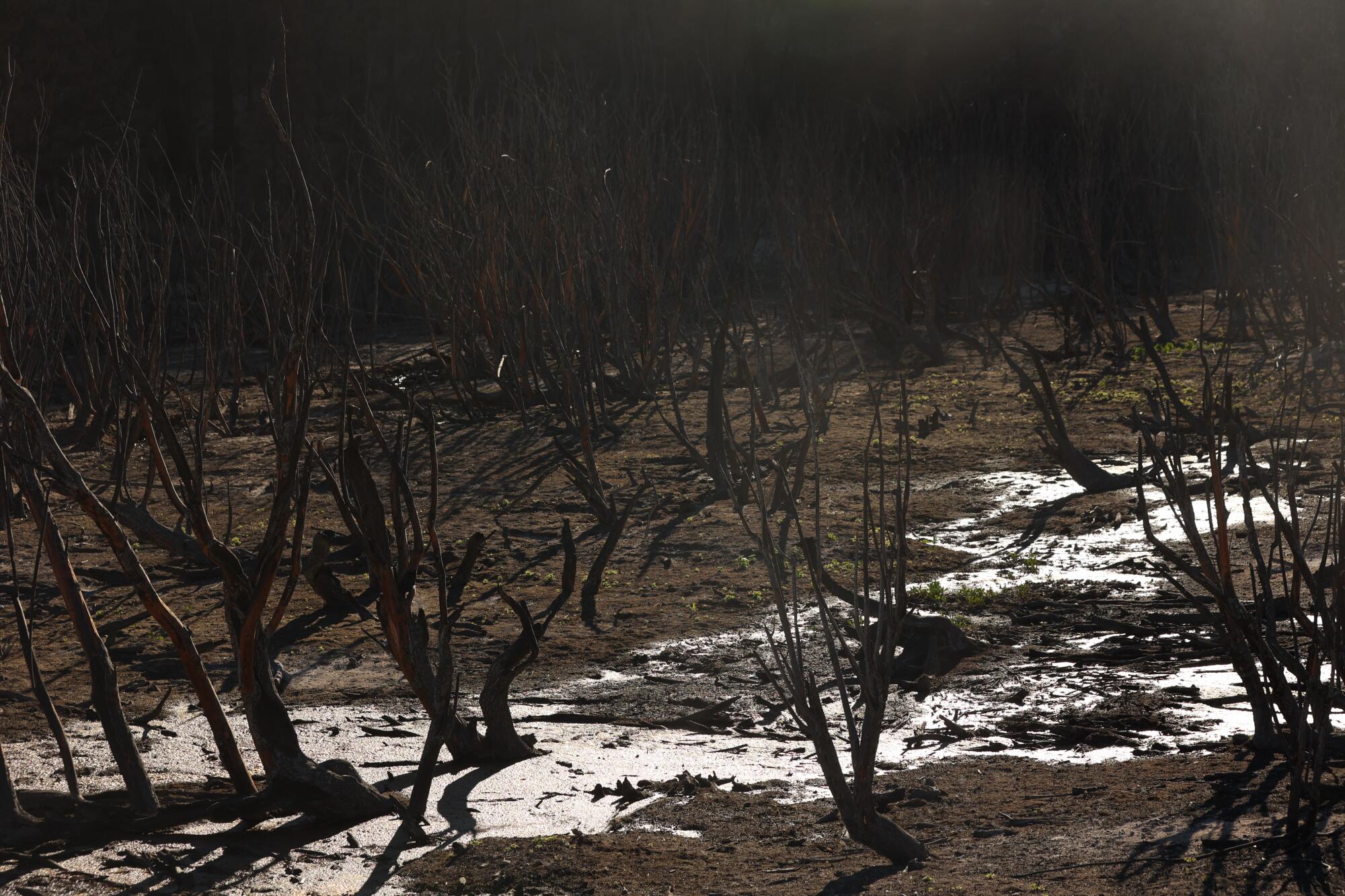
Trees around Mountain High ski resort were left scorched by the Bridge fire.
(Michael Blackshire / Los Angeles Times)
By early afternoon, Smith could no longer see more than 100 feet in front of him. There was no way to directly monitor the fire anymore.
Ash and debris — still on fire — started falling from the sky. At one point, a burning stick about a foot long hit the ground.
Employees started leaving, worried about safety and air quality.
“I got out of here about 2 o’clock, and the sky was black,” said John McColly, vice president of sales and marketing at the resort. “A lot of smoke was being whipped up, and it had this reddish hue to it. … Just for the sake of my lungs, I probably need to get out of here,” he recalled thinking.
Then, around 4:30 p.m., the nightmare scenario that was unfathomable just a few hours earlier became reality. A wall of flames over 300 feet tall by Smith’s estimate crested the ridge, roaring with the sound of a jet engine and blasting the resort with superheated wind and debris.
What had started as cautious fire protection preparations had suddenly became a fight for survival.
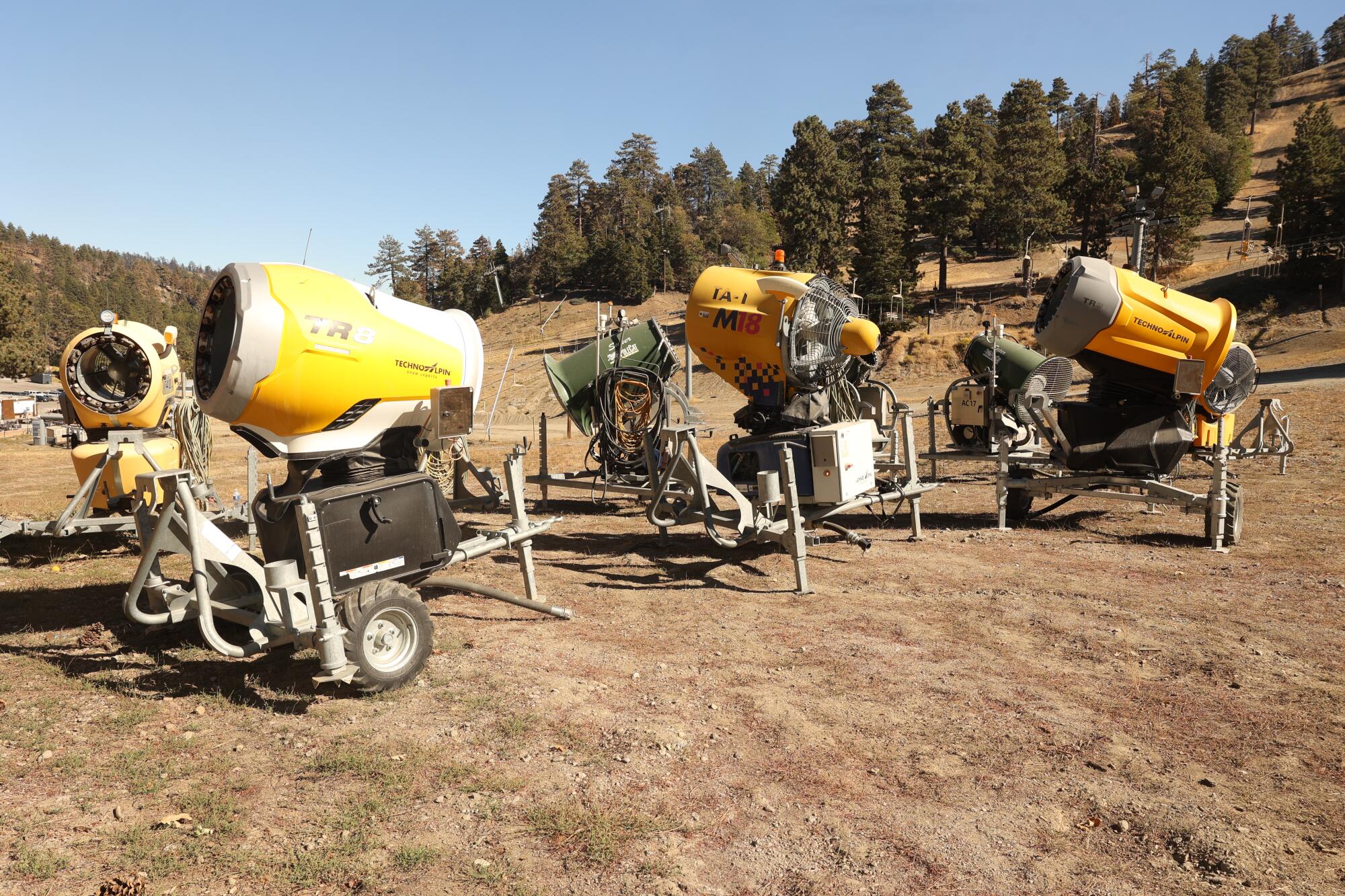
Workers at Mountain High ski resort used snow fan guns to battle the flames of the Bridge fire.
(Michael Blackshire / Los Angeles Times)
Smith directed staff to evacuate nearby campers. The team started pulling time sheets to make sure every employee was accounted for.
Smith sent another team member racing toward the snowmaking control center to activate the giant water system.
The team had stationed about 100 of their roughly 500 snow guns to defend the resort. While they could start about three quarters of them with the push of a button, the rest had to be turned on by hand.
As the majority of the staff evacuated, Smith and a handful of employees remained and raced around the property activating snow guns.
McColly monitored the fire’s progress via the resort’s live camera feed — which is intended to provide skiers a look at snow and weather conditions. He and countless others who had tuned in via social media beheld the flames with awe as they silhouetted a seemingly doomed ski lift terminal.
Smith had alerted fire crews, whom he knows personally through his role with the fire safety council and past wildfires, but they wouldn’t arrive for hours still.
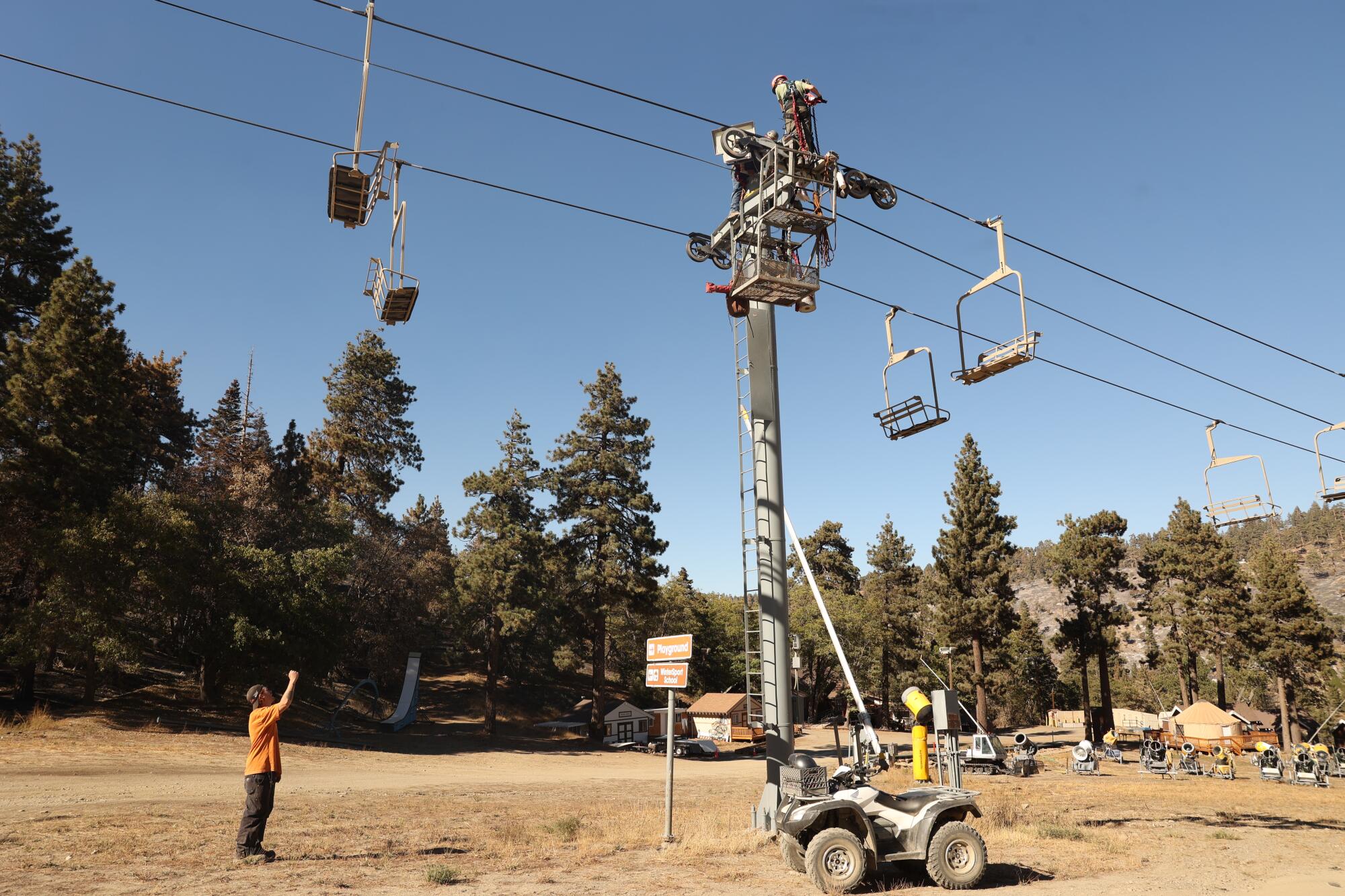
A Mountain High ski resort crew works on a chairlift recently.
(Michael Blackshire / Los Angeles Times)
At multiple points, massive explosions shook the ground, accenting the roar of the fire.
The upper elevations of the resort lost power first. By 5:30 p.m., the base area went dark as well. Without electricity, the water pumps for the snow guns fell silent. Now, the guns were powered only by gravity, which sent water rushing downhill from the 500,000-gallon reservoirs and out the guns’ nozzles.
As the fire burned through telephone poles, phone service went down.
The number of employees left at the resort dwindled to three. Then, two. Then, one: Smith.
At this point — 6:30 p.m. — fire flanked both sides of the resort. Realizing there was nothing left he could do, Smith made his escape.
“I wasn’t trying to be a hero,” he said. “I’ve got a wife and family.”
It wasn’t until night that firefighters were able to get to the scene.
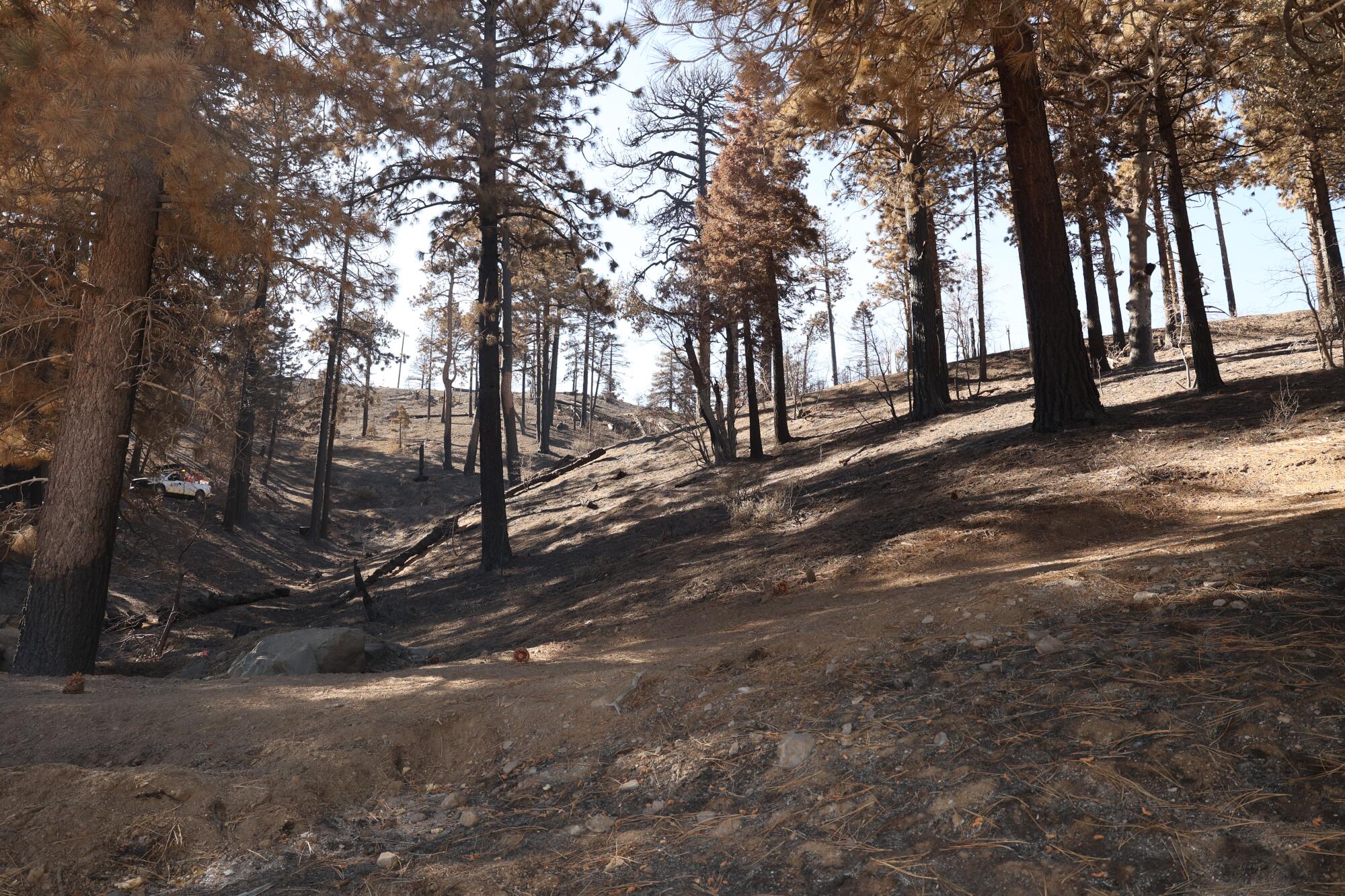
Burnt trees from the Bridge fire dot the landscape in Wrightwood.
(Michael Blackshire / Los Angeles Times)
Smith arrived back at Mountain High the next morning to assess the damage and assist firefighters. The fire continued to rage on — still with hundred-foot flames, just not fanned by violent winds.
“I came up through Wrightwood, and before you get up to our East Resort, … you’re like, ‘hey, everything’s gone,’” Smith said. “But then you hit the East Resort and start seeing green trees, and you see buildings, and you’re like, ‘Well, damn, that ain’t so bad.’”
Not only was the majority of the resort standing, but the snowmaking guns were still pouring water onto the edge of the resort.
In all, the resort had one, unessential ski lift damaged, while a few ski patrol and maintenance shacks burned down.
“I’m very proud of my team,” Smith said. “A lot of what’s still standing here is because of them.”
When the resort isn’t a victim of the fires in Angeles National Forest, it frequently provides firefighters with an invaluable operations hub. Its buildings serve as a command center, its parking lot becomes a helipad, and its water reservoirs are essential resupply stations.
“Through the years, through the fires, through the fire safe council — just having the partnerships with all those groups and to be able to have all those contacts at your fingertips is amazing,” said Smith.
It took nearly a month to secure the resort and restore power, allowing the full team of employees to safely return.
By early October, crews worked to repave Highway 2, which was left cracked and scarred from the fire and the efforts to fight it.
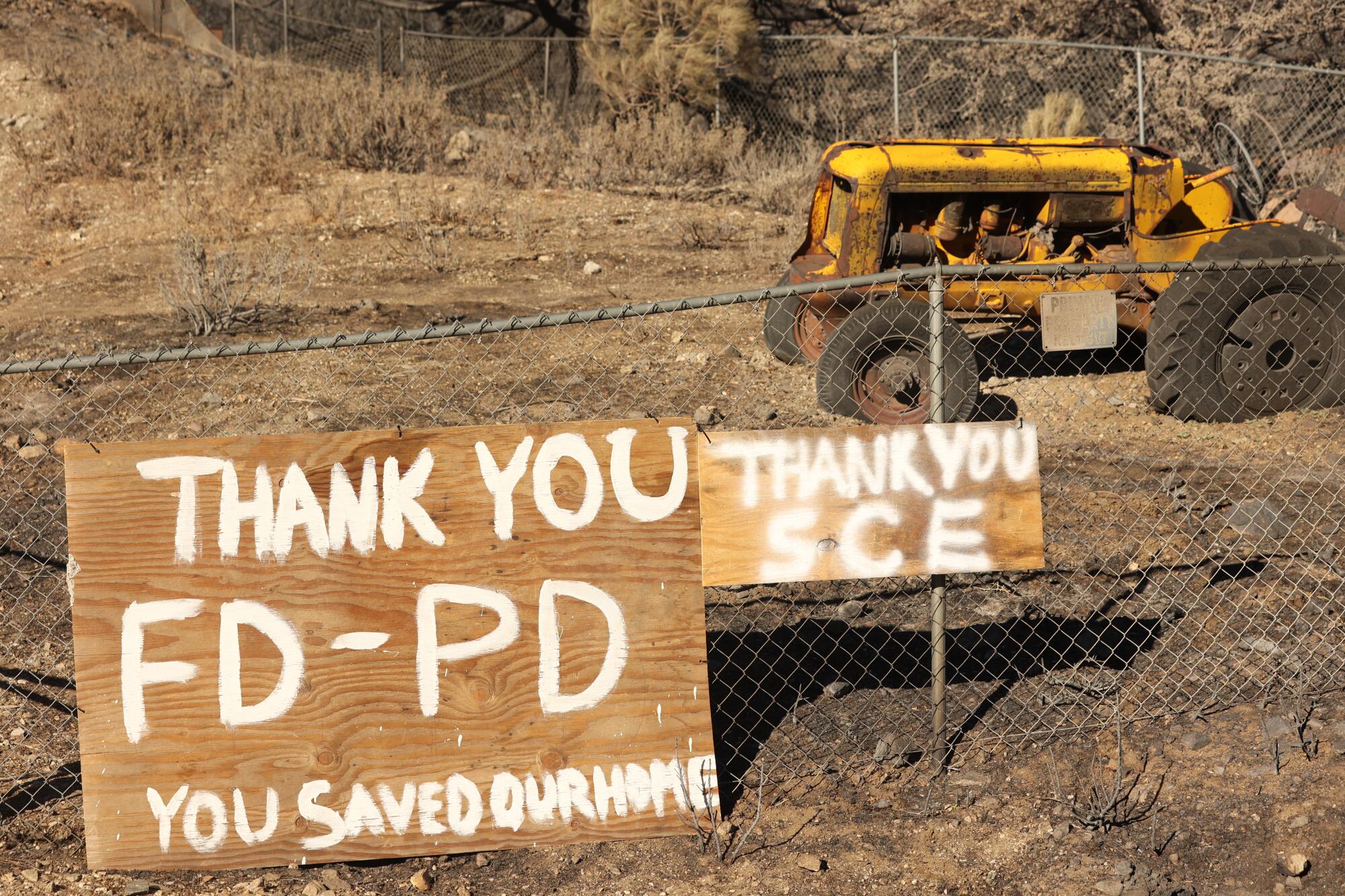
A sign in Wrightwood thanks emergency crews in the wake of the Bridge fire.
(Michael Blackshire / Los Angeles Times)
In Wrightwood, residents have adorned the city with homemade signs.
A piece of plywood, fixed to the Wrightwood city line sign, with black spray-painted letters read “Thank you for saving us.” A colorful hand-painted sign with a firetruck cartoon hung next to the fire station. “We [heart sign] you,” it read.
McColly had returned to his office in a historic cabin, which now smelled like wet rags and old cigarettes.
He turned his computer screen to show a season pass special offer for the resort’s 100th anniversary. Customers would receive a special hat and pin commemorating the season. And the resort would donate $25 to the American Red Cross Disaster Relief.
The Red Cross was onsite after the fire, supporting relief efforts, McColly said. Partnering with the Red Cross is a way to say thank you and pass the help forward.
“They were great to work with,” said McColly. “They really helped us out a lot.”



LOS ANGELES (KABC) — Worshippers across Los Angeles were met with an increased law enforcement presence on Sunday as police and sheriff’s deputies stepped up patrols outside mosques, synagogues and cultural landmarks following the strikes on Iran.
Local officials said there are no credible threats to Southern California, but the Los Angeles Police Department and the Los Angeles County Sheriff’s Department heightened visibility as a precaution to ensure communities stay safe.
More demonstrations tied to the attack on Iran are expected Sunday and Monday. Several protests were held across Southern California on Saturday.
READ MORE | Rallies for and against military action in Iran draw demonstrators across Southern California
While Iranian-Americans celebrated in Westwood, protesters gathered in downtown Los Angeles to oppose the Trump administration’s attacks against Iran.
While some groups gathered in downtown Los Angeles to protest the strikes, others assembled in Westwood to celebrate “the fall of the Ayotollah,” according to organizers.
Authorities said they will continue monitoring events as the region prepares for additional gatherings in the days ahead.
This is a developing story. This article will continue to be updated as more information becomes available.
Copyright © 2026 KABC Television, LLC. All rights reserved.

Watch CBS News

A rare celestial event will be taking place in the sky above California on Saturday night, as six planets are expected to be visible in what is being called a “planetary parade.”
Look towards the western horizon 30-60 minutes after sunset. Mercury, Venus, Jupiter, and Saturn will all be lined up along an arc, visible to the naked eye creating a literal parade of planets.
The alignment only occurs every few years, with the next one not until 2028.
Mars, Jupiter, and Saturn are frequently seen in the night sky, but the addition of Venus and Mercury make this planet lineup particularly noteworthy.
In the San Francisco Bay Area, there will be some cloud coverage Saturday evening, but it should be in the high levels of the atmosphere so hopefully the horizon remains clear. In Los Angeles and San Diego, the forecast is expected to be clear.
Meanwhile, the planetary parade may not be visible in the northern part of the state, with cloudy conditions expected Saturday night in Sacramento, and possible showers and thunderstorms in Eureka and Redding.
People with telescopes and binoculars will also be able to see Uranus and Neptune as well.
For amateur astronomers, this also would be a fun time to test out your telescope skills by checking out Jupiter’s many moons or Saturn’s rings.
Please note that if your view is obscured by buildings, trees or hills, you won’t see the parade because it will appear very low on the horizon.
The nontechnical term is Parade of Planets, but the technical term is planetary alignment. Basically, it’s just the name for what happens when the planets and sun line up in the sky, these happen during events called oppositions and conjunctions.
Opposition is the term for when a planet is directly opposite the Earth from the Sun. Meanwhile, conjunction is when they are aligned with each other and is when we get the best views of the planets.
Missouri Lottery Pick 3, Pick 4 winning numbers for March 1, 2026

Your guide to local sports events, plus what’s on TV
Nebraska Lottery results: See winning numbers for Pick 3, Pick 5 on March 1, 2026

How the strikes on Iran could impact gas prices in northern Nevada

New photo released in unsolved 1997 homicide of a N.H. woman

Florida High School Football Rankings: Top 25 teams – Oct. 21

Cleary's 21 help Le Moyne down Central Connecticut State 69-64 in OT

How old is Bo Nix? What to know about Oregon quarterback ahead of 2024 NFL Draft

99th annual Pony Swim held in Virginia

Indiana Members Credit Union announced as new anchor tenant at Bottleworks District

House Republicans push Johnson to go to war with Senate over SAVE Act

Israel FM says Europe too divided, slams Spanish PM

Satellite images provide view inside Iran at war

Video: What the Texas Primary Battle Means for the Midterms

Dems’ potential 2028 hopefuls come out against US strikes on Iran
-

 World4 days ago
Exclusive: DeepSeek withholds latest AI model from US chipmakers including Nvidia, sources say
-

 Massachusetts5 days ago
Mother and daughter injured in Taunton house explosion
-

 Denver, CO4 days ago
10 acres charred, 5 injured in Thornton grass fire, evacuation orders lifted
-

 Louisiana1 week ago
Wildfire near Gum Swamp Road in Livingston Parish now under control; more than 200 acres burned
-

 Technology1 week ago
YouTube TV billing scam emails are hitting inboxes
-

 Politics1 week ago
OpenAI didn’t contact police despite employees flagging mass shooter’s concerning chatbot interactions: REPORT
-

 Technology1 week ago
Stellantis is in a crisis of its own making
-

 News1 week ago
World reacts as US top court limits Trump’s tariff powers