California
How California School of the Deaf, Riverside became a football dynasty


Thomas Fuller remembers being intrigued by an email from the California Department of Education announcing that the football team for California School of the Deaf, Riverside would be heading to the playoffs.
After an undefeated season.
SEE ALSO: Sign up for our free Book Pages newsletter about bestsellers, authors and more
In fact, the reporter, then San Francisco Bureau Chief for the New York Times, was so intrigued that he hit the road for a seven-hour trek from the Bay Area to the Inland Empire.
“It was really breathless. I showed up just a couple hours before the game started and met with some of the players,” Fuller recalls. “They must have thought that I was a little bonkers, because I just walked into the room where they were hanging out before the game and I said, ‘I love this story.’”


1 of 11
Expand
Throughout his career, Fuller has been more likely to cover political turmoil and natural disasters than sports. But he does like football.
“I’m a lifelong fan of the New York Jets, so I know something about being an underdog,” he says.
And he knows a good story: The Cubs of California School of the Deaf, Riverside had one.
In fact, Fuller’s article about that 2021 game went viral. Television stations picked up on the story. Gov. Newsom included a budget proposal to build the school a new stadium. Disney came calling to bring the story to the screen.
“Then I felt a responsibility because I was seeing the coverage, which I wasn’t sure I really liked,” says Fuller. “I also didn’t know how they would be portrayed in a movie.”
So the reporter, who spent most of his career covering international stories, embedded himself with the team and began work on a book. “The Boys of Riverside: A Deaf Football Team and a Quest for Glory” arrived in stores on August 6.
Fuller followed the team throughout its championship-winning 2022 season. (The team repeated the feat in 2023, beating Canoga Park’s Faith Baptist in the CIF championship for their division for the second year in a row.)
But football is only part of the story Fuller tells. Really, “Boys of Riverside” is a book about deaf community and culture, as well as about language and communication.
“I was very much new to the deaf world, to deaf culture,” says Fuller. “It’s not something that I have in my family. It’s not something that I had been immersed in before doing this.”
That Fuller was an outsider at the school helped him understand one of the book’s central questions about deafness. As he says, “Is it a handicap or is it just a language barrier?”
Fuller has a knack for languages. He also speaks French and Thai and has picked up other languages while working as a foreign correspondent. While he did start to learn American Sign Language in the course of his reporting, he relied on an interpreter, Melika Angoorani, throughout the project.
“I quickly understood that, if I wanted to do this with the utmost accuracy, I was going to need to see this world through the lens of experts and expert interpreters,” he explains, “because I couldn’t afford to have any misinterpretation of what I was seeing.”
Fuller hung around so many practices that he would joke about the two-tone tan he developed. “My face was tan on one side of my head because I stood on the sidelines of the practices every day with the setting sun to my left,” he says. He also attended the team’s meetings and nearly all of the games. He spent hours interviewing every player on the team. During his stay in Riverside, Fuller lived with deaf roommates.
Come game time, he would watch on the side of the opposing team. “I wanted to talk to them,” he says. “I would get their impressions of the game, but I wanted to hear them and how they were reacting to the deaf team.”
“When it came to be game time, I had to be very poker-faced,” says Fuller. “But inside of me, there was no way to not want to cheer for the Cubs.”
Reading “The Boys of Riverside,” you might find yourself cheering not just for the Cubs, but for the whole community surrounding California School of the Deaf, Riverside.
“The most rewarding thing about working at CSDR is being able to communicate effectively with every student and staff here, and seeing the students blossom over the years with intelligible conversations and speeches, after they first enrolled with minimal or no language,” says Erika Thompson, the school’s outreach specialist, in an email interview.
And through its football program, the school’s name is reaching more people.
“We are the first deaf high school to win two straight playoff sections in national. Our deaf community really supports our football and many deaf people show up for the game,” says Coach Keith Adams in an email interview.
Referring to the team’s story and how it affects people, Adams adds: “I am sure it inspires them because all of us face our own challenges so they can see someone who overcomes difficulties can help their hopes and motivation to keep striving towards their own goals.”
Originally Published:



California
Forest Service workers held hostage at gunpoint by father, son in CA forest for hours: Authorities

SISKIYOU COUNTY, Calif. — Law enforcement in far Northern California’s Siskiyou County announced the arrests of a father and his adult son in the alleged kidnapping of two U.S. Forest Service workers, who are now safe and free.
The sheriff says they got a call around 10:55 a.m. Thursday from the Forest Service that a man had taken two Forest Service employees hostage in a very remote area.
The 49-year-old suspect had zip-tied the two Forest Service workers, holding them at gunpoint for nearly 15 hours in a trailer near Gumboot Lake in the Shasta-Trinity National Forest, officials said.
The suspect indicated he wanted to speak with the FBI, but it remains unclear why. Officials are still investigating motives for the kidnapping.
A huge contingent of law enforcement moved into the area. The FBI’s Hostage Rescue Team arrived on a Boeing 757 from Quantico as snipers, SWAT teams, bomb units, and drones were deployed.
Dashcam footage shows armed officers in tactical gear hitching a ride from a passing pickup truck.
Eventually, after many hours of negotiating, the two Forest Service workers were released just before 2 a.m. and are now safe at home.
The suspect and his adult son came out and were arrested at around 2:30 a.m.
The father will be charged with kidnapping a federal employee. In the trailer, he had an AR-15, knives, and claimed to have grenades.
It’s unclear if the trailer was his, but it did not belong to the Forest Service.
ABC7 Eyewitness News contributed to this story.
Copyright © 2026 ABC News Internet Ventures.
It lurks ominously beneath California’s many natural wonders, a reminder that nothing in this landscape is truly permanent.
It’s been described as “the mother of all earthquake faults,” the source of both our geological birth and, perhaps, our ultimate undoing.
But the most unnerving thing about the San Andreas fault these days may be its silence. It’s a mystery scientists are still trying to unlock.
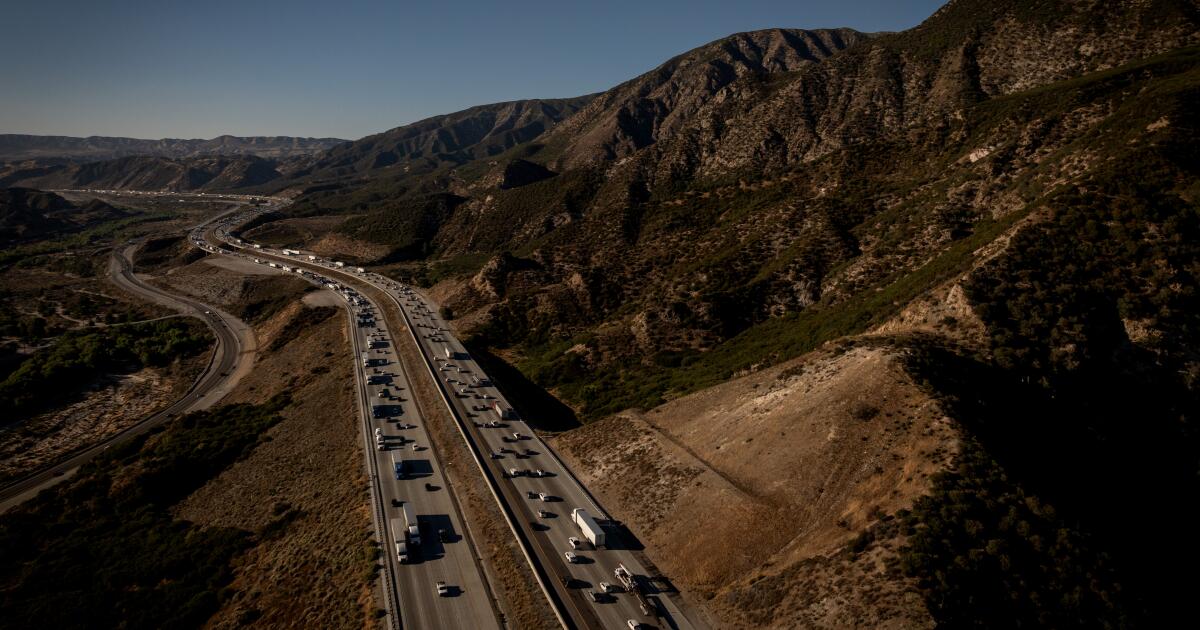
The San Andreas is central to any discussion of California. It’s the massive 800-mile spine of the state, trundling up the Coachella Valley to the San Gabriel Mountains, and pushing along the edge of Silicon Valley to beyond the Golden Gate.
There is no simple answer for why California’s longest fault, responsible for some of America’s most powerful earthquakes, has produced so few in the last century.
But it is clear that the quiet period is only increasing strain on the San Andreas, as well as on the state’s second-longest fault, the San Jacinto.
A new study underscores the concern. Researchers estimated that key sections of the fault in Southern California are at their highest level of tectonic strain in the last 1,000 years.
The San Andreas, in other words, is locked, loaded and inevitable.
A red-hot San Andreas
Tectonic stress on these sections of the San Andreas and San Jacinto faults is high — shown in red — a product of no significant quakes on them for more than a century. At the Cajon Pass, sections of the faults are at their highest strain in 1,000 years, calculations suggest.
Average tectonic stress, in megapascals

Liliane Burkhard / University of Bern / University of Hawai’i at Manoa; Statewide California Earthquake Center Community Fault Model
Sean Greene LOS ANGELES TIMES
Ticking tectonics
There are generations of Californians who have never experienced the fury of the San Andreas.
The fault was responsible for a megaquake that ripped through the then-sparsely populated state in 1857 — an event that, if repeated today, would reap mass destruction.
In 1906, “a crack in the edge of the world,” as author Simon Winchester described it, flattened San Francisco.
Modern Californians have been forced to make do with Hollywood’s CGI versions of the fault, which cast it as one of our state’s darkest villains.
But sooner or later, scientists say, California’s earthquake faults will rupture in a way not seen in the modern era. While California has seen sizable temblors since the great San Francisco quake of 1906, the state’s faults are capable of producing intense shaking over a much larger area than seen during more modern events such as the Sylmar, Loma Prieta or Northridge quakes.
“We keep accumulating that earthquake energy, and it has to be released. And the only way it gets released is through large earthquakes,” said U.S. Geological Survey geologist Kate Scharer, one of the new study’s co-authors. “The small ones don’t really do it.”

A section of the California Aqueduct crisscrosses the San Andreas fault dozens of times.

-
Share via
The latest study, published last month in the Journal of Geophysical Research: Solid Earth, set out to create a model that calculated the seismic strain on three key segments of the San Andreas and San Jacinto faults where they intersect at the Cajon Pass in San Bernardino County.
The model is based on a number of factors: the estimated timing of earthquakes on the faults over a record of the last 1,000 years; satellite observations of how fast tectonic plates are moving; and estimates of how rigid Earth’s crust is, which determines how much stress can be accommodated and then released, Scharer said.
The computer model “found that tectonic stress has now reached higher levels than at any point in that entire record. From the model, we see that the conditions that historically preceded large joint ruptures crossing both fault systems are now approaching,” said Liliane Burkhard, the lead author of the study and a scientist at the University of Bern in Switzerland and the Hawaii Institute of Geophysics and Planetology at the University of Hawaii.
The last major temblor to strike urban Southern California, the magnitude 6.7 Northridge earthquake of 1994, resulted in severe damage and the deaths of about 60 people. But it was also mostly limited to a relatively small area of Los Angeles County.
By comparison, a hypothetical magnitude 7.8 earthquake on the southern San Andreas would simultaneously bring violent shaking to L.A., Orange, Riverside, San Bernardino, Ventura and Imperial counties and could result in 1,800 deaths, according to a U.S. Geological Survey estimate published in 2008.
The findings of the latest study don’t change the overall expectation of a big earthquake hitting Southern California. But they underscore the persistent risk — as well as the possible scale of the disaster.
There’s a 60% chance of a magnitude 6.7 or greater earthquake striking the Los Angeles region by 2045, according to USGS estimates published in 2015. There’s about a 1 in 5 chance of such a quake striking on the San Andreas fault within L.A. County and the Inland Empire.
Why the drought?
The decades-long relative earthquake drought “is an unusually long interseismic period, and stress has been accumulating continuously throughout,” Burkhard said.
The authors created a 28-second animation, showing how tectonic strain increased along the faults over the last 1,000 years. Big earthquakes then release that strain, before the cycle starts again.

This animation condenses 1,000 years of the Cajon Pass’s earthquake history into 28 seconds. Tectonic stress, shown in shades of orange and red, builds up along three fault segments. Following an earthquake, that stress is released. (Liliane Burkhard / University of Bern / University of Hawai’i at Manoa)
The study calculated that the San Andreas fault just northwest of the Cajon Pass and the San Jacinto fault just southeast of the pass are at their highest tectonic strain since the year 1100.


The pass, located roughly 50 miles northeast of downtown Los Angeles, marks the dividing line between the San Gabriel Mountains to the west and the San Bernardino Mountains to the east.
Specifically, the study’s authors calculated that the current tectonic stress was 2.8 megapascals on the San Andreas northwest of the pass, surpassing the previous highs of 2.7 just before big quakes in 1469 and 1691.
For the San Jacinto, the authors calculated a current seismic stress of 3.6 megapascals, surpassing the previous high of 2.9 before an earthquake in the year 1249.
The study noted that it has been an unusually long time since a megaquakes has hit Southern California. The San Andreas fault northwest of the Cajon Pass usually has big quakes every 100 to 150 years, Scharer said, though intervals of about 200 years are not unheard of.
On the San Andreas southeast of the pass, big quakes usually happen every 200 to 250 years. But the most recent quake on the San Andreas along the Salton Sea, close to the Mexican border, was about 300 years ago.
There are some limitations to the study’s model, scientists acknowledge. For instance, the model presumes that when large earthquakes hit, all the tectonic stress that had been accumulated in the fault gets released, “so you start at a ground state of zero and then you accumulate back up until you have that next big event,” Scharer said.
But whether all that stress actually gets released during a big quake is not definitively known.

The Mormon Rocks in Phelan, Calif.
Tectonic risks
Whenever it strikes, a supersized earthquake on the southern San Andreas would be like no earthquake seen in living memory in California.
The 1857 quake, estimated to be a magnitude 7.9, produced 63 times more shaking energy than the 1994 Northridge earthquake, and across a much larger swath of the state.
In 1994, “violent shaking,” or Level 9 on the Modified Mercalli Intensity Scale, causing great damage in substantial buildings, affected only part of the San Fernando Valley.

But a magnitude 7.8 San Andreas quake hypothesized by the USGS in its 2008 ShakeOut scenario would cause that kind of shaking across Southern California.
In 1994, emergency responders from across Southern California were able to focus the bulk of their efforts on especially hard-hit areas. That wouldn’t be possible in a regionwide disaster.


It might be tempting for Californians to tune out talk of the “Big One” after hearing about it for most of their lives. But generational catastrophes do strike — be they an earthquake in San Francisco in 1906, a hurricane in New Orleans in 2005 or tsunamis in the Indian Ocean in 2004 or Japan in 2011.
Tectonic rewards
Earthquakes are part of the bargain of living in California, a product of the same forces that allow people to ski and surf on the same day. The same tectonics that drive earthquakes act as the state’s landscape artists, said Julian Lozos, associate professor of geological sciences at Cal State Northridge.
“Because we are on the edge of the continent, we’re on a plate boundary, and have been a plate boundary for a couple hundred million years. There’s constantly been stuff crashing into North America, and getting stuck to it, and getting uplifted, and erupted through, and slid around,” Lozos said.
The Sierra Nevada, California’s mightiest mountain range, “are the guts of the volcanoes that used to be there when there was a subduction zone … and then when those volcanoes stopped erupting, the guts of them lifted up through the crust,” Lozos said.

Big Pines Highway rises out of a valley to ride a ridge created by the tectonic forces of the San Andreas fault, two miles southeast of the unincorporated Mojave Desert community of Valyermo, home to about 450 residents.
The same forces that produce earthquakes are also what led gold to form in the Sierra foothills, inciting the state’s famous rush.
Tectonic movement also created today’s Central Valley, a highly productive agricultural area that was once part of the ocean, then an inland sea, and then a freshwater lake, Lozos said.
“Everything about what we see here is stuff that formed because of that plate boundary then, and it’s getting moved around by the plate boundary now,” Lozos said. “And so if we didn’t have anything like that, we would be Nebraska.”
But the risks, like the rewards, are significant. The San Andreas runs right through cities in the Inland Empire. The Los Angeles Basin is also at risk.
If an earthquake on the San Andreas comes from the south and heads north, it would shuttle all that shaking energy “right into downtown,” Lozos said, causing shaking that could last two to three minutes.
“Geologically, L.A. is a bowl of Jell-O. It is a hard rock bowl full of really soft, squishy stuff that shakes very easily,” Lozos said.

It is business as usual at the Wrightwood Inn on a recent Tuesday night. According to a recent study, seismic pressure has been gradually building in the area for more than a century.
It’s not certain why it’s been so quiet between earthquakes, said Scharer. Another study, published in 2023, suggested the lack of sudden, major floodwaters funneling into Lake Cahuilla, the larger historical predecessor to the Salton Sea, may have something to do with it.
Scharer said the study’s results are a good reminder to prepare for the next big earthquake.
To be sure, the computer model’s results are not a prediction, and all models have their limitations and uncertainties. Still, its suggestion that the fault systems are “more loaded than at any point in the 1,000-year record,” Burkhard said, “is a finding worth taking seriously.”
“In the end, the most important message is a simple one: Let’s make sure we are prepared,” she said.

A new poll in the race for California Governor shows Democrat Xavier Becerra is leading Republican Steve Hilton by a wide margin — 61% to 36%.
Becerra leads Hilton across several demographics: age, gender, homeownership, income, racial/ethnic groups and across the state’s major regions.
The poll also found 85% of likely voters say that the gubernatorial candidates’ positions on the environment are important — 60% of Democrats call it “very important,” compared to 29% of Republicans.
The poll surveyed 1,578 California adults from June 29 through July 6 and was conducted by the Public Policy Institute of California. The poll was conducted in English and Spanish, and 1,003 of those who were polled were likely voters.
The same poll found that a large majority of Californians do not want new data centers built in their area. Only about a quarter of those surveyed are in favor of the construction of data centers.
The PPIC survey focused on Californians and the environment.
Another key finding was that Californians are most likely to name wildfires as the top environmental issue facing the state today, followed by climate change, government overregulation and water supply. Of those polled, about six in 10 think that the state and local governments are not doing enough to address wildfires.
The California General Election will be held on Nov. 3, 2026.
Copyright © 2026 KABC Television, LLC. All rights reserved.
-

 Rhode Island4 minutes ago
Rhode Island couple returns from Florida trip with with surprise newborn
-

 South-Carolina10 minutes ago
Non-native blue land crab sightings across the South Carolina coast
-
South Dakota16 minutes ago
SD Lottery Mega Millions, Millionaire for Life winning numbers for July 17, 2026
-

 Tennessee22 minutes ago
Tennessee woman arrested after allegedly trying to drown one of her children in backyard pool
-

 Texas28 minutes ago
How a man once ordered to pay libel damages helped launch an investigation into Islamic private schools
-

 Utah34 minutes ago
Utah Jazz vs Portland Trail Blazers Summer League recap and final score
-
Vermont40 minutes ago
VT Lottery Mega Millions, Gimme 5 results for July 17, 2026
-

 Virginia46 minutes ago
Maryland, Virginia elections officials push back on Trump assertion that system is ‘broken’ – WTOP News

